Many of my classes consist of a large writing component. I’ve designed the courses so that most students write the best paper that they’ll ever write in their life. Recently, I had reason to believe that a student was using AI or a paid service to write their paper. I couldn’t find conclusive evidence that they didn’t write it, but it ended up not mattering much in the end.
Continue readingAuthor: Zachary Bartsch
Inflation, Information, & Logic
Most economists know that the CPI is overestimated and therefore prefer the PCE price index. However, monthly CPI data is consistently released before PCE data for a given month. One would think that they move in the same direction and be highly correlated. Indeed, in the past five years, the correlation is 0.96. Therefore, it stands to reason that the there is less new relevant information on the PCE release dates than on the CPI release dates. Yes, CPI is biased, but it still contains some information about prices and it is known well prior to the more accurate PCE numbers.
Supply and Demand react to new information. Sometimes the new information changes our expectations about the future, and other times we learn that our beliefs about goods and assets were previously not quite right. So, with new relevant information comes new prices as people update their beliefs and expectations.
Let’s get financial.
Continue readingThe Imperfection of Subgame Perfection
I’ve written previously about Pure Strategy Nash Equilibria (PSNE). They are the set of strategies that players can adopt in equilibrium – with no incentive to change their strategy. Students have an intuition that PSNE aren’t great because some outcomes that they identify depend on players making silly decisions in the past. In jargon, we can say that some PSNE depend on players choosing irrationally in a subgame while still reaching a PSNE.
See the extensive form game (below right). There are two players, each with two strategies per information set, and player two has two information sets. All PSNE will include a strategy for each information set. We can present the same game in normal form in order to make it easier to identify the PSNE (below left).

Player 1 (P1) can choose the row (B or C) and Player 2 (P2) can choose the column. Importantly, whether P1 might want to change his mind depends on P2’s strategy at the decision node in the alternative information set. Therefore, P2 must have two strategies, one per information set.
The four PSNE strategies and payoffs are underlined in the above table and they are noted in red on the below extensive form games. Again, the logic of PSNE states that no player can improve their payoff by changing only their own strategy, given the opposing player’s strategy. After all, a player can control their own strategy, but not that of their opponent. For example, note PSNE II. In the left subgame, P2 chooses M. His payoff would be unchanged if he changed his strategy, given the strategy of P1.
Continue readingMises’s Interventionism, A Recap
I suspect that Mises may have felt somewhat restless after writing Socialism. He had taken a very good stab at describing the socialist economy and its inadequacy for the promotion of human flourishing. By 1940 fascism had arisen in both Italy and in Germany, who Mises considered the clear antagonists of World War II. Further, the communist Soviets were allied with Germany at the time of writing Interventionism.
A communist-fascist alliance may seem strange to idealogues, but it appeared quite natural to Mises that the two distasteful versions of socialism should find cooperation convenient to achieve their own ends. In America, the revelations of German atrocities had yet to arrive and there were many sympathizers with both Russia and Germany. In Britain, union leaders were promoting the idea of socialism as a reward to the public who would be bearing the costs of the war.
Mises thought that the disfunction of socialism was adequate to describe its ultimate failure as an economic system. However, socialist tendencies were pervasive in the liberal market economies among both idealogues and demagogues enough to make the transition to socialism a very real threat. After all, while socialism may not be a stable regime in a dynamic world, certain features within specific market economies may nonetheless tend toward it. What is the cause of such tendencies?
Continue readingThe Unimportance of Inflation: Stocks & Flows
One of my specializations in graduate school at George Mason University was monetary theory. It included two classes taught by Larry White who specializes in free-banking, Austrian macroeconomics, and monetary regimes. Separately, my dad was a libertarian and I’ve attended multiple Students for Liberty events. Right now, I’m writing from my hotel room at a Catholic/Crypto conference, where I learned that the deepest trench in Dante’s Inferno includes money debasers.
Everything about my pedigree suggests that I should have a disdain for the Federal Reserve and cast a wistful gaze toward the perpetually falling value of the US dollar. But I don’t. I certainly do have opinions about what the Fed should be doing and how our monetary system could work. But I’m not excited by the long-run depreciation of the dollar.
Let me tell you why.
Learning a little bit of theory is a dangerous thing. Monetary theory is especially hard because we examine the non-good side of the transaction: the medium of exchange. In frantic excitement, enthusiasts often point out that the value of the dollar has lost very much of its value in the past 100 years. They describe that loss by describing the lower quantity of something that a dollar can purchase now versus what it could have purchased historically. That information is incapsulated in the price of a good. The price of a good is the number of dollars that one must exchange in order to purchase the good. Similarly, the price of a dollar is the number of goods that one must give up in order to purchase the dollar.
We can consider a variety of goods. Below is a graph that describes the quantity price of the dollar where the quantities are CPI basket units, gold, and housing. In the 35 years following 1986, a single dollar purchases 60% less of the consumer basket, 74% fewer houses (not quality adjusted), and 76% less gold.
Continue readingThe Price of Food: Farm to the Table
If you’re like me, then you are very fond of food. What determines the price of food? Supply and demand of course!
We can consider food as a commodity because just about anyone can buy and sell it. Almost all foods have partial substitutes. Therefore, the long-run price in the competitive market for food is largely dictated by the marginal cost. Demand has an impact on the price only in the short run.
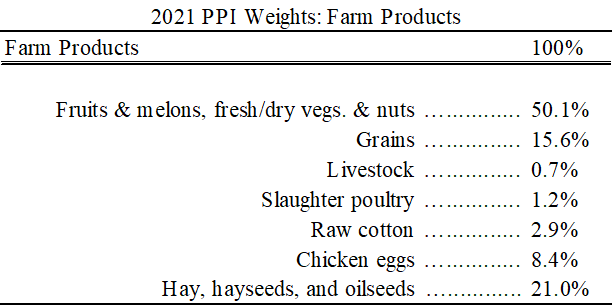
A long-run driver of food prices are the costs that food producers face. The US Bureau of Labor Statistics divides the Producer Price Index into multiple categories that are relevant for a variety of sectors and points within the production process. Below is a table of the most fundamental, relatively unprocessed farm products and their weight among all farm products in December 2021. Cotton is a relatively large component for farm products even though it’s not a food and I include it for completeness. Fruits, veggies, and nuts makeup the overwhelming proportion of the cost of farm products. I was at first surprised that grains composed such a small proportion. But, being dirt cheap, it makes sense.
We all know that inflation has been in the news. It’s been elevated since the second quarter of 2021. Consumer prices tend to lag producer prices. One indicator of where food prices will be in the near future is where the producer prices are now. Below is a graph that displays the above seasonally adjusted farm product prices since the start of 2021*.
Continue readingMust-Have Practical Gifts
My wife and I have different preferences for the kind of gifts that we like to receive. She likes earrings, flowers, massages, and electronics. I like hand tools, power tools, and any other item that makes domestic life more efficient. I can really appreciate a nice new pair of dockers or a button-down.
If you have a dad, husband, or anyone else in your life who appreciates practical gifts, then this list is for you. Below are four gift ideas that are sure to make the practical person in your life very happy – even if they may not be what you would want to receive. I’ve personally vetted all of the below items, so I can attest to the satisfaction that they are sure to provide that hard-to-shop-for person.

Is your life in disarray? Are your cords and chargers in disarray? Then look no further. Nothing compares to the knowledge that the nest of cords behind your wall unit is no more. Use Velcro to bind and truncate your computer cords and your kitchen appliance cords. Do you have a drawer or box full of tangled extras? Velcro is nice because you can cut it to your custom length and reuse it with minimal loss of life. You can also use it in electrical applications or in the cabin of your vehicle. Do you have a phone charger beside your bed that keeps falling on the ground? Just Velcro it to the nightstand lamp and it will stay exactly where you want it. AND, because it’s reusable, you can easily remove it and keep the cords in your luggage nice and compact.
2) Minute Soil

Growing stuff is hard. But flowers, greenery, or even vegetables are nice. Yes, I’m basically recommending that you give someone dirt. But it’s awesome dirt. There’s this stuff called coconut coir. It’s coconut fiber that’s been compressed into a small disc or brick that’s ideal for shipping and delivery. Just add water and you’ve got some fancy dirt just waiting for an application. Coconut coir is all plant-based material, drains well, and it’s easy to store. You may not think of dirt as something that has a shelf life, but regular potting soil can definitely grow some unsavory things if you let it sit for long enough. Coconut coir is the solution to all of your spur of the moment small-scale horticultural endeavors.
3) Qwix Mix

Shipping items to our homes has been a game changer for shopping. But home delivery is not sensible for low priced heavy items like some liquids. My family was frequently running out of windshield wiper fluid and we’d end up stopping at a grocery store and overpaying. But no more! Qwix Mix is a windshield wiper fluid concentrate. Just an ounce in addition to a gallon of water saves us unplanned trips, high prices, and the storage cost of purchasing gallons of fluid ahead of time. I can’t vouch for the de-icing formulation, but the southern climate formula does exactly what it’s supposed to do.

Since the Covid recession, many of us have taken up our hand at cutting hair at home. For a while, we were borrowing a neighbor’s clippers. They were loud and had a short cord. But I’ve since purchased Ufree clippers and they are so much more convenient. They’re quiet, cordless, charge with a USB cord, and have a battery level display. But the battery lasts so long that you don’t even need to think about it. This kit comes with a beard trimmer, several guards, and a cape (throw the cape away, it’s bad). The clippers are metal and have some heft to them. Several colors are available – they come in black, silver, and gold finishes. But how can one not choose the gold ones?
That’s my list of great gifts for practical people. IDK your gift limit, but if you buy all 4 of these gifts you’ll spend about $100. That might leave room left over for stocking stuffers and chocolate.
(We’re not paid for any of these recommendations. But using our links is always helpful.)
Cheers to Sumproduct!
I teach macroeconomics, finance, and other things.
Often, I use Excel to complete repetitive calculations for my students. The version that I show them is different from the version that I use. They see a lot more mathematical steps displayed in different cells, usually with a label describing what it is. But when I create an answer calculator or work on my own, I usually try to be as concise as possible, squeezing what I can into a single cell or many fewer cells. That’s what brings me to to the sumproduct excel function that I recently learned. It’s super useful I’ll illustrate it with two examples.
Example 1) NGDP
One way to calculate NGDP is to sum all of the expenditures on the different products during a time period. The expenditures on a good is simply the price of the good times the quantity that was purchased during the time period. The below image illustrates an example with the values on the left, and the equations that I used on the right. That’s the student version. There is an equation for each good which calculates the total expenditure on the individual goods. Then, there is a final equation which sums the spending to get total expenditures, or NGDP.

What do they even want?: Inflation Edition
People were all excited last week when the CPI numbers were released because… the year-over-year rate of inflation did a whole lot of nothing. See below. The 12-month rate of inflation was practically constant. The 8.2% number was all over the headlines and twitter. We already know that news outlets don’t always report on the most relevant numbers. And I say that this is one of those times.
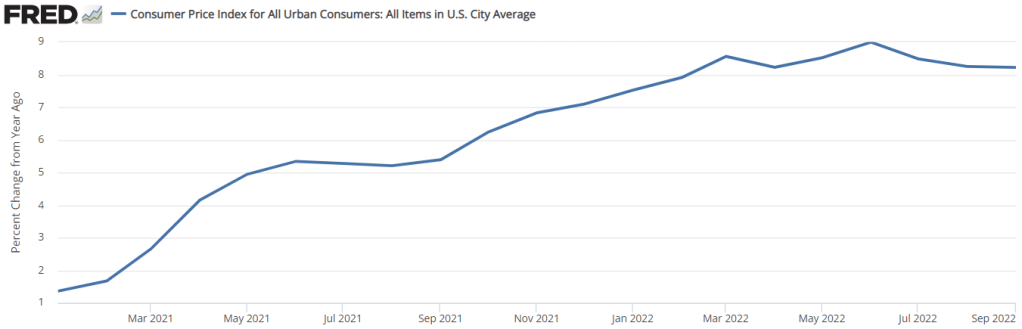
First of all, there is a problem with the year-over-year indicator. Well, not so much problem in the measure itself, but more a problem of interpretation. The problem is that the 12-month rate of inflation is the cumulative compound rate for 12 individual months. Each month that we update the 12-month inflation rate, we drop a month from the back of the 12-month window and we add a month to the front of the 12-month window. Below are both a graph and a table indicating the monthly rate of inflation and the 12-month periods ending in August 2022 (pink) and in September 2022 (green).
Continue reading6 Tips for Taming Your Inner Spock
The younger, high school and undergrad version of me was not the best person. My sense of humor was too dark and I didn’t much care about the experience of other people. When I went to grad school, I was so excited. I would finally be around other economists and I would be able to drop all of the niceties, empty social signals, and fuzziness that I thought non-economists employed. And I was oh so very wrong.
It turned out that economists are also human beings and that no amount of self-congratulatory Spock-praising would stop that from being the case. Indeed, with some candid feedback, I became convinced that I was in desperate need of the kind of prosocial norms that could help me to better produce social capital. In other words, I needed to figure out how to get along. Below is some advice that I’ve found pivotal. Maybe you can share it with another person who might be well-served by reading it too.
Below are six norms that are good to employ in order to improve social cohesion, agreeableness, and, frankly, better mental health. And these aren’t just for economists. I suspect that there are plenty of people (maybe young men) who can benefit from what took me too long to learn. So here we go!
Continue reading Economist Writing Every Day