Forgiveness is Underprovided

Forgiveness is Important

Whether one might socially offend us or whether one commits a crime, we face a fundamental tension between punishment and forgiveness. Punishment is important because it acts as a deterrent to the initial offense or to subsequent offenses. But punishment is also costly. Severing social or commercial ties reduces the number of possible mutually beneficial transactions. We lose economies of scale and lose gains from trade when we exclude someone from the market. Forgiveness is important because it permits those who previously had conflict to acknowledge the sunk cost of the offense and proceed with future opportunities for trade. However, an excess of forgiveness risks failure to deter destructive behaviors.

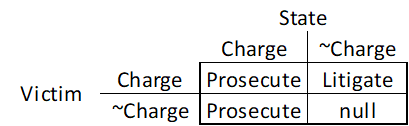
In the US, we enjoy a state that can prosecute alleged offenders and enforce punishments regardless of the economic status of the offended. While not perfect, the state incurs great cost by being the advocate of those who could not enforce great retributive punishment by their own means. A victim may choose to press charges against an offender, or the state can press charges despite a permissive victim.

In fact, our system of prosecution is somewhat asymmetrical. The state can press charges against a suspect, regardless of the victim’s wishes. While a victim can’t compel an unwilling state to press charges, say if the evidence is scant, an individual can engage in litigation against the accused.

Most of the possible combinations of victim and state strategies result in some kind of prosecution of the alleged offender. Except for litigation, our punishments in the US tend not to be remunerative – the victim isn’t compensated for the evils of the offender. ‘Justice’ is often construed as a type of compensation, however.

Herein lies a problem.

Continue reading

Free Money, Courtesy of Credit Cards

In grad school, I learned about the overlapping-generations model. The idea is that we simplify people down to the fundamental parts of their life-cycle. Each person lives for 2 periods. In the first period, they can produce only. In the second period, they can consume only. A popular conclusion of the model pertains to old-age benefit programs such as Social Security.

The first beneficiaries receive a gift that is free to them, then each subsequent generation accepts the debt, pays it off, and then passes on new debt to the proceeding generation. In this manner, the program benefit of the current generation is limited by the income of the following generation. Therefore, every single generation can consume as if they lived a generation later – and a generation richer – in time. That’s exciting.

But this model is not unique to governments. With a little bit of finance, we can model every person as their own self-encapsulated overlapping-generations model – with two similarly exciting conclusions. Let’s consider a person who has monthly consumption expenditures of $1k per month and let’s assume a discount rate of half a percent per month.

Life is pretty good for this person. They earn income each month and they spend $1k of it during the same period. Now let’s give the person a credit card. It doesn’t matter what the interest rate is – they’re going to pay it off each subsequent month. Now let’s see what’s possible.

What’s going on here? The difference in the consumption pattern is that the first month with a credit card can enjoy twice the consumption. How’s that? $1k of that January consumption is just the typical monthly spending. The other $1k is running up a month’s worth of spending on the credit card. So long one pays-off the card in the following month, there are no interest charges. But wait – if one pays-off the credit card in February, then how does one consume in February? By borrowing from March’s income, of course! And so the pattern repeats ad-infinitum. With a credit card one can borrow against next month’s spending. You too can borrow from your future self. And your future self won’t mind because they’ll do the same thing.

Conclusion #1: Having a credit card entitles you to one free month of double consumption.

The above example includes identical income over time. But, what if your income grows? Let’s assume that your income and commensurate consumption grow at a rate of one quarter percent per month. Our consumption without a credit card is tabulated below.

Obviously, having income and consumption that grow is more enjoyable than ones that are constant each period. Now let’s observe below what happens when we again introduce a credit card that one pays-off each month.

What’s going on here? Just as happened previously with a credit card, one can enjoy an extra boost to consumption in the first period. But what does growing income do for us besides greater complication? Just as previously, one can pay their debt each period and consume by borrowing against the next month’s income. But with growing income, having a credit card means that one can enjoy the next month’s level of consumption today. That is, next month’s higher consumption is shifted sooner in time by one month. Notice that, with growing income, consumption for July without a credit card ($1,018) is the same as the consumption in June with a credit card. Even without the first-month-gift, credit cards increase the present value of one’s consumption by making next month’s greater income available today – and the same is true for every single month.

Conclusion #2: Having a credit card today entitles you to next month’s greater income.

How big a deal is this? Obviously, it will differ with the discount rate and the rate of income growth. Using the numbers above, having a credit card permits one to consume with a present value that is 10.5% higher. Let that sink in. People who have access to credit consume as if they are 10.5% percent richer. Access to credit can make the difference between a pleasant Christmas, having quality internet, paying for car repairs, and so on. Being poorer is one thing. Being poorer and lacking access to credit is like taking an instant haircut to one’s quality of life. On the flip side, people can be made better-off without additional improvements to their productivity. Increasing access to credit may be a less costly improvement to the value lifetime consumption than many of the other less politically feasible improvements to labor productivity.

Compulsory Schooling by Gender & Age

This weekend I’ll be at the Southern Economic Association Conference in Houston Texas. I’m organizing and chairing a session called Education Policy Impacts by Sex (you should come by and see me if you will be there too!).

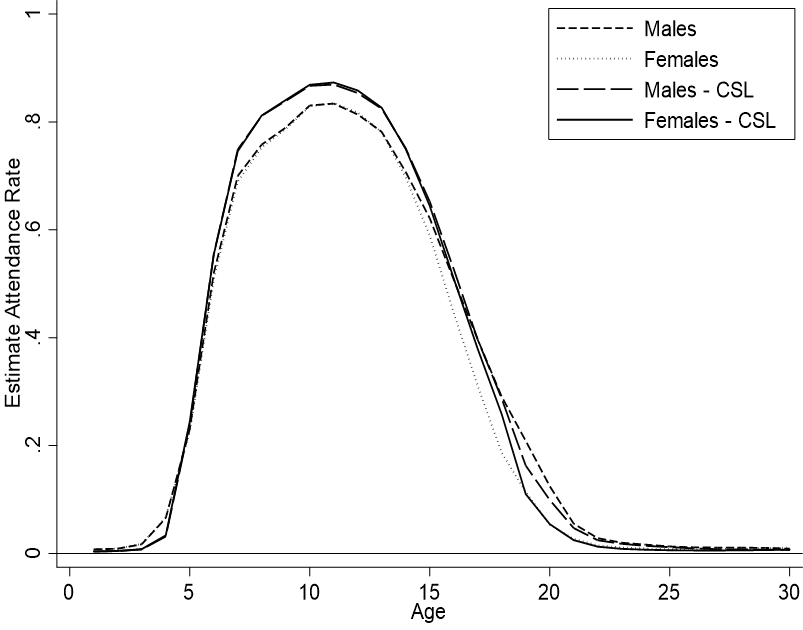
Personally, I will be presenting on the impact of compulsory school attendance laws on attendance. Today I just want to share and discuss a single graph that’s not my presentation.

Prior to my research, there was already a canon of existing literature on compulsory attendance legislation (CSL) and I’ve previously written on this blog about it (attendance, CSL, and differences by sex). However, the literature had some limitations. Authors examined smaller samples, ignored gender, or ignored different effects by age.

I examine full-count IPUMS data from the 1850-1910 US censuses of whites in order to investigate the so-far-omitted margins mentioned above. Here are some conclusions:

Prior to CSL:

  • Males and females attended school at similar rates until the age of 14.
  • After 14, women stopped attending school as much as men.
    • By the age of 18, the attendance gender gap was 10 percentage points.

After CSL

  • Male and female attendance increased from the ages of 6 to 14
  • Women began attending school more than prior to CSL until about age 18.
  • After the age of 18, women experienced no greater attendance than previously.
  • But, both sexes attended school less than prior to CSL for ages 5 and younger.
  • Men began attending school less after the age of 17.
  • CSL increased lifetime attendance for both males and females

Overall, examining the impact of CSL across many ages allows us to see when and not just whether people attended more school. Previous authors would say something like “CSL increased total years of school by about 5% on average”. For men, almost all of those gains were between the ages of 6 & 16. But women experienced greater attendance from ages 6 to 18.

Additionally, examining the data by age reveals that there was some intertemporal substitution. Once it became legally mandatory for children to attend school between the ages of 6 & 14, parents began sending their younger children to school at lower rates. Indeed – why invest in education for two or three early years of life if you’ll just have to send your children to school for another eight years anyway. Older boys dropped out of school at higher rates after CSL too. Essentially, the above figure became compressed horizontally. People ‘put in their time’, but then reduced investments at non-mandatory ages.

This reveals a shortcoming of the current literature, which focuses mostly on 14 year olds. By focusing on a popular age of attendance that was also compulsory, previous authors have missed the compensating fall in attendance at other ages. Granted, the life-time effect is still positive – but it’s attenuated by a richer picture. The picture reveals that individuals were not attending school by accident. Students or their parents had in mind an amount of educational investment for which they were aiming. When children were forced to attend school at particular ages, the attendance for other ages declined.

Buying in Bulk: Money Saver or Self Sabotage?

Recently, I’ve been buying a lot more non-durable goods when they are on sale. Whereas previously I might have purchased the normal amount plus one or two units, now I’m buying like 3x or 4x the normal amount.

What initially led me here was the nagging thought that a 50%-off sale is a superb investment – especially if I was going to purchase a bunch eventually anyway. I like to think that I’m relatively dispassionate about investing and finances. But I realized that I wasn’t thinking that way about my groceries. The implication is that I’ve been living sub-optimally. And I can’t have that!

If someone told me that I could pay 50% more on my mortgage this month and get a full credit on my mortgage payment next month, then I would jump at the opportunity. That would be a 100% monthly return. Why not with groceries? Obviously, some groceries go bad. Produce will wilt, dairy will spoil, and the fridge space is limited. But what about non-perishables? This includes pantry items, toiletries, cleaning supplies, etc. 

Typically, there are two challenges for investing in inventory: 1) Will the discount now be adequate to compensate for the opportunity cost of resources over time? 2)  Is there are opportunity cost to the storage space?

For the moment, I will ignore challenge 2). On the relevant margins, my shelf will be full or empty. I’ve got excess capacity in my house that I can’t easily adjust it nor lend out. That leaves challenge 1) only.

First, the Too Simple Version.

Continue reading

You Current Grade: It’s Complicated

By now, most US universities are 4-5 weeks away from the end of the fall semester. Whether it’s now, or just prior to the withdrawal deadline, student tend to demonstrate increased interest in their grade for their courses. They say that they want to know how they are doing. But they often prefer to know what grade they will earn at the conclusion of the course. The answer to the latter question could include all kinds of assumptions. But “What is my grade right now?” is a deceptively subtle question.

It seems direct. We could easily be curt and claim that it shouldn’t be complicated to tell a student what their grade is, and that it’s a failure of the teacher or of the education system writ large if it is complicated. While I entirely agree that a teacher should have an answer, it’s important to emphasize that “What is my grade right now?” is an ill-defined question. The problem is that a student can mean two different things when they ask about their grade.

Q1) What proportion of possible points have I earned so far?

Q2) What proportion of points will I have earned if my performance doesn’t change?

It’s important for teachers to ensure that their students understand which question is being answered.

First, I’ll illustrate when there is no distinction between the answers. Let’s say that there are two types of assignments: Exams, which are worth 75% of the course grade, and quizzes, which are worth 25%, of the course grade. So long as the two assignment types are identically distributed throughout the semester, Q1 & Q2 have the same answer. Below is a bar chart that illustrates a distribution of points over 4 weeks. The proportion of points for each assignment type is identically distributed over time (not necessarily uniformly distributed).

What is the student’s grade at the end of week 2 if they have scored 90% on the exams and 70% on the quizzes? By the end of week 2, there have been 30 possible exam points and 10 possible quiz points. The student has earned 34 of the 40 possible points so far. The math for Q1 is:

(0.9)(30)+(0.7)(10) = 27+7=34

34/40 = 85%

And, if they continue to perform identically in each assignment category, then they can expect to earn an 85% in the class. The math for Q2 is:

(0.9)(75)+(0.7)(25) = 67.5+17.5 = 85%

Both Q1 and Q2 have the same answer. And, honestly, principles or introductory courses have formats that often lend themselves well to having assignments distributed similarly over time. My own Principles of Macroeconomics class matches up pretty well with the above math. Each week, there is a reading, a homework, and a quiz. By the time students complete the first exam, they’ve completed about one third of all points in each assignment category.

Higher level classes or classes with projects tend *not* to have identical point distributions across time among assignments. Maybe there are presentations, projects, or reports due throughout the semester or at the culmination of the course. For example, my Game Theory class has two midterm exams, but no final exam. It has homework in the first half of the semester, and term paper assignments in the latter half.

The bar chart below displays a point-split among the same quizzes and exams, but they now are differently distributed throughout the semester. Quiz points have been frontloaded.

What is the student’s grade at the end of week 2 if they have scored 90% on the exams and 70% on the quizzes? By the end of week 2, there have been 30 possible exam points and 15 possible quiz points. The student has earned 37.5 of the 45 possible points so far. The math for Q2 is:

(0.9)(30)+(0.7)(15) = 27+10.5=37.5

37.5/45 = 83.33%

And, if they continue to perform identically in each assignment category, then they can expect to earn an 85% in the class. The math for Q2 is:

(0.9)(75)+(0.7)(25) = 67.5+17.5 = 85%

All I did was frontload 5 percentage points for quizzes and now the answers to Q1 and Q2 differ by 1.66 percentage points. That may seem like small potatoes. But consider that a) many students and universities use and care about the +/- system of grades, and b) a grade difference of 1.66 points was caused by a mere change of 5-point change in the distribution. Bigger changes result in bigger differences. Frontloading the remaining 5 quiz points from the end of the semester would result in a Q1 score of 82% – yielding a 3 point difference between the two calculation methods.

The differences between Q1 & Q2 illustrated above are even more pronounced once you begin to include extra credit. One point of extra credit has a smaller effect on the answer to Q1 as more and more possible course points have been earned.

If students only care about their ultimate grade in the course, then they will always prefer to receive the answer to Q2. But, students may also want to know how effective their recent study habits have been so that they can re-evaluate them conditional on the knowledge of the assignment point distributions. Q2 requires more assumptions if an assignment type hasn’t even occurred yet. Students can ask “Have I given this course the appropriate amount of attention given the types of assignments that we’ve had?”.

For example, my Principles of Macroeconomics course has the first exam at week 5. Students should have an average score that is greater than 90% by the end of week 4 because the reading assignments are simple, the homeworks are lenient, and the quizzes permit practice attempts. Students who have an 80% by the end of week 4 are going to have a rougher time once they encounter an exam.

Reasonable people can disagree about which calculation is more useful. And more mathematically inclined students can calculate their own grades anyway. Therefore, after every exam, I send a mail-merge email to each of my students in order to update them about their grade. I give them the answer to both Q1 & Q2, and I illustrate the impact of several alternative scenarios for their future performance. If there is information that a student wants about their grade, then it’s in that email.

In conclusion, teachers should take great care in making student grades and progress reports clear. Students should take great care to understand what they are asking and and what the answer means. Grades can be very important for students who are close to the margin for scholarships, academic probation, or failure. While students may care too much about their grades, teachers should be sensitive to the fact that the care is real none the less. Teachers owe their students a firm and clear indicator of performance.

*There is another case in which Q1 & Q2 have the same answer. It’s when the student earns exactly the same grade in each assignment category, regardless of whether the category points are distributed identically across time.

Stocking Stuffers: First Mover Advantage & Nested Utility Functions

I have two gift recommendations for you this year. Typically, I purchase a lot of very practical items. My wife makes fun of me for requesting tools and hardware as gifts – but hopefully the following list will provide some crossover between practicality and good gift ideas.

Depending on your family’s traditions both of these gifts are stocking stuffers.

1) Laurie Berkner CDs

Having children means that you hear opinions and preferences from more people. And children are sure to share those opinions. When you’re in the car, I recommend that you strike first with 2 different CDs (or mp3 albums) by Laurie Berkner. Laurie Berkner is a singer songwriter who creates outright good children’s music. She has variety and produces earworms that are not too bad to have around. The Ultimate Laurie Berkner Band Collection is a crowd-pleaser. If you’ve got a more intense personality and your children can handle it, then I strongly recommend The Dance Remixes. It rocks.

The idea here is game theoretical. Your children are going to find something that they like. A lot. Odds are good that waiting for them to encounter something won’t bode well for your happiness once they find it. Take the first-mover advantage and introduce them to Laurie Berkner. They’ll get hooked and you’ll be stuck listening to a lot of children’s music. But at least it will be good/tolerable that you also enjoy… Unlike some other alternatives

2) Highly Specific Treats

We live in a rich society. Most of us walk the store aisles implicitly saying ‘no’ to the vast majority of goods. Even the ones that we like. Take the opportunity that the holiday season provides and say “yes” to getting some special treats. These treats fall into two categories: 1) “Nostalgic Treats” & 2) “I’ve never tried it”.

1) Sharable Nostalgic Treats

When I was about 4-5 years old, I remember getting great big bags of pretzels that were covered in a mustard powder (“mustard pretzels”). As it turns out, they are only a regionally available product and I never saw them again after my family moved from Tennessee. But 33 year old me thought “Surely, the internet has them”. And indeed they do! I made this purchase at a per-unit price that I would not typically indulge. However, I got to share the story and the experience with my family. It pleased me to share a deep memory with them and it pleased them to get a ‘special’ snack. For me, it was mustard pretzels. For my wife, it was a bulk pack of Heath and Skor bars.

2) I’ve never tried it

Separately, while watching Captain America and the Winter Soldier, it occurred to me that I had never knowingly had Turkish Delights. So, I found a variety pack of fancy ones. First, they’re delicious and you feel fancy while eating them. Second, this is 21st century America. What’s the point in saying that we’re rich if we’re not willing to act like it a little? Maybe it’s not Turkish Delights for you. Maybe it’s Pilipino rice candies or Mexican Tamarind candies. Make sure that you get a couple of new treats and share them with others. The purchases are much more worth the price when you consider the nested utility function among your loved ones.

The (Employment) Depressing Child Tax Credit

For those who didn’t know, as part of the American Rescue Plan, there were some changes made to the Child Tax Credit (CTC) for the tax year 2021.

  • First, the credit was expanded from $2k to $3,600 per child for children under 6 years of age (to $3k otherwise). It’s also fully refundable.
  • Second, half of the credit is being disbursed to tax-filers early: over the latter 6 months of 2021.

What does this mean?

For context, I have 3 children all under that age of 6. My total 2021 CTC is $10,800. Half of that is being distributed as monthly checks from July through December. For me, that’s a check for $900 per month that I had not anticipated. While it is true that I will see less of a remaining credit when I file my taxes by April of 2022, I strongly suspect that most similar households are somewhat short-sighted about these funds.

Depending on the number of children in a household, the monthly check from the IRS can be quite significant. From the parent point of view, there has been a lump-sum transfer. There is no endogenous response to obtain more children – there’s no time for that. The transfer also occurs regardless of any activities, economic or otherwise. In essence, tax-filers with children have experienced a positive income shock.

The big question is: What is the effect on employment?  

In one sense, the effect is ambiguous and depends on preferences: People can now afford more leisure and more consumption. How they engage in more of each is a matter of preference. But, given that both are goods, both will increase by some amount.

That’s my simple model. I hereby make multiple predictions:

  1. Parents with children will have consumed more in the 3rd and 4th quarters of 2021.  
  2. Parents with children will have lower employment growth for those quarters.
  3. The effects will be stronger for parents with children under 6 years of age.
  4. The employment rebound in the 1st quarter of 2022 will be stronger for these groups (and stronger than forecasted overall).
  5. Finally, while I’m feeling silly enough to make predictions publicly, I predict slower growth in consumer durable expenditures in 2022 Q1.

I looked at the BLS for data to corroborate my predictions. Excitingly, the Current Population Survey (CPS) does slice the data by sex, age, and age of own children (conveniently by younger than 6 and 6-17 years of age). This is where I post the great visual to demonstrate the veracity of my claims, right?

WOMP WOMP.

The relevant data is currently only available annually as recent as 2020

Inflation: Not Merely a Monetary Phenomenon

I’m a big fan of Milton Friedman. I’m also a big fan of easy-to-remember phrases that impart great wisdom. It honestly made me wince the first time I said the following:

Inflation is *not* everywhere and always a monetary phenomenon“.

The reasoning is as plain as day. Consider the quantity equation:

MV=PY

For the uninitiated, M is the money supply, V (velocity) is the average number of times dollars transacts during a period, P is the price level, and finally Y is real output during a period. This equation is often called the “equation of exchange” or “the quantity equation”. Strictly speaking, it is an identity. It is a truism that cannot be violated. All economists agree that the equation is true, though they may disagree on its usefulness.

Inflation is simply the percent change in price. We can rearrange the quantity equation, solving for price, in order to see the relationship between the price level and its determinants.

P= MV/Y

What does this mean? It means that more money results in more inflation, all else held constant. It means that higher velocity results in more inflation, all else held constant. It means that less output results in more inflation, all else held constant.

Why would Milton Friedman say that inflation is always caused by changes in the money supply if it is clear that there are two other causes of the price level? When Milton Friedman said his famous quote, output growth was relatively steady. Velocity growth was relatively steady. For his context, Milton Friedman was right. The majority of price and inflation volatility was found in changes in M. See below.

Strictly speaking however, Milton Friedman knew better and he knew that the statement was not strictly correct. Friedman was a public intellectual and he was a great simplifier. He taught many people many true things. At the time, people were blaming inflation on a great variety of things: taxes, fish catches, and unions, to name a few. Arguably, Friedman got them closer to the truth.

Now, there are economists that are pointing to total spending as the driver of inflation. After all, both sides of the equation of exchange describe NGDP (a.k.a. – Aggregate Demand or Aggregate Expenditure). Replacing M and V in the equation with NGDP yields:

P=NGDP/Y

What does this mean? It means that higher NGDP results in more inflation, all else held constant. It means that less output results in more inflation, all else held constant.

But economists dismissing M in lieu of AD are committing the same oversimplification. Y can also change! Maybe economists figure that our recent history is full of relatively stable Y growth and that we ought not pay attention to it. And indeed, unsurprisingly, RGDP growth has been less than NGDP growth.

But what is driving the current bought of inflation?

Pardon the crude image. The pink lines are eye-balled trend lines on natural logged data for AD, Y, and P. Prices are up. Is it because of exceptionally high NGDP? Nope. Total spending is back on pre-2020 trend. Does Y happen to be down? Yep, it sure is.

Right now, assuming the previous trend was anywhere close to potential output, inflation is not being driven by excess aggregate demand. It’s being driven by inadequate real output. The news tells the story. There have been supply-chain bottle-necks, difficulty employing, lockdowns, and fear of covid. Right now we have an output problem and higher prices are a symptom. We do not have an aggregate spending problem.

PS – In fact, it is my belief that the Fed successfully avoided a debt-deflation aggregate demand tumble that would have been catastrophic. Inflation is expected when supplies of goods decline.

Social Security: Not a Great/Terrible Investment

Upfront: I’m totally replying to a meme.

I sympathize with the sentiment of the meme. But friends of friends were quickly critical of it. Then I wasn’t sure what to believe. So, I crunched the numbers.

First of all, there is an inherent ambiguity in the meme’s claim, seeing as future tax rates, maximum taxable income, benefits, and plausible returns are unknown. But we can address the data so far. The meme is dated in 2019, but current data is even more charitable toward it.

What we know as of 2021:

The maximum annual benefit is currently $46,740. It was previously lower, but this is a charitable post.

We also know the historical tax rates and maximum taxable incomes. Currently, 12.4% and $142,800. YES, we’re about to assume that somebody met the maximum income criteria over their entire working life.

If someone worked for 40 years while making the maximum contribution each year, then they would have contributed $406,255.20. If we plainly calculate the rate of return on this amount, then we’d yield 11.5%, which is not too shabby ($46,740/$406,255.20). Of course, this is entirely unreasonable because the funds could have been earning interest in private hands during the contribution period. If the funds had been earning 5% throughout the entire period, then the 2021 value of the contributed funds would be $968,838.39. The annual benefit implies a return of 4.8% ($46,740/$968,838.39). Investing those funds in a private account that yielded 5% would have provided $48,441.92 per year, which is not a huge difference. In this light, social security appears not to be a terrible deal. Not as good as the private sector – but not far off.

Let’s be more charitable to the spirit of the meme. What about for 50 years of work? Then the total contribution would have been $423,905.38, yielding an implied return of 11%. Considering the time value of money changes the rate of return to 4.2%. Again, not terrible, but now noticeably less than 5%. If the funds had been invested at and paid out 5%, then the private annual benefit would be $55,846.56. In other words, the privately invested funds would have yielded an annual benefit that is 19.5% higher than what is currently paid. That is substantial. The social security investment is definitely not excellent.

How reasonable is the meme? Well, in order to get the $1.9M figure, interest rates would have to be 7.2% (assuming 50 years of work and that we don’t spend the principal). The concomitant annual retirement benefit would be $136,825.51 (Now that’s an exciting number). In order to get the $95k, we only need to assume 6.3% per year. The S&P 500 has yielded an annual return of 7.6% over the same period (not including dividends). The meme is reasonable. Not perfect. But not ridiculous.

One BIG caveat is that this entire analysis assumes that the employee could simply invest equivalent amounts if Social Security were abolished. This is very unreasonable. Currently, part of the contribution comes from employers. While employees would experience an increase in total pay if the taxes were abolished, the employer would also enjoy a lower cost of labor. Not all of the gains would go to the employee.  One could also argue that abolishing Social Security would improve growth and real incomes generally, but that’s a counter-factual beyond the scope of this post.

Here is the sheet where I show my work.

Avoiding Intertemporal Idiosyncratic Risk

Hopefully by this time we all know about index funds. The idea is that by investing in a large, diversified portfolio, one can enjoy the average return across many assets and avoid their individual risk. Because assets are imperfectly correlated, they don’t always go up and down at the same time or in the same magnitude. The result is that one can avoid idiosyncratic risk – the risk that is specific to individual assets. It’s almost like a free lunch. A major caveat is that there is no way to diversify away the systemic risk – the risk that is common across all assets in the portfolio.

We can avoid the idiosyncratic risk among assets. But, we can also avoid idiosyncratic risk among times. Each moment has its own specific risks that are peculiar to it. Many people think of investing as a matter of timing the market. However, people who try to time the market are actively adopting the specific risks that are associated with the instant of their transaction. This idea seems obvious now that I’m writing it down. But I had a real-world investing experience that– though embarrassing in hindsight – taught me a heuristic for avoiding overconfidence and also drilled into my head the idea of diversifying across time.

I invested a lot into my preferred index fund this past year. I’d get a chunk of money, then I’d turn around and plow it into the fund. What with the Covid rebound, it was an exciting time. I started paying more attention to the fund’s performance, identifying patterns in variance and the magnitude of the irregularly timed and larger changes. In short, by paying attention and looking for patterns, I was fooling myself into believing that I understood the behavior of the fund price.

And it’s *so* embarrassing in hindsight. I’d see the value rise by $10 and then subsequently fall to a net increase of $5. I noticed it happening several times. I acted on it. I transferred funds to my broker, then waited for the seemingly regular decline. Cha-ching! Man, those premium returns felt good. Success!

Silly me. I thought that I understood something. I got another chunk of change that was destined for investing. I saw the $10 rise of my favorite fund and I placed a limit order, ensuring that I’d be ready when the $5 fall arrived. And I waited. A couple weeks passed. “NBD, cycles are irregular”, I told myself. A month passed. And like a guy waiting at the wrong bus stop, my bus never arrived. All the while, the fund price was ultimately going up. I was wrong about the behavior of the fund. Not only did I fail to enjoy the premium of the extra $5 per share. I also missed what turned out to be a $10 per share gain that I would have had if I had simply thrown in my money in the first place, inattentive to the fund’s performance.

Reevaluation

I hate making bad decisions. I can live with myself when I make the right decision and it doesn’t pan out. But if I set myself up for failure through my own discretion, then it hurts me at a deep level. What was my error? Overconfidence is the answer. But why did it hurt me?

Continue reading