Slips of the Atheist’s Expert Tongue

People have a lot of opinions about diet. For many, dietary opinion is individual – they don’t prescribe that anyone else adopt their beliefs and practices. Others have a more universal bent. Some people are dead-set against starches and others think that meat is taboo – for themselves and others. There are a lot of beliefs about diet.

The reasoning that people use for their dietary beliefs are just as diverse. Motivations range from religious beliefs, moral systems, social signaling, personal experimentation, anecdotal evidence, and so on.

Some people use the theory of evolution. They reason that we have canine teeth, like carnivores, so our ancestors had advantages in meat-eating. Others reason that we have relatively long small intestines, like herbivores, so our ancestors had advantages in plant-eating. Expert scientists from any one of a plethora of subjects are interviewed or write as authorities on the matter.

Scientists who are atheists say things like “Were humans designed to eat meat?”, or “If humans were meant to eat meat, then…”, or “our canines aren’t specially meant for processing meat”.

The problem, of course, is that using words like ‘meant’ or ‘designed’ implies one who ‘means’ or one who ‘designs’. For most religious people, there is no conflict. For an atheist, it’s strange turn of phrase. Why? Because evolution has two parts: 1) mutations that introduce variety and 2) natural selection. The former occurs prior to an animal’s birth. The latter occurs as a result of environmental reproductive pressure and opportunity.

In other words, to an atheist, there is no designer. So, what gives? I’ve settled on several plausible good-intentioned explanations that I order by increasing charity.

  1. Poor Evolutionary Understanding: The atheist scientist’s understanding of evolution is flawed. Maybe their theory includes first-person or third-person intentionality. An example would be that giraffes stretched and intended that their necks would become longer over the generations. An alternative poor belief is that environmental pressures, including predators and vegetation, intended that giraffe necks would lengthen. Environmental pressures achieved their goal through reward of the long-necked and the punishment of the short-necked. I like to think that scientists have a better handle on their area of expertise rather than having beliefs such these.
  1. Poor Grasp of English: The atheist scientist has a perfect grasp of evolution, but they are unpracticed at English in contexts of emergent order. Economists often have similar challenges and often refer to speaking allegorically as a crutch. Economists will say that prices ‘want’ to change or that a government desires social outcomes. Neither of which is true. Suppliers lower prices as their sales become lackluster.  Policy outcomes are desired by someone within a governing process – though the social outcomes may be desirable by nobody. Similarly, predators desire to eat and unknowingly exert selective pressure for genetic traits. Or, a drought causes smaller lizards to survive and larger ones to dehydrate and die. English speakers have difficulty discussing biological processes without intention-denoting verbiage.
  1. Implicit Theism: The atheist is really no atheist at all, but has belief in God that they cannot shake, despite their professions and logic otherwise. Using the past perfect tense in regard to the design of humans is case of parapraxis – a Freudian slip.
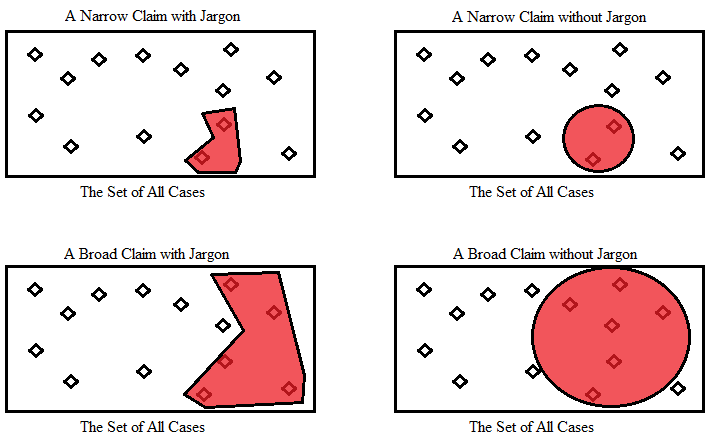
  1. An Expertise Gap: Specialists in arts and sciences utilize highly specific jargon so that very specific concepts can be expressed concisely. But such jargon muddies communication with those who aren’t specialists in the field. The specialist grapples with this expertise gap. Although the struggle deserves sympathy, anthropomorphizing is far different from the expert’s idea of the truth.
  • The problem is that jargon has highly a specific meaning. So, when a specialist makes a claim with jargon, the claim is also specific. A narrower set of applicability has less room for credible challenges at the margins of a claim and ideas can be clearly communicated precisely – though, the applicable cases may not be interesting. As the breadth of a claim increases, jargon can help to ensure that the breadth is limited to appropriately specific cases.
  • When the listener is not an expert, the scientist is uncertain of the gap in knowledge. They attempt to make relatively broad and interesting claims, but without the aid of their case-narrowing jargon. The result is that the expert says something which is clearly false to another specialist, but may be mostly true – or true enough for the listener.

Again, these four interpretations of misspeaking and miscommunicating experts are ordered by charity. I especially sympathize with the last interpretation. Imagine trying to teach a student that inflation is always costly, but sometimes more beneficial than costly. And that the costs still exist when the benefits outweigh the costs. So, should we have a policy of inflation? The true answer is highly specific.

Does an atheist scientist understand that there is no designer of human bodies – much less one that had diet in mind? Very much. Does the same atheist scientist know how to communicate unintentional biological advantages to the non-specialist? They do not.  What’s more is that they are not alone. Specialization introduces a knowledge gap and the unavailability of common jargon prevents adequately finessed broad claims.

How HOAs are Born

I live in Florida and there is a lot of residential construction down here. It’s not typically people just deciding to build a house on some isolated plot of land. A large portion of construction is private or semi-private neighborhoods built by developers. They often include manicured common spaces and strict Home Owners Association (HOA) rules.

The typical procedure is that a developer purchases a large parcel of land, and then starts building. Before the first house is even sold, the HOA is established and the governing board is packed with developer representatives.  Written into the HOA bylaws is that the developer maintains a preponderance of the HOA representation during construction. This makes sense. ‘Nice’ neighborhoods command higher property prices and the developer has often invested *very* large sums of money. Certainly more money than it’s willing to risk at the hands of a sloppy, owner-controlled HOA.

Best practice differs by developer.

Typically, the residents will have seats on the HOA board in some proportion of development project completeness. For example, if 75% of the total planned lots have been built and sold, then the developer may retain 2/3 or 3/5 control of an HOA board. The developer finally relinquishes all HOA control after 100% of the planned units are completed and sold.

Ignoring policies for beautification and such, a HOA boards under developer control act differently from those that are resident controlled. As I said, the developer has full discretion on HOA policy, practically speaking, because it maintains a majority of the voting members. But, HOA fees are *not paid* by the developer.[1] Only homeowners pay HOA fees.

For example: Not everyone wants cable TV. But the developer knows that home-buyers want the option for cable TV. Typically, one of the first HOA orders of business is to pay for monthly cable TV. Every single unit pays for cable TV through their HOA fees – whether they use it or not – in exchange for the cable company laying cable lines and providing access. Typically, these contracts are often a decade in duration, after which time the contract can be cancelled and owners can individually decide whether to pay for cable. It’s not obvious that an owner-controlled HOA would pay for cable and have lines laid in the first place (Satellite TV anyone?).

To be clear: The developer sets the HOA policy priorities and determines the HOA budget. Then, the owners pay the quarterly HOA fee. Can you say Principal-Agent problem? Early HOA activities include less resident engagement because residents don’t much affect outcomes. The developer also doesn’t mind higher HOA fees because it doesn’t bear the cost. Do you expect your HOA to put contracts up for bid, say, to do landscaping, pressure washing, etc.? If your HOA is developer-controlled, then you should expect no such thing. Putting contracts ‘up for bid’ is time consuming and reflects a concern for costs. Not to mention that the quality of the bid work may be variable. Developers want high property values and they want them dependably. HOA fiscal prudence, besides solvency, is not a priority.

Having said all this – it’s true that your neighborhood may be ‘nicer’ due to developer control of the HOA. Depending on you preferences, this might align nicely with your priorities. If that’s true, however, you can expect to be less happy in the long-run when your neighbors ultimately gain control of the HOA.

I’m on my HOA board and it’s now 100% privately owned. There are still principal-agent problems. But they are much easier to address now that everyone on the board pays HOA fees. Our problems and our opportunities are truly ours.


[1] Sometimes, the developer will provide a loan to the HOA to provide for initial management costs.

Probably Proportions

Statistics is hard…

I want to share a conversation about proportion Vs. probability.

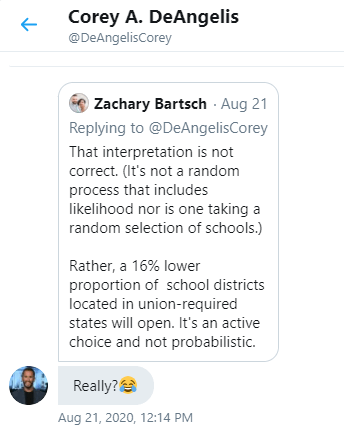
My friend, Corey DeAngelis, has a new research paper that measures the link between school district unionization and in-person re-opening in the time of Covid-19.

He promoted it on Twitter – but little did he know that a member of the statistics police was on patrol…

Am I splitting hairs? Of course I am. Do most people know what he means? I think so. Is the distinction important? You betchya.

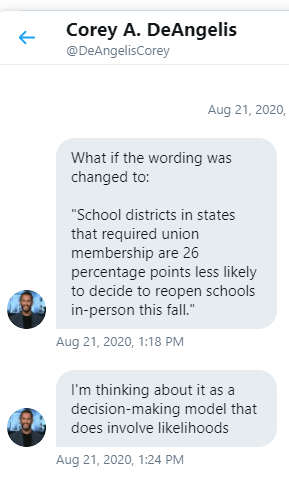
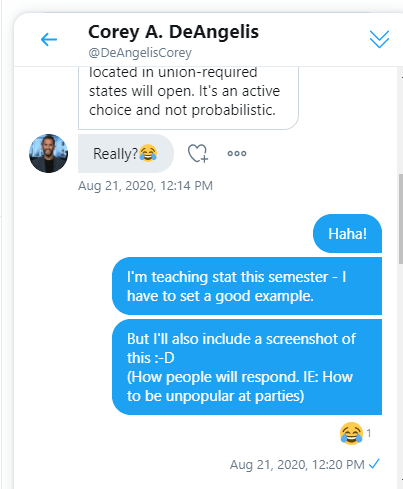
Corey, sent me a private message with the appropriate response:

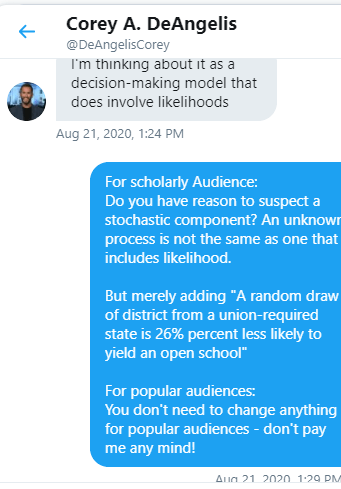
Oh, yes – really.  Speaking probabilistically when we don’t have all of the information is so very tempting. To us the observer, lots of things appear probabilistic to us that are deterministic in nature (Have you ever played the board game “Don’t Wake Daddy!”, “Hot Potato”, or “Musical Chairs”? There is a process that determines when daddy will awaken or when the music ends). Not knowing the underlying process makes the experience appear probabilistic. But appearances can be deceptive.

Often, people speak as if they are taking a random draw from a sample. That can be probabilistic.  Given a draw of school districts, the likelihood of selecting an opening school from non-union districts is greater than choosing an opening school from a union district. This is entirely right. What is not right is saying that teacher-unionized districts are “more likely” to stay closed.

The decision to stay closed or to open is a product of collective choice – the decisions of several parties with diverse interests. Of course, we don’t know every single influence on the decision. But we do know that the outcome follows a pattern. A lower proportion of schools open in teacher-unionized districts than the proportion in non-union-districts.

Researchers often talk about their sample as if it is reality. A random draw from a sample has a probability. Nobody is randomly drawing an actual school district and expecting a probabilistic process to determine the policy outcome. Just ask yourself: “Does the sample proportion tell me an empirical probability?”

*Note: This is why we have different language when using a standard normal distribution.

“What proportion of area is to the left of z*=1.5?”

“Given a random draw from a standard normal distribution, what is the probability of selecting a value that is less than 1.5?”

One describes randomness. The other describes an already determined outcome.

Note: Yes, this kind of behavior does have implications for one’s popularity.

A Covid Conversation… But with Humility.

We know WAY more about Covid-19 than we used to. But there is plenty of appropriate and inappropriate incredulity concerning the data meaning, validity, and implication. I want to take a minute and give it the good ol’ Stat – 201 college try. Here’s the level-headed and appropriately humble Covid statistics conversation.

A: “The US has more cases of Covid than Portugal.”

B: “Yes, but that’s not important. They are very different countries. After all, 65% of people in Portugal live in urban centers. For the US, that number is 80%. Obviously, people being close together, such as in urban places, will contribute to more Covid cases.”

A: “OK. Fine. They may be incomparable. But the US has more cases than the UK, which has a similarly urban population of 83%.”

B: “Yes, but the US is larger. The UK has a smaller population – Of course the US has more cases.”

A: “Ah! And the US also has a Covid positivity rate well in excess of the UK.”

B: “Hmm… That is something. The problem is that the testing is not administered in the same fashion in both places (or across time). That is, neither set of tests is a simple random sample of people and neither is biased in sampling in the same sort of relevant ways.”

A: “But how do you know that the samples aren’t collected in the same sort of ways? Someone feels poorly, then they go and get tested. Isn’t that how is works everywhere?”

B: “Not necessarily at all. Some countries and municipalities offer free testing. Other places have more or less scarcity of tests and surely that affects whom they decide to test. Not only that, different people are differently willing to get tested (maybe they’d have to involuntarily stop working, for example). My point is that the testing samples are not both biased in favor or against positives in the same way and we have little way of telling either the direction or magnitudes. The fact that both countries test a similar proportion of the population doesn’t address the sampling method.”

A: “OK. Well, I suppose that we ought not try at all then, according to you? Isn’t some problematic data better than none?”

B: “Problematic data is not better than none at all if we have good reason to think that there isn’t enough in common between sample collection methods to make valid comparisons.”

A: “Right, so you’re saying that we have to be agnostic.”

B: “In some sense, yes. But rather than Covid cases, we can track relevant variables whose sampling is more comparable. Hospitalizations are better, but we still have the issue of selection bias among those being admitted and a bias due to different hospital capacities between localities. The best measure is the number of deaths due to Covid. People can’t elect out of that sample.”

A: “Hm… Ok. But while total deaths is a more dependable statistic, it is less relevant. Of course deaths matter a great deal, but Covid makes people feel terrible and may even have long term effects.”

B: “You’re right. Covid deaths Vs cases has the trade-off of relevance Vs dependability. Arguably, deaths are the most important possible symptom – although I take your point that it’s not the only relevant symptom. Ultimately, however, the death numbers are more dependable and we should use them if we want a high degree of certainty.”

A: “Fine. The US has more Covid deaths than does the UK, both in level and in deaths per thousand of population.”

B: “Yep. You are right. But the US has more Covid cases, so of course it has more Covid deaths than the UK. The correct statistic is, given a Covid diagnosis, how likely are you to die of Covid? In the UK, a much higher proportion of people with a Covid diagnosis die. In other words, Covid is more dangerous in the UK than it is in the US.”

A: “Time out. Two things: 1) Didn’t you say just a moment ago that the testing data wasn’t reliable enough? Now you’re using it as if it’s reliable. 2) If we are making a cross country comparison, then can’t we just say that a person, randomly drawn from the population, is more likely to die from the Covid in the US than in the UK?”

B: “Mea culpa. You’re right on both points. At the end of the day, a US person is more likely to die of Covid. But, in the UK a person with Covid may be more likely to die. So what do we do about that?”

A: “Good question…”