Inflation-Adjusted Wages Have Been Rising Since June 2022

Back in May 2022, I wrote about the very bad picture for inflation-adjusted wages in the US. While they were still slightly above pre-pandemic levels, wages had been falling consistently since the beginning of 2021.

But since then, we’ve got some better news. The chart below shows the data (note: I’m using wages for private production and non-supervisory workers here, rather than for all private workers in the May post).

While the overall inflation picture still looks bad, with 7.1% annual inflation in the latest report, we also see that in the past 5 months wage growth has exceeded CPI growth. It’s also been true compared with the PCE price index for the past 4 available months (November PCE data won’t be available until next Friday). Inflation has cooled slightly in the past few months, while wages have continued to grow.

This all means that real (inflation-adjusted) average wages in the US have been rising consistently since June 2022. Finally, some good news!

Inflation, Information, & Logic

Most economists know that the CPI is overestimated and therefore prefer the PCE price index. However, monthly CPI data is consistently released before PCE data for a given month. One would think that they move in the same direction and be highly correlated. Indeed, in the past five years, the correlation is 0.96. Therefore, it stands to reason that the there is less new relevant information on the PCE release dates than on the CPI release dates. Yes, CPI is biased, but it still contains some information about prices and it is known well prior to the more accurate PCE numbers.

Supply and Demand react to new information. Sometimes the new information changes our expectations about the future, and other times we learn that our beliefs about goods and assets were previously not quite right. So, with new relevant information comes new prices as people update their beliefs and expectations.

Let’s get financial.

Continue reading

Introducing Students to Text Mining II

In the Fall of 2020, I blogged about how I introduce students to text mining, as part of a data analytics class.

Could Turing ever have imagined that a human seeking customer service from a bank could chat with a bot? Maybe text mining is a big advance over chess, but it only took about one decade longer for a computer (developed by IBM) to beat a human in Jeopardy. Winning Jeopardy requires the computer to get meaning from a sentence of words. Computers have already moved way beyond playing a game show to natural language processing.

https://economistwritingeveryday.com/2020/11/07/introducing-students-to-text-mining/

I told the students that “chat bots” are getting better and NLP is advancing. By July 2020, OpenAI had released a beta API playground to external developers to play with GPT-3, but I did not sign up to use it myself.

In April of 2022, I added some slides inspired by Alex’s post about the Turing Test that included output from Google’s Pathway Languages Model. According to Alex, “It seems obvious that the computer is reasoning.”

This week in class, I did something that few people could have imagined 5 years ago. I signed into the free new GPTChat function in class and typed in questions from my students.

We started with questions that we assumed would be easy to answer:

Then we were surprised that it answered a question we had thought would be difficult:

And then we asked two questions that prompted the program to hedge, although for different reasons.

It seems like the model is smarter than it lets on. For now, the creators are trying hard not to offend anyone or get in the way of Google’s advertising business. Overall, the quality of the answers are high.

Because of when I was born, I believe that something I have published will make it into the training data for these models. Will that turn out to be more significant than any human readers we can attract?

Of course, GPT can still make mistakes. I’m horrified by this mischaracterization of my tweets:

Fight for $15? $25? $40?

Remember the “Fight for $15”? It’s a 10-year-old movement to raise the federal minimum wage to $15 per hour. While there hasn’t been any increase in the federal minimum wage since the movement began in 2012, plenty of states and localities have done so.

I won’t rehash the entire debate on the minimum wage here, but I will point you to this post from Joy on large minimum wage changes, and here are several other posts on this blog on the same topic. But lately I have seen an increasing call for even larger minimum wage increases, well beyond $15.

A prominent recent call for a higher wage comes from the SEIU, the second largest labor union in the nation. They are calling for a $25 minimum wage in Chicago, where the legal minimum wage just recently crossed $15 last year. Again, without getting into the detailed debates about the economics of the minimum wage, we can recognize that this would be a massively high minimum wage, given that median hourly wage for the Chicago MSA was $22.74 in May 2021. It’s certainly a bit higher in 2022, and the city of Chicago is probably a bit higher than the entire MSA. Still, we are talking about a minimum wage that would cover roughly half the workforce. Well, at least half the current workforce. The negative employment effects would potentially be large.

Here I will dabble a little bit in the minimum wage literature. One of the most famous recent papers that suggests increasing the minimum wage doesn’t have large negative employment effects is a 2019 paper by Cengiz, et al. This paper only looks at legal minimum wages that go up to 59% of the median market wage, which is the highest wages have been pushed up so far. By contrast, that $25 minimum wage in Chicago would be somewhere around 100% (!) of the local median market wage. That’s huge, and goes far beyond what even the most sympathetic-to-the-minimum-wage research has looked at.

But here’s the most recent minimum wage call that really takes the cake: over $40 per hour in Hawaii. That comes from, in a way, a Tweet from Hal Singer:

Now in fairness, he doesn’t exactly call for a $40 minimum wage in Hawaii, but he does say we should use the minimum wage as a tool to address homelessness, and then points to a study showing that you would need to earn $40/hour in Hawaii to afford a two-bedroom apartment. That’s pretty close. The median wage in Hawaii? About $23 in May 2021. In fact, the 75th percentile wage in Hawaii was $36.50 in 2021! So, depending on exactly how much wage growth there has been in Hawaii since May 2021, we are likely talking about a $40 minimum wage covering 75% of the workforce! That would likely have some “bite,” as economists say.


Thanksgiving Dinner is Once Again More Expensive (But Not the Most Expensive Ever)

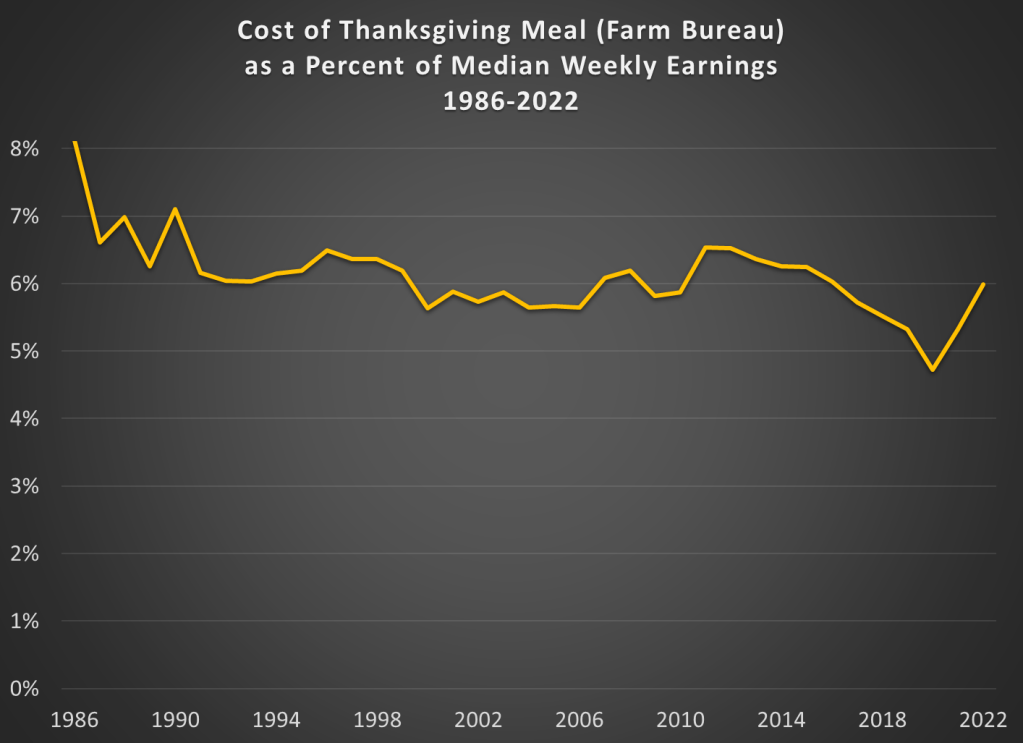
Last year inflation hadn’t quite hit the levels we would see in 2022, but they were already rising. When Thanksgiving rolled around, many media sources were reporting that it was the “most expensive Thanksgiving ever.” In nominal terms that was true, though in nominal terms it isn’t that surprising. In a post last year, I compared the prices of Thanksgiving dinners (using the same data from Farm Bureau) to median earnings going back to 1986. While 2021 was more expensive the 2020, it turned out it was still the second lowest it had been since 1986.

As you might expect, this year’s Thanksgiving dinner is even more expensive than last year in nominal terms. It’s up about 20% since last year or over $10 more, according to Farm Bureau. That’s certainly more than the overall rate of inflation (7.7% in the past 12 months) and more than inflation for groceries (12.4% in the past 12 months). But how does that compare with median wages? Comparing the 3rd quarter of this year with the same quarter in 2021, median wages are only up about 7%, certainly not enough to keep up with those rising turkey prices.

When we add 2022 to the historical chart, here’s what it looks like.

The spike in the last 2 years is clear in the chart but notice that at about 6% of median weekly earnings, we have essentially returned to the average level of the entire series. From 2017-2021, we could be thankful that the price of your Thanksgiving dinner had dropped below that 6% level. We’ll have to find something else to be thankful for this year.

The Unimportance of Inflation: Stocks & Flows

One of my specializations in graduate school at George Mason University was monetary theory. It included two classes taught by Larry White who specializes in free-banking, Austrian macroeconomics, and monetary regimes. Separately, my dad was a libertarian and I’ve attended multiple Students for Liberty events. Right now, I’m writing from my hotel room at a Catholic/Crypto conference, where I learned that the deepest trench in Dante’s Inferno includes money debasers.

Everything about my pedigree suggests that I should have a disdain for the Federal Reserve and cast a wistful gaze toward the perpetually falling value of the US dollar. But I don’t. I certainly do have opinions about what the Fed should be doing and how our monetary system could work. But I’m not excited by the long-run depreciation of the dollar.

Let me tell you why.

Learning a little bit of theory is a dangerous thing. Monetary theory is especially hard because we examine the non-good side of the transaction: the medium of exchange. In frantic excitement, enthusiasts often point out that the value of the dollar has lost very much of its value in the past 100 years. They describe that loss by describing the lower quantity of something that a dollar can purchase now versus what it could have purchased historically. That information is incapsulated in the price of a good. The price of a good is the number of dollars that one must exchange in order to purchase the good. Similarly, the price of a dollar is the number of goods that one must give up in order to purchase the dollar.

We can consider a variety of goods. Below is a graph that describes the quantity price of the dollar where the quantities are CPI basket units, gold, and housing. In the 35 years following 1986, a single dollar purchases 60% less of the consumer basket, 74% fewer houses (not quality adjusted), and 76% less gold.

Continue reading

New Data: State Regulatory Procedures

Released this April, but I just heard about it today. Researchers did the painstaking work of going through all 50 states to determine which steps must be taken in each state before new regulations can take effect. For instance, it turns out half of states require economic analysis for new regulations, and half don’t. The paper is here: https://www.mercatus.org/publications/regulation/50-state-review-regulatory-procedures

The Price of Food: Farm to the Table

If you’re like me, then you are very fond of food. What determines the price of food? Supply and demand of course!

We can consider food as a commodity because just about anyone can buy and sell it. Almost all foods have partial substitutes. Therefore, the long-run price in the competitive market for food is largely dictated by the marginal cost. Demand has an impact on the price only in the short run.

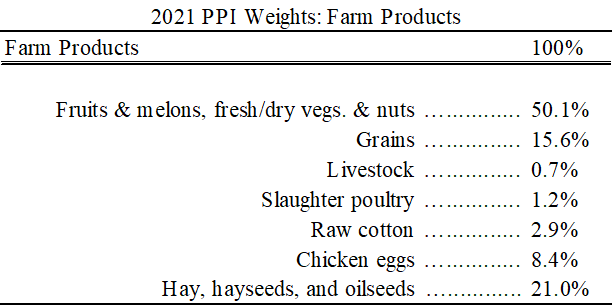
A long-run driver of food prices are the costs that food producers face. The US Bureau of Labor Statistics divides the Producer Price Index into multiple categories that are relevant for a variety of sectors and points within the production process. Below is a table of the most fundamental, relatively unprocessed farm products and their weight among all farm products in December 2021. Cotton is a relatively large component for farm products even though it’s not a food and I include it for completeness. Fruits, veggies, and nuts makeup the overwhelming proportion of the cost of farm products. I was at first surprised that grains composed such a small proportion. But, being dirt cheap, it makes sense.

We all know that inflation has been in the news. It’s been elevated since the second quarter of 2021. Consumer prices tend to lag producer prices. One indicator of where food prices will be in the near future is where the producer prices are now. Below is a graph that displays the above seasonally adjusted farm product prices since the start of 2021*.

Continue reading

Two Types of News: Elections vs Crashes

Some events are like elections: it was obvious that some big political news would break on Election Day, we just had to wait to find out what exactly would happen. Others are like market crashes: you might know in principle they’re a thing that can happen, but you don’t really expect any particular day to be the day one happens, so they seem to come out of the blue. As it turns out, for one of the largest crypto exchanges the day of the crash also happened to be Election Day.

FTX.com is facing a bank run sparked by competitor Binance tanking the price of the token that backed some of their assets. Customers are having issues withdrawing their money, Binance has withdrawn its offer to bail out FTX by taking them over, and bankruptcy seems likely. Supposedly this doesn’t affect Americans using FTX US, but I’d be nervous about any funds I had there, or indeed with funds in any centralized crypto exchange or stablecoin (Tether and even USDC seem to be having issues holding their pegs). All this was especially shocking because many considered FTX founder Sam Bankman-Fried one of the most trustworthy people in the often sketchy world of crypto. He was always meeting with US regulators and lawmakers, and seems not to be motivated by greed; he had already begun to give away his fortune at scale.

After any surprising event like this, some people claim it was actually obvious and they saw it coming (despite usually never having said so beforehand), while others start looking back for warning signs they missed. The most interesting one is something that shocked me when I first heard it March, but I never considered the risk it implied for FTX until the crash:

Going forward, red flags to watch out for seem to be topping a list of youngest billionaires (as Elizabeth Holmes also did) and buying naming rights to a stadium.

In contrast to this crash, the election happened right when we all expected, and at least largely how I expected. Like markets, I underestimated Democrats a bit; polls overall were impressively accurate this year, though they of course missed on some particular races. Votes are still being counted, and as of now we don’t even know for sure which party will control Congress (PredictIt currently gives Democrats a 90% chance in the Senate and a 20% chance in the House). But here are some early attempts to assess forecast accuracy. As I said, some polls were quite good:

Some polls weren’t so good, which means its important to weight better pollsters more heavily when you aggregate them. Some attempts at that were also quite good:

Oddly, some no money (Metaculus) / play money (Manifold Markets) forecasting sites seem to have done better than the real-money prediction sites: