In the short term, there are only a few million doses of the COVID vaccines available, but well over 100 million adults in the US that want to take the vaccine if offered for free to the consumer. There are also billions worldwide that would like the vaccine.
So who should get it first? In practice in the US, the allocation method has already been determined politically: the federal government will allocate vaccines to the states, and states will allocate them to individuals based on a priority list: health workers and the most vulnerable first, then teachers, etc. The NY Times has a tool that shows you your probable place in line.
But essentially the allocation method being used is central planning.
John Cochrane has proposed a “free market” solution: sell the vaccine to the highest bidder. Or at least, sell some doses to the highest bidder.
As an economist, there is always some appeal in thinking about a free market solution. But there is a problem in this case: there are positive externalities from taking the vaccine. It not only benefits me, but it also benefits others. My willingness to pay only reflects the benefit to me, the private benefit. The social benefit is mostly ignored by a simple auction, and in the aggregate for a vaccine most of the benefits are likely to be social benefits. But positive externalities don’t imply we need to use central planning!
In the course of research work, I read “Sticky Prices as Coordination Failure” today, published in 1991 by L. Ball and David Romer.
They suggest that “coordination failure is at the root of inefficient non-neutralities of money”. They write an elegant theory of price setting and adjustment that includes a menu cost. A menu cost is imposed on an individual who adjusts prices. The name comes from the fact that some restaurants face a literal cost for switching the paper menus.
If changing prices is costly then there is inertia. People tend to stay where they were before, even if adapting to fluctuating external conditions is more efficient.
According to their model of rational individual agents, people will change if the expected benefit of adjustment is larger than the menu cost. In some cases, the optimal action for an individual depends on what others are doing. Thus
Increases in price flexibility by different firms are strategic complements: greater flexibility of one firm’s price raises the incentives for other firms to make their prices more flexible. Strategic complementarity can lead to multiple equilibria in the degree of nominal rigidity, and welfare may be much higher in the low-rigidity equilibria.
An implication is that if you are surrounded by people who are open to constantly changing, then you yourself will be more likely to adapt. The world is always fluctuating, so welfare is higher for communities that can adapt quickly. Example of changing circumstances include global warming and novel safety procedures suddenly needed during the time of Covid.
In this paper, “multiple equilibria” means that a community might settle at a high-wealth level or a low-wealth level simply because of what everyone else is doing. Ball and Romer don’t try to figure out which equilibrium is more likely to be the outcome in reality.
No one in their model would be out of equilibrium (unnecessarily poor) if it were not for the “sticky” prices. As the title implies, coordinating the optimal levels of production and consumption is difficult because of the inertia of prices.
In their conclusion, they reflect on the role of government when multiple equilibria are possible:
… with multiple equilibria, policy can be less coercive. Instead of prohibiting certain contract provisions, the government could simply convene meetings of business and labor leaders to coordinate adjustment … Second, by moving the economy to a new equilibrium, temporary regulations can permanently change the degree of nominal rigidity.
They assume that after a recession, the price adjustment that needs to happen is “for decentralized agents to reduce nominal wages in tandem.” It’s interesting to see, culturally speaking, how hesitant they seem to strongly recommend government intervention through inflation. I feel like writers in econlit today would not be shy about saying they think governments should intervene through monetary policy, if they believe that to be true.
In my JEBO paper, I found that a little inflation caused workers to not lower production so much in response to a real wage cut after a recession. In our environment, I would say “cooperation” was more important than “coordination”, because there were only two agents and their decisions were sequential.
Although I write on a variety of subjects, my main professional training (through the PhD level) is as a chemical engineer. Chemical engineering is one of the broader technical disciplines. It bridges between chemistry, which is mainly associated with academic-type laboratory work, and huge chemical plant equipment. One year I was making and testing catalysts in the lab, then next I was calculating fluid flows and designing internals for a 100 ft high distillation tower (and climbing around inside that tower to insure the parts were being properly welded in place):
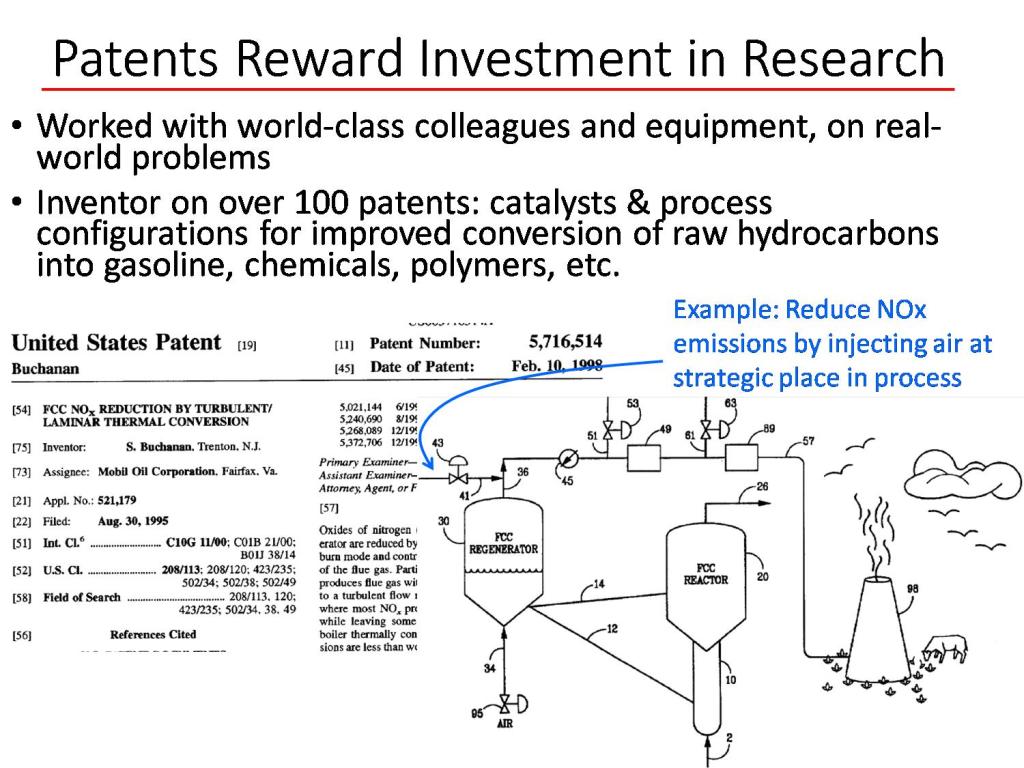
In my work in industrial research, I have been paid to develop technical improvements which could have economic value. A key incentive my company had for investing in this research was the expectation that if we came up with a novel improvement, that we could have exclusive rights to practice that improvement. There would have been little point in paying for research if our competitors could immediately make use of our hard-won insights. A snip of one of my patents is shown below.
For the world, and for most large groupings such as nations, the average income per capital is roughly equal to the average production per capita. The way to get more “stuff” (goods and services, and all their benefits) is to make more stuff. The way to make more stuff (per capita, and for fixed a workweek) is to make workers more productive. A key factor in productivity is technology. Two hundred years ago, nearly everyone in the U.S. had to be out in the sun and cold, working the soil, sowing by hand and plowing with the aid of animals, to grow enough food to feed everyone. Now I believe we are fed by only 2% of the workforce, using artificial fertilizers, improved seeds, huge tractors and combines, and satellite-aided computer scheduling. Most of the rest of us get to work in air-conditioned offices (or homes, in a pandemic year) and eat as much food as we want.
The patent system of the U.S. and other nations is designed to promote progress in productive technology. Early on, the newborn U.S. Congress passed the Patent Act of 1790, titled “An Act to promote the progress of useful Arts”. Without getting into all the legal details, a valid U.S. patent allows the inventor to exclude any other party from practicing their invention, for a period of twenty years. However, one of the requirement for a patent application is to clearly explain to the public how the invention works. When the twenty years is over, anyone can take advantage of the technology which the inventor has disclosed, which hopefully leads to widespread practice of technical improvements. While we can always ponder improvements to our system of patents, readers can thank it in part for many medical advances, and for delivering them from trudging behind a plow.
A balance sheet gives a snapshot of a corporation’s assets and liabilities. The difference between total assets and total liabilities is (by definition) the value of the equity owned by the owners or shareholders of the company.
With, say, a manufacturing firm, the assets would include tangible items such as buildings and equipment and inventory, and intangibles such as cash, bank accounts, and accounts receivable. Liabilities may include mortgages and other loans, and accounts payable such as taxes, wages, pensions, and bills for purchased goods.
The balance sheet for a bank is different. The “Assets” are mainly loans that the bank has made, plus some securities (such as US Treasury bonds) that the bank has purchased. These assets pay interest to the bank. The money the bank used to make these loans and purchase these securities came mainly from customer deposits or other borrowings by the bank (which are considered “Liabilities” of the bank), and also from paid-in capital from the bank owners/shareholders. [1] As usual, the current equity of the bank is assets minus liabilities. Thus:
The Federal Reserve System is a complex beast. We will not delve into all the components and moving parts, but just take a look at the overall balance sheet.
Unlike other banks, the Fed has the magical power of being able to create money out of thin air. Technically, what the Fed can do with that money is mainly make loans, i.e. buy interest-bearing securities such as government bonds. The Fed makes its transactions through affiliated banks, so it credits a bank’s reserve account with a million dollars, if it buys from that bank a million dollars’ worth of bonds. Those bonds then become part of the Fed’s “assets”, while the reserve account of the bank at the Fed (which is a liability of the Fed) becomes larger by a million dollars. Since the Fed is not a for-profit bank, the “Equity” entry on its balance sheet is nearly zero. Thus, total assets are essentially equal to total liabilities.
The Fed also has the power of literally printing money, in the form of Federal Reserve Notes (printed dollar bills). These, too, are classified as liabilities. Thus, you are probably carrying in your wallet right now some of the liabilities of the central bank of the United States.
Before 2008, the balance sheet of the Fed was under a trillion dollars. Nearly all the “Liabilities” were the Federal Reserve Notes and nearly all the “Assets” were US Treasury securities. The reserve accounts of the affiliated Depository Institutions was minuscule. All that changed with the Global Financial Crisis of 2008-2009. To help stabilize the financial system, the Fed started buying lots of various types of securities, including mortgage-backed securities (MBS) [2]. The Fed thus propped up the value of these securities, and injected cash (liquidity) into the system.
Here is a plot of how the assets of the Fed ballooned in the wake of the GFC, from about $ 0.9 trillion to over $ 4 trillion:
The initial purchases in 2008 were US Treasuries, which the Fed had prior authorization to do. To buy other securities, especially the mortgage products, required congressional authorization. The increased liabilities of the Fed which offset these purchases were mainly in the form of larger reserve accounts of the affiliated banks. The Fed started paying interest on these reserve accounts, to keep short term interest rates above zero at all times (otherwise the whole money market in the U.S. might implode).
With the Fed relentlessly buying the mortgage and bond products, the interest rates on long-term mortgages and bonds was kept low. This was deemed good for economic growth. The Fed tried to sell off some securities to taper down its balance sheet in 2018, but that effort blew up in its face – – the stock market started crashing in response in late 2018, and so the Fed backtracked . You can look at weekly tables of the Fed balance sheet here.
Anyway, the GFC and its aftermath provided the precedent for massive purchases of “stuff” by the Fed. When the Covid shutdown of the economy hit in March of this year, the Fed very quickly went into high gear. Its balance sheet shot up from $4 trillion to $7 trillion in just a few months. It bought not only Treasuries and MBS, but corporate bonds. This was way outside the Fed’s original charter, but the crisis was so intense that nobody seemed to care whether these actions were legal or not. And now, to finance the huge deficit spending of the federal government in the wake of the shutdowns, the Fed has been buying up nearly the entire issuance of Treasury bonds and notes.
These actions may have long term consequences we will explore in later posts [3]. For now, the Fed has made it clear that it will keep interests rates near zero for at least the next couple of years. Invest accordingly.
ENDNOTES
[1] Huge caveat: This statement gives the impression that a bank must first receive say a thousand dollar deposit before it can make a thousand dollar loan. That is not the case. The reality is just the opposite: the act of making a thousand dollar loan actually CREATES a corresponding thousand dollar deposit. This is very counterintuitive, and I won’t try to explain or justify this point here.
[2] Technically, the Fed is not “buying” the mortgage-backed security (MBS). Rather, it is making a “loan” to the bank, and holding the MBS as collateral against that loan.
[3] It is now harder to take the federal deficit seriously as a constraint on spending: the government can issue unlimited bonds to fund deficits, which the Fed will purchase to keep interest rates low. Yes, the government has to pay interest on those bonds, but the Fed has to return most of that interest to the Treasury, so the real cost to the government of that extra debt is low.
A week ago, we described commercial loans in general, and how they differ from bonds. Companies nearly always need money to make money, and thus have to borrow money in addition to selling stock shares. Companies that are new or smaller or doing poorly or have already borrowed a lot can still get loans, but these loans typically come with stringent conditions and require paying relatively high interest. These “leveraged loans” are the loan equivalent of “junk” bonds. When a bank lends money as a “Senior Secured Loan”, this entails agreements (“covenants”) which may specify that in event of default, this loan gets paid off ahead of any other creditor, and also that some specific asset held by the company, such as a building or an oil field, will be given over to the bank.
Financial institutions like insurance companies and pension funds are hungry for “investment grade” securities like bonds rated BBB or higher. Normally, these institutions would not consider buying into the senior loan marketplace, since these instruments are not considered investment grade.
Enter “Collateralized Loan Obligations” (CLOs). With a CLO, 200 or so loans which have been made by banks and then sold off into the market are bundled together, and then the cash flow from the interest paid on these loans plus the principal paid back is repackaged into slices or “tranches”. The highest level tranches get first dibs on being paid from the overall CLO cash flow, then the lower and lower tranches. The majority of bank loans today end up being packaged into CLOs. CLOs are an example of a lucrative operation known as “securitization”: “Securitization is the process of taking an illiquid asset or group of assets and, through financial engineering, transforming it (or them) into a security” (per Investopedia).
The rate of loan defaults in recent years has been only 3-4%, and on average the recovery on a given defaulted senior secured loan has been around 80%. So the actual losses (e.g. 4% x 20%, or 0.8% net) have been quite low. The highest annual default rate in recent memory was about 10%, in the Global Financial Crisis of 2008-2009.
The theory is that, although any particular loan has a nontrivial chance of defaulting, it is unthinkable that more than say 20% of all loans would default; and even if a full 20% of the loans did default, we would expect that the actual losses after liquidating the pledged collateral would be more like 4% of the entire loan portfolio (i.e. 20% defaults x 20% loss per default). This means that the top 95% or so of CLO cash flow should be considered very secure, and the top 60-70% are utterly secure.
Thus, the top 60-65% of the CLO cash flow is packaged as super secure, relatively low-yielding AAA rated debt, and as such is bought up by conservative financial institutions, including banks. This arrangement keeps those institutions happy, and also facilitates the making of loans to the needy companies who are taking out the underlying loans.
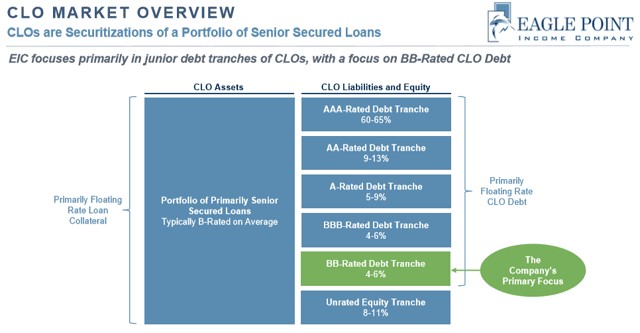
The figure below from an Eagle Point Investment Company presentation depicts typical CLO tranches:
The lower the position in the CLO cash flow “waterfall”, the higher the yield and the higher the risk of non-payment. The AA, A, and BBB debt tranches are all considered investment grade, though with higher risk and higher yields than the AAA tranche. The Eagle Point Investment Company happens to buy into the BB-rated debt tranche, which is just below investment grade. You, the public, can buy shares Eagle Point Investment (stock symbol EIC). These shares pay about 7% yield, after hefty management fees have been subtracted.
The equity tranche lies at the very bottom of the CLO heap. If there were, say, 20% loan defaults with only 50% recovery of the loans, the equity tranche might get completely wiped out. So these are more risky investments. As usual, there is high reward along with the risk. Oxford Lane Capital (OXLC) deals in CLO equity, and it will pay you about 15% per year, which is huge in today’s low-interest world. But….you need to be prepared to have the stock value cut in half every ten years or so, whenever there is a big hiccup in the financial world.
Anyone who was an economics-savvy adult during the GFC should be asking, “But, but, but…aren’t these CLOs essentially the same thing as the collateralized debt obligations (CDOs) that blew up the world in 2008?” The answer is partly yes, in that in both cases a bunch of loans get bundled together and then resliced into tranches. That said, we hope that the underlying loans in today’s CLOs are more robust than the massively shady home mortgage loans of 2003-2008 that fed into those CDOs. Back then, unscrupulous banks and mortgage companies handed out thousands of housing loans to ill-informed private individuals who did not remotely qualify for them, and then the banks dumped these loans out into the broader financial markets via CDOs. The bank loans behind today’s CLOs are more sober, serious, vetted affairs than those ridiculous subprime home mortgages.
This past summer, in the thick of the Covid shutdowns which have stressed small businesses, The Atlantic published a dire assessment of the potential for CLOs to sink the system, with the catchy title The Looming Banks Collapse . The article noted, fairly enough, that there has been a trend in the past few years to weaken the covenants on loans which would normally protect the lender against losses. Most loans these days are considered “covenant-lite”, compared to several years ago. There is genuine concern that the recovery on these loans might be more like 40-50%, instead of the historic 70-80%. On the other hand, the looser requirements on these loans may mean that fewer of them will technically violate these looser covenants and thus fewer companies will actually default. A recent survey estimates that the default rate in the $ 1.2 trillion dollar leveraged loan universe will peak at only 6.6% in 2021.
Also, today’s CLOs seem to be rated by the major ratings agencies more responsibly than the notoriously optimistic ratings given to CDO’s back in 2008. “CLOs are usually rated by two of the three major ratings agencies and impose a series of covenant tests on collateral managers, including minimum rating, industry diversification, and maximum default basket”, according to an article by S&P Global Market Intelligence. That article has a good description of CLOs, including a brief tutorial video on the nuts and bolts of how they work.
My dear friend Mark Lutter has had me all riled up about charter cities for a few years now. I link to a new podcast from USFQ’s Aula Magna magazine on the subject that gives a very short introduction to the topic. After recording the podcast I returned to preping a class on genetic algorithms and got all riled up because I saw a connection between the two I hadn’t seen (clearly) before. Charter cities can be real life genetic algorithms for institutional innnovation.
Genetic algorithms are a form of machine learning that searches for solutions to problems by trying out a variety of solutions. As the name implies they are based on the evolutionary algorithm of diversity-selection-amplification to adapt solutions. In a genetic algorithm a population of of possible solutions to an optimization problem is instantiated and solutions with high fitness and reproduce (using cross over, mutation, and other genetic operators) to create new populations of solutions. over enough iterations genetic algorithms are goods ways to search for solutions whe the solution space is complex and poorly defined, which is probably what institutional space looks like.
Now imagine a country that is designed as a genetic algorithm and charter cities within the country as posible institutional solutions. The constitution of the central government is the overall framework of the genetic algorithm and the diversity of institutional arrangments at local government levels (i.e. different charters) are posible solutions.
Viewing charter cities in this light, the interesting question now turns to the rules of the central government and not necesarily to the rules implemented by the charters themselves.
A few of the questions that have begun to bother me follow. What country level rules lead to convergence, or at least continual adaptation to better institutional arrangments at the local level? What should the constriants be imposed on the charters for better, faster convergence and learning? Zoning and housing restrictions would be a clear impediment to convergence as they limit foot voting. If we view charter cities (and fiscal federalism) as an experiment to search for solutions to institutional arrangements for governance, can we use the criteria used by IRB boards as the minimum set of requirements that informa the central government constitution/framework where this experiment takes place?
Continuing on the theme of last week’s minimum wage increase in Florida, there are two interesting papers recently accepted for publication that both cover the 1966 Fair Labor Standards Act. This law extended the federal minimum wage to a number of previously uncovered. Crucially, the newly covered industries employed a large number of African-American workers.
The two papers agree on some points, such as that African Americans saw large wage gains following the increase. But was there a disemployment effect? Here is where the papers differ.
Ellora Derenoncourt and Claire Montialoux’s paper “Minimum Wages and Racial Inequality” is forthcoming in the Quarterly Journal of Economics. Here is what they find: “We can rule out significant disemployment effects for black workers. Using a bunching design, we find no aggregate effect of the reform on employment.”
So who is right? Let me clearly state here that both of these papers are very well done, both in their methods and in their assembling of historical data. But I think there is a key difference in the samples they analyze: Derenoncourt and Montialoux’s paper only includes workers aged 25-55. Bailey and co-authors use a broader age range, 16-64, which importantly includes teenagers (this is discussed in Section D of their online appendix).
Since teenagers and other young workers are the ones we suspect are going to be most impacted by the minimum wage (much of the literature focuses on teenagers), the exclusion of workers under 25 seems like a curious omission, and a reason I tempted to believe the results of Bailey and co-authors. But Derenoncourt and Montialoux do try to justify their choice of age group: 1. workers under 21 were subject to a different minimum wage; and 2. workers under 25 were subject to the draft for the Vietnam War.
So once again, you might ask, who is right? I will admit here that I don’t know. Standard economic theory suggests that disemployment effects will result from a legal minimum wage (I fully acknowledge the emerging literature on monopsony power, but I maintain this is still not the standard analysis), and especially so for teenagers and young workers. So I am skeptical of any analysis which excludes these workers, whatever other merits it may have.
Here’s my take: we probably can’t tell much about how the minimum wage will impact young workers today based on these studies. If Derenoncourt and Montialoux’s reasons for removing young workers are indeed sound, then we aren’t really testing the question most economists are interested in today (so I would caution against their attempt to apply the results to labor markets today). But that doesn’t mean these aren’t interesting papers to read on an important change in the history of minimum wage laws in the US!
Corporations raise money in various ways to invest in their operation. A company may sell common stock to the public; the shareholders are not guaranteed any particular return on their investment, but if the company does well, the share price and the dividends paid by the stock can be expected to go up.
Preferred stock falls in between common stock and bonds. Investors mainly buy preferred stock for its dividends. Typically, the price of the preferred stock doesn’t go up like common stock can, but the company cannot pay any dividends on the common unless all of the promised dividends on the preferred are paid up.
CORPORATE BONDS: INVESTMENT GRADE AND JUNK
Companies can sell bonds to raise money. Bonds are somewhat standardized securities, which are marketed to the broad investing community. The company is legally bound to pay the interest, and eventually the principal, of a bond. Bonds are senior to stocks in case of extracting value from a company that has gone bankrupt. Some bonds are more senior than others, depending on the “covenants” in the fine print of the bond description (debenture). For smaller, less stable companies, the only way they may get someone to buy their bonds is to agree to certain conditions that make it more likely the bond will be repaid. For instance, the company selling the bond might be restricted from issuing more than a certain amount of total debt relative to its earnings, or from taking on additional debt which might be senior to its existing debt.
Bonds are rated by agencies such as Moody’s and Standard and Poor’s. Large, stable companies get high ratings (e.g. AA), and can pay lower interest. You, the public, can buy into investment grade bonds through funds such as iShares iBoxx $ Investment Grade Corporate Bond ETF (LQD). This fund currently pays about 2.6%, but most of the returns in the past several years have been from an increase in the price of the fund shares. (For longer term bonds, the market price of a previously-issued bond increases as market interest falls, which it has in recent years).
The lowest investment grade is BBB. The bonds of shakier companies are rated at BB or lower, and have pay higher interest. This is called high yield debt or junk bonds. You can invest in junk bonds through funds such as JNK and HYG.
CORPORATE BANK LOANS
Companies also obtain loans from banks. Banks scrutinize the operations of the company to decide whether they want to risk their money in making a loan. Banks usually demand restrictions and guarantees to help ensure the loan will paid back. These restrictions are called covenants. Sometimes the payback of the loan is tied to a specified asset. For instance, if the income of a company falls below a certain level (which might imperil paying off the loan), the covenant may require the company to give ownership of some asset, like a building or a set of oil wells, to the bank, so the bank can sell it to pay back the loan immediately, before economic conditions worsen.
This graphic shows some of the conditions a company might have to sign to in order to get a loan from a bank:
Here is a summary of the differences between bonds and loans, courtesy of WallStreetMojo (slightly edited):
The main difference is that a bond is highly tradeable. If you purchase a bond, there is usually a market place where you can trade it. It means you can even sell the bond, rather than waiting for the end of the thirty years. In practice, people purchase bonds when they wish to increase their portfolio in that way. Loans tend to be the agreements between borrowers and the banks. Loans are generally non-tradeable, and the bank will be obliged to see out the entire term of the loan.
In the case of repayments, bonds tend to be only repaid in full at the maturity of the bond – e.g., 10, 20, or 30 years. With bank loans, both principal and interest are paid down during the repayment period at regular intervals (like a home mortgage).
Issuing bonds give the corporations significantly greater freedom to operate as they deem fit because it frees them from the restrictions that are often attached to the loans that are lent by the banks. Consider, for example, that lenders or the creditors often require corporates to agree to a variety of limitations, such as not to issue more debt or not to make corporate acquisitions until their loans are repaid entirely.
The rate of interest that the companies pay the bond investors is often less than the rate of interest that they would be required to pay to obtain the loan from the bank. Sometimes the interest on the loan is not a fixed percent, but “floats” with general short-term interest rates.
A bond that is traded in the market possesses a credit rating, which is issued by the credit rating agencies, which starts from investment grade to speculative grade, where investment-grade bonds are considered to be of low risk and usually have low yields. On the contrary, a loan don’t have any such concept; instead, the creditworthiness is checked by the creditor.
LEVERAGED LOANS
The rough equivalent of a junk bond in the world of corporate loans is called a “leveraged loan”. A leveraged loan is a type of loan that is extended to companies or individuals that already have considerable amounts of debt or poor credit history. Lenders consider leveraged loans to carry a higher risk of default, and so they demand higher interest on the loan. Leveraged loans and junk bonds play a key role in helping smaller or struggling companies achieve their financial goals. Leveraged loans are widely used to fund mergers and acquisitions.
Because the company itself is considered shaky, creditors typically require that the company offers some specific asset for collateral to “secure” the loan. Also, the loan is typically written to be “senior” to other debt, including bonds, in case of bankruptcy. Historically, the recovery rate for such senior secured loans has been about 80%, as compared to a recovery of about 40% for unsecured bonds, if the company goes bankrupt.
Typically, a bank would not want to take all the risk of such a loan upon itself. Therefore, for a leveraged loan, the bank arranges for a syndicate of multiple banks or other financial institutions to own pieces of the loan. You, too, can get a piece of this action by buying shares of the fund Invesco Senior Loan ETF (BKLN), which is currently yielding 3.2%.
S&P Global Market Intelligence offers a primer on leveraged loans, complete with tutorial videos. As shown below, the market for leveraged loans in the U.S. is now over $ 1 trillion:
John Steinbeck’s The Grapes of Wrathdetails the impoverished circumstances of the fictional Joad family during the Great Depression and the Dust Bowl. Initially, the Joads are tenant farmers in Oklahoma, but due to the consolidation and mechanization of agriculture during the 1920s, they are displaced from their farm and without many options. After receiving a leaflet that promises abundant jobs and housing, the family follows in the path of many of their neighbors that have already left for California in search of more opportunity. Yet the hardships continue for the Joads. The grandfather dies on the arduous trip and find that they have been misled about the availability of jobs and the conditions of the squalid camps.
According to Steinbeck, the introduction of the tractor and the power of the bank are responsible for their initial misfortunes. The tractor makes farming easier and more efficient, but leaves families without work including the Joads. In an encounter with a tractor driver, a tenant farmer without work asks, “what you doing this kind of work for—against your own people?” (pg. 25). The tractor driver is seen as treasonous because he improves his own standing while a hundred other people—his people— are left without a means to provide for their own families. But the tractor driver doesn’t revel in his improved circumstances, instead he is blunt about all of their predicaments, “crop land isn’t for little guys like us anymore” (pg.25). This assessment indicates that despite their divergent trajectories, neither the tractor driver nor the tenant farmers have any influence, but they are both pawns of a larger power. Steinbeck insinuates that both individuals—the tenant farmer and the tractor driver– is largely expendable. If the driver leaves another tractor driver would gladly accept the job; if that one left, still another one would come along. The greater enemy is the big-wigs in ‘the East’ who give orders to ‘the bank,’ who are ultimately responsible for displacing the farmers.
The increasing efficiency of agriculture and its effect on the fictional Joad family illustrates what many families have faced due to the increasing efficiency of manufacturing. For the Joads, there is a strong sense of alienation. Their family home is damaged by a tractor, the neighbors are leaving, and there is no work available. Similarly, as factories and plants that were economic drivers have shuttered in rust belt towns, other main street staples such as the barber shop, the diner, and the hardware store can’t afford to stay open. As a result, formerly vibrant communities are emptied. Individuals are faced with the reality that the relatively straight-forward path to the middle class afforded to their parents will not be the same for them as options diminish for blue-collar work. The next steps for people, specifically without a college education, may not seem clear or within reach.
The monsters outlined in the first section of The Grapes of Wrath— the bank and the tractor—could be subbed in for the current monsters in our current political and economic discourse—automation and trade. The novel picks up on some of our current anti-establishment rhetoric as individuals in ‘the East’ that run the bank profit handsomely while families such as the Joads have their lives uprooted. The bank and the people in the East create a new class of winners and losers as well. The winners in this case are the tractor drivers who can now afford to give their kids shoes for the first time; the losers are the tenant farmers who have no income for food. The income inequality between the tractor driver and the tenant farmers is a microcosm of increasing income inequality in the U.S. as a result of rapidly increasing productively for a small sector of the labor force. In Average is Over, Tyler Cowen illustrates how low-skilled laborers face a similar scenario to the tenant farmer of the 1920s: individuals who are a complement to innovative technology are richly rewarded, but unskilled labor that can be replaced by it will struggle to find work in the knowledge economy.
The Grapes of Wrath demonstrates how creative destruction brought about by innovation and technology is an enduring phenomenon. Yet the characterization of this trend in The Grapes of Wrath seems prescient given the sentiments of many Americans that computers, automation, and globalization are richly benefitting a small portion of Americans that can harness these technologies at the drastic expense of many Americans that have been automated or outsourced out of their jobs.
Hannah Florence is a student at Samford University, where she studies economics, political science, and data analytics. She is currently a Young Scholar for the American Enterprise Institute’s Initiative on Faith and Public Life. After graduation, she hopes to continue her public policy research as she begins a career in Washington, D.C.
The title comes from Bewley’s famous book “Why Don’t Wages Fall During a Recession?” In that book, Truman Bewley asks managers why they do not cut wages in a recession when equilibrium analysis tells us that the price of labor should fall.
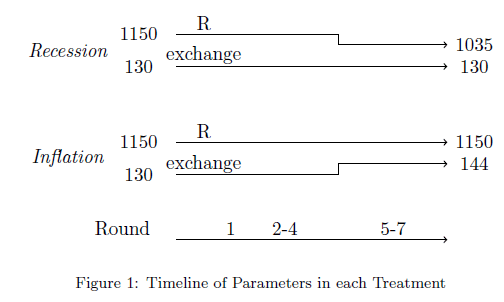
We run an experiment in which employers and workers encounter a recession. The employers could cut wages, or they could keep them rigid as we normally observe during recession. The concept of a “cut” assumes a reference point from which to go down from. We establish that reference point by letting the employer set a wage before the recession and repeating that payment to workers for 3 rounds.
We use a Gift Exchange (GE) Game to model the relationship between employers and workers. Employers offer a wage that is guaranteed to the worker. Employers have to trust that workers will not shirk. We do observe a few subjects shirking, and those people are not very interesting to us. We are interested in the workers who respond with positive reciprocity because that means there is “good morale” in the “workplace”. The employers interviewed by Bewley were afraid that wage cuts would damage the good morale that is necessary for a business to run.
After three rounds, there was a recession. The total surplus available in the GE game shrank by 10%. In the Inflation treatment, the exchange rate of tokens to dollars increased, such that if firms kept nominal wages rigid there would in fact be a 10% real wage cut.
If workers resent nominal wage cuts, then firms should keep wages rigid in a recession. If worker morale falls and workers decrease effort, then firms will be hurt more by the fall in productivity than by a large real wage cost.
In fact, about half of the firms did cut wages. So, we did not observe wage rigidity and we’d like to do follow-up research on that point. It did mean that we had variation and could observe the counterfactual that we were interested in.
Workers don’t like wage cuts. Workers who had been selecting an effort level near the middle of the feasible range dropped their effort significantly if they experienced a wage cut. The real wage cuts under Inflation did not have as sharp of an effect on effort, which suggests some nominal illusion.
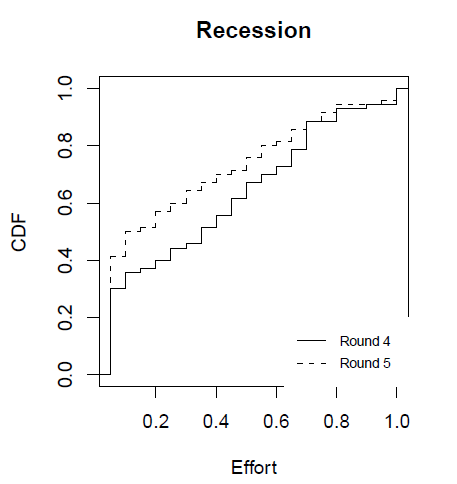
Here’s a cumulative distribution of effort choices among workers (Recession treatment had no inflation). After half of the workers experienced a wage cut, the effort distribution moves toward 0.05, the minimum effort level.
We measured loss aversion at the end. We can’t say that loss averse workers resent wage cuts, because everyone resents wage cuts. There’s maybe some evidence that loss averse employers are less likely to cut wages. Thanks for reading! Please reach out through my Samford email if you’d like to know more.
The relationship between loss aversion and wage rigidity deserves more attention from behavioral economics.
Special thanks to Misha Freer, Cesar Martinelli, and Ryan Oprea for conversations that helped us. Also, we are indebted to everyone that we cited, of course, and to all the people we failed to cite.