La Dolce Vita Economica

I thought about writing about soccer (again). I thought about writing about time management and personal production functions. I considered writing about Lebron James or how I manage multiple research projects. I thought about writing about a classic, and entirely addictive to the point of career ruination, video game. They all seem a little redundant at the moment, though, because they are all the same basic story.

One soccer manager is over-exhausting their resources because of a confluence of bad contractual incentives while another team is witnessing a renaissance in a player they essentially forced to take 7 weeks off. While so many NBA careers of the 80s evaporated in a cloud of cocaine and clubbing, Lebron James’ entire life is built around managing the only two resources whose limits are salient to his life: his body and relationship with his family. Playing baseball growing up I watched pitchers blow out their arms before they finished puberty in service to Little League glory, while modern professional pitchers are (finally) on strictly managed pitch counts to maximize their expected output.

There are two manners in which I armchair quarterback the rest of the world. One is the things in which I have just enough knowledge to be frustrated by others decisions, but no so much as to actually know what I am talking about. These frustrations are ephemeral, they flatter myself to the point of mild embarrassment upon reflection, and, if I am being honest with myself, are fun.

The other manner is resource management. These are the times when armchair quarterbacking is less fun and more exasperating because they are the moments when outsiders, with inferior levels of narrowly-applicable expertise, are often actually right. Which is not to say the knowledge that resources are being poorly managed is uniquely held by outsiders. Insiders are more often than not quite aware of the suboptimal deployment and conservation of resources, but are unable to overcome the status quo institutions, incentives, or inertia of decision-making power loci. It’s obvious to lots of people that athletes, CEOs, doctors, and congressional representatives are over-extended. What’s not obvious is how to get out of these equilibria.

When I see most attempts at self-improvement, I am generally skeptical of anything that doesn’t start with the identification of a key resource that is salient to outcomes and the options available to better manage it. Maybe its calories and how to budget them. Maybe its time and how to better partition and conserve it. It could always be money, but in general I find that money is so immediately identifiable as a finite resource and entirely fungible that people who ostensibly are managing it poorly are, in actuality, failing at managing a different resource (time, emotional energy, vices, etc) that is intertwined with financial resources.

When I see successful firms, teams, and individuals, what I most often find myself admiring is not (just) a worldly talent, but a facility with managing resources that others haven’t yet adopted or mimicked. An appreciation for sleep, a protection of time blocked for creativity, an adeptness trading low opportunity competitive minutes for higher opportunity cost moments on the biggest stages. Or even just the ability to recognize that this is the moment to savor a 600 calorie dessert with a loved one because the emotional sustenance will make it easier to walk away from three vending machine Hostess pies during the high-stress moments in the week to come.

Once you learn to manage your donut-based caloric intake, the spreadsheet of your life will be revealed before you, an endless cascade of resources to be managed and optimized. A life with the right donuts at the right time. The dolce vita economica.

Weigh costs, benefits, and evidence quality

Living means making decisions with imperfect information. But Covid provides many examples of how people and institutions are often still bad at this. A few common errors:

  1. Imperfect evidence = perfect evidence. “Studies show Asprin prevents Covid”. OK, were the studies any good? Did any other studies find otherwise?
  2. Imperfect evidence = “no evidence” or “evidence against”. In early 2020, major institutions like the WHO said “masks don’t work” when they meant “there are no large randomized controlled trials on the effectiveness of masks”
  3. Imperfect evidence = don’t do it until you’re sure Inaction is a choice, and often a bad one. If the costs of action are low and the potential benefits of action high, you might want to do it anyway. Think masks in 2020 when the evidence for them was mediocre, or perhaps Vitamin D now.
  4. Imperfect evidence = do it, we have to do something Even in a pandemic, it is possible to over-react if the costs are high enough and/or the evidence of benefits bad enough (possibly lockdowns, definitely taking up smoking)

Any intro microeconomics class will explain the importance of weighing both costs and benefits. But how do we know what the costs and benefits are? For many everyday purchases they are usually obvious, but in other situations like medical treatments and public policies they aren’t, particularly the benefits. We have to estimate the benefits using evidence of varying quality. This creates more dimensions of tradeoffs- do you choose something with good evidence for its benefits, but high cost? Or something with worse evidence but lower costs? Graphing this properly should take at least 3 dimensions, but to keep things simple lets assume we know what the costs are, and combine benefits and evidence into a single axis called “good evidence of substantial benefit”. This yields a graph like:

Applied to Covid strategies, this yields a graph something like this:

This is not medical advice- I say this not merely as a legal disclaimer, but because my real point is the idea that we should weigh both evidence quality and costs, NOT that my estimates of the evidence quality or costs of particular strategies are better than yours

Judging the strength of the evidence for various strategies is inherently difficult, and might go beyond simply evaluating the strength of published research. But when evaluating empirical studies on Covid, my general outlook on the evidence is:

Of course, details matter, theory matters, the number of studies and how mixed their results are matters, potential fraud and bias matters, and there’s a lot it makes sense to do without seeing an academic study on it.

Dear reader, perhaps this is all obvious to you, and indeed the idea of adjusting your evidence threshold based on the cost of an intervention goes back at least to the beginnings of modern statistics in deciding how to brew Guinness. But common sense isn’t always so common, and this is my attempt to summarize it in a few pictures.

Racial Gaps and Data Gaps

Are there racial gaps in the distribution of the COVID-19 vaccine? This is an important and interesting question in its own right. But I’ll talk about this question today because it’s an interesting example of how confusing and sometimes misleading data can be.

How do we answer this question? One is by surveying people. There are a number of surveys that ask this question, but a recent one by the Kaiser Family Foundation finds that among adults 70% of Blacks and 71% of Whites report being vaccinated. And given the sampling error possible with surveys, we would say that these are virtually identical. No racial gap! (Note: there was a racial gap when they did the same survey back in April, with 66% of Whites and 59% of Blacks vaccinated.)

But, surveys are just a sample, and perhaps people are lying. Maybe we shouldn’t trust surveys! And shouldn’t there be hard data on vaccines? Indeed, the CDC does publish data on vaccinations by race. That data shows a fairly large gap: 42.3% of Whites and only 36.6% of Blacks vaccinated. This is for at least one dose, and the percentages are of the total population (which is why it’s lower than the survey data). So maybe there is a racial gap after all!

But wait, if you look closely at the footnotes (always read the footnotes!), you’ll see something curious: the CDC admits that the race data are only available for 65.8% of the data. We don’t have the race information for over one-third of those in this data. Yikes! And given the exist disparities we know about in terms of income and access to healthcare, we might suspect that the errors are not randomly distributed. In other words, if there is probably good reason to suspect that Blacks are disproportionately reflected in the “unknown” category. But we just don’t know.

So what can we do? Since this data comes from US states, we can look at the individual state data and see if perhaps some of it is better (fewer unknowns). What does that data show us?

Continue reading

Purchasing Drinks with Push-ups.

Early in the summer of 2021, I was having fun. The semester was ended and traveling was on the horizon. Due to changes at my wife’s job I began driving to work instead of making the 20 minute trek by foot. And there was plenty of time to be social. And social I was — several days of the week. And, inevitably, drinks would be served. I was doing a lot less walking and a lot more drinking alcohol (responsibly).

I was footloose and fancy free. Until… The bathroom scale reminded me that I had surpassed the age of 30 years old. Being sedentary and drinking were starting to add up.

Right then and there, I made a decision. I would disincentivize my drinking, but I would also make drinking beneficial rather than detrimental to my waist line.

I made a deal with myself. For each drink that I had, I would have to ‘pay’ 25 push-ups. No exceptions. And, no borrowing from myself. Push-ups *had* to come first. None of this “I owe myself push-ups” nonsense (it’s a trap!). I could *save* for the future, however. Knowing that a social event was approaching, I’d build myself a nice little balance. And the exchange rate was constant: 25 push-ups per drink – always.

Who held me accountable? Me, myself, and I… And some incentive compatible approbation.

I wasn’t shy about any of it. At a outdoor beer garden with my wife and her cousin, I had prepared by banking 50 push-ups. But round 3 was impending… and I’m no square. So, over to the side, quite out of the way on the outdoor patio, I knocked out a quick 25. Round 4 came after still another 25.

Now let’s talk incentives. Requiring push-ups of myself increased my physical activity, so I felt better about my body. Further, if I hadn’t banked push-ups ahead of time, paying prior to each drink limited how many push-ups I could comfortably do. Once push-ups became uncomfortable, I stopped drinking.

That’s all great. But the social incentives were pivotal in keeping me dedicated. Upon seeing the push-ups in action, female friends would talk to my wife who quickly developed a well-crafted dialogue for each new observer, complete with convincingly spontaneous gesticulations and eye-rolls. I can’t say that I didn’t enjoy the attention.

Other men provided direct positive approval. I combined 3 activities that were already ‘manly’ when separate: muscle building, drinking, and dispassionate self control. Men would praise me immediately and similarly feel compelled to do there own sets of push-ups in my presence — as if being sedentary in my presence convicted them as guilty of something. At least one wife sent me a text after we had left town that included a picture of her husband knocking out some of his own pre-drink push-ups (Is this what it feels like to be an influencer??).

Aristotle would be proud.

I was very consistent for months. Being the summer and seeing a lot of friends and family, I did a lot of push-ups. But, as time passed, the exercise habit stuck even as the drinking began to pass by the wayside. What began as an arbitrary, self-imposed rule soon became a legit change in behavior. And then, that change in behavior became a practice. Did that practice improve my temperance and fortitude through habituation? Idk. But wouldn’t that be nice?

Behavioral Economics Conversation: Cutler and Glaeser

I haven’t written a formal response, yet, to the “behavioral economics is dead” claim going around Twitter. I’m too busy doing my referee reports on behavioral papers to write in depth about why behavioral is not dead. Incidentally, I’m not loving the most recent paper I was sent, so maybe that’s a point in the column of Team Death. I’ll write a few posts intersecting with the arguments being had.

First, I’ll point out two places in a CWT discussion of health and cities where the phrase “behavioral” was used. This is obviously a current conversation. David Cutler probably wouldn’t say that behavioral economics is his field, but here’s how he describes puzzles in decision making over health issues. (bold emphasis mine)

Everything that we know in healthcare is that people have difficulty choosing on the basis of price and quality. It goes back a little bit to some of the behavioral issues that we were talking about, but I think it’s slightly different. If you go to the doctor, and the doctor says you should take medication X, and you go to the pharmacy, and the pharmacy says that’ll be $30, a fair number of people will walk away and say, “I don’t have $30.”

What we would hope they would do is go to their doctor and say, “Doctor, is there any way that there could be a cheaper medicine that might work because $30 is hard for me this month?” In practice, people are extremely uncomfortable doing that. They really don’t like to go to their doctor and say, “Doctor, how do I trade off the money here versus the medicine?”

David Cutler

The previous issues Cutler mentioned had to do with time preference and delayed gratification. The turmoil over dieting alone is evidence that people don’t always make the best decisions.

Here’s the second of two appearances of the word “behavioral”, in response to Tyler’s question about how to make cities healthier.

I certainly join the crowd of economists who have argued that congestion pricing is the best way to deal with urban traffic jams. There’s no reason not to charge people for the social cost of their actions on that. And giving away street space for free is just crazy, especially since we now have technologies that can handle this.

And if we introduce autonomous vehicles without congestion pricing, you have just lowered the cost of sitting in traffic, which means the first-order behavioral response is that more people will sit in traffic, and our congestion will get even worse unless we introduce this from the beginning. So I think pricing is really good.

Ed Glaeser

In the second use of the word, it sounds like an individually-rational decision to sit in your autonomous vehicle and read blogs until your arrive at your destination. Maybe we can use mechanism design to reduce traffic congestion and improve life for all.

Whether or not you think behavioral economics is dead, economists are going to keep using the word “behavioral” for a long time.

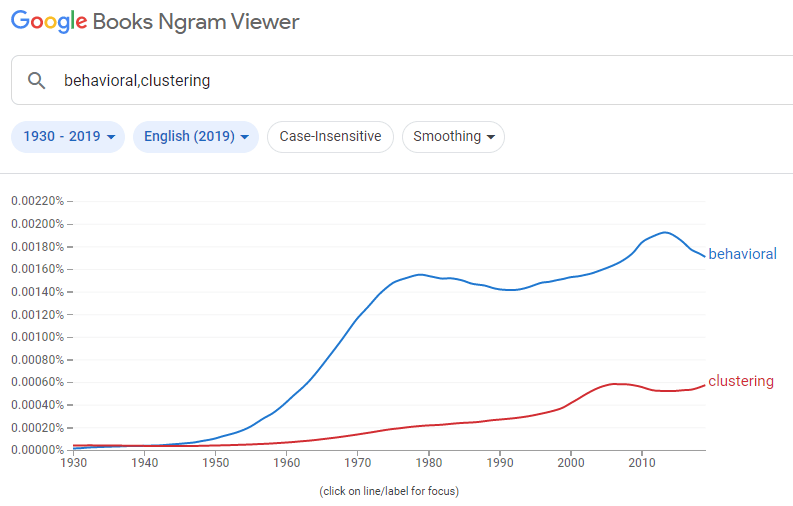
I did a quick Ngram to get a sense of how common the word is, although this does not restrict the search to books about economics. Ngrams are easier to interpret if there is a comparison word. I choose the word “clustering” because it’s also a relatively new technical term. Both words were quite rare before 1930.

If you missed the small discussion about behavioral econ, Mike Munger did a link round-up here. Tomorrow’s post will be Vernon Smith’s view of behavioral economics.

Why do Costa Ricans outlive Americans?

Which country in the Western Hemisphere has the longest life expectancy?

Unsurprisingly its Canada, at 82.2 years (pre-Covid).

But which country in the Americas comes in second?

Surprisingly, its Costa Rica at 80.8 years.

Source

The United States, by far the richest country in the Americas, had a life expectancy of 78.4 years that was falling even before Covid.

How is it that Costa Rica outperforms not only the much richer United States, but also other somewhat richer countries like Panama, Mexico, Argentina, and the Dominican Republic?

Clearly they don’t do it by outspending us- Costa Rica spends the equivalent of $1600 dollars per person per year on health care, compared to nearly $12000 in the US (7.3% of their GDP goes to health care vs 16.8% for the US).

Source

So what exactly is Costa Rica doing right? Atul Gawande tackles this question in his latest article for the New Yorker.

He argues that the key has been Costa Rica’s investment in primary care and public health. The US might may have many more of the world’s best (and most expensive) hospitals, but the easiest and cheapest health benefits come from keeping people out of hospitals in the first place.

the country has made public health—measures to improve the health of the population as a whole—central to the delivery of medical care. Even in countries with robust universal health care, public health is usually an add-on; the vast majority of spending goes to treat the ailments of individuals. In Costa Rica, though, public health has been a priority for decades.

In the nineteen-seventies, Costa Rica identified maternal and child mortality as its biggest source of lost years of life. The public-health units directed pregnant women to prenatal care and delivery in hospitals, where officials made sure that personnel were prepared to prevent and manage the most frequent dangers, such as maternal hemorrhage, newborn respiratory failure, and sepsis. Nutrition programs helped reduce food shortages and underweight births; sanitation and vaccination campaigns reduced infectious diseases, from cholera to diphtheria; and a network of primary-care clinics delivered better treatment for children who did fall sick. Clinics also provided better access to contraception; by 1990, the average family size had dropped to just over three children.

The strategy demonstrated rapid and dramatic results. In 1970, seven per cent of children died before their first birthday. By 1980, only two per cent did. In the course of the decade, maternal deaths fell by eighty per cent. The nation’s over-all life expectancy became the longest in Latin America, and kept growing. By 1985, Costa Rica’s life expectancy matched that of the United States.

Gawande goes on to describe how every Costa Rican gets a home visit from a health care worker at least once per year. This is quite the contrast to the US, where even getting primary care doctors to let you see them in their office can be a fight. I moved to Rhode Island last year and this week finally tried getting a primary care doctor here. I looked through the list of doctors covered by my insurance that my insurer said were accepting new patients and started making calls (by the way, why calls? do any doctors book appointments online?). 2 said that they actually weren’t taking new patients. 9 never answered the phone. The 12th doctor I tried, one farther away and lower-rated than I’d like, finally agreed to see me- in 3 months.

For anyone with less free time, determination, or insurance coverage, it would be natural to just give up after the 5th or the 10th “no”. Clearly many Americans do, leading manageable conditions like diabetes or high blood pressure to turn into acute health crises and expensive hospital visits.

I do think individual doctors could do better here by thinking through their appointment process from the patient’s perspective. But at its core this is simply a numbers issue- we don’t have enough primary care doctors to go around. We actually have fewer doctors per capita than Costa Rica, and relatively high share of specialists means that we have even fewer primary care doctors to go around. More medical school spots, more primary care residency spots, and fewer restrictions on immigrant doctors could go a long way way toward helping to US catch up to…. Costa Rica.

That, or their secret is just the volcanoes. This is surprisingly plausible- the US state with the longest life expectancy is also the one best known for volcanoes, Hawaii.

GDP Losses and COVID Deaths (6 month update)

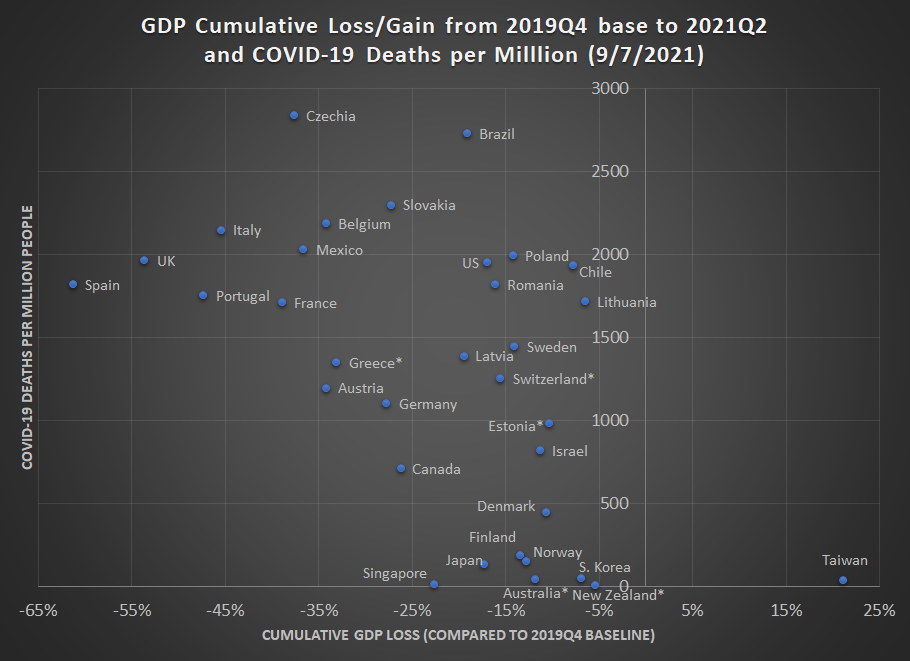
Back in March of this year, I wrote blog posts providing data on GDP losses and COVID-19 deaths for 2020, both for selected countries and US states. Since we’ve now had another 6 months of GDP data and the pandemic continues to take lives, I thought it would be useful to update that data.

I will update the data for US states in a future post, but here is the most recent data for about 3 dozen countries (mostly European and North American countries, since they have the most believe COVID data).

*indicates that the GDP data is only through the first quarter of 2021
Continue reading

Institutions Getting Smarter on Covid

Two weeks ago I argued for 4 non-coercive anti-Covid policies I thought were under-rated. I haven’t generally been impressed by the institutional response to the pandemic, and so I wasn’t expecting the policies I mentioned to get traction any time soon. But some did!

I argued for:

  1. Full vaccine approval
  2. Emergency vaccine approval for children
  3. Ventilation
  4. Outpatient treatments that work

Since then, the big news is that the FDA fully approved the Pfizer vaccine. This seems to have increased the pace of new vaccinations.

I really wasn’t expecting the FDA to move that fast- they have generally learned to be slow because Congress has been much more likely to complain about them approving a bad drug than about them denying or slow-walking a good drug. But Congress itself seems to be changing in response to Covid, with 108 House members pushing the FDA for a timeline on approving vaccines for 5 to 11 year-olds.

I don’t know of a good way to gauge progress on ventilation overall, but I was pleased to see HEPA filters show up in the classrooms at Providence College:

Likewise, I don’t know if Fluvoxamine prescriptions are up in the weeks since a good sized study showed it reduced Covid hospitalizations 31%, but the popular press articles about it keep coming (don’t be deterred by “Vox”, the linked article is by Kelsey Piper and its excellent).

So some institutions seem to be getting smarter, and perhaps coincidentally, we seem to be at the peak of the Delta wave. According to Covidestim.org, Rt is now below 1 in 31 states, and falling in 45 states, including all of the Southern states hit hardest by Delta. Barring a new twist (another worse variant? Winter Delta wave in the North?), things just get better from here.

Suggestions for Comfortable and Effective Face Masks, e.g., Korean KF94’s

With Covid cases and deaths surging despite widespread vaccinations, face masks are back in. Back in the dark days of early-mid 2020, all commercial masks of any kind were allocated to medics/first responders. Back then, the only mask option for the rest of us was to cobble together something made of regular cloth. But studies I looked at show that the protective performance of those cloth masks, and even standard rectangular surgical masks, is really quite poor [1].

A cloth or surgical mask is definitely better than nothing, but is much inferior to other mask options which are now widely available. If you are going to bother with a mask at all, why not use a more effective one? A well-known effective mask is the KN-95. It has a kind of aggressive beak-like profile, as shown below, and typically uses elastic earloops. It gives good protection because it seals to the face (including around the nose, thanks to a malleable metal strip there) and is made of appropriate multi-layer filter materials. It is the standard protective respiratory mask in China, whereas in the U.S. the standard protective mask is an N95, with elastic straps that go around the whole head, not the ears.

Image Source: Amazon

I got a box of ten KF95’s back in June of 2020. I loved them – they were comfortable, worked OK with my glasses, and clearly sealed well to my face. However, I gave some of these away to family members, lost a few, and used the rest so many times so they started to lose their shapes.

There are lots of KN95’s for sale on Amazon, all made in China. Not all of these may be of the same quality. Some but not all of these brands were tested and approved by the FDA for emergency use; this article from March 2021 notes some of these brands that were for sale on Amazon at that time. It seems the approved Powecom masks are still for sale.

A problem with most of these Amazon KN95’s is that the earloops are painfully tight around the ears. I pored over the comments to try to select masks where at least some of the reviewers claimed the masks didn’t hurt. Alas, all my KF95’s are pretty much unbearable for a guy like me with maybe an oversized head. (I compared the length of their earloops with my original comfortable KF95, and indeed the earloops are clearly shorter on all the new ones).

In the course of reading dozens of reviews of KN95 masks, I saw several comments recommending KF94 masks instead. These are made in South Korea. They are standard personal protective equipment in that country, and as such must meet certain standards for fine particle capture. They look a little different than most masks, but seem less beak-like than the KN95s. They have a flattish rectangular middle part which is the main filter, with two triangular sections that cover the nose and the chin:

Image: Amazon

So I got a box of KF94’s, large size, and they are wonderfully comfortable for me. No stress on the ears, and sealing over the whole face. The shape of the mask keeps it from rubbing on your mouth. The “Large” size I got was actually a tiny bit looser than felt optimal, so I tied tiny knots in the lower part of the earloops to shorten them a bit. My wife uses a mask extender strap (e.g., HX AURIZE Mask Extender Strap on Amazon) around the back of her head to pull the KF94 earloops a little tighter, with the added benefit that if she wants to take the mask off temporarily, it can hang around her neck via the extender strap. In sum, the KF94s are a win, and I highly recommend them.

I see on Amazon that small (for e.g. 7-12 year old children) and medium KF94 masks are also available. One caveat on buying is to make sure that you are buying from an actual Korean seller, else you risk getting an inferior Chinese knockoff.

Back to my unusable KN95’s. I know that you can use mask extender straps like the HX Aurize straps linked above, or similar homemade hacks, to go behind your head and take some of the direct pressure off the back of the ears. However, I found using a behind-the-head strap still put pressure on part of my ears, and was just an added complication. I thought, surely there must be some way to make those darned earloops simply longer. What I did for one mask was to cut the earloops close to the bottom of the mask, and tie in a small rubber band into each loop, to make them effectively longer. (I put a dab of glue on the cut ends of the earloops, to keep them from unravelling). That worked out well, so I can recommend this as a “hack”. I also see on Amazon that you can order ¼” wide white elastic ear loop type band material, and I think I will buy some. I can then take more of my tight KN95 masks, cut the existing earloops, and tie in an extra inch or two of this elastic to get the length right for my head size.

ENDNOTE

[1] Some studies on masks:

(A) https://pubmed.ncbi.nlm.nih.gov/32845196/  Kim, et al. 2020. They had seven Covid-inflected patients cough five times with various masks on, and with petri dish sitting in front of them to catch germs. A surgical mask did no better than no mask at all (3 out of 7 patients’ petri dishes got infected in both cases), whereas zero out of 7 patients’ petri dishes got infected for a full N95 respirator made by 3M (not a Chinese KN95) or for a Korean-made KF94 mask.

(B) https://www.acpjournals.org/doi/10.7326/M20-6817   Bundgaard, et al., 2020. Done in Denmark around April-June 2020. From 6000 participants, all of whom initially tested Covid-negative, half were randomly selected to wear standard surgical-type masks while in public and half to not wear masks. (These are the usual rectangular masks that do not seal tightly to the face). Incidence of Covid infection after about a month was assessed for each group. For mask-wearers, the infection rate was about 1.8% versus 2.1% for the non-masked group. According to the standard statistical definitions, this was not enough to show that wearing that type of mask gave significant protection against becoming infected. That said, the difference between the 1.8% and the 2.1% is compatible with a 46% reduction to a 23% increase in infection on 95% confidence intervals. Depending on how you want to slice the numbers, it seems fair to say that there may have been “some” effect of the masks here. Also, it should be noted that this study did not test whether wearing a surgical mask would help keep an infected person from spreading the disease (I suspect the answer to that would be “yes, sort of”).

(C) https://pubmed.ncbi.nlm.nih.gov/33087517/ Ueki, et al., 2020. They used two full size human mannequin heads, and tied masks on their faces. The “Spreader” head was piped to have a stream of covid-aerosol-laden air coming out of its mouth. The “Receiver” head had a pipe that pulled air in through its mouth and through a gelatin membrane filter to collect the covid viruses that made it through the masks. Some of the results are shown below. I am not sure how to summarize them accurately in a few words. Note that these plots are on log scales, so small visual differences in the bars are actually big (see the numbers at the bottom of the bars). It seems clear that the cloth (cotton) and the surgical masks blocked some virus spreading compared to no masks, but a full N95 mask was much more effective (the N95 was tested with its edges naturally resting on the contours of the mannequin face, and also “fit” with the edges sealed against the face with adhesive tape). A KN95 or KF94 mask was not tested here.

POSTSCRIPT

After publishing this POST, I noted Jeremy Horpedahl’s post from last week, suggesting that the costs of wearing masks may be worth it even if they give a 10-15% decrease in viral incidence. Jeremy referenced an article by Bryan Caplan who questions the trade-offs with wearing masks having only marginal effectiveness vs. the discomfort and the dehumanization of having people’s faces obscured. Caplan in turn referenced a survey of research by Jeffrey Anderson (August, 2020) which summarized many real-life randomized controlled trials with populations wearing/not-wearing masks (presumably the surgical kind, not N95/KN95/KF94 better-sealing types) which found generally no benefit to wearing these types of  masks in reducing the incidence of virus transmission. (These studies were mainly pre-Covid, dealing with SARS and other viruses). This overall result is roughly consistent with the Danish study mentioned above, which did not find a significant difference for using those types of masks to protect from viral infections.

Would You Pay $3,000 to Not Wear a Mask?

How well do masks work at preventing disease transmission? This is a question that many of us have been asking throughout the pandemic. I have been trying to read as much about mask effectiveness as I can (for example, here’s a Tweet of mine from way back in June 2020). I think the bottom line is that, if you want really good RCTs of mask use during the COVID pandemic, there is surprisingly little evidence in any direction. But there are lots of studies, less well done but still OK, suggesting that masks do provide some protection.

I don’t want to wade into all of that research here, because Bryan Caplan has been doing that lately himself. His reading of the literature is that masks aren’t a silver bullet, but he suspects “that masks reduce contagion by 10-15%.” Still he thinks that the costs of masks (inconvenience, discomfort, and dehumanization) are large enough that they don’t pass a cost-benefit test. But this seems like a very strange conclusion given that he suspects masks reduce contagion by 10-15%! So let’s be explicit about the cost-benefit analysis.

[I am assuming that reducing contagion by 10-15% means 10-15% fewer cases and deaths. I see this as a bare minimum, since contagious disease can follow exponential growth trends, so 10-15% less contagion could mean that cases/deaths are reduced by more than 10-15%, but I’m making a simplifying assumption and the hard case.]

Quantifying the costs of the pandemic deaths is tricky, and it’s something that Bryan and I have debated before. Perhaps this is just a rehash of that debate (Bryan is highly skeptical of the VSL estimates), but I think it’s worthwhile to plug in some numbers.

What numbers should we use?

Continue reading