Oil money has flooded into soccer/football,golf, and a host of sporting events. The prevailing term is “sportswashing” i.e. the attempt to reinvent the public image of the Saudi Royal Family, United Arab Emirates, Qatar, and anything petro-state adjacent. Partners in these endeavors can be found regularly providing sound bites praising parties whose records in human rights are less than sterling.
I just want to point out one thing: when your extended family’s net worth is $1.4 trillion (with a `T’, not a typo), your public image remains important, but nonetheless a potentially second order concern. What is a first-order concern is maintaining that wealth for the generations to come. When it comes to the oil-based wealth, the sun is setting. Not in terms of calendar months (not yet), but certainly in terms of generations. Oil, as the fulcrum of geopolitical history, is in it’s final period. Which is simply a long-winded way of saying that if a petro-state magnate cares profoundly about the global standing of their grandchildrens’ grandchildren, they’re looking for ways to move away from oil.
Oil is one of those special commodities that is of interest to economists because it enjoys high demand, has few substitutes, and it’s supply is relatively inelastic. You can’t merely will oil into existence. So if your family happened to enjoy high status and power over a previously low-value plot of land that an ocean of oil randomly happened to exist beneath, you could parlay that into tremendous wealth and power in the world. And they did.
With solar power setting the sun on oil (I am so sorry), you can’t blame oil magnates for looking for the next thing to tie their wealth to. What’s interesting is that the lesson they appear to have learned is the importance of hard-to-reproduce commodities. They fell into the first, now they are actively looking for the second.
You know what’s hard to reproduce? Status. Prestige. History. Identity networks. You know what characterizes those exact things? Sports teams and luxury brands. I fully expect oil money to keep pouring into soccer teams and handbags. Watches and sports cars. The kind of products that are grown and historically selected for across multiple generations, in processes that often take more than a century. Production processes that are less engineering than social geology.
Petro states and families have been tied to oil for 100 years, but now they want out. And we should let them, encourage them even. The fewer forces there are in the world working to continue fossil fuel dependence, the better. The more they tie themselves to products where labor holds more leverage than capital i.e. sports, the better. If you’re waiting for fossil fuel money, or human rights abusers, to get their come-uppance, prepare yourself for disappointment. But if you’re excited to the see a better world with cleaner air and a better climate future, then don’t be surprised if it’s first harbinger isn’t solar farms in Texas, but princes in stadium press boxes sponsored by Rolex.
I really don’t like the time and effort wasted in cleaning crudded-up frying pans, so I appreciate non-stick coatings. I have a small diameter Gotham ceramic pan that works well, and I was thinking of getting a larger one for cooking bigger loads. As usual, I went to the internet for wisdom on preferred ceramic pans to buy.
However, in the course of trying to get a fix on how they work, I fell down a rabbit hole. It turns out that this subject is complex and controversial. I will try to summarize my understanding in a brief post, with the caveat that I am not sure of everything here.
First of all, the “ceramic” coating is not really ceramic. Typical ceramics are made from firing powders of inorganic materials like silicon/aluminum oxides (including clays) at extremely high temperatures to where the particles fuse together. For the ceramic coatings on pans, this is not the case. I looked pretty hard on line without success to pin down the actual process or composition of the pan coating. It seems to involve some sort of silicone or silica polymer, applied using a sol-gel process. (Silica is just silicon and oxygen – quartz and white sand are pure silica – while silicone is typically a Si-O-Si-O-Si polymer with two extra hydrocarbon side groups attached to each Si).
100% silicone, in the form of rubbery sheets or cupcake papers for cooking on or in, is known to give a non-stick cooking surface. The “ceramic” coating in pans appears to be a solid equivalent of silicone cookware. A key factor mentioned in why it is slick and why it loses its slickness is that (supposedly) a thin layer of silica or silicone comes off with each cooking episode, and that thin layer is what gives the non-stick effect. (I would not mind ingesting a little adventitious silica, but eating random silicone worries me a little – but I don’t know if all this is actually true).
See this link for further discussion of the safety of ceramic versus teflon coatings. Be aware that makers of teflon coatings often choose names for their coatings that include the words “stone” or “granite”, perhaps to make the unwary consumer believe that these are ceramic coatings. My teflon pans have usually started to flake (into my food!) after a couple years’ use. A happy exception is a newer electric skillet which has temperature control so it never gets above about 425 F (high temperature destroys teflon). We do keep it oiled in use. Its teflon coating is still good as new after two years.
There seems to be general agreement that ceramic pans start off super slick, that fried eggs slide right out, but that after some months of use, food starts sticking noticeably. It helps to use a little oil every time you cook, and to avoid using metal utensils or abrasive cleaning pads, and to avoid very high temperatures or the use of cooking sprays (which deposit something harmful to the ceramic coating) or olive oil (which can burn on). Some users say it is important to clean the pan well between uses, e.g., using salt as a mild abrasive.
Why Do Ceramic Pans Lose Their Non-Stickiness?
There seem to be two main schools of thought as to the deterioration of performance. One school points to the (alleged) continual loss of silica particles or (presumably oily) silicone from the surface; perhaps once this surface layer is depleted, it’s game over. Another camp points to the buildup of burned-on deposits, even very thin, nearly invisible deposits, that then become a locus of food sticking.
What Can Be Done to Restore a Ceramic Pan Coating?
It is common to read that you just have to be prepared throw the pan away every 1-2 years. However, this does not seem economical. Can these pans be salvaged? One author claims that slickness can be restored by “seasoning” a ceramic pan, similar to how cast-iron pans are treated: after cleaning the pan, rub a very thin layer of a recommended oil (e.g. soybean oil, not olive oil) on the pan and then heat it to the smoke point. This should bond a polymerized oil layer to the surface. I have not tried this, but it might be worth a try.
A diametrically opposite approach is recommended by the maker of GreenPan ceramic pans. Here the theory is that if an offending film of cooked-on crud is removed, the native, clean ceramic layer beneath will once again be non-stick. A wet Magic Eraser type cleaning pad is recommended.
A similar remedy touted on the internet (e.g. here and here) is to rub with coarse salt (for long time, but not too hard) to get down to a pristine ceramic surface. Good results are claimed.
As a (retired) experimental scientist, I was itching to try something like this. At a family member’s house, I found an older ceramic pan that was not in really bad shape, but had lost its primal non-stick.
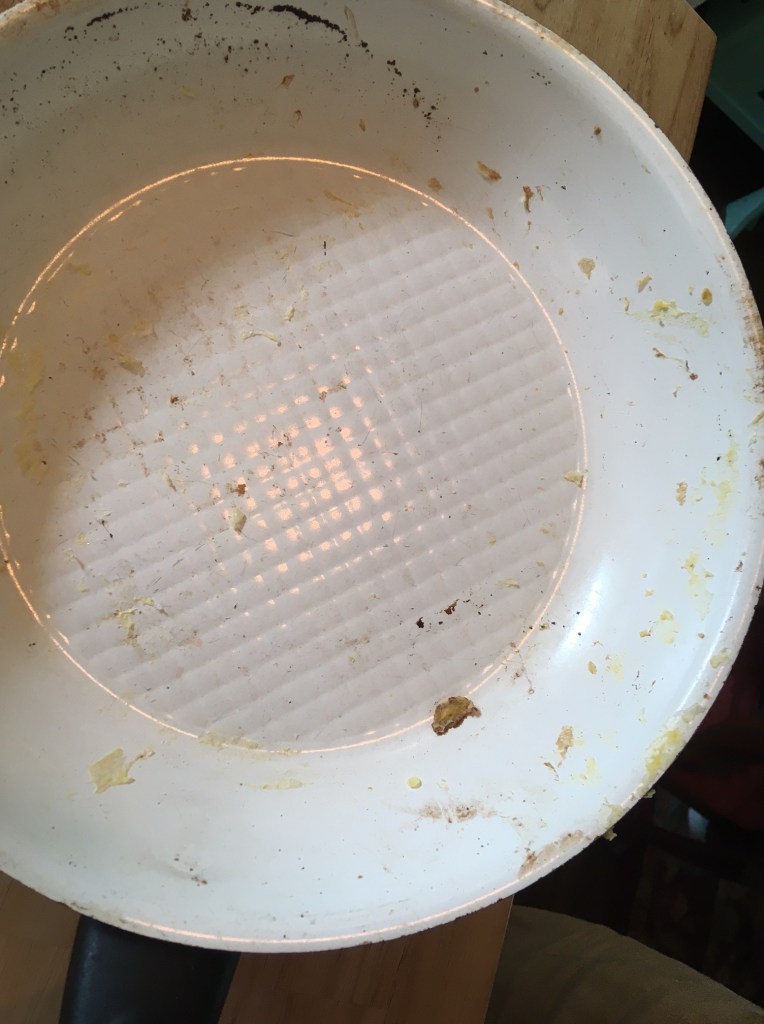
The BEFORE picture is above. There was a persistent brown film in parts of the pan, and cooked omelets (my test vehicle) did not simply slide out. I cleaned the pan with soap and water and a sponge, then went at it with a wetted Magic Eraser. I got the brown film off, though you could still see some pitting in the coating due to the use of metal utensils.
The AFTER picture is below. This is after cooking yet another omelet (with oil), and just wiping the pan with paper towel afterward. I can’t say that it was a night and day difference, but the Magic Eraser treatment definitely seemed to improve the performance. Score one for sustainability.
APPENDIX: Finally Understanding What Make Ceramic Pan Coatings Non-Stick
As noted in the original article above, I was puzzled over how the ceramic coatings worked. The descriptions in articles I could find on-line talked of forming these coatings from sol-gel solutions, using ingredients such as tetraethoxysilane. Without going into details, my chemical intuition led me to believe that, yes, you could form a dense silica pan coating from that, but the final outer surface would have Si-OH groups, like quartz or glass or ordinary “enamel” ceramic pan coatings. This would not give the oily, silicone-like surface that is evident with the nonstick ceramic pan coatings.
My “Aha” moment came when examining a patent application ( United States Patent Application No. 20180170815) for making a GreenPan ceramic pan coating. Among the ingredients for making the coating is methyltrimethoxysilane (MTMS). And THAT should give Si-CH3 groups on the outer surface, which is exactly the type of oil-like outer surface that silicone has. (The -CH3 methyl group is a fairly nonpolar, “oily” hydrocarbon type group).
A restless itch has now been scratched. I think I now understand why fresh ceramic pan coating can have such fine non-stick properties, and perhaps why they might be vulnerable to losing their non-stick properties. With Teflon type pan coatings, it is plasticky, oily Teflon all the way down, so if you abrade off a hundred molecular layers, it should make no difference. But with the ceramic coatings, it is not clear to me whether the oily Si-CH3 groups are only in the topmost atomic layer; maybe if that gets abraded off, there is only the quartz-like Si-OH groups to be found; or maybe there is a substantial (in atomic terms) topmost layer rich in Si-CH3 groups. Anyway, it makes sense to keep using oil when cooking on ceramic pans, to keep a hydrocarbon-type surface coating going there, and to avoid using metal utensils that can scrape and scratch the coating.
Sep 2026 Update:
For readers here, I figured I should harness the power of AI, so I asked Claude about restoring ceramic pan coatings. Some takeaways, which basically agree with the above:
For cleaning deposits off the pan, as an alternative or supplement to Magic Eraser, try : Simmer a mix of water + a few tablespoons of baking soda in the pan for 8–10 minutes, then let cool and wipe out. For stubborn buildup, a paste of baking soda + a little water…left on for 15–20 minutes, then scrubbed gently with a soft sponge (never steel wool or abrasive scrubbers — that’s what actually damages ceramic).
After cleaning, re-season lightly: wipe a thin layer of a high-smoke-point oil (avocado, grapeseed) over the warm, dry pan and heat it for a few minutes, then wipe off the excess. This won’t rebuild the ceramic, but it restores some slickness by filling in micro-pores.
Prevention going forward: avoid metal utensils, avoid high heat above medium (ceramic coatings degrade faster than PTFE at high temps), hand-wash rather than dishwasher, and avoid cooking sprays with lecithin (like Pam), which leave a residue that’s notoriously hard to remove and accelerates the buildup that looks like “degradation.”
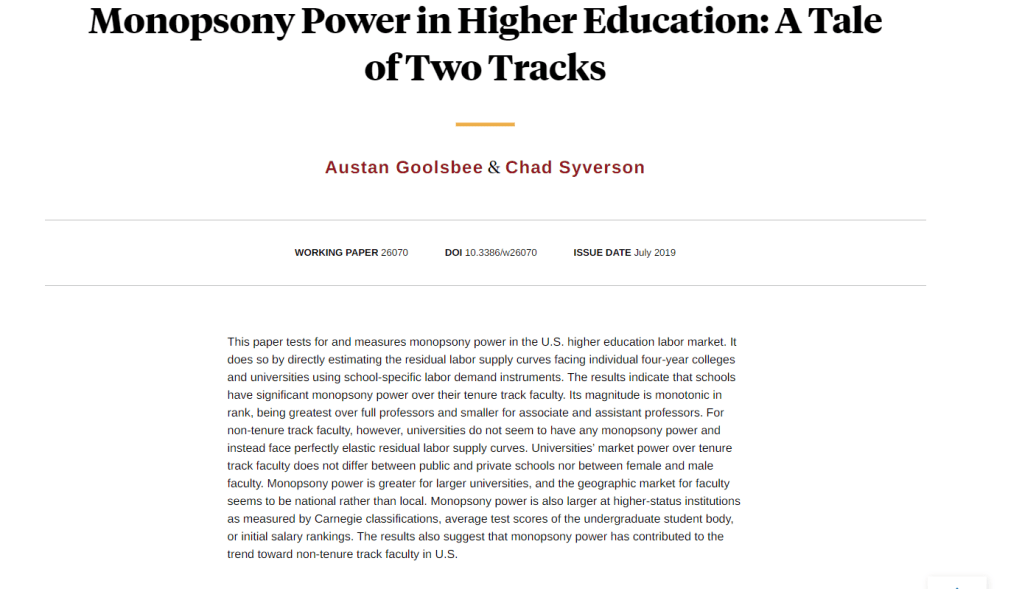
Let’s take the findings at face value, and say that all faculty at the various stages of tenured and tenure-track academic appointments work within a monopsonistic market. Let’s also accept that it is reducing not just wages, but total compensation inclusive of all benefits and compensating wage differentials. What’s the solution?
I mean, so much of the monopsony literature circles back to the policies and industrial institutions that researchers, wonks, and advocates think will improve worker welfare. Well, if *we*, the researchers in question are so confident in our findings, our models, and our policy recommendations, what have we done to improve our own market? Have we done anything? Can we do anything?
I heard someone in the back yell “We unionized!” Okay, that’s great. I just I could say “More unions” and end the post, but I’m not confident that this is a problem that unionization, absent additional innovation, is going to solve. Don’t worry, I have an idea.
Release sheets. I’ll explain.
At the moment, the majority of academics opearate under administrative regimes that think the best way to keep faculty costs down is leverage employee exit costs to the absolute hilt. That means, more than anything else, that the only way to get a non-trivial raise is to have a formal letter offering you a job at another university, with a start date, salary, and benefits all enumerated. Only then will the department/college/university consider offering you a “retention” raise. The administration’s hope is the the cost of pursuing an outside offer combined with the cost of moving to a new area (“local” outside options are almost non-existent in academia) will deter you from pursuing them, reducing the probability of receiving one.
The problem with this tactic is that it discourages faculty from contributing, participating, and investing in all of the public goods that make a department and university successful. Every investment ties the researcher to the school and community, raising their exit costs and, in turn, lowering their expected probability of pursuing and receiving an outside offer. Contributing to public goods reduces expected future wages. “Retention raises only” insititutions undermine the mission of their own faculty by incentivizing their faculty to be as independent, aloof, and myopically selfish as possible.
Now, the obvious solution here for universities is to simply preempt the market by raising salaries to better match their market value, but that would require both having a clear and unified vision of what their product and mission are (good luck) and not giving in to the overwhelming temptation to capture rents on labor wherever they can (fat chance). If there is one unifying attribute of bad managers everywhere, its conflating rent maximizing with profit maximizing. Yes, I know there is definitional overlap, but we’ve all known a manager that confuse percentage returns for absolutes, acting as if paying $3 for $5 of marginal labor product is better than paying $8 for $11.
If you want faculty to contribute to public goods, you’re going to have to give them something as compensation for their higher exit costs. I suggest exchanging reduced asymmetric information for enduring higher exit costs. How? The two-part release sheet.
The idea is actually pretty straight forward. Part one: every employee contract includes a release sheet that includes a retention ceiling that the university promises it will not make a retaining offer in excess of. If you have a retention ceiling at $200k a year, then another school can come and offer that with absolute confidence that they will have a real shot at landing the employee. This encourages rival schools to make the investment in scouting and recruitment. It lowers the cost of making offers that will raise someones income. More offers, more raises, less rents.
Part two: the merit raise ladder. Between the employee’s current salary and their retention ceiling is a schedule of merit raises. At each step of the ladder, the department evaluates the employee’s revealed productivity since their last evaluation and decides whether to give a raise. The tartgeted amount of the raise is pre-determined. If the employee receives an amount less than the pre-determined full target raise amount, the difference is subtracted from their retention ceiling. Let’s go through an example:
Contract A: $150k/ year. 6 year contract. $10k raises at years 2 and 4. Retention ceiling: $225k/year.
That means that after year 2, the department can give a raise. If they raise their salary by $7k a year (total 157k), then their retention ceiling is lowered (7-10 = -3) to $222k. After 6 years the two parties have the option to renegotiate the whole package. If both parties can’t agree, then they simply project the old schedule forward, $10k every two years, differences lowering the retention ceiling. If salaries are frozen it’s entirely possible for the retention ceiling to drop below their actual salary.
I see a lot of benefits here, and not just for faculty. Everyone benefits from reduced assymetric information. A high retention ceiling doesn’t actually bind anyone’s hands – a rival university can still show up with any offer they like, the current employer simply retains the right to make an equal or higher retaining offer. Failure to keep up with employee market value, however, will quickly result in the vultures circling your best employees. At the same time, employees have greater incentive to continue contributing in every possible way to the department, and not just those that are visible on the outside. Departments will know that they have to keep salaries commensurate with total productivity or they will forfeit their right to make competitive retention offers.
We already have a central hub in academic economics: the AEA-JOE. We post job openings and vitaes on the JOE, we coordinate letters of references. Posting our retention ceilings alongside our vitaes would be a nearly costless addition.
Would their be other consequences? Almost without question. This is a blog post not a theory paper. But if we’re going to complain about monopsonistic markets, we should probably consider taking steps to fix our own.
“At the moment, the T-bill market is in a state of dislocation, one in which yields ranged from as little as 2.614% on government obligations maturing on May 30 to as high as 6.881% on the bill that matures two days later on June 1, according to Bloomberg’s data.”
What that tells me is that market thought there was non-trivial risk of debt going unpaid. That also tells me that the market views current US politics as having introduced real risk of default, regardless of whether some fraction of the players intend it as theater or not. That a deal was reached is almost (almost) besides the point.
Yes, media observers often engage is a certain amount of performative credulity to heighten dramatic interest in the story du jour. But I take a Schelling-esque stance on debt default, which is to say that not unlike pre-emptive nuclear strikes, it is something where the mere discussion of it increases the probability of occurrence. Each time our elected officials indulge in this melodrama, the underlying probability of default goes up, as will the cost of serving US debt, making each and every American a little poorer. Add in the current status of the dollar as the global reserve currency, and we’ve got ourselves perhaps the greatest example of concentrated benefits and diffused costs I’ve ever come across. A reduction in global wealth touching upon very nearly every human on earth all for the benefit of a few marginal votes for a couple dozen Congressional representatives.
Maybe I’m being melodramatic now. But honestly, I don’t think so.
The Writers Guild of America is on strike because everyone in Hollywood is unhappy. Nobody is making enough money or getting hired for long enough stretches. Complaints appear fairly universal as well, from showrunners and producers all the way down to the newest hire. In fact the only thing that doesn’t appear to be running a shortage is blame.
I know the complexity of trying to collectively bargain such an enormous industry means that any deal struck, even if it starts out relatively efficient, will be a bad deal for someone within 3-5 years. That’s just the nature of things when you’re trying to forecast both technology and the shape of multiple labor markets. It’s an impossible task. That said, I think we can boil down a lot of what has gone to hell to a single problem. Streaming is currently the dominant platform and streaming studios don’t pay points i.e. profit share on the back end.
Of course streaming services aren’t the totality of the television and movie business, but they are sufficiently dominant that the lack of points, and the problems downstream of it, have fundamentally altered both the labor market and the incentives facing the people creating entertainment. Writers, directors, producers, and even some of the bigger actors have routinely accepted a percentage share (i.e. percentage points, get it?) of the profits of an enterprise as a portion of their compensation. Blumhouse films famously got bigger name actors to join their small genre projects for scale (i.e. guild actor minimum wage) by contracting them for a sizable profit share. It’s a great way of mitigating risk for small studios while also attracting actors with the possibility of a big pay day.
Profit sharing is about far more than just mitigating risk, though. They are about aligning incentives. Everyone cares that much more about the quality of the product when their eventual payout is directly connected to success. Aligning incentives is both exceptionally important and difficult in contexts where quality is difficult to assess and forecast at intermediate stages of production. The only thing you need to know about Hollywood is a cliche that I choose to attribute to legendary screenwriter William Goldman who always asserted, with regards to the entertainment business, “Nobody knows anything.”“
“Nobody knows anything” means that 1) forecasting success or failure of a project is difficult, but just as importantly, that all of the really important information is tacit. There’s somone who knows what the best bit of dialogue is, the perfect costume, who to cast as the best friend and the villain, how to frame the shot, how to light the third scene, how to make the write kind of fake snow, what kind of bagels to get, etc. Someone knows, but that someone probably couldn’t explain why they know what they know, couldn’t pass that information on, couldn’t identify the underlying factors in audience and historical film data. They just know. And if you want them to take the optimal action, and make the necessary committments and sacrifices to make the film the best it can be, they need to have incentives in place to ensure that they are rewarded for infusing their tacit knowledge within the final product.
Those incentives are currently broken in the film and television business.
As best I can tell, what broke them was that a) streaming is a lot less profitable than Netflix, Disney, et al. hoped, and b) out of a desire to keep internal data private, compensation contracts could no longer include an “outcome” based component i.e. profit sharing.
Streaming services make money from subscriptions. How an individual production contributes to those subscriptions has a relationship to data associated with that production, but streaming companies have thus far been unwilling to release data associated with individual productions. Yes, Netflix started releasing a little bit of data, but nothing compared to previous entertainment paradigms. Ticket sales, nielson ratings, and advertising always allowed for intuitive mechanisms for profit sharing via points and residual checks. In order to keep their data private, firms have opted instead to move to simple compensation structures, including before-after compensation where a writer, producer, or director is paid when a project is started and when it is deemed completed.
Receiving roughly half of your pay when a an amorphous product, like a film script, is “done” is a really terrible idea for the simple reason that the writer has far less incentive to make the script “good” and far more incentive to make it acceptable to person who must stamp it “done” so they can get paid. How do you get that stamp? By doing whatever they tell you to do. The problem is, they don’t know what the script needs to be good, that’s why they aren’t a writer. They don’t have the tacit knowledge. The writer has it, but fighting to infuse that knowledge in the script does nothing to improve their pay, in fact, it only delays it.
These breakdowns in incentives are all over Hollywood and you can feel it in the films and shows coming out. Scripts feel half-assed, as if written by disconnected employees scattered to the winds of Zoom and a California housing crisis. Performers seem unsure of what to do within a menagerie of green screen and tennis balls on sticks. Audio is famously terrible in movies now.
So how do they fix it? Well, I’m not even sure who “they” are one answer might be found in the Blumhouses, A24s, and every troupe of actors and filmmakers who keep working together. Shrink the number of people involved to the point where you solve incentives not with perfect contracts but with longer term relationships. Repeated interactions have always been a great way of aligning incentives. When credit can more naturally flow to smaller number of people, when working together over and over is the best way to create job security, all of the other problems become easier to solve.
What about the revenue problem though? Well, maybe ticket sales never recover, and streaming never prints money the way advertising did, but modern technology also means you can make a show or film with a smaller number of people than ever before, which means every single one of those people could feasibly participate in profits. Maybe the answer is to simply recreate the old model externally to the big studios, at the earliest stages of coordination, recruiting and writing, before distribution or marketing even enter the equation. Smaller teams, direct participation in profits. Smaller movies and shows. Smaller can be better, just ask anyone who’s ever tasted a beer in the last 20 years.
Maybe the WGA (and the directors and actors guilds too, for that matter), should be thinking a little bit less about what they can negotatiate from the studios, and more more about how much it can cut them out of pre-distribution entirely. Vertically integrating the film and television business is not the only possible state of the world. In fact, given the current state of technology and the broader labor market, it’s entirely feasible that one of the main reasons that industry has collapsed into such a small number of firms is that guild contracts grant cost advantages to being enormous, even in the case where much of the companies in question have next to zero knowledge about the creative side of their industry. There may very well come a time where a million micro-studios, teams of writers, actors, directors, and production staff simply work to make their products and then sell ex-post to the highest of the content-starved bidders. There was a time with the Shane Blacks of the world got to enjoy the benefits of bidding wars for their scripts. Maybe the WGA,DGA, and SAG can bring those back. Does anyone have Sotheby’s number?
Or maybe the world collapses into a hellscape of reality-influencer tik tok stars and I wholly divorce myself from entertainment entirely. Bird watchers seem happy. Maybe I could get into bird watching.
The president of my university said that he wants the following strategy publicized.
The purpose of an admission application is to find good matches between students and the university. We want the application to be easy for people to complete, but to filter out those with low conscientiousness and those who aren’t a good mission fit. If the application is arbitrarily difficult or convoluted, then we’ll lose great applicants. But, if it’s not costly enough, we’ll attract students who are closer to indifferent about attending. Those are the freshmen who don’t return for their sophomore year.
My kids go to public school, and I love our Parent Teacher Organization (PTO). I’m going to keep this focused on one wonderful bit of collective action.
Students need to show up on the first day of school in August with certain school supplies. For example, first graders must have a 24-count crayon box. The school posts a list of supplies that parents must pay for. One option is to go to the store yourself to get all these items.
Or the PTO will do it for you if you pay a fee online. So, you don’t go shopping at all, and your kid just walks into school and the supplies are on their desk.
One reason for sharing this is just to spread this particular idea, although many PTOs around the country already do it. It requires some volunteers to coordinate activity.
In my experience, collecting money and handling new office supplies is something American volunteers will do. There are certain jobs that seemingly always have to be paid positions in any organization, because no one wants to do it no matter how warm the fuzzies are.
Another reason for mentioning it is as just one of thousands of examples of how my life is improved by the networks of volunteers and local leaders that I live near. These kinds of benefits do not automatically follow from people living in proximity to each other, but they are one of the potential benefits of clustering together geographically.
The UN estimates this milestone event – when the number of people in urban areas overtook the number in rural settings – occurred in 2007.
Gifs are really cool. They’re like the animated photos on loop from Harry Potter. They’re also great for teaching. You can show students exactly what you want them to see over, and over, and over. They don’t need to navigate to the right part of the video, wait for ads, or worry about whether the particular grammar of a book is opaque. They can just look and think.
For example: Why are prices higher than 3 years ago? We can use the Aggregate Supply- Aggregate Demand model (AS-AD) to help us think about it. Prices have increased because demand has grown faster than long-run aggregate supply (LRAS).
At first, the SRAS, which does the work of finding the long run equilibrium, increased rightward. This is because we’ve had a decade of low, stable inflation and inflation expectations were anchored at a low level. Greater demand was met with greater output. But, as AD continued to grow and people began to confront the unavoidable reality of scarcity, SRAS began moving upward, increasing the price to ration the quantity demanded.*
See the below gif. I made it in Stata and ezgif.com. It’s pretty cool.
But first a point of clarification. I think we sometimes confuse benefits with reasons. Intellectual freedom is a benefit of tenure, a byproduct possibly, but I don’t think that is a reason. There is no shortage of industries and fields that would benefit from creative, intellectual, and artistic freedom, but we don’t tenure them. Just ask any of the major film directors of the last 50 years how much job security they’ve enjoyed and they’ll laugh out loud. I think it is pretty safe to say we’d probably observe greater artistic integrity in a variety of fields if people could fall back on a lifetime contract, albeit integrity coupled with some dropoff in productivity. Tenure remains a rare commodity across labor contracts.
So why tenure in academia?
To become an academic researcher is to make an enormous upfront investment in human capital, often remaining in school until someone’s late 20s, even early 30s. These are people who often have a relatively high opportunity cost of time, even early in their careers, and they do this while also staring down the possibility of technical obsolescence within a decade of graduation. An academic, if they make a major contribution, often knows it will happen before they turn 40 (30 if they’re a mathematician). This is not a trivial endeavor or decision.
Building a critical mass of high quality employees when such high opportunity costs underlie the requisite labor pool presents a financial challenge. In the face of these costs, as much as half of academic compensation takes the form of non-pencuniary benefits (lifestyle, freedom, flexibility, status, etc). And there’s one more problem, and it might be the biggest. For those in more technical fields, the full career’s worth of (discounted) wages would have to be collected in their first 8 years on the job. To put it another way,for the academic labor market to clear absent these non-pecuniary benefits, salaries would have to double or more.
There should be little doubt in your mind that all but a tiny fraction of universities would much prefer to pay in non-pecuniaries, clinging to solving their fiscal puzzle simply by letting their gaggle of weirdo nerds hang out in their clubhouses. Here’s the rub, though: you can’t front-load non-pecuniaries. If you know you’re going to peak at 34, you’re going to want to get paid now because nobody trusts an employer to keep paying them out of “loyalty”. Just ask every professional athlete who’s ever blown out their knee how well the franchise took care of them after their elite attributes were taken from them by the dark forces of randomness and age.
So how have universities solved this quandary? By paying their very best employees a lifetime contract, an annuity bundled with all those precious non-pecuniary benefits that blessedly never show up as an expenditure in a budget.
Sure, this story applies a bit more directly to departments whose faculty enjoy outside options in the private sector and government. But still, ten years studying literature and rhetoric remains an investment in human capital with a significant opportunity cost that most universities would be loathe to compensate for in pure wages. Better again to bundle a lifetime annuity with all those non-pecuniaries, especially since the kind of people who want to study esoteric subjects with little outside market value are exactly the kind of people who are willing to even less of their total compensation in wages.
Tenure exists to balance the books in a peculiar labor market. So what happens if tenure goes away?
Well, first off universities will have to start paying more money if they want to hold their incoming labor pool historically consistent. More of those wages will have to be frontloaded as well. I have a hard time imagining the state legislature is going to increase the line item for universities to accomodate a massive increase in the wage bill. More likely the quality of talent coming in will drop, especially for technical fields.
Second, university faculty employment will become more vulnerable to the preferences of their peers, students, and to a lesser degree the state legislature. Sure, once a year some poor soul will find themselves in the crosshairs of guileless politician desperate to sacrifice an academic for media attention, but the reality is most academics will gallop unnoticed within the herd. No, the real problem will be when students decide they don’t like you. Or your colleagues decide they don’t like you. Woe unto the professor who finds themselves outside of the political zeitgeist. It’s funny to me to that politicians in Texas and North Carolina seem to think that tenure is what’s protecting liberal professors. Liberal professors are the median voter in these little quasi-democracies. It’s the conservatives who are vulnerable. Or, more accurately, the most conservative faculty member in each department.
When you imagine departments purging colleagues, what sort of department do you imagine? Chemistry? Mechanical Engineering? Marketing?
Of course not. It’s obviously a humanities-adjacent department. Which brings us to perhaps the greatest irony of eliminating tenure: it will take the biggest hotbeds of godless communist socialist conspirators and make them even more liberal.
Now, I have little doubt that universities will strategically respond with contract designs that offer quasi-tenure. They will do everything they can to reconstitute the lifetime annuity compensation structure that keeps them competitive and fiscally afloat. But you can only do so much and there seems little doubt that job security absent tenure will decline, which means wages will have to increase some, particularly for fields without the kinds of large grants for which universities are desperate.
There’s no real workaround, no panacea for losing job security that protects you from political and intellectual isolation. Perhaps the biggest effect of eliminating tenure will be to make faculties more homogenous, more paranoid, more boring, and yes, I’m talking to you state legislatures, more liberal. Eliminating tenure will, at the margin push the most valuable, most talented, and most conservative faculty away, from red states to blue states. Those left behind will, at the margin, focus more on teaching than research, activism than grants, politics than science. When red states eliminate tenure, they are taking a significant step towards conjuring exactly the bogeyman that has thus far only existed in their imagination: an institution dedicated towards indocrinating students into a monolithic political worldview contrary to their own.
When your grandchildren come home from college, they’ll explain that is what we call “ironic“.
I’m not arrogant enough to believe I can actually solve Twitter in under an hour, but let’s walk through the product and see if we gain any clarity.
Twitter is a microblogging site. Users get value from 1) access to content produced by others, 2) the ability to produce original content and place it in front of others, and 3) the ability to act as the middle-man, sharing content produced by others. It’s principal advantage in the marketplace is that it has already achieved a critical mass of users, such that content placed on Twitter has more value than content placed on competitor sites. It’s biggest disadvantage is no one is sure how to optimally generate revenue from their user base.
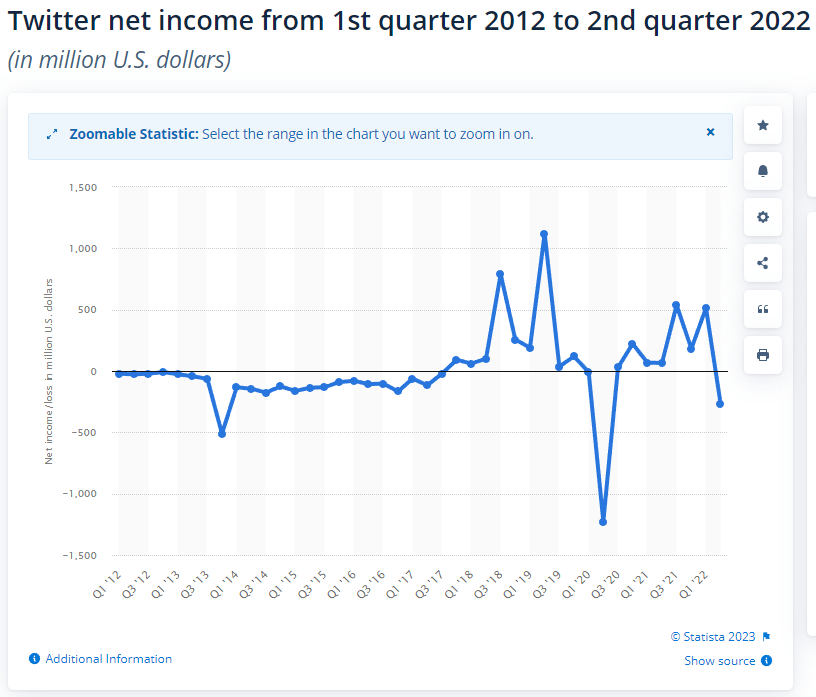
For a moment’s perspective, Twitter can comfortably be expected to earn $4 billion /year in advertising revenue if it just held steady, which isn’t peanuts. The problem is that it hasn’t been enough to turn a steady profit and it’s definitely not enough since Musk spent $43 billion for Twitter. I won’t pretend to understand his utlity function, but I’m pretty sure he’s not hoping to just (nominally) break even on his deathbed. He at least wants to break even in terms of net present value.
How can Twitter make money? As best I can tell, there are only three possible revenue strategies. It can charge user fees. It can sell advertising. It can sell the data it accumulates. That’s it.
Let’s get the first one out of the way. User fees can be charged in two dimension, tall or wide. Tall fees focus on charging a large fee from a small number of high value accounts. Brand accounts, like Coca-cola or Beyonce. Wide fees focus on collecting a small fee from a large number of lower value accounts (<100k followers). Musk wants to charge for user verification, which is a fairly wide tactic. There is nothing inherently right about wide or tall user fee strategies. The problem with charging for verification is that it lowers the quality of information discourse on Twitter. Reducing the quality of the product diminishes the value of advertising and generated data while also lowering the bar for competing products (NB: competing products aren’t necessarily or even likely to be other microblogging sites. Just whatever else might substitute e.g. TikTok, Instagram, Substacks, high fidelity smoke signals from vaping, whatever).
Advertising and user data go hand in hand. One could speculate that the reason Twitter’s advertising revenue underperforms relative to their position in the market is either because a) Twitter is a bad channel to advertise within, b) the manner within which users engage the produce yields low quality consumer data, and c) Twitter is bad at collecting and producing advertising opportunities based on that data. My guess is all three.
Is there a way to generate revenue while protecting or increasing the value of the product and data generated? Glad you never asked.
Focus on charging fees from users who need Twitter and not from users that Twitter needs. Good rule of thumb: if they’re a person, Twitter needs them. If they are not a person, they need Twitter. Don’t charge $8 to verify a sportscaster from Tuscaloosa. Charge $0.01 per follower for each a corporate entity or brand. Charge them $1 per reply, $2 per retweet. Bundle user fees with engagement. When you’re selling printers to Chase Bank you don’t make money off the printers, you make it off the ink.
Verify everyone with more than 10k followers. It incentivizes users to pursue more followers.
Kill the bots. Just require monthly captcha, randomizing day and mechanism. The numbers you’ll lose on your sales pitch to advertisers will be more than made up for in increased quality.
Allow for parallel content streams within users. Twitter advertising isn’t making enough money because they don’t know what to advertise to me. To be fair, nobody really knows how to advertise to me. Except Instagram. They have a window straight into my consumer id. Why? Because I take photos of things I love, write captions that betray my sense of humor, and scroll content that entertains me. They have a dossier on how to sell me crap and it works. Maybe I hate it, but I’ve also bought more from Instagram ads in the last year than I’ve bought from Gmail ads in 20 years.
Let’s talk about this last one a bit. If Twitter wants to learn more about me, they need to give me more opportunities to produce data, such as:
Multiple feeds from subsets of the accounts I follow. Better yet, suggest alternate feeds. If I say yes to the 100 accounts you suggested as a starter, you’ve added a dimension to your data’s model of me.
Multiple streams from which I produce content. I’m pretty sure a lot of my followers would love to subscribe to just me talking about economics or just about sports. Let me click a button on each tweet that says A stream, B stream, C stream, or ALL. Now Twitter is learning about me and each of the followers that makes a decision about which stream(s) they want to follow.
Separate streams/feeds for photos. Steal a little Instagram market share.
Separate feeds/streams for meso-blogging (10,000 characters). Steal a little from Substack. Charge $2 a month to produce meso-blog posts.
One last thing. Stop forcing content into feeds. Yes, people will pay to promote their content, but forcing it into my feed reduces the quality of the product. It’s like an informercial without the warning and bad sweaters. You have to at least color code it differently. Good advertising can dilute the product, but it can never degrade it. Forcing crazy people and grifters into my feed pushes users away, reducing trust and engagement. Just don’t.