The younger, high school and undergrad version of me was not the best person. My sense of humor was too dark and I didn’t much care about the experience of other people. When I went to grad school, I was so excited. I would finally be around other economists and I would be able to drop all of the niceties, empty social signals, and fuzziness that I thought non-economists employed. And I was oh so very wrong.
It turned out that economists are also human beings and that no amount of self-congratulatory Spock-praising would stop that from being the case. Indeed, with some candid feedback, I became convinced that I was in desperate need of the kind of prosocial norms that could help me to better produce social capital. In other words, I needed to figure out how to get along. Below is some advice that I’ve found pivotal. Maybe you can share it with another person who might be well-served by reading it too.
Below are six norms that are good to employ in order to improve social cohesion, agreeableness, and, frankly, better mental health. And these aren’t just for economists. I suspect that there are plenty of people (maybe young men) who can benefit from what took me too long to learn. So here we go!
I listen to a lot of podcasts, but many are forgettable, and even the good ones can be hard to share, since they get their point across slowly and gradually. But on the latest Conversations with Tyler, I found foreign policy thinker Walter Russell Mead to be eminently quotable. Some highlights:
On Germany:
Kennan’s goal for Germany was to have a united, neutral, disarmed Germany at the heart of Europe. In some ways, [laughs] Kennan’s goal looks, maybe, closer than ever.
China’s development plan, much more than its Taiwan policy or its human rights, is a gun pointed at the head of German business
On America:
Over the last 40 years, there’s been an enormous increase in the number of PhD grads engaged in the formation of American foreign policy. There’s also been an extraordinary decline in the effectiveness of American foreign policy. We really ought to take that to heart.
One of the teachers at Groton used to take aside some of the boys — it was an all-boys school at the time — and explain to them how their family fortune was made. He might say, “Well, George, we’ve been reading a lot about war profiteers in World War I. You need to know that your grandfather . . .”
I think neoconservatism reflected a sense of people who’ve never been wrong and never been beaten, at least in their own minds
On the Middle East:
In the Arab world, the Middle East, Islamism, and jihad — just call it jihadi ideology more broadly — is seen to have failed. Like socialism, like Arab nationalism, it’s one more in a long list of failed ideological movements. Not that there still aren’t terrorists, or for that matter, Arab socialists, but it’s not the same.
Nobody really thought, in 2008, as George W. Bush left office, that you could possibly mess up the Middle East worse than the Bush administration. But President Obama proved that that was wrong and that you could actually take the Middle East at the end of 2008 and make it almost infinitely worse, both for American interests and for the safety and happiness of the people in the region
On Ukraine:
The message, actually the totality of the message that we sent to Putin [through the intelligence we released] is, “You are going to win if you do this”.
I read Mead’s book Special Providence in college and enjoyed it then, but have’t kept up with his work since. The book’s title comes from another great quote, this time attributed to Otto von Bismarck:
God has a special providence for fools, drunks and the United States of America.
The Mont Pelerin Society was founded 75 years ago. The title of this post was the opening sentence of the Statement of Aims the new Society agreed upon. They had many concerns about what they considered “central values,” but primary among those concerns were the dangers related to market economies: “a decline of belief in private property and the competitive market” and “the growth of theories which question the desirability of the rule of law.”
How has the world done since 1947? It’s easy to point to the decline of communism and socialism, both in practice and as a dominant theory, as a victory for the goals of the Mont Pelerin Society. However, we might be concerned that in the non-communist world, economic freedom has declined even as communism has failed. Let’s dig a little deeper.
One source we can use is an extension of the Fraser Institute’s Economic Freedom of the World index. The primary index only extends back to 1970, but recently Lawson and Murphy have constructed a version of the index which goes all the way back to 1950 for some countries. As far as I’m aware, they haven’t yet perfectly mapped the pre-1970 index with the primary index that extends to the present, but I’ll make a quick comparison using the available data. The 1950 data brings us very close to the date of the first MPS meeting.
Here’s a list of countries relevant to the discussion at MPS in 1947. The list includes countries where attendees came from, as well as other countries of interest to the discussion, such as China and Russia (I’m using the list from Caldwell’s recent edited transcripts of the 1947 meeting). Caveat: this isn’t a chain-linked index, so the 1950 and 2020 numbers are perfectly comparable. Also, the 2020 number only includes Areas 1-4 of the index, since that’s what the pre-1970 data contains.
The table above should give us some optimism about the state of market economies in the world from the perspective of 1947. Not only have China and Russia, clearly improved their economic freedom scores, but all of the Western market economies have as well. Again, exercise caution in interpreting these, since it’s not a chain-linked index, and it excludes one area of economic freedom (regulation, which surely has grown substantially since 1947). Despite those cautions, the picture in 2020 looks pretty good compared with 1950.
But what of other liberal institutions? While the MPS statement of aims doesn’t specifically mention democratic institutions, the threat to democracy seems to clearly be a concern in 1947 (“extensions of arbitrary power” and “freedom of thought and expression”).
Although fracking technology has enabled renewed oil production in the U.S., the West remains heavily dependent on oil imports, especially from the Middle East. Even in the U.S., the current refining capacity is not well-matched to the type of light oil produced by fracking, so we still import oil (of types that our refineries can handle), although we also export fracked oil. Since oil remains the basis of so much economic activity, and since many oil exporting countries are unstable or even hostile to the U.S and our allies, the U.S. in 1975 established a large Strategic Petroleum Reserve (SPR) to store up crude oil. The storage is mainly in caverns in Texas and Louisiana, dissolved out of underground salt deposits. It was mainly filled in the Reagan/Bush administrations in the late 1970’s, and topped up under Bush II around 2003-2004.
The statutory purpose of this stockpile is to protect us and our allies against a “a significant reduction in supply which is of significant scope and duration,” per the Department of Energy. If such an event occurs, leading to high prices and associated economic impact, the President is authorized to release oil from the SPR. However,
In no case may the Reserve be drawn down…
(A) in excess of an aggregate of 30,000,000 barrels with respect to each such shortage;
(B) for more than 60 days with respect to each such shortage;
Somehow various administrations and also Congress have circumvented these restrictions on draining the SPR, and over the years have sold off bits and pieces to raise money for government spending. However, the current administration has decimated the SPR, selling off a third of it (some 200 million barrels), mostly in the past six months:
The administration projects this gusher to stop after November. Essentially all objective observers recognize this as primarily a political move, to reduce gasoline prices in order to curry favor with voters for the mid-term elections this November. It’s one thing to knock the price of gasoline down from $5.00/gallon back in the spring, when the world was panicked about Russia’s invasion of Ukraine, but to keep on selling into a moderated market is irresponsible. We haven’t had an actual shortfall in supply these past few months. Among other things, Russia keeps happily pumping and selling, out into the global grey market.
I won’t belabor the point here (stay tuned for more posts on this subject), but the world is structurally short of oil. With this administration having spent its first year demonizing oil and oil companies, the petroleum industry is understandably cautious about making expensive investments in future oil production. They know they will be stabbed in the back as soon as the current party in power no longer needs them.
By dumping this oil now, the administration is making the U.S. and the West more vulnerable later, if there is an actual global oil supply crisis (think: Iran vs. Saudi Arabia in the Persian Gulf…). Irritated by the lowish oil prices engendered by the SPR release, OPEC just announced production cuts which will drive prices right back up. They can cut production far longer than we can drain the SPR. If this all motivates further investment in low CO2 energy (including nuclear), that is perhaps a good thing. But between now, and attaining a carbon-free utopia in the future, we need to keep the crude flowing. Let us hope for the best here.
Ultimately, drawing down the SPR was a political decision. Think about it. An administration that has frequently emphasized the importance of reducing carbon emissions is trying to increase oil supplies to bring down rising oil prices — which will in turn help keep demand (and carbon emissions) high.
But even though the Biden Administration wants to address rising carbon emissions, high gasoline prices cause incumbents to lose elections. So, they try to tame gasoline prices even though it contradicts one of their key objectives of reducing carbon emissions.
The SPR has now been depleted since President Biden took office from 640 million barrels to 450 million barrels…
President Biden’s gamble to deplete the SPR in order to fight high oil prices may not hurt him at all. Of course, if for some reason we had a true supply emergency and found ourselves needing that oil, it would be looked upon as a terrible decision.
If you were worried that we haven’t spent enough time and intellectual energy pondering terrible people, I give you this thought-provoking tweet from Zach Weinersmith:
How come every crazy person eventually gets around to anti-semitism? Is there some kind of secret racism cabal trying to run the racist world for its own ends?
There’s a million unsatisfying answers to the question “Why are terrible people terrible?”, but maybe we can get a little traction here from a few simple economic concepts. Why are racist people and groups so often racist in the same way? Why do we observe so little innovation in racism?
Let’s sketch a toy model.
The production ofsocial goods (mutual support, friendship, community, etc) can be reductively modeled using labor inputs (human time and energy) and social technology. One very important strain of social technology is the amalgam of ideas, identities, and institutions that groups leverage when producing the mutual support systems and emotional goods that all but the most pathologically isolated of us depend on.
Ideas have the important property that they are unaffected by parallel use i.e. use comes at zero marginal cost. That means they offer the possibility of not just significant returns to scale, but in some contexts increasing returns to scale. In this case, the path to massive scale returns through social technology will come through network effects. Goods that are consumed within social networks, and where the value of the good being consumed is positively increasing with the number of other people who use ie (i.e. social media, media formats, etc), will often be characterized by critical mass thresholds beyond which use rapidly escalates as each marginal consumer increases the value of consumption, attracting more subsequent consumption.
Racist ideas as zero-marginal cost network social technology
Let’s model racism as a set of ideas that serve as social technology that serve to increase the output from labor inputs into the production social goods. Internalization of stupid racist ideas by one person does not diminish the stock of stupid racist ideas (they have zero marginal cost), but the output elasticity from that labor is actually increasing as more people contribute to the production of social goods using the same set of ideas. The network effects of production using zero-marginal cost racist ideas gives them a least some range of increasing returns to scale.
What’s the net of all this? There will be extremely powerful incentives to return to the oldest forms of racist ideology because the pre-existing body of believers grant significant scale advantages over newer racist ideologies. For both your everyday racist looking to enjoy the social goods of mutual admiration and support from your fellow bigots or the aspiring leader of a racist faction aiming to effect social change through the scale of your community of monomaniacal twits, the returns to scale to be enjoyed by leveraging a set of racist beliefs that have already achieved historical critical mass are too attractive to pass up.
The pre-existing body of zero marginal cost ideas, in this model, endows a tremendous amount of path dependence to the ideas being leveraged by communities seeking to produce social goods using the technology of racist ideas. The deck is stacked against innovation, which means we should expect endless regurgitation of the same racist bullshit.
Path dependenceis a systemic property where the current state is heavily influenced by past events and states. Much of the “Guns, Germs, and Steel” model of the world is that the current state of things is heavily determined by past states (widespread animal domestication and husbandry in the Old World) and events (Europeans bringing germs from those animals to the new world) that can never be undone. In much the same way, I suspect we observe the same racist tropes over and over simply because the old tropes got there first and there’s no undoing the past.
Or maybe racists are all just stupid and lazy? Who knows, I can barely even tell most racists apart.
Authors of the kinds of books I read present themselves as a voice of reason against our declining society that no longer can evaluate arguments or define moral principles. (I’m fun at parties.) “Postmodernism” has been attacked all my life.
For a while, I have been looking for a successor of postmodernism. To simply define our age as the one that came after modernism seems unsatisfactory. How many more decades can we coast along on this antithesis idea?
One reason I don’t like the term postmodernism is that it gives a sense of progress where we might be losing ground. If you aren’t modern, then you are pre-modern. If you aren’t a verbal culture, then you have regressed to pictographs. If you aren’t engaging arguments, then you have degenerated to tribalism. So, postmodern might be dressing up a decline with a word that is too respectable sounding.
Calling people who use smartphones premodern does not seem right. But, what information are they consuming on those screens? Is it mostly low-quality videos and quick poasts? That doesn’t seem like what someone in 1900 would expect of a modern person.
Here’s an idea for the new century. We are in an age of poastmodernism, beginning with the founding of Twitter. This is different from the kind of skepticism or moral relativism that defined postmodernism. The poasters and their followers can be earnest. They retweet like evangelists. (A “poast” is a message posted in an internet forum.)
Poasts are short. This does not allow for nuance or traditional rational forms of argumentation. A poast could be referencing a rich history or body of literature, but if this generation has not evaluated those original sources then they are really just getting the meme. The poast does not provide its own context. Tyler Cowen says that people who think “modern art” is absurd have no context. Context for modern art would be the classical art and realistic landscape paintings that came before. Most Americans including myself are pretty ignorant about classical art. Similarly, how much value would teenagers get from Lord of the Rings internet memes if they have never seen the movies or read the books?
I’m on Twitter. The pace of discourse is more fun than reading a 50-page econ journal article. I get the appeal of poasting. It’s easy. Our first pediatrician told us not to let our baby use touchscreen games. She told us that it is good for a child to struggle to touch a ball that is two feet away across the floor. Better that they cry over the ball than get the dopamine too easily on a tablet game. Tapping on a screen trains kids for instant rewards. Something that concerns me about a generation that was not raised on books is that they will actually enjoy poasting less than I do, because they will be used to the rapid pace of reward. Twitter as a company benefits from the current generation of people who did not grow up with Twitter.
Poasting affects politics. This week two US Senate candidates had a debate. What would someone who gets most of their news from social media learn about the debate? Some top poasts about the debate have almost zero positive policy substance. Campaigners use the internet medium to dunk on their opponents instead of offer solutions to problems. What attracts engagement is the fire emoji.
It says a lot about Blake Masters that he’s the only one on this stage who never wore a uniform for our country, and yet he thinks he knows better than our military on how to fight wars.
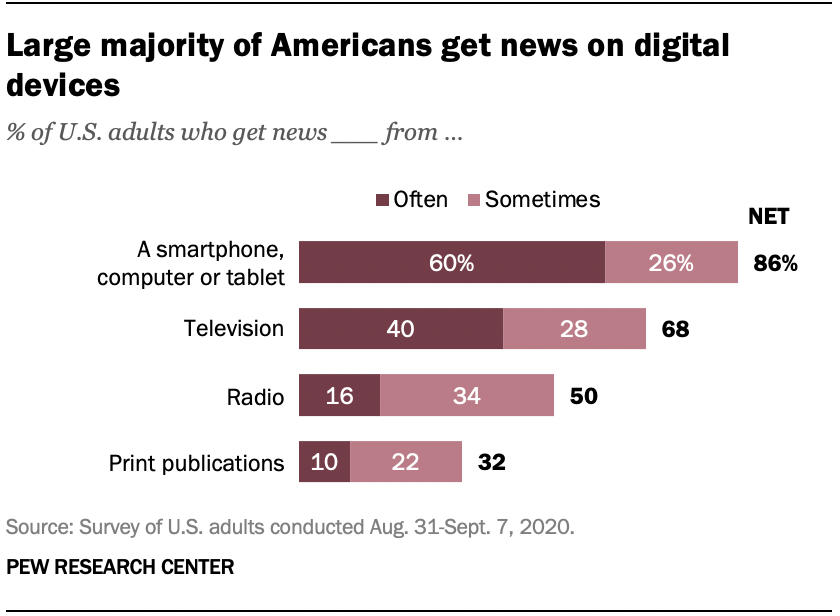
This is not meant as a comment on either men as candidates. I share these jabs because lots of Americans are consuming their “news” in this form (see Pew Research chart). In postmodernism a successful political candidate has to appeal to feelings as much as reason. In poastmodernism, they only have 280 characters to work with. (Donald Trump was a skilled poaster.)
Getting elected today might require great poasting, but that has little to do with being good at governing. Most people think the details of government are dull. Ten minutes into a city council meeting, I’m bored and ready to check the notifications on my phone. And yet, we cannot just poast about poasting. It’s the physical political world and the classic books that make the best subjects of conversation. So, I’m not sure if the era of poastmodernism will last for a long time, or simply to the end of my lifetime. Millennials are not going to give up the dog fire meme.
You’ll have to pry it from our hands after our large generation has passed on. But will it inspire people in the future? I have already been informed that teenagers are calling our gifs “cringe”. They seem to prefer 90 second videos of their peers dancing to pop music. Don’t ask me what comes next after that.
I’ll end on a positive note by saying that sometimes shorter is better. Get to the point quickly, if you can. Some of the novels produced in the modern era were too long. Adam Smith’s books would be more widely read if they were shorter. Long-winded speeches are not necessarily good and I’m glad I am not forced to listen to them. (I get the tl;dr the next day.)
A lot of bad ideas were dressed up in pages of smart-sounding language and then passed off for wisdom in the modern era. It might be harder to pull that off today. Authoritarian regimes in the past relied on being able to lie about conditions on the ground. Today, we know what is happening because of individuals on the ground sharing to Twitter (although social media can also be used for disinformation). American elites believed lies about what was going on inside the Soviet Union for years. That would be more difficult today.
Its Nobel Prize season- the economics prize will be announced Monday, while most prizes are announced this week. My favorite so far is the Medicine prize being awarded to Svante Pääbo “for his discoveries concerning the genomes of extinct hominins and human evolution”. He figured out how to sequence DNA from Neanderthal remains despite the fact that they were 40,000 years old.
As recently as 2010 it was controversial to suggest that Neanderthals might have mixed with humans, until Pääbo’s DNA definitively settled the debate, showing that “Neanderthals and Homo sapiens interbred during their millennia of coexistence. In modern day humans with European or Asian descent, approximately 1-4% of the genome originates from the Neanderthals”
While the Neanderthal genome settled an existing controversy, Pääbo’s other big discovery came entirely unlooked for. The Nobel Foundation explains:
In 2008, a 40,000-year-old fragment from a finger bone was discovered in the Denisova cave in the southern part of Siberia. The bone contained exceptionally well-preserved DNA, which Pääbo’s team sequenced. The results caused a sensation: the DNA sequence was unique when compared to all known sequences from Neanderthals and present-day humans. Pääbo had discovered a previously unknown hominin, which was given the name Denisova. Comparisons with sequences from contemporary humans from different parts of the world showed that gene flow had also occurred between Denisova and Homo sapiens. This relationship was first seen in populations in Melanesia and other parts of South East Asia, where individuals carry up to 6% Denisova DNA.
Pääbo’s discoveries have generated new understanding of our evolutionary history. At the time when Homo sapiens migrated out of Africa, at least two extinct hominin populations inhabited Eurasia. Neanderthals lived in western Eurasia, whereas Denisovans populated the eastern parts of the continent. During the expansionof Homo sapiens outside Africa and their migration east, they not only encountered and interbred with Neanderthals, but also with Denisovans
The same techniques that enabled these discoveries have been applied much more widely throughout the field of Paleogenomics, which continues to rewrite what we thought we knew about history and pre-history. The field has been advancing so quickly over the last decade that its hard to keep up with it. I’ve found the best introduction to be David Reich’s Who We Are and How We Got Here, though again the field is moving so fast that a 2018 book is already a bit out of date. Razib Khan is always writing about the latest updates at Unsupervized Learning. If you haven’t kept up with this stuff since school, this post and diagram give a quick introduction to how much our understanding of human origins has recently changed:
I have previously wrote about living standards in Ireland, and how GDP per capita overstates typical incomes because of a lot of foreign investment.
This is not to say that foreign investment is bad — to the contrary! But standard income statistics, such as GDP, aren’t particularly useful for a country like Ireland.
Norway has a similar challenge with national income statistics, but a different reason: Oil. Norway has a very large supply of oil revenues relative to the size of the rest of its economy, and oil revenues are counted in GDP. But those oil revenues don’t necessarily translate into higher household income or consumption.
Using World Bank data, Norway appears to be very rich: GDP per capita in nominal terms was about $90,000 in 2021. Compare that with $70,000 in the US, which is a very rich country itself. Sounds extremely wealthy!
Of course, by that same statistic, average income in Ireland is $100,000. But after making all the proper adjustments, as we saw in my prior post, Ireland is right around the EU average in terms of what individuals and households actually consume.
The ups and downs of the U.S. stock market are largely driven by the degree to which the Federal Reserve makes easy money available. After (ridiculously) insisting for most of 2021 that inflation was merely “transitory”, chairman Powell has finally put on his big boy pants and started to attack the problem by raising short term interest rates, and (only now) starting to reduce the Fed’s holdings of bonds. Massive buying of bonds is termed “Quantitative Easing” (QE), and its opposite is known as “quantitative tightening” or QT. QT can be accomplished by outright sales of bonds into the open market, or (as the Fed is doing) simply letting bonds mature and not replacing them with purchases of new bonds.
The specter of Fed tightening drove stock prices down all year, to a low in June. Then a new mantra began to circulate on Wall Street, that the Fed would relent at the first sign of economic slowdown, and hence would “pivot” back to easy money (low interest rate) policies. Stocks enjoyed 15% rise until stern speeches from the Fed in August convinced the Street that the Fed was going to stay the course until inflation is broken, and so stocks slumped back down to their June lows. Other major central banks like the European Central Bank and the Bank of England have likewise pledged tighter money policies in order to curb inflation.
However, stocks had a short-lived rally last Wednesday, when the Bank of England intervened in the markets by buying up long-term bonds. Aha, the central banks are caving at last! QE is back!!
It turns out that the reason the BOE intervened was not because of tight money conditions affecting general employment and income. Rather, there was a specific, technical reason. Many pension funds in the UK had entered into so-called “liability-driven investments” (LDIs), which involve interest rate swap agreements. I won’t try to explain the mechanical details of these beyond showing one figure:
In a stable world, these instruments allow pension funds to take money that they would have invested in boring, stable, low-interest bonds, and allocate it to (hopefully) higher-yielding investments such as stocks. But there is a huge catch, involving posting collateral, which in turn involves margin calls if the market price of long term bonds declines (as always happens when long-term interest rates go up).
The world has become less stable in the past six months, particularly since the Russian invasion of Ukraine. UK finances are shaky in the base case, and a proposal by the new prime minister for an unfunded tax cut that would exacerbate the budget deficit pushed the markets over the edge. Yields on British government bonds (“gilts”) surged, which would have triggered forced disastrous selling of assets (margin calls) by the pension funds at ever-lower prices. This death spiral would have imperiled the solvency of these nationally-important funds. See here and here for more explanations.
…according to Cardano Investment’s Kerrin Rosenberg, most UK pension funds “would have been wiped out” were it not for the bond buying.
“If there was no intervention today, gilt yields could have gone up to 7% to 8% from 4.5% this morning and in that situation around 90% of UK pension funds would have run out of collateral,” Rosenberg told The Financial Times.
Will other central banks be forced to abandon money-tightening because of imperiled pension funds? The consensus seems to be probably not. The UK funds had a relatively high exposure to these derivatives, and British finances are in worse shape than most other major economies. That said, this is a cautionary example of the vulnerabilities of cleverly engineered financial instruments. In the end, there is no free lunch.
A NYC councilman has proposed a reward system for civilian-provided evidence of parking violations. The revenue motivations are obvious, but the consequences are far easier to speculate upon than confidently predict. I’m usually reluctant to make policy forecasts, but in this one case it is probably fair to say I am unusuallyqualified. So how’s this going to play out?
Well, first of all, this is a relatively narrow set of bounties that promise a person 25% of the resulting $175 ticket for providing evidence of an illegally blocked bike lane, sidewalk, or school entrance (five minutes of googling did not yield insight into any associated fees that might be applied on top of the fine). Not only is it relatively specific in its aims, it’s also not unprecedented: rewards for NYC citizens who report illegally idling vehicles “generated 12,267 reports in 2021… netting the city $2.3 million and $724,293” for the reporting citizens. Which is to say that relatively modest rewards appear to be more than sufficient to get New Yorkers to snitch on each other, and the institutions appear to be more than comfortable issuing fines based on a civilian-provided evidence. Ninety-two percent of the idling vehicle reports lead to a fine being issued (though not necessarily paid), each generating a $87.50 bounty for the reporting party. One man has reportedly earned $125,000 from reporting idling vehicle.
For a bounty to be earned “a citizen needs to submit a time- and date-stamped video taken during the time of observation that shows the commercial truck or bus continuously idling for more than three minutes,… needs to contain the license plate and the company information [and] the sound of the idling engine needs to be clearly heard”. Given those standards, the 92% issuance rate is perhaps less surprising. It only takes a little reflection for $87.50 is seem a pretty healthy bounty. If we consider that affordablity of modern digital equipment (i.e. your phone) and video editing software (often bundled free with your phone or computer), opportunistic enforcement seems more than sufficiently incentivized.
But what about more than opportunistic enforcement? There is the very real possibility that private enforcement could scale, and not in the way a city would at least purport to hope. If we may recap the context in question:
There is an unending supply of vehicles
low cost carried video equipment
low cost video editing software
Individuals with a high material reward for submitting evidence sufficient to receive a reward
A city whose revenue needs provide it every incentive to be entirely credulous of any evidence provided
A relatively high cost (if only in time spent) of challenging a violation
Revenue incentives distort police discretion. While it may feel like this bounty system is outsourcing the work to civilians, but what it’s really doing is moving the discretionary moment institutionally downstream to the court system that must now adjudicate the quality of the evidence provided. I expect the chain of command within a court system to be no less effective at channeling budget incentives down their own hierarchies of supervision and reporting.
Okay, I’ve laid out enough bread crumbs leading from incentives to potentially unintended consquences. What do I think will happen when this and other similar civilian traffic law bounties go into effect?
Non-trivial revenue will be generated, which will accelerate contagion to other municipalities
Violation issuance rates will be >85% (comparable to anti-idling laws)
Violent confrontations will occur around people who appear to be taking videos with their phones. Many of these people will just be taking selfies.
Most violation reporters will be one-offs, but a small number will make a very large number of reports (i.e. the distribution will be long-tailed).
These “super-reporters” will focus on hot spots where pick-up/drop-offs are inconvenient. Some will use long range microphones to avoid conflict.
Some super-reporters will be credibly accused of submitting videos with edited sound.
This will hurt ride share drivers more than anyone else, lowering their supply, while simultaneously reducing passenger convenience and reducing demand. The net price effect is uncertain, but I expect that the supply effect will dominate.
I expect that other cities will introduce civilian bounty systems unless there is a news-worthy spike in violent interactions around traffic-snitching accusations. Most municipal governments are strapped for cash at the moment, especially those who saw their traffic enforcement revenues plummet during lockdowns.
Lastly, I would only remind you that revenue-motivated law enforcement always has social consequences. Anyone who has ever lived under an HOA has had to deal with busy-bodies operating with a low opportunity cost of time and an eagerness to exert power in the smallest of fiefdoms. Bounties systems may end up creating exactly the institutional structure needed to increase the social footprint and subsidize the lifestyle of the most annoying person you know.


:format(webp)/cdn.vox-cdn.com/uploads/chorus_image/image/49493993/this-is-fine.0.jpg)


