Don’t just be an input, be an investment

As we sit here with both historically low unemployment, but also a labor force participation rate that hasn’t yet recovered from covid, I expect that we will start to see workers lured back not just with the prospect of high wages, but the prospect of re-tracking their careers. I expect to see a bump in field and industry switching, as well an interest in educatonal programs that might enable such a switch. Since we’ve already wrung our hands over the fields (teaching, nursing, etc) that are mired in labor shortages, we should start thinking more about the opportunity to re-track their careers that workers are grabbing with both hands. And with that, I’d like to give my one piece of universal career and education advice: be an investment, not just an input, and never customer.

This works in a lot of ways. First, and this isn’t trivial, it will keep you out of scams and traps. They want to hire you, but you have buy $300 worth of training videos? Scam. You can start immediately, but you have to buy your sales stock from the partner who recruited you? Ponzi scam and trap. You’re admitted to the professional degree program, but you can’t find any evidence that recent placements are earning at least double the tuition immediately after graduating? Trap. Your incoming cohort seems wildly underprepared given your expectations for the program? Sorry to be the bearer of bad news, but you’re not there to bring presige to the school with your subsequent exploits. You’re there to write checks and wait for your degree in the mail. You’re not an employee or a protege, you’re not even a product. You’re a customer and, I promise, you’re not getting your money’s worth.

Avoiding drains on your wealth isn’t sufficient, of course. You’re trying to pay your bills and hopefully build a career. Well, if you wank into an office filled with uniform, impersonal and undecorated cubicles filled with nothing but recent graduates and temps, you should be on immediate alert. Decent chance you haven’t stepped on the first rung of a corporate ladder – you’re entered a mill that does the grunt work for the people actually on the ladder. Your job, on the other hand, will be to execute monotonous tasks until boredom or a loose labor market pushes you out the door, while a rotation of temps ensures that your exit proves esssentially unnoticeable for your employer. You’re not an team member, you’re barely an employee. You’re a commodified cog, one that they expect to wear out before any improvement in your capacities or value could possibly pay off.

What you want to be is an investment. Whether it’s school or an entry-level job, the most important thing to find is firm/school that has a stake in your long-term success, incentive to invest in your human capital, and a structure within which this investment can in you can reliably flourish. Easily advised, harder to pull off, especially as a job applicant on the outside. There are, however, signs and signals to look for.

A mixture of employee ages is a good sign that people are sticking around because they see a payoff to long-term employment. While a program of temp-to-hire can actually be a great sign, a constant rotation of temps to backfill in a perpetual exodus is a huge red flag. Training and education reimbursement programs? Great sign, doubly so if they come with built-in time off. It might seem counter-intuitive, but I consider it a better sign if the company requires continued post-training employment i.e. you have stick around for at least x years or pay the company back for the training. It might seem like a limitation on your career, but it’s also a really good sign that your employer anticipates significant value in the labor market for your training. They’re not just looking for good PR, they’re looking to protect their investment in you.

Training and education are great, but the absolute best signal that your employer views you as an investment remains dedicated mentorship. If your senior leadership is investing time and energy to prepare you for the next round, great. What you really want, however, is leadership investing in you to eventually replace them. Why is that such a positive signal? Because it means that they don’t see training you as a threat because they’re going to keep moving up too! It means that the firm invests in their employees up and down the ladder, and everyone is anticipating the continuedf acquistion of skills and progression in their careers. If, on the other hand, every bit of process knowledge is a secret fiefdom, every scrap of credit jealously fought over? That’s a sign of employees that feel stuck, desperate only to find an exit while clinging to job security like under-paying driftwood in a storm.

If you’re going to grad school for a doctorate, it’s easy to assess whether you’re an investment or a customer.

  1. Are they paying you or are you paying them?
  2. Is there a defined pattern of how people are trained, granted a degree, and eventually placed within the job market?
  3. Is the program transparent about their students first job placements?

If you’re picking a PhD program, you should obviously go work with professors whose research excites you, but always on the understanding that they view you as an investment. Sure, they’ll get cheap labor our of you with regard to research and teaching assistance, but even those should be investments in your skill sets and experience. At the end of the day, good departments are eager, bordering on desperate, to brag about their former students. They are willing to pay you to go to school there because you will become a valued and hard-to-duplicate input in their research in the short run and a labor market star that further contributes to their own prestige in the long run.

Whatever step you are taking next in your career, especially if you are making a big sweeping change, make sure to find people who’s interests are aligned with investing in you, not just plugging you into their machine or selling you something. Remember, labor is an input, but that doesn’t mean you have to be an easily replaced and interchangeable commodity. Everybody wins if you become more valuable. Make sure you work and study somewhere smart enough to know that.

Ambitious Parenting

Things go by online about moms and kids that bother me. Here I will Be Like Pete and try to articulate a positive vision. We could talk more about parenting small children.

Ambitious people, both men and women, might want to be parents. Time spent on parenting takes away from other projects, so the earlier you start planning the better. Hearing about the experiences of other parents is both instructive and inspiring.

Parenting, like modern creative careers, is an unpredictable enterprise. Maybe one reason people are not encouraged more to plan is because the disappointments can be so devastating in this arena. There is a risk that I will sound insensitive if I am too positive. That said, I feel like discussions I see in public miss the point too often and fail to use the “billboard space” we have effectively. There is an ocean of thoughtful honest free content for How to Achieve Your Writing Goals, but there is very little on how to achieve your parenting goals that resonates with ambitious young people. The writing advice can be ignored by those who don’t want to write; parenting advice can be ignored by those who don’t want kids.

Economists talk a lot about parents and children, especially now that the US is near population decline. One particular point I have heard is: “Data shows that piano lessons do not have a causal impact on lifetime earnings, so your problems are solved. Everyone sit back and enjoy your kids.”

This message may be helpful to some people, but it seems like primarily a lie to me. “Enjoy your kids” assumes a lot. I’d prefer an honest approach about the sacrifice involved, or the “opportunity cost”. I think that the benefits of parenting outweigh the cost, but it’s not inspirational to say “selfish lazy people will enjoy parenting.” Raising kids who you enjoy being around is not easy, but there are tricks and proven methods to help.

The economist who gets it is Emily Oster. Her books go more like this: “You probably aspire to having family meals that you can enjoy. Sit down with your co-parent 6 months ahead of time and plan out how you are going to achieve such a wonderful ambitious goal while also being able to schedule other events and pursuits.”

Emily Oster books/newsletter is a great place to start. She’s not for everyone, but if you are reading an econ blog then she might be for you. The good news for ambitious parents is that many books have been written that explain how to achieve certain results. Ambitious smart people can figure out good techniques, although as I said earlier be prepared for things not to go as planned. It helps to start on the learning process before you have kid to care for. Once you become a primary caregiver, you will have less time to read, so read widely and often whenever you can.  We have a /Parenting category in this blog, to curate some of the good stuff.

This boy’s ambition was to dig a trench from a tidal pool all the way to the ocean.

Kids could come up in conversation about ambition more, as a possible complement not just as a substitute.

This Elon tweet has layers: “Being a Mom is just as important as any career” What do you think the subtext is? How would a college student understand this?

Why use this hackneyed phrase when he could say something to actually inspire both his male and female Gen Z fans to become parents? If Elon is a good parent, then teach us how he combines it with an ambitious life. And if he’s a bad parent, he should say less about it. If he’s trying to elevate mothers, then retweet a mother.

Similarly, a male economist who writes books about how easy parenting is should explain how he got through the first 5 years. Either someone else raised his children or he worked hard to maintain a routine and boundaries. Did he create his own routine from scratch or did he borrow from someone else’s model? Were his children in daycare 40 hours a week?

It can be hard to write about these topics honestly, because of privacy issues. So, we are back to Emily Oster, because she has been willing to tell the world what really goes on in her own family. Elon should just tweet out her newsletter every week if he’s such an advocate for mothers.

Dr. Oster is not the only one. There are millions of mothers creating content who would value the exposure. What if Elon (or some other ambitious person with a large platform) retweeted a trick for getting children to try carrots. “Wow, genius technique. Follow this Mom for more…” Or, Elon could highlight a man who being a great parent.

Ambitious people just talking about their kids and their own honest personal experiences is a good way to achieve Elon’s stated goal of getting more people to have kids. If Elon wants to tell us that he loves his kids, then that’s inspirational, and I don’t think it’s a lie.

I will engage in some introspection here, not because I think I’m so interesting, but because I see pro-natalist men talking past everyone else on how to raise the birth rate. I had a parenting win this past week. I solved a behavioral problem in a creative way and I’d love to talk about it. I’d like to feel like I’m part of a community conversation. I’d like to be recognized for my expertise. That’s what most people want, right? More resources in the attention economy devoted to parents is a form of compensation that I have not heard discussed before.

I have heard advice to female professors to not put up pictures of their children at the office. If colleagues know you care about your children, then you might be ostracized from the intellectual community that you have spent your whole life trying to join. In my own small way, I have pushed back against this norm by occasionally talking about kids and babies, so that other people who want families can feel part of a bigger community online and in academia. My broader point in this post is that there is a kind of rhetoric about family life and parenting strategies that would make young ambitious people think that having kids will not prevent them from pursuing other goals.

It’s not bad to talk about a 14-hour workday or an organizational strategies for achieving professional goals. I wouldn’t want to censor anyone or stop them from sharing how they accomplished something valuable. On the margin, more conversations could also include a discussion of how life changes if you become a parent, so that ambitious young people can build mental categories for this.

The Freakonomics podcast provides examples:

Stephen Dubner brought the teen children of famous economists on his show to talk about what it was like to grow up with those weirdos. It’s funny. Listeners will not feel like they are being told what to do or judged. Dubner is simply lending his platform to parents and children. He’s using the billboard space. There is parenting content on the internet already, but if it’s all siloed over at parents.com then it may not make it to the young person who is trying to figure out what “the Good” is.

Birmingham AL Coffee Shop Crawl

There are lots of fun coffee shops in Birmingham. I’m going to limit this list geographically to make it a “crawl” that you could potentially bike around. I’ll list the cute places I know that are between Railroad Park downtown and Samford University south of Birmingham.

Starting at the North end, coffee shops that border Railroad Park:

Red Cat: Website | Instagram | Facebook

Honorable mention to Hero Doughnuts that operates two locations within the Crawl Area and serves great coffee.

Starbucks does operate here, although I assume that’s of less interest in terms of local color.

Moving South to Five Points:

Domestique (operates in multiple locations on the Crawl)

Filter Coffee Parlor: Website | Facebook | Instagram

Moving South, crossing into Homewood:

Caveat: Website | Facebook | Instagram

O’Henry’s (multiple locations)

Santos: Website | Instagram | Facebook

Chocolate America is not a coffee shop but the caffeine levels are high enough to make the Crawl.

It’s just slightly out of the crawl zone to the West, but I can’t leave out:

Seeds: Website | Instagram | Facebook

From the Seeds Instagram

A Theory of Certificate of Need Laws and Health Care Spending

I just published a paper on CON laws and spending in Contemporary Economic Policy. As frequent readers of this blog will know, CON laws in 34 states require healthcare providers in 34 US states to get permission from a state board before opening or expanding, and one goal of the laws is to reduce health care spending. The contribution we aim for in this paper is to lay out a theoretical framework for how these laws affect spending.

There have been many empirical papers on this, typically finding that CON laws increase spending, but the only theory explaining why has been simple supply and demand. Health care markets are hard to model for a few reasons, but one big one is that most spending is done through insurers, so the price consumers pay is typically quite a bit lower than the price producers receive. This leads to “moral hazard”- i.e. overuse and overspending by consumers. Normally economists hate monopolies because they lead to underproduction, so in a market with overuse its fair to ask (as Hotelling did about nonrenewable resources)- could two market failures (moral hazard overuse and monopoly underuse) cancel each other out?

Continue reading →

GDP Growth and Inflation in G7 Countries

Back in April I wrote about GDP growth rates and inflation rates in G7 countries and the OECD broadly. James also wrote about a broader set of countries (182!) using these two measures. Since the economic scene is evolving so quickly, and we now have 6 more months of data, I wanted to provide an update on the US and our other large peer nations.

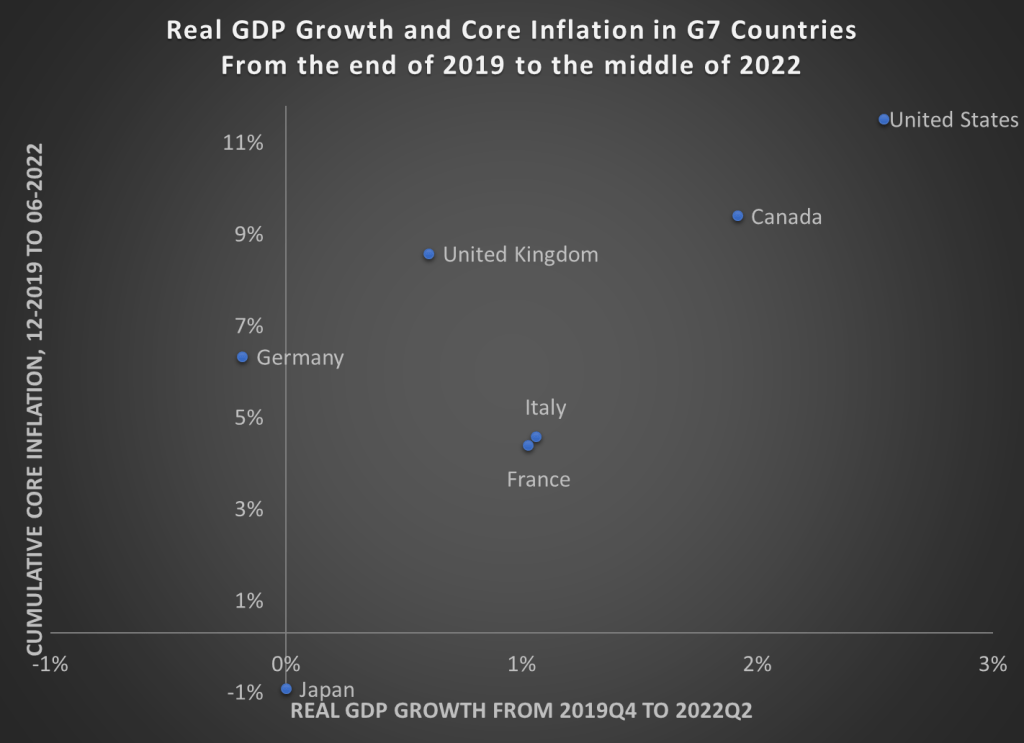
Here’s the data, showing cumulative real GDP growth and cumulative core inflation since the right before the pandemic (please note that I flipped the x- and y-axis from the previous post — sorry for the confusion, but this way makes more sense).

The picture looks roughly the same, but here are a few notable changes:

  • Despite the slight slowdown in GDP growth in the first half of 2022, the US still clearly has the highest rate of economic growth
  • UK, Italy, and Canada have now moved into positive territory for cumulative economic growth (yes, it’s all inflation adjusted)
  • But Japan and Germany still have had no net economic growth during the pandemic — and even worse for Germany, they have had a healthy dose of inflation too

The US once again stands out as having both the best economic performance and the worst inflation performance in the G7. Are these two things connected? That’s a question that is unanswerable from a simple scatterplot, and may be unanswerable completely. But I think it’s fair to say that the US hasn’t taken an obviously inferior economic path relative to other countries, even if our path has been inferior compared to some ideal policy. But don’t commit the Nirvana Fallacy!

Finally, we should recognize that the GDP is not the only important measure of how an economic is performing. For example, the US labor market has not recovered as well as some other peer nations have. Still, GDP is one of the important broad measures to look at, even if it is not ideal for diagnosing recessions.

Some Countries Use Too Much Fertilizer, and Some Use Too Little

In a world where China and India continue to build huge, CO2-belching coal power plants, and a world where global supply chains can no longer be taken for granted, you might think that a small, crowded country like the Netherlands would prioritize home-grown food production over concerns about greenhouse gas emissions from a relatively small volume of cow manure. But this is Europe, the land of eco-utopianism, and so you would be wrong.

Cow poop does emit nitrous oxide (a greenhouse gas) and ammonia (which can potentially pollute local water if uncontained). In a burst of green virtue,  the Netherlands has, “unveiled a world-leading target to halve emissions of the gasses, as well as other nitrogen compounds that come from fertilizers, by 2030, to tackle their environmental and climate impacts.” This target is expected to result in a 30% reduction in livestock numbers and the closure of many farms. Dutch farmers are not amused, and have vented their ire by dumping hay bales on highways and smearing manure outside the home of the agricultural minister. Protests over green policies hobbling local farmers have spread to Germany and Canada.

All this raised in my mind the question, could we really get along with using much less nitrogen-based fertilizers? I found a great article by Hannah Ritchie on OurWorldinData.org, “Can we reduce fertilizer use without sacrificing food production?”, which provides lush tables and graphs on the subject.

First, it’s estimated that artificial nitrogen fertilizers (where hydrogen, mainly derived from natural gas, is reacted with atmospheric nitrogen at high pressure over catalysts to make ammonia and derivatives) allow the world’s population to be about twice as high is it would be otherwise. Put another way, take away nitrogen fertilizers, and half of us die. So any campaign to massively scale back on fertilizer usage would result in mass starvation. You first…

That said, Ritchie’s article pointed out that some countries such as China seem to be (inefficiently) using much more fertilizer than they need to get similar results, some countries (e.g. America) seem to be about in balance, and some areas (e.g. sub-Saharan Africa) would benefit from using more fertilizer. So globally we could probably use a bit less fertilizer if the profligate countries used (a lot) less, while the deprived countries used a little more.

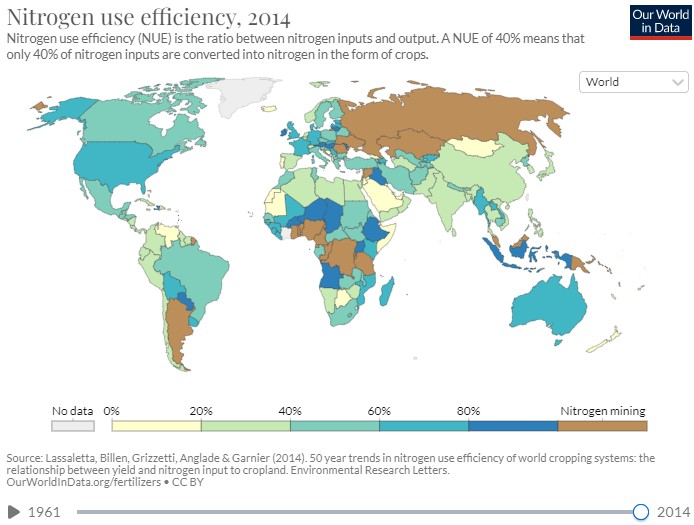
I’ll conclude with two charts from Ritchie’s article. The first chart shows, for instance, that Brazil uses twice as much fertilizer per hectare or per acre as the U.S, and China uses three times as much, while Ghana uses about a tenth as much.

The second chart shows estimated nitrogen use efficiency (NUE). An NUE of 40%, for instance, shows that 40% of the nitrogen in the fertilizer is converted to nitrogen in the form of crops, while the other 60% of the nitrogen becomes pollutants. In China and India, only about a third of the applied nitrogen is fully utilized, compared to two thirds in places like the U.S. and France. ( Some countries have a very high NUE – greater than 100%. This means they are undersupplying nitrogen, but continue to try to grow more and more crops. Instead of utilizing readily available nutrients, crops have to take nitrogen from the soil. Over time this depletes soils of their nutrients which will be bad for crop production in the long-run).

Six months working a Waffle House griddle and other irreplicable labor market signals

Rather than wade into the long running argument about how much of the value of education is in acquired skills versus the ability to signal ability or aptitude, let’s take a moment to appreciate the majesty of signaling in the wild. I hold the view that education has value far in excess of simply demonstrating to others that you can execute four years of tasks in a structured environment sufficient to warrant a degree. Make no mistake, however, I also firmly believe the labor market is constantly on the lookout for signals of high productivity employees that are entirely orthogonal to education and often values them more than most forms of broad training. To be honest, part of the reason I believe that education must have some training value is that the wage premium remains enormous, but the signal itself is actually kinda, well, generic. Sure, different degrees have different signals (i.e. did you dodge calculus?), but the fact remains that you really don’t learn all that much about a person from their simply having a degree.

If they worked the griddle at a Waffle House for a year? Now that’s a signal.

Perfectly summarized by icookfood42

I’ll tell you straight up – I’d take a faculty job candidate with a PhD from State U and 12 months of Waffle House on their CV over someone who got an Ivy League PhD straight out of undergrad. And not just accept, I’d push hard for them. That person has seen. some. ahem, stuff, and they came out the other side a person that then went and finished their doctorate? That’s the stuff co-authoring dreams are built on.

There are plenty of attributes that certain lines of work leverage. Grit. Attention to detail. Follow through. Resilience. Calm. Creativity. Cleverness. Reliability. I could go on for a 100 more at least, but at some point it just becomes a thesaurus for “awesome person who can accomplish tasks and handle challenges that are hard to define in advance”. And those kinds of things are difficult to ascertain without a) observing them first hand over an extended period of time, or b) those attributes being vouched for by someone whom you trust implicitly, neither of which are options for the typically hiring process, unless you’re “hiring” a 10-time All Star that was once coached by the person who took a knife for you in 5th period study hall 20 years ago.

There are some occupations and life experiences, however, like an extended run paying your bills scattering and smothering the world’s best hash browns, that do manage to signal those incredibly valuable, but hard to credibly observe attributes with at least some degree of reliability. Here’s a few that come to my mind:

  1. Restaurant. Back of House and Front of House are very different signals. Bonus points for BOH in a short order or quick serve setting, you’re basically getting a soldier without a specialization in violence. Any generic FOH experience, short of selling ice cream at a posh beach, is at least useful for stepping out of social bubbles.
  2. Military, especially if they fulfilled their duty, but chose to change careers. This is a person who not only follows through, but can make independent decisions. Immune to sunk cost fallacies.
  3. Flight Attendant. They are emotionally bulletproof.
  4. Hotel. Problem solvers.
  5. Peace Corps or missionary work. Committed and make good on promises.
  6. Delivery (i.e. UPS or FedEx). Big tasks don’t overwhelm them.
  7. Independent Record Label/Zine distributor/Band promoter Utterly unfazed by high risk endeavors, get lots of intrinsic value out of their own labor

Before I wrap up, let me tack on a few specific summer jobs that have signal value to me. I’ve never met anyone who worked construction as a summer job who wasn’t tireless and reliable. Everyone I ever knew who worked at a movie theatre is funny and interesting, though usually a bit introverted. Kids with paper routes grow up to be independent adults. Screenwriters and novelists who never got a foot in the door make good industry creatives. Anyone who’s done an open mic comedy night more than once is probably a good teacher.

What about you? Are there jobs on a resume that let you know something important about a person that you couldn’t learn any other way?

Business Analytics Textbook plus Discussion Book

Many undergraduates take at least one business analytics course at the 200 course level. A book that I and other professors at our business school have selected to teach business statistics is by Albright and Winston

Business Analytics: Data Analytics and Decision Making (Amazon link)

This book provides three essential ingredients to a successful course:

  1. Covering core concepts like descriptive statistics and optimization
  2. Providing relevant examples in a business context (e.g. how much inventory should a retail store order)
  3. Showing step-by-step instructions for how to do applications in a specific software which in this case is Excel

Microsoft Excel is essential for business school graduates (arguably all college graduates). No one is born knowing how to select cells or enter formulas. The book does not assume anything, so the professor does not have to require supplementary material on how to use Excel. There are lots of exercise and examples that teach proficiency in the tool while demonstrating the concepts. Analytics courses should be hands-on.

Sometimes statistics courses do not feel like they allow for critical thinking or discussions. There is only one correct formula for an average, and it is merely and exactly what the formula determines it to be. Therefore, an interesting addition to a technical class is the book by Muller

The Tyranny of Metrics (Amazon link)

Muller spends most of the book pointing out cases where measuring results backfired. He is not so much against “analytics” as he is skeptical of pay-for-performance management schemes. Many of these schemes were sold to the public as incredible technocratic improvements, such as No Child Left Behind. I do not always agree with Muller, but he gives students something to debate. Note that only select chapters should be assigned so that it does not take up too much time from the other course material.

Data Analytics with R Textbook

For an advanced undergraduate analytics class for business school students, I use a textbook by Saltz and Stanton called

Data Science for Business with R (Amazon link)

This textbook teaches R and analytics at the same time. The professor does not have to provide a separate R curriculum or require students to buy a second book.

The running example in the textbook is an airline business scenario that is interesting and builds with the complexity of the subject matter. The authors provide the dataset that students can work with for the airline case study. Many examples in the textbook use data that is available online and therefor can be imported to R with just a few lines of code.

One semester is not enough time to cover every chapter in the book. I emphasize predictive analytics, so I skip the chapters on maps and shiny apps.

I do some supplemental lectures on concepts in predictive analytics before students reach the chapters on regression and decision trees. For example, overfitting is a new concept to undergraduates. I want them to have a more intuitive grasp of that subject before learning the R code to separate data into training and validation sets.

Note that these students have already taken what has traditionally been called Business Statistics, so they already understand basic descriptive statistics and graphing. The book is no substitute for that primary class.

There are free supplementary materials online for learning R. Students find message boards especially helpful in pinpointing answers for questions that come up while coding.

Free download: If wages fell during a recession

You can download my full paper “If Wages Fell During a Recession” with Dan Houser from the Journal of Economic Behavior and Organization (only free until September 24, 2022).

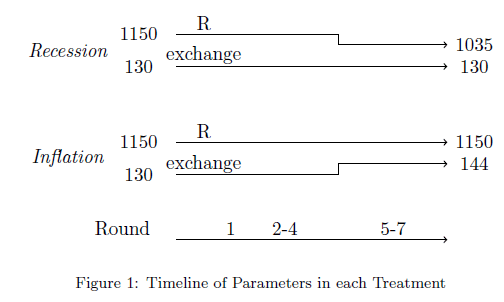
There is a simulated recession in our experiment. We ask what happens if employers cut wages in response. Although nominal wage cuts are rare in the outside world, some of our lab subjects cut the wages of their “employee”. Employees retaliated against nominal wage cuts by shirking, such that the employers probably would have been better off keeping wages rigid.

We also tried the same thing with an inflation shock that allowed the employer to institute a real wage cut without a nominal wage cut. The reaction to that real wage cut was muted compared to the retaliation against the obvious nominal wage cut.

Inflation was implemented after 3 rounds of the same wage to create a reference point.

I blogged about the experiment previously, so I won’t go into more detail here.

The Great Recession happened when I was an undergraduate. As I started my career in research, the issue of employment and recessions seemed like THE problem to work on. The economy of 2022 is so different from the years that inspired this experiment! Below I’ll highlight current events and work from others on this topic.

Inflation used to be something Americans could almost ignore, and now it’s at the highest level I have seen in my lifetime. Suddenly, people are so mad about inflation that politicians named their bill the Inflation Reduction Act just to make it popular.  

The EWED crew has made lots of good posts on inflation. Although job openings and (nominal) wage increases are noticeable right now, Jeremy explored whether inflation has wiped out apparent wage growth.

More recently, the WSJ reports that real wages are down because inflation is so high. “Wage gains haven’t kept pace with inflation. Private-sector wages and salaries declined 3.1% in the second quarter from a year earlier, when accounting for inflation.”

Firms in 2022 did not just sit back and let real wages get eroded exactly proportional to inflation. But it is also not the case that Americans got a raise of 9% to exactly offset inflation. According to our experiment, there would be outrage if workers were experiencing a nominal wage cut in proportion to the real wage cut they are getting right now.

The high inflation combined with a hot job market makes this current economy hard to compare to anything in our recent history. Brian at Price Theory explained that inflation pressure is coming from both supply and demand factors.

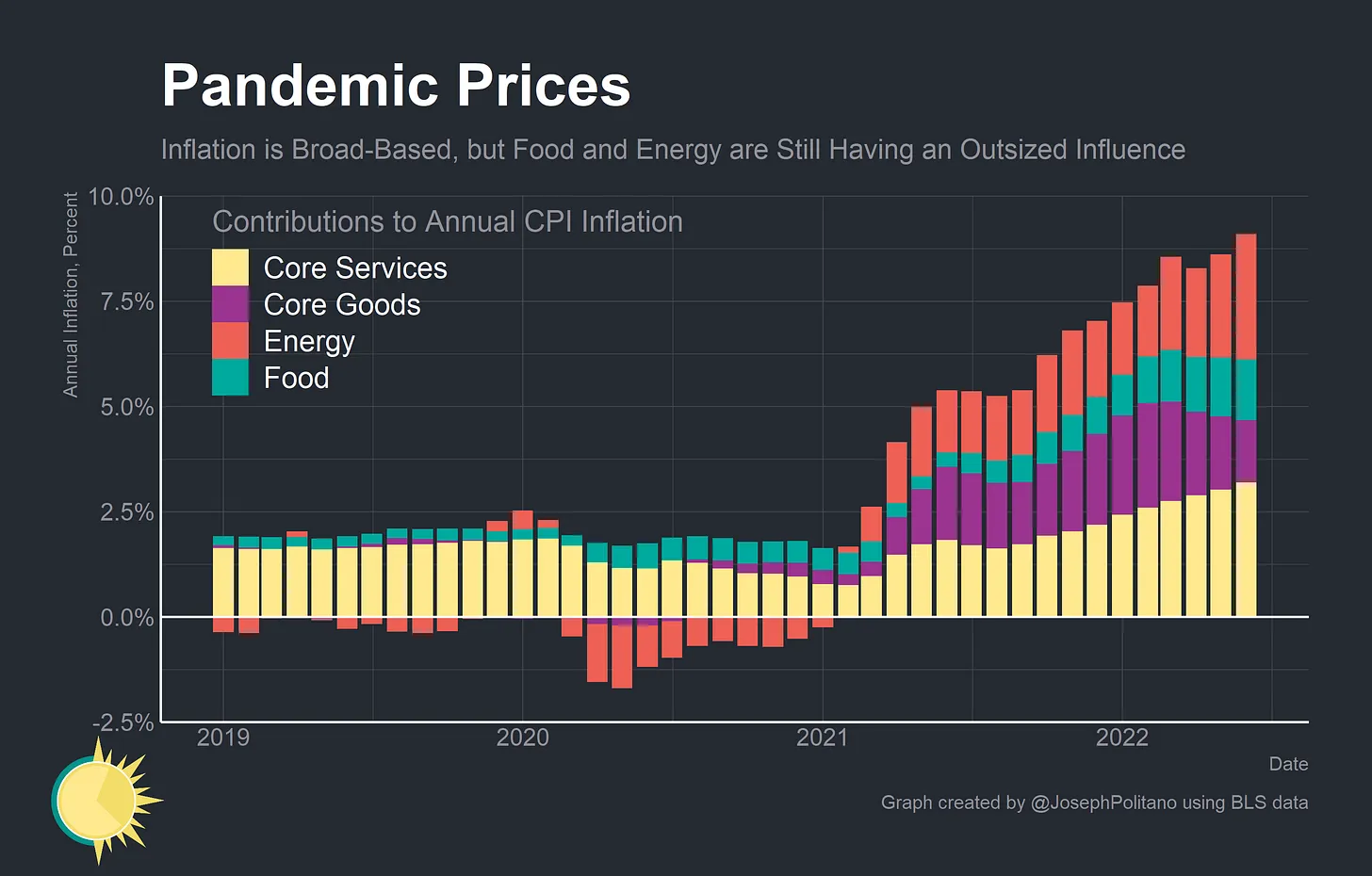
Joey has a nice graph on inflation composition.

Did anyone see this coming? Watch Jim Doti of Chapman University predict high inflation based on the money supply in his forecast back in July 2021.

Lastly, our experiment on wage cuts has been cited in these papers:

Intentions rather than money illusion – Why nominal changes induce real effects

Economic stability promotes gift-exchange in the workplace

Wage bargaining in a matching market: Experimental evidence

Can reference points explain wage rigidity? Experimental evidence

Shocking gift exchange