Journal Crisis at Games and Economic Behavior

I used Grok for this query because economists were discussing the issue on X(Twitter) this week and Grok would have quick access to that discourse. Note that Grok provided links to legitimate web sources, not just Twitter speculation. I am providing those same links in the place where Grok put them. I do not know how much the chatter of the week affected the response below.

Prompt from J. B. on 8/22/26 to Grok: What happened to the economics journal Games and Economic Behavior?

The leading game theory journal Games and Economic Behavior (GEB), published by Elsevier since its founding in 1989, remains active and is still publishing issues (including volumes into 2026), but it is in a major editorial crisis due to a mass resignation of its leadership. (https://www.sciencedirect.com/journal/games-and-economic-behavior)

In late July 2026, Editor-in-Chief Hervé Moulin (who had held the role since January 2021) was informed by Elsevier that his 3-year contract would not be renewed, despite his willingness to continue. Elsevier cited a desire to move “towards a closer alignment with Elsevier strategic priorities and publishing policies.” Requests for further explanation (from Moulin and then collectively from the other six editors) were dismissed; Elsevier simply asserted its contractual right to make the decision and began searching for new editors without input from the existing board. (https://gametheorysociety.org/message-from-herve-moulin-geb-editor/)

In response, by August 14, 2026, all seven editors (Moulin plus Sushil Bikhchandani, Aislinn Bohren, Nicole Immorlica, Roberto Serrano, Emanuel Vespa, and Nicolas Vieille) resigned with the required three-month notice. Nearly all of the advisory editors (the equivalent of associate editors) also resigned in solidarity. The outgoing team is handling papers already under review and new submissions until November 14, 2026 (with some flexibility for papers already assigned by mid-August); after that, they will only finish evaluations already in progress. Elsevier has publicly thanked Moulin for his service. (https://gametheorysociety.org/message-from-herve-moulin-geb-editor/)

The journal continues under Elsevier ownership (it is one of the two official journals of the Game Theory Society, alongside the International Journal of Game Theory). Community discussion has focused on the implications for the field, the role of commercial publishers, and possibilities such as launching a successor journal. Similar recent mass resignations have occurred at other Elsevier titles over governance and editorial control issues. (https://casrai.org/news/2026-editorial-board-mass-resignations)

In short, GEB has not shut down, but its longstanding editorial team has largely departed over Elsevier’s non-renewal of the Editor-in-Chief and related decisions.

Prompt from J. B. on 8/22/26 to Grok: What will be the implications for the reputation of the journal?

The reputation of Games and Economic Behavior (GEB) is likely to face significant short- to medium-term damage, with longer-term outcomes depending heavily on how Elsevier handles the transition and whether a strong successor journal emerges.

GEB has long been viewed as the leading specialized journal in game theory (and one of the stronger outlets in theoretical economics more broadly). Its prestige rests on attracting high-quality, creative work; the expertise and independence of its editorial team; rigorous standards; and community trust. The mass resignation of all seven editors (including Editor-in-Chief Hervé Moulin) plus nearly the entire advisory board in August 2026, following Elsevier’s non-renewal of Moulin’s contract, directly undermines those foundations. (https://gametheorysociety.org/message-from-herve-moulin-geb-editor/)

Short-term effects

  • Loss of trust and submissions: Top researchers often choose journals partly based on the known editors and the expectation of fair, expert handling. With the board depleted (current editors only fully process papers until mid-November 2026), many authors are likely to pause or divert submissions. Community discussion already includes calls for boycotts of the Elsevier GEB and support for alternatives. @Afinetheorem
  • Perception of publisher interference: Elsevier’s stated rationale (“closer alignment with Elsevier strategic priorities and publishing policies”) and its decision to search for new editors without board input have fueled views that commercial priorities overrode academic ones. This echoes other recent mass resignations (e.g., Journal of Approximation Theory at Elsevier, where resigning editors declared the journal “as we have known it has effectively ceased to exist”). casrai.org
  • Operational disruption: Delays in reviews, potential quality variation under interim or new leadership, and uncertainty can further erode confidence among authors, referees, and readers.

Metrics such as impact factor or AJG ranking (currently 3) change slowly and will not immediately reflect the crisis, but subjective reputation in the game theory and economics communities can shift quickly.

Medium- to long-term scenarios

Historical patterns from similar mass resignations offer useful analogies:

  • “Zombie journal” risk: The title, ISSN, indexing, and historical impact factor stay with Elsevier. If the new editorial team is perceived as less distinguished or more aligned with volume/publisher goals, submissions from leading researchers can decline, citation patterns can shift (sometimes toward more geographically concentrated or lower-prestige work), and the journal’s standing within the field can permanently weaken. Cases like Lingua (Elsevier, 2015) and others show that the brand can persist while the scholarly niche contracts. sciencedirect.com
  • Recovery path: If Elsevier rapidly appoints highly respected new editors who maintain rigorous standards and rebuild community confidence, the damage can be limited. Some journals have stabilized after board changes, though full restoration of prior prestige is uncommon when the exit was acrimonious.
  • Successor journal effect: Strong community interest already exists in launching a new outlet (possible names floated include variations on “Theory of Games and Economic Behavior” or society-backed alternatives; comparisons are drawn to how JEEA or other breakaways have functioned). If a credible successor is established—especially one endorsed by the departing editors and the Game Theory Society—and is treated as the “true” continuation by tenure/promotion committees, the original GEB’s relative prestige would likely decline further. Successful breakaways (e.g., Glossa after Lingua, or Imaging Neuroscience after NeuroImage) have often captured much of the field’s attention and high-quality papers. journalmetrics.org

**end of Grok responses **
If you want some chatter, you can put “GEB” into the search bar at x.com, LinkedIn, or BlueSky this week and see some more speculation.

There is a lot happening with publishing, including a huge shock of strangeness from the ability to both write and review papers with LLMs. Tumult will be normal. Read Mike on Will AI kill the research paper? or Mike on The actual AI problem in academic economics or Mike on Academic economists are overcommitted . The real perennial problem is that nothing is free but no one wants to pay.

Lastly, dear reader, you might wonder why so much of my post was AI-generated this week. I see this as burning my tokens so you don’t have to. You can find this with a free web search. Some people predict that “cheap AI” is coming to an end, so we might find it worthwhile to publish responses as well as prompts for each other. Regards, fellow humans and AI readers.

Intellectual Squatting

So a professor at a major institution wrote 200 papers last year. Unlike other commenters I’ve observed so far, I think this is neither true research nor pure AI fraud. It is likely AI “slop” to varying degrees, but unlike a lot of slop there is probably real value within it. What I have not yet seen ascertained is whether any of it has been vetted, investigated, or curated by the author in a meaningful way. The real question is: what is the actual ambition here? I think the tell is the lack of submission to peer review.

I think this is a form of intellectual squatting. The nice version is it’s putting out a series of half-baked papers in the hopes of establishing a property right to the underlying ideas at an earlier stage of the research process than previously possible. The less generous interpretation is it’s dumping a series of haystacks on the plains and laying claim to the needles probabilistically within each. Imagine you are a person who has highly esoteric, potentially important ideas every day. Many of those ideas you suspect, based on some combination of experience and ego, are new in at least one dimension. You would like to get credit for that newness. For being first. What’s the problem?

The problem is that scholarship remains more perspiration than inspiration. Having a new idea is great, but it takes years to work through the nuance in sufficient detail that you can convince your peers of the coherence and originality of the contribution. During the minutes each day you are not working on this singular project you have the inspiration for other ideas, sometimes multiple within a single day. How frustrating is the proposition that someone else gets credit for the originality of contribution just because they had time to reveal it to the world while you were embroiled in your investigation of what is only one of your many score ideas!?

Ah, but meta-level inspiration has struck you! What if you took each one of those ideas, spent an hour curating a series of prompts around it, and then let Chat GPT (or another LLM) fabricate an entire research paper around it? It might not be good, correct, or even coherent, but it does somethine far more important. It establishes an intellectual property right to the claim of being first. Now, to be clear, you are fully aware of the deficiciency of your paper as an actual scholarly contribution, but if somone else writes a full paper you at least have something to point to and say “I was here first. Cite me. Hell, if I’m close enough you might even have to name it after me. Well, sure, us. But definitely include me. Glory shared via hypenhnation is better than no glory at all.”

Is it a contribution? That’s something that will vary on a case-by-case basis, but I expect far more misses than hits. The work isn’t there. It’s like plopping down a block of marble with a dramatic-ish sketch of a man on an adhered post-it note and claiming that Michaelangelo needs to share credit with you on any subsequent sculptures. It’s like asking people to cite that one cool tweet you did about how DNA is cool but maybe RNA could be useful in vaccines one day. Intellectual property rights trolling via AI blunderbuss.

BTW, I’m not 100% sure this isn’t an AI take on a modern Sokal hoax. An attempt to show how much AI slop is introducing a whole new version of Gresham’s Law to scholarship. But if we treat it as earnest, it’s proof that a very smart person can potentially disrupt the market for scholarship, patents, or any other intellectual property by laying claim to ideas in much the same way that the printing press undermined the market for plenary indulges. Flood the market, leave it to someone else to sort through the ecumenical consequences.

Getting Music On Streaming Is Surprisingly Easy

Before recording and broadcasting technologies, there was no way for people all over the world to hear the same music performance- you had to be in the same room as the performer. Even when I was growing up, distributing your worldwide meant getting a record deal, something few could do. But the modern internet allows for music to easily be uploaded from anywhere, to be listened to anywhere.

For artists, this means to problem shifts from just being available, to standing out to listeners among the sea of available music. How best to do this- other than making great music- is a complex and detailed question of marketing. But one crucial early step- getting on the right streaming platforms where artists make their money– is now surprisingly simple and easy.

Source: My image made from Chartlex data

Amateur artists tend to start with what is free- uploading their music directly to Youtube or Soundcloud. But huge numbers of listeners are on streaming platforms like Spotify, Amazon Music, or Apple Music. These don’t allow artists to upload music directly, which can make listeners or new artists think that getting on streaming platforms is a bit like getting a record deal in the old days, where an industry insider needs to approve the artists. In fact, approval for streaming now mostly runs automatically through third-party music distributors.

Adding third parties into the mix sounds complicated, but in fact they are easy for artists to work with, and a single distributor can get your music onto all major streaming platforms at once. Here’s how the page for uploading a song starts at the largest distributor, Distrokid:

There are many distributors; Spotify currently recommends 21 that work directly with artists. Distributors charge artists, but not very much. Some charge by the song or album (CD Baby does this, starting at $10/song or $15/album), others let artists upload unlimited songs for an annual fee (DistroKid does this, starting at $25/yr). Distributors also collect royalties from streams on behalf of artists. To me this looks like a no-brainer for any semi-pro musician who is out there playing some gigs, but also makes sense for stronger amateur artists looking to expand their reach* (for professionals with record deals, of course, the label will do this for you).

For an academic comparison, getting your music out there is now less like hoping an insider likes you or your work enough to invite you to NBER, and more like just uploading to SSRN (if SSRN charged a small fee).

All this is a long way of saying- you can now find my son’s piano compositions on all the streamings (Spotify, Youtube / Youtube Music, Apple Music, Amazon Music).

*At least if you write your own songs- buying the rights to distribute covers costs extra (e.g. $12 per song per year for DistroKid), and on streaming people can listen to the original artist just as cheaply and easily, so there’s not the same niche for cover bands that there is in live music.

Welcome Back to School: Potential College Students are Now Declining

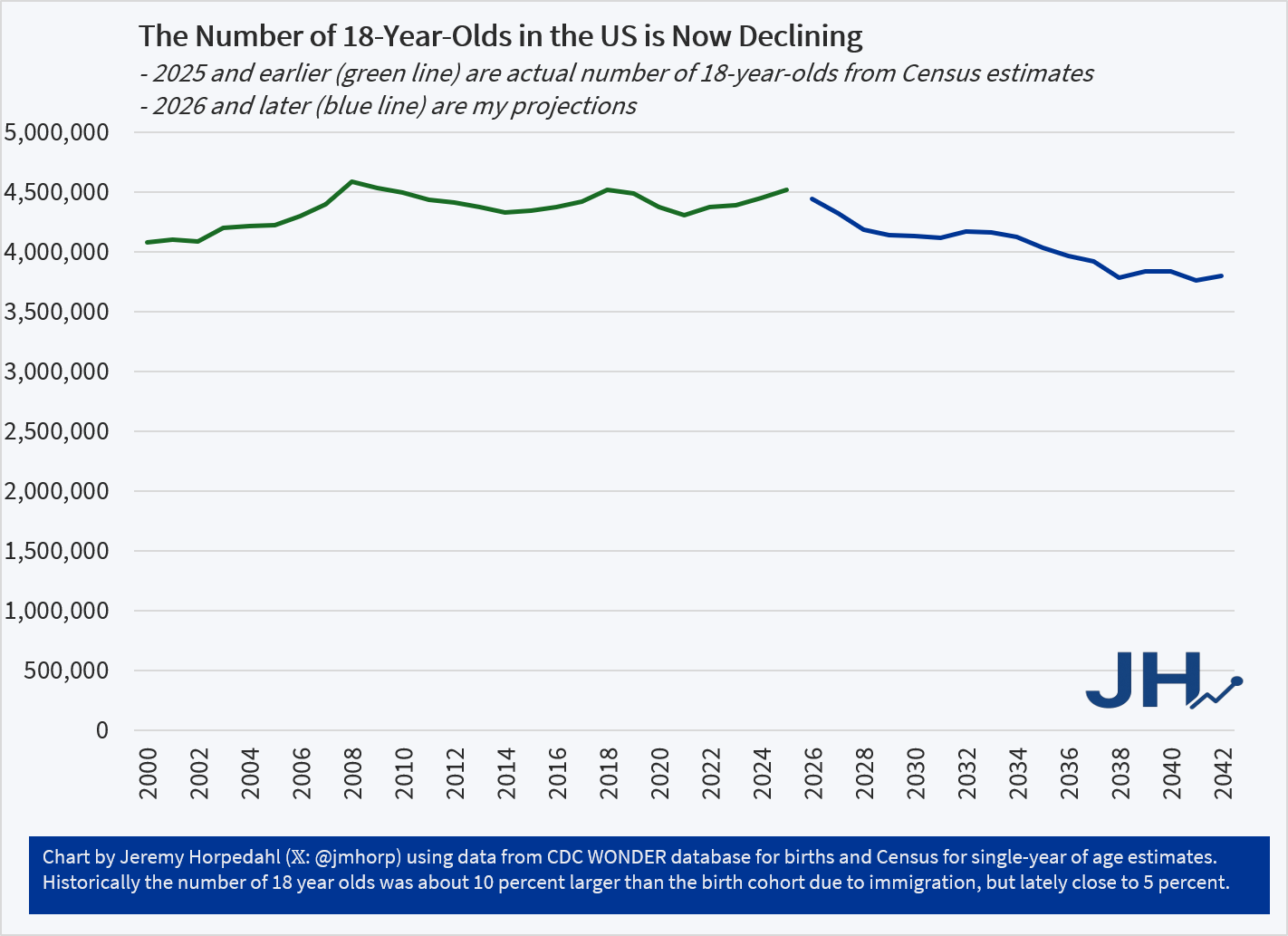
If you have spent any time around higher education lately, you have probably heard of the “demographic cliff” or “enrollment cliff” for years now. Well, it’s finally here. In terms of total number of births, the US peaked in 2007 at a little over 4.3 million births. That’s the highest year ever, even higher than the peak of the Baby Boom (not in terms of fertility rates, of course, I’m just talking about absolute number of births).

Babies born in 2007 turned 18 in 2025. But after 2007, births started to fall. In 2025, there were just about 3.6 million births, a decline of about 700,000 babies since 2007, or a 16 percent decline. The number of 18-year-olds won’t be exactly the same as the number of births in a given year: it’s actually usually a bit higher, as net immigration is much larger than the small number of children that die before they reach 18. For example, the 1982 birth cohort had 3.68 million babies, but 18 years later in the year 2000 there were 4.08 million potential college students.

Historically there have been about 10 percent more 18-year-olds than the birth cohort, but lately (2021-2025) it has only been about 5 percent higher than the birth numbers.

There are, of course, all kinds of social, economic, and political implications of falling births. I just want to mention one that is specific to the industry that I work in: potentially falling college enrollment. And because this enrollment will not be uniform across states and universities, this will cause serious budget issues for many colleges in the coming years.

Some folks in higher ed have lately been asking when the demographic cliff will hit. It’s here:

WWII Strategic Initiatives 6. Fort Commander’s Lonely Decision Saves Norwegian Government from Capture by Germans

At 4:21 a.m. on April 9, 1940, a 64-year-old Norwegian colonel six months from retirement had about ninety seconds to decide whether to start a war.

Birger Eriksen, who entered Norwegian military service way back in 1893, commanded Oscarsborg, a sleepy coastal fortress on a rocky island in the Oslofjord, armed with three 28cm (11 inch) Krupp guns dating to the 1890s – – plus a secret weapon the Germans didn’t know about: torpedo tubes from 1901. His garrison was mostly reservists conscripted a week earlier. Out of the pre-dawn dark came six unlit, unidentified warships steaming toward Oslo.  Norway had assumed that its diligently neutral stance would avert any foreign attack, and so was lax about maintaining coastal surveillance. The ships could have been British. Firing on the wrong flag meant international catastrophe; not firing, if they were German, meant the capital fell before breakfast.

Colonel Birger Eriksen, the commander of Oscarsborg on 9 April 1940.

Eriksen had no orders from Oslo and no time to ask. He gave the command anyway, reportedly saying: “Either I will be decorated, or I will be court-martialed. Fire!”

The lead ship was the Blücher, a brand-new 16,000-ton heavy cruiser packed with troops, Gestapo officers, and administrators meant to seize the king, the government, and Norway’s gold reserves in one stroke. Two shells from the fort tore into her at point-blank range, followed by torpedoes into her flank. Within ninety minutes she rolled over and sank, taking hundreds of men down with her. The German attack on Oslo was not completely averted, but it was significantly delayed and hampered.

German Heavy Cruiser Blücher (Image by Bundesarchiv)

That single decision to attack the invading fleet bought Norway’s government just enough hours to flee Oslo by train with King Haakon VII — and to load 53 tons of gold bullion onto trucks barely ahead of the advancing German columns. The gold made it out to Britain via a harrowing overland and sea relay; the government reached London and kept functioning as a legitimate exile authority, which gave the Norwegian resistance something to fight for rather than just against. Also, Norway had an enormous (~1000 ships) merchant marine fleet, and the intact, legitimate Norwegian government in exile ordered it into the service of the Allies, right when Britain desperately needed ships and sailors to transport cargo to stay in the war.

The strategic hangover lasted five years. Hitler, rattled by the loss of the king and by ongoing Allied fake Scandinavian invasion plans, garrisoned Norway with somewhere around 300,000–400,000 troops for the rest of the war. This was a staggering commitment, sitting largely idle when they could have made a decisive impact elsewhere. One old colonel, one hunch, one order — which tied down a whole German army guarding a country it barely needed.

This is the sixth in a series of occasional blog posts on individual initiatives that made a strategic (not just tactical) difference in the course of the second world war, an event that gave us the world of the second half of the twentieth century. Here are previous posts:

WW II Key Initiatives 1: FDR Prodded the Navy to Convert Cruisers to Carriers, Just in Time

WW II Key Initiatives 2: “Thatch Weave” Tactic to Counter More-Agile Japanese Fighter Planes

WW II Key Initiatives 3: Kurt Tank Gives Germany a Superior Fighter Plane, the Focke-Wulf 190

WW II Key Initiatives 4: Building Hundreds of Small, Slow, But Cheap Ships to Counter the U-Boat Threat

WWII Key Initiatives 5: General Zhukov Helped Save USSR By Mastering the Pincers Counterattack

First Derivatives

Lebron James is obsessed with golf. His new YouTube channel is what is getting the most attention, but this has been a publicly known fact for a while. There’s even a (largely unevidenced) theory that he chose to play his potentially final season in Philadelphia for it’s proximity to elite golf courses.

I just want to take this time to deconstruct why Lebron’s golf obsession is interesting. It’s a reminder that first derivatives often matter more than both absolute values and higher order derivatives. Let me explain.

Lebron at 41 years of age, in the face of history, experience, and logic, is still one of the 20 very best human beings at basketball in the world. So, in terms of absolutes, playing basketball should still give him immense satistfaction. The problem, of course, is his personal reference point (how good he used to be) and the rate of decay he is experiencing from that reference point. This is a person who spent more than two decades getting better and better at something, who arrived at a point where they were literally the very best in the world at it, only to then at some point in time arrive at the awareness that they were in fact getting worse at it. To be clear, that rate of decay is far slower than anyone could have predicted, but it remains decay nonetheless. And it’s not just “getting worse”. It’s getting worse at something that you are orienting your every day around. Your meals, your sleep, your family life, everything, all in dedication to something you are getting worse at.

I’m now going to generalize from my own lived experience, but I think the emotional returns to dedication are always stronger when the first derivative is positive, but no amount of work can guarantee it. You can work harder and increase the positive gains or, failing that, slow down the decay, but at some point the decay is inevitable (i.e. the work shows up in the second derivative). And no matter how much you slow it down, decay just isn’t as satisfying as the day-to-day lived experience as improvement or even plateauing.

And this is where golf comes in. Golf is a sport that has much lower athletic barriers to entry and, for Lebron or anyone who is starting out, a vastly lower reference point for quality. It is entirely likely that every time Lebron has ever picked up a golf club he is better at golf than he was the previous month. It is the 100% inverse to what Lebron has experienced playing basketball for at least 7 or 8 years now, likely longer. The relief he must feel, directly experiencing and observing the returns to his efforts.

Coming to terms with being past your prime is a standard trope in narrative fiction of all formats, but from an actual mental health point of view, I don’t think it is given enough attention, particularly for those at the tops of their field. There are vanishingly few purely natural elites in any profession, vocation, or craft. Most have had to sacrfice whole avenues of life experiences to achieve such levels, and when they do begin to decay they either have to endure public scrutiny bordering on censure, or the quiet tragedy of being alone in their ability to discern just how much they have lost. The latter is almost worse. Almost.

As a final tidbit, let me make a loose connection to technological innovation and AI specifically. Obsolescence hurts. A negative first derivative hurts. But what hurts even more is an unexpected shock that accelerates that decay. Injuries are mentally hard for athletes, in part, because of their often discontinuous nature. They were still improving, the rate at which they were improving was accelerating, until they weren’t. There are professions that are wrestling with this right now. There are professionals who reasonably expected to have another half decade before the decay began. That timeline is now in question. And most of us don’t have the luxury of being a generationally great athlete who can immediately become great at something completely new.

Predicting Social Media from 1997

At a rummage sale, I picked up a book by cartoonist Scott Adams called The Dilbert Future: Thriving on Stupidity in the 21st Century published in 1997. I thought I might find a clever prediction about the future, which we can now verify from the standpoint of 2026.

The text of the book is mostly dumb. I get the impression that Scott Adams was making easy money with a guaranteed humor book contract. I don’t recommend the book to anyone.

HOWEVER, with my paper copy I kept skimming ahead to see if any of his predictions about the future were impressive. Finally, on page 200 I found something.

Recall, the internet only became publicly available in the early 90’s. Respectable newspapers might have started to lose out to cable news in the mid-90’s. Blogs did not start until after Adams’ book was published. Social media proper (marked by the launch of Facebook) started in 2004. (Let millennials quietly walk away from Xanga journals and pretend that never happened.)  So, my interest in this passage hinges on the fact that this book has a publication date of 1997.

The following is copied from Adams’ humor book.

I predict that news outlets will try to compensate for the loss of relevant news by focusing on stories that are more shocking and depressing than ever. At least that way they’ll get your attention and sell advertising even if the stories aren’t “news” in the traditional sense.

This will limit the reporting to a few stories per year about famous people who are killing other famous people. And if there are not enough of those stories to sell advertising slots, the media will…

Prediction 51: In the future, the media will k*** famous people to generate news that people will care about.

The end of traditional news outlets will not limit people’s access to information. Thanks to the ubiquity of video cameras and the Internet, every citizen will be a reporter. If something happens in your neighborhood, you’ll tape it, stick it on the Internet with your own commentary and make it available to the world… The weather reports will be computer-generated and constantly available by computer, pager, voice-mail… All news gathering will be disaggregated.

Prediction 52: In the future, everyone will be a news reporter.

People will have access to software that constantly combs the internet for “small” news that is relevant to them.

…

your software will be able to do a sort of “credibility credit check” on any person who posts information to the Internet… This won’t be foolproof, but nothing is.

This new model depends on people being willing to take the time to put information on the Net without the benefits of payment. Why will people do that? They will do it because that’s our most basic human nature: People like to talk more than they like to listen.

Joy again: Not bad as predictions go. Notice the quaint terminology, such as “tape it” and pagers. (Pagers use radio networks instead of cell towers.) Attention is scarce, and writing is not (even pre-LLM). Adams predicted what I call poastmodernism.

High Income Rentals are Low Income Rentals

Have you heard about the abundance movement? It basically says that we should enact a mix of regulatory and supply side reforms in order to produce more for everyone, especially the least economically advantaged. The reforms extend to the housing market and ensuring adequate housing.

There’s an argument that building any housing, even at the high end, can reduce the cost of shelter for everyone – even people who would never live in the newly built housing. The idea is that high income people switch to the newly built housing and leave less attractive housing. Someone else in that high income bracket snatches up the older place, leaving their prior housing vacant. The vacancy shuffles around high priced rentals until, ultimately, the vacant rental price must fall in order to attract a renter, such as someone further down the income distribution. Then the entire process continues, with the game of vacancy musical chairs working its way down the renter income distribution.

The more overlap that there is between housing consumption choices the quicker there is an impact on lower priced housing.   If you think that high income people consume higher priced housing, then you might think that there is a substantial difference between housing consumption choices and that it will take a long time for this ‘trickle down’ to get to the people who need it most. If income groups compete more for the same housing, then the effects on price will occur sooner for the lower income people.

How much Rental Overlap is there?

Miami, Florida has some of the highest housing costs in the US. Below is a histogram of annual rental costs in Miami by household income quartile (ACS 2024).   I restricted the data to positive incomes and rents and the highest rents are censored down to $98.4k annually. First, we can definitely see that the highest incomes (quartile 4) have the most censored annual rents and that the 1st income quartile (lowest) has the most annual rent payments nearer to zero. So, the histograms make sense in that way. But I was surprised by how much overlap there is. Different income quartiles are consuming many units in the same price range!

Continue reading →

Bubble Worries Mean Diversify…. But How?

Mike is concerned that US stocks could be a bubble, as are many others:

if we take parallels to the past seriously, there arises the question of whether a 40 year old with a 100% index fund portfolio should consider hedging/reallocating their portfolio a decade sooner than they planned on becuase, well, just look at that [CAPE] chart.

But what to do about it?

So, seriously. Are we hedging? And what are we hedging into? Asking for a friend. Who is an economist. And also me.

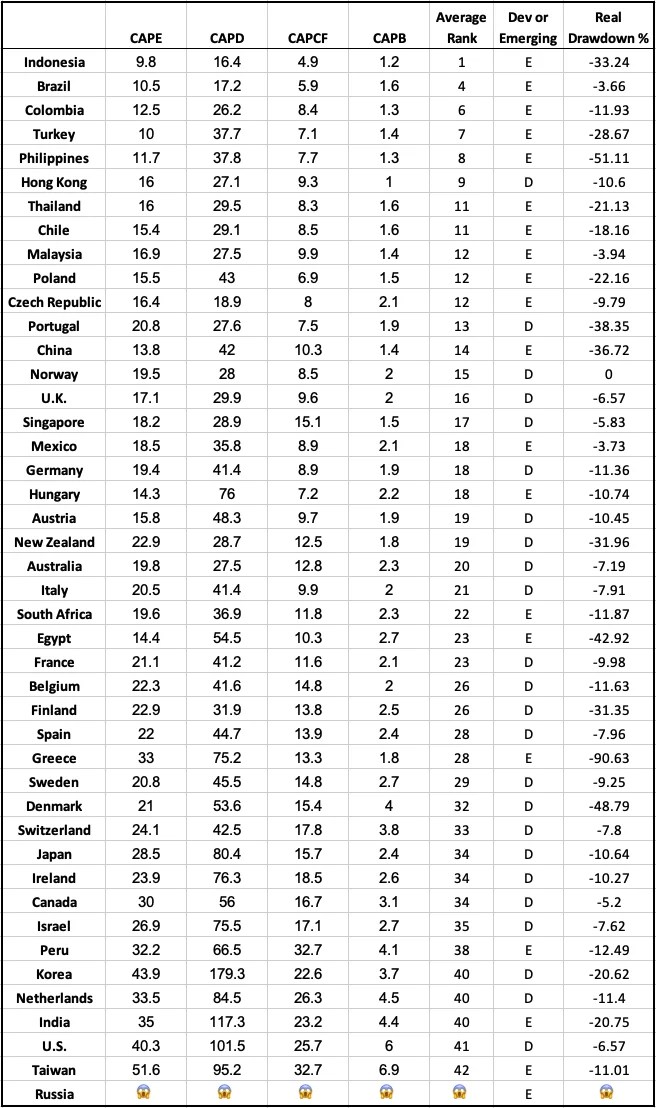
My answer: I’m diversifying into global stocks, which tend to be much lower-priced: 

Source: The Idea Farm, Global Valuations Update July 2026

But how do you practically do this?

A simple and cheap way to get a highly diversified basket of global stocks is VEU (Vanguard ex-US). Over 3000 stocks from around the world, P/E of 19, rock-bottom fees. One disadvantage for diversification purposes is that its biggest 5 holdings make up 12% of the index and they are all AI-related.

If you’re willing to make more concentrated and specific bets in order to get even cheaper, here are some other foreign indices I like:

  • FRDM (Freedom 100 Emerging Markets ETF): Invests in emerging markets with the highest economic freedom ratings. I love the theory & it’s performed very well for me & its overall PE is a reasonable 17, though it’s largest holdings are in Taiwan and South Korea, so not a good way to get away from AI.
  • ILF (iShares Latin America 40): Invests in large Latin American companies. P/E 11 with low AI exposure.
  • FYLD (Cambria Foreign Shareholder Yield ETF): Invests in high-yielding companies in developed countries outside the US. Measures yield using stock buybacks in addition to dividends. This serves as a value screen that keeps PE low (currently 13) and avoids expensive sectors like AI.
  • EYLD (Cambria Emerging Shareholder Yield ETF): Same idea as FYLD but for emerging markets. Current PE 12

I also hold single-country indices for Japan (FLJP, PE 20), Poland (EPOL, PE 13), and India (EPI, PE 17). These are probably riskier than the broad indices above, but still fairly diversified across companies.

While foreign stocks are my preferred hedge, there are many others. For US stocks there are small-cap or value indices, or just buying individual stocks you like (not necessarily crazy). The 20- and 30-year US treasury bonds are intriguingly yielding over 5%, though between my age and my inflation concerns I don’t own any. TIPS are much more attractive, yielding 2-3% over inflation, I don’t own any yet but I’m considering it. Gold indices like IAUM are another good hedge.

Of course this isn’t necessarily a bubble that will pop any time soon, or at all- AI is a real technological advance- so between that & general efficient market principles I don’t think the answer is to sell everything & go to cash, much less short the market. But Mike is right to ask how to hedge, and I think anyone holding ~100% US stocks should consider diversifying.

Disclaimers: Not investment advice, I hold some of the indices named.

Everything At the Grocery Store is On Sale Relative to 1980

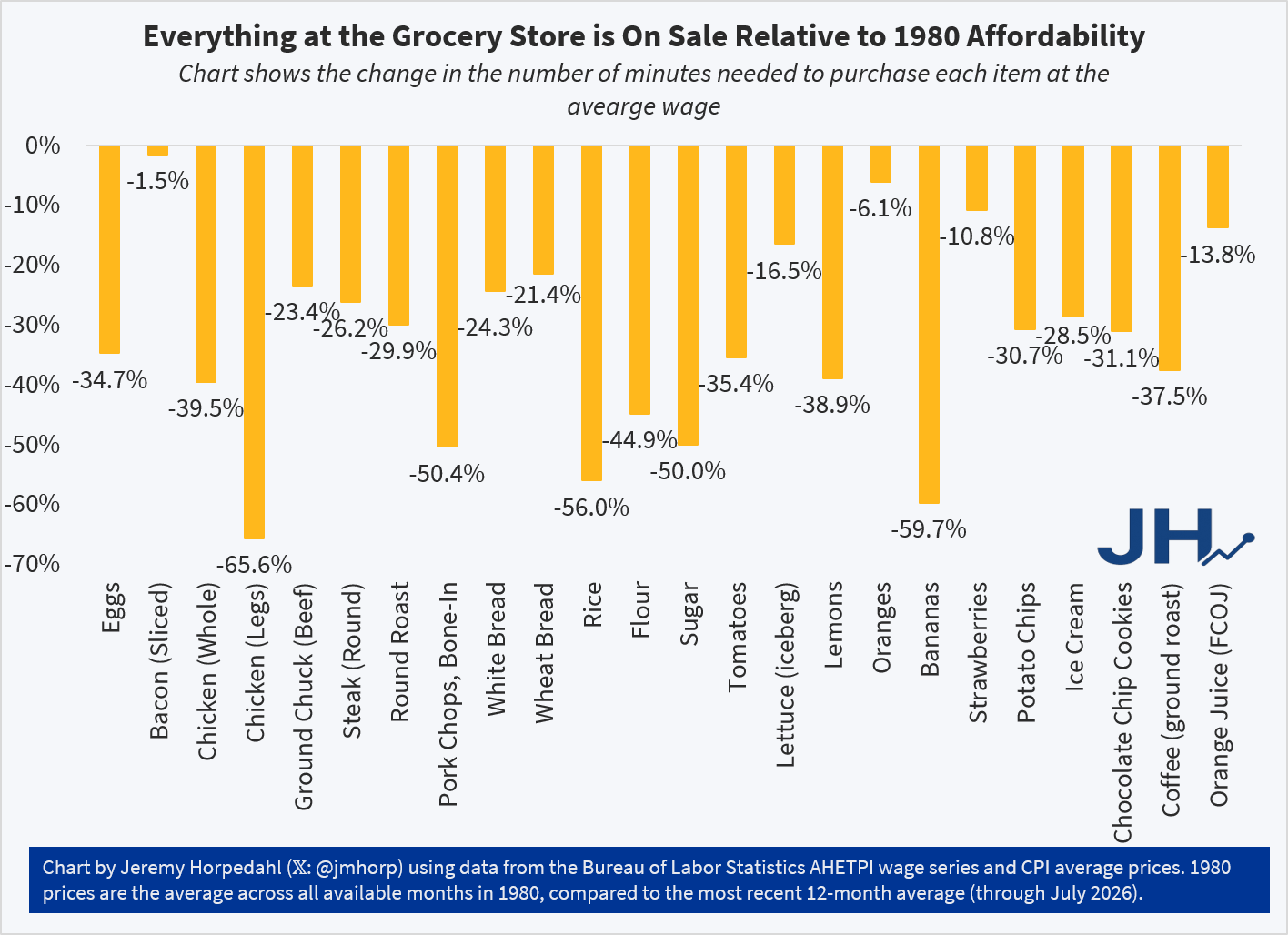
Back in May 2024, I wrote about grocery prices in 2024 compared to 1980. Relative to average wage increases, almost everything was more affordable — the one exception was bacon.

Grocery prices have continued to climb since 2024, but so have wages. What does the comparison look like now? Well, I have good news for bacon lovers:

Figure 1

The chart shows the change in relative affordability, as measured by how many minutes of work at the average wage it would take to purchase the item (using consistent product sizes and weights). As I wrote in that 2024 post, these are not items that I cherry picked. These are all 24 grocery items where BLS has price data in both 1980 and 2026 (out of about 150 items total). Perhaps there is some survivorship or selection bias as to which items are available in both years, but looking at the list this seems like a pretty reasonable shopping cart for a typical consumer (well, maybe there aren’t buying all the meats every week, but probably every month). The prices are updated through July 2026, with the CPI data just released this morning.

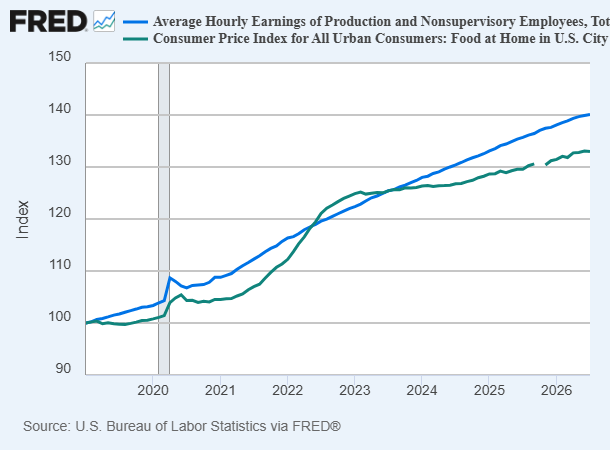
While I have used average wages here, that isn’t a trick. We don’t have a median wage for 2026 yet, but using a measure of median earnings you can see that average wages and median weekly earnings increased at exactly the same rate since 1980.

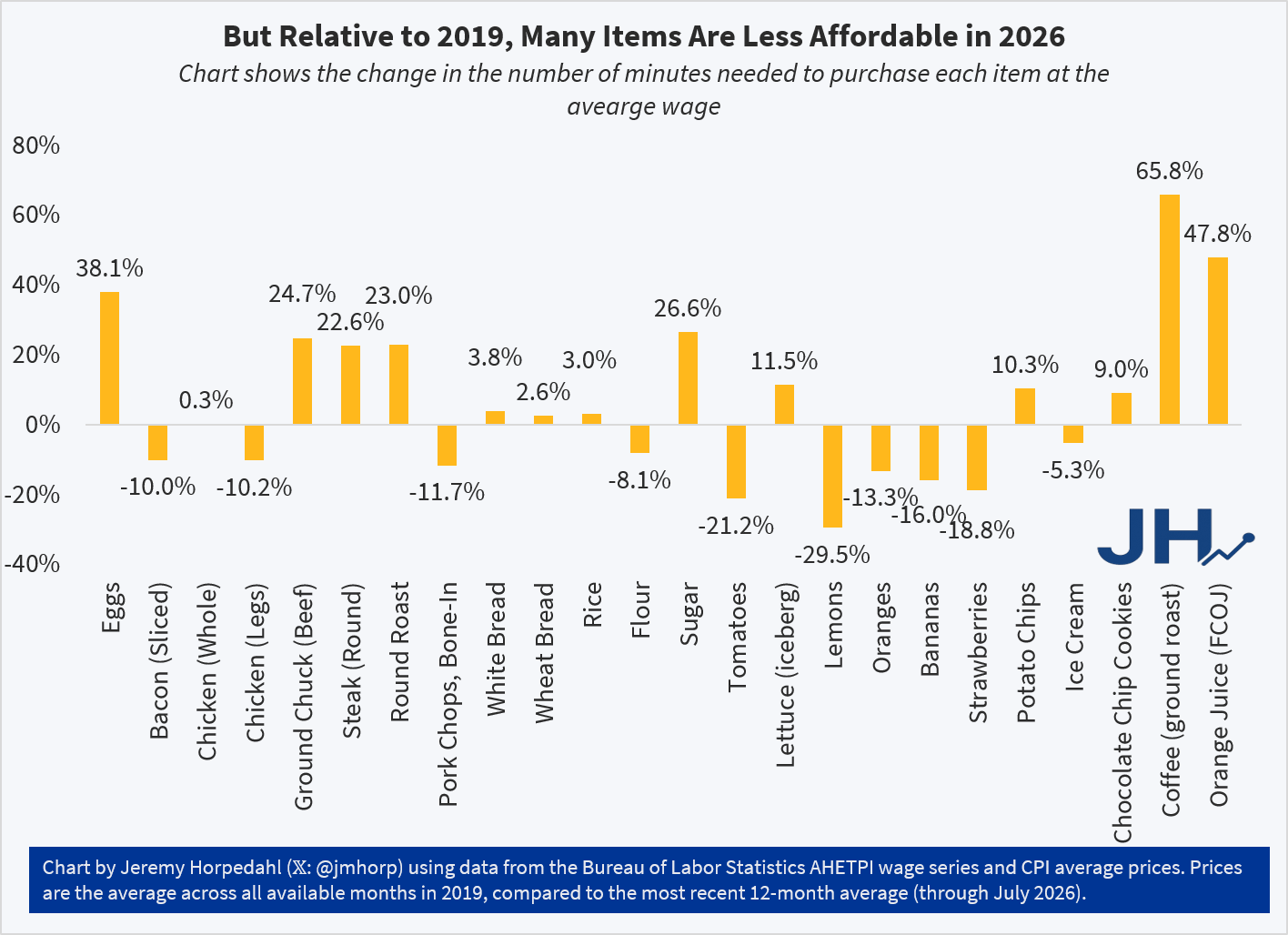
But consumers probably aren’t thinking about prices relative to 1980. Their time horizon is likely shorter. What if we made the same comparison to 2026 using the 2019 prices, which is right before the pandemic and within most shopper’s recent memory:

Figure 2

Relative to 2019, things do look quite as rosy. Some items are “on sale” in terms of affordability, but a lot of items aren’t, especially a lot of proteins. And no doubt many consumers will focus on the items that are less affordable, rather than those that are more affordable (and even for these items, the nominal price is higher, so consumers might still be frustrated).

It is important to note that this basket of 24 items isn’t a perfect representation of all the items consumers purchase. Compared to the CPI “food at home” index, average wages have actually increased more since the beginning of 2019. But consumers are right to feel that beef and few other items are much less affordable than 2019, even if over the long run they are more affordable.

Figure 3