I keep reading and hearing people who are waiting for the shoe to drop on the next recession. They see high interest rates and… well, that’s what they see. Employment is ok and NGDP is chugging along.
One indicator of economic trouble is the delinquency rate on debt. That’s exactly what we would expect if people lose their job or discover that they are financially overextended. They’d fail to meet their debt obligations. But the broad measure of commercial bank loans is quiet. Not only is it quiet, it’s near historic lows in the data at only 1.25% in 2023Q2. Banks can lend with a confidence like never before.
But maybe that overall delinquency rate is obscuring some compositional items. After all, we know that many recessions begin with real-estate slowdowns. Below are the rates for commercial non-farmland loans, farmland loans, and residential mortgages. All are near historical lows, though there are hints that they’re might be on the rise. But one quarter doesn’t a recession make. I won’t show the graph for the sake of space, but all business loan delinquency rates have also been practically flat for the past five years.
The RWI − Leibniz Institute for Economic Research has funding for researchers to replicate papers in development economics:
RWI invites applications for several positions of Replicator on a self-employed basis to conduct a robustness replication of a published microeconomic study in the field of Development Economics. The successful applicant will work with us on the project “Robustness and Replicability in Economics (R2E)”, funded by the German Science Foundation (DFG) Priority Programme “Meta-Rep”….
The ultimate goal is to contribute to the ongoing debate about replicability and replication rates in eco- nomics. We collaborate closely with the Institute for Replication (I4R). All robustness replications will contribute to a meta-paper summarizing the collective findings. We plan to publish this meta-paper by the end of 2024, and all replication fellows will be co-authors….
The position starts as soon as possible and is limited to six months. The work can be done fully remotely. The applicant will receive compensation of 2,500 € gross in total, possible distributed in installments based upon predetermined deliverables. Additionally, replication fellows will be listed as co-authors on the meta-paper. At the conclusion of the project, it is foreseen to gather all fellows for a final workshop at RWI in Essen, Germany.
I don’t know the team here but I’m alwayshappy to see more attempts to make economic research more reliable. The funding and the planned publication make this potentially a good deal for applied microeconomists, especially grad students. Full details are here (warning: PDF).
Last week I gave some advice on how to save money on food. Food prices are up a lot in the past 4 years, but especially since the beginning of 2021. Over the 32 months since January 2021, grocery prices (according to the CPI) are up 20 percent (keep that number in mind). To give you an idea of how unusual that is, in the 32 months before the pandemic (up to January 2020), grocery prices only rose 2 percent. Perhaps even more astonishingly, if we look at October 2019 grocery prices, they were slightly lower on average than 4 years earlier in October 2015. From a flat 4 years to a 25 percent increase over the next 4 years. That’s a huge change for consumers.
But we also shouldn’t overstate the price increases. As you might guess, the best place for overstatements is social media. You can find plenty of them. For example, this very viral video claims that her family’s grocery prices doubled (in fact, almost exactly doubled, to the penny, which is suspicious) in just one single year, from August 2021 to August 2022. According to the CPI data, grocery prices were up 13.5 percent over that period — which, don’t get me wrong, is a lot! But it’s not 100 percent. I’ll focus on this one example, but I’m sure you will believe me that you can find dozens of examples like this on social media every single day (for example, yesterday someone claimed bread prices had tripled since 2019).
Let’s leave aside for a moment that in that viral video she claims to spend $1,500 per month on groceries. This would be a massive outlier for 2022. A family in the middle income quintile spent $460 per month on groceries in 2022, and $713 on all food including restaurants. So even if this family eats every single meal at home, they are still spending twice as much as a middle income family. Even a family with 5 or more people (the largest bucket BLS uses in that report) spent $755 per month on groceries ($1,232 on all food). According to the Consumer Expenditure survey, the middle quintile grocery spending went up 16%, and the five-person household went up 19% from 2021 to 2022. Big increases, no doubt! But not 100%.
So who are we to believe? Have prices roughly doubled since 2021? Or are they up about 20 percent? People are sometimes skeptical of the consumer price index, so let’s look at the actual price data that goes into the index. BLS has data on hundreds of individual food items, but here’s a summary chart with eight common food items. Here’s the change in the prices of those items since January 2021:
The other day I was chatting on Zoom with a friend. She noted that she and a couple of girl friends go on an interesting vacation each year. They start off by each of them writing down their top three destinations, and then comparing notes. This year, it is a tour of the Danube region.
Thinking of a similar “Where do we go next year for kicks, guys?” scenario in the movie City Slickers, I jokingly suggested running with the bulls in Pamplona. That is kind of a guy thing (50-100 injuries each year, occasional fatal goring), but it triggered a comeback from her: “Well, maybe the tomato festival instead.”
So of course I started poking around the internet to see what was up with tomato festivals. They sounded less than exhilarating, on a par with a midwestern pumpkin growing contest. Now, in Lancaster County, PA (Amish country), some of the tomato festivals feature..wait for it….a bounce house! That’s nice, but maybe not worth a plane flight to get there.
Nashville goes all out with their Tomato Art Fest, with food vendors, live performances and people walking around costumed as giant tomatoes. This year’s theme was, ““THE TOMATO: A Uniter, NOT A Divider! – Bringing Together Fruits & Vegetables.” In Leamington, Ontario they get really physical by putting a layer of tomatoes in kiddie pools on the ground, so you can take off your shoes and socks and step in and squoosh those tomatoes under your bare feet. Woo hoo!
But it turns out the real action is La Tomatina in Bunol, near Valencia (Spain). Excitement builds as truckloads of ripe tomatoes are brought into town:
Then there is the greasing of a tall pole with lard; a ham is perched at the top of the pole. And then (since the pole is unclimbable), enthusiastic people pile their bodies up around the pole till someone can reach the top of the pole and cast down the ham, whereupon a signal cannon fires.
That is the signal for total mayhem to erupt – 20,000 people (you have to buy a ticket beforehand) hurling tomatoes at each other, until the whole town square is deep in squishy red pulp. Participants are asked to hand-squash each tomato before throwing it.
After an hour, a second cannon fires to signal cease firing. Local residents may hose you off, or you can go wash off in the river. (Tips include bringing a change of clothes, because you aren’t allowed on the train or bus with your gooey clothes). Afterward, the firetrucks come and hose down the town square. Reportedly, due to the annual rinsing with acidic tomato juices, the town streets appear remarkably clean. During the days leading up to the main event, there are local parades and tours and a paella cooking contest. (Paella is an amazing local rice-based dish, worth of a blog article of its own)
So if you want to do something memorable in Spain but you are too lazy to walk 500 miles on the Camino de Santiago pilgrimage, or you are too chicken to run in front of a crowd of angry bulls, put La Tomatina on your bucket list.
Housing remains the most expensive monthly outlay for most Americans. There are signs of things getting better, but the fact remains that for those living within the first or second ring of suburbs surrounding a given city, space is at a premium. For this holiday season, give the gift of not taking up any more of that precious, precious space.
Don’t give them instant pots or juicers for their already full kitchen counter. Don’t give them clothes to go in their overflowing closets. Don’t give them knick knacks, tschotckes, or decorative thingamajigs that will rapidly migrate from shelves to bins to (shudder) storage units. Don’t get them stuff.
I’m not going to say get them “an experience” because we’ve all become a little weary of that cliche. What I suggest is getting them a luxury that might fall at the margins of their budget. Get them a massage. A facial. A stretching session (that’s a real thing). If they line wine or whiskey, get them a bottle they’ve never tried. The stuff they already like is easy, but my expectation is that is probably already in their budget. Gift them the risk of trying something they might not like.
Books are acceptable because there is an entire ecosystem that exists that take books from one home to the next once it has been read. Get them a subscription to Amazon Music or a download code for a new game on their PlayStation. Get them tickets to a concert or play. Get them a two hour cleaning service.
Babysit their kids for a Saturday. Tell them their hair looks nice and really sell it that you mean it. Leave them alone for a couple days so they can recooperate from a long week. Just no more stuff please.
This is the 4th year in a row that the crew has put together some recommendations on products or books that we actually use, for your consideration in holiday gift buying. I’m going to put things into categories of Stuff for Adults, Kid’s Toys, Books for Adults, and Kid’s Books
Stuff for Adults (Men can be hard to shop for, so this might save Christmas!)
Scott says these scissors are amazing: “Fiskars 9 Inch Serrated Titanium Nitride Shop Shears”, available from Amazon here. Unlike some thick, heavy, or stubby heavy-duty shears, these have the feel of regular scissors, with fairly long, narrow blades. The handles are fairly substantial, and very comfortably contoured to the hand/thumb. The real magic is in the blades. They are sharp, with a very hard titanium nitride coating. Also, they have fine serrations in the cutting edge, that tend to grip the material in place as you are cutting.
Zachary recommends 5 things that he really uses at home
Food makes great presents for adults. Just give me Doritos, thanks.
Kid’s Toys
A wonderful game that you might not already have is Protect the Penguin. It’s high-energy but much less work than something like Twister. I actually enjoy playing it, too.
I’ll re-up from last year that Spot It is incredible and fits in your coat pocket. Fun for all ages. Several versions of the game. Not everyone has to know how to read or add to play so good for events with lots of ages represented. LEGO sets are always fun. If you keep the difficulty level age-appropriate than your kid should be able to play independently for an hour. I’ll put up one link but of course there are many thousands to choose from that can be tailored to any interest. My son likes Minecraft-themed sets.
Books for Adults
If you want to see all the books we have read and reviewed, just click on the Books category or go to
Not all of those posts are going to give you quick gift ideas, so if I had to pick out one from the last year it would be:
Secondhand: Travels in the New Global Garage Sale is a great book in my summer stack on fast fashion. I have always been interested in the combination problem-blessing of too much stuff. Adam Minter explains perfectly what many of us have been curious about.
You might have a relative who is very environmentally conscious or works hard to reuse and recycle. They might think it’s interesting to learn about the secondhand markets in America and beyond.
Kid’s Books
I’m reading The Hobbit aloud to my son right now and I highly recommend the experience. It’s going to take us months to get through it by reading a few pages at a time around bedtime.
Camp Out!: A Graphix Chapters Book (Bug Scouts #2) Funny graphic novel series about a group of friends in a scout troop. Probably especially fun for a kid who is in some kind of scouts program. Calvin and Hobbes is another comic series that my kid genuinely looks forward to reading.
Joke books can lead to great conversations. If the kid wants to know why something is funny, you can end up talking for a long time about the complex world.
See what we recommended in previous years. We have always had a mix of kid and adult items.
Do you know someone who likes practical gifts? Then these timely recommendations are for you given that Christmas is on the horizon. If none of the below recommendation strike your fancy, then there’s also the list that I made last year. The nice thing about practical gifts is that they tend to remain good gifts from year after year. This year’s list mostly concerns home-goods.
I didn’t build my house. And whoever installed the light fixtures had the poor foresight of choosing ones with candelabra bulbs (smaller bulbs with smaller plugs). They are much less bright. I like a nice bright room because it makes everything feel cleaner, neater, and there’s always enough light. I can always provide accent lighting with lamps, but the overhead light needs to – well – enlighten the room. I found these 800 lumen candelabra bulbs and they are pricey, but they are better than the daily resentment of a disappointing overhead light.
If you liked last year’s custom length Velcro recommendation, then you’ll also like this year’s worm-gear clamps. Have you ever needed a heavy-duty fix that’s also fast and easy? It’s the same clamp that’s used in to affix dryer exhaust ducts. It’s great for any project that needs a quick and secure solution. It’s super easy if you have a drill, and relatively easy if you just have a screwdriver. I used mine for some mechanical elements of my golf card.
This week I was in Bretton Woods, New Hampshire. The Mount Washington Resort there is lovely on its own terms as a grand old hotel surrounded by mountains, but it is better known (at least among economists) as the site of the 1944 conference that gave us the International Monetary Fund, the World Bank, and the postwar international monetary system.
This got me thinking about what other destinations should top the list of sites for economics tourism. Adam Smith’s house in Scotland has to be on there. In the US I’ve been trying to visit all 12 Federal Reserve banks; they tend to have nice architecture as well as a Money Museum. You can stay at Milton and Rose Friedman’s cabin in Vermont, Capitaf. I’d like to go to Singapore for many reasons, but one is that they seem to listen to economists more than any other country; I’m not sure what places to visit within Singapore that best reflect that, though.
The places I’ve listed so far are somewhat inward looking to the economics profession; you could get a much bigger list by looking outward to the economy itself, doing “economic tourism” rather than “economics tourism”. Visit a port, a mine, or a factory (like Adam Smith visiting a pin factory and getting ideas for the Wealth of Nations); visit a stock exchange or a bazaar. Visit whatever country currently has the fastest economic growth, or the worst inflation.
Those are my ideas, but I’d love to hear yours: what are the best places for econ tourism?
It’s the time of the year when we share ideas for things to buy, possibly as Christmas or other holiday gifts. But I’m going to share with you not a specific thing to buy, but instead a method for buying things. And probably not the kind of thing you might think of sticking in a wrapped present: food.
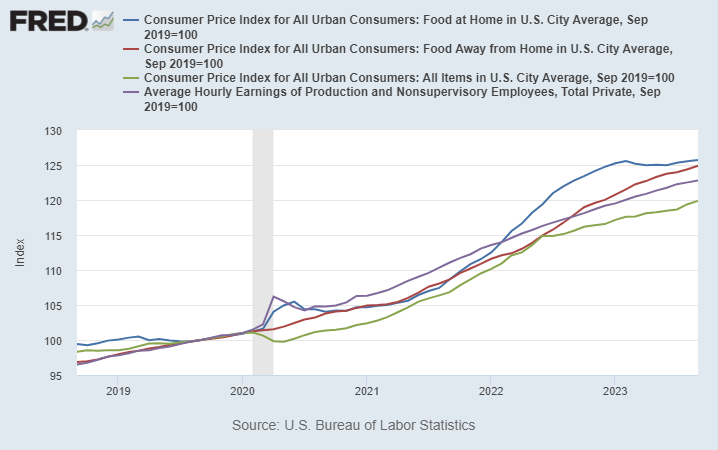
We’ve all heard about and felt inflation lately. But food prices have been especially noticeable to consumer, and not just because it’s a product you frequently buy and probably know the price of many food items. Food prices, both at home and restaurants, have increased much more than the average price levels.
On average, prices are up about 20 percent in the US over the past 4 years. But food prices are up about 25 percent, on average.
Wages (the purple line) actually have increase faster than the general price level over the past 4 years — that may shock you given what we constantly hear in the traditional and social media about “price increases outpacing wage gains” — but it is true when we are talking about food. Your dollar doesn’t go quite as far as it used to for food.
In some sense these costs are hard to avoid: food is a necessity. But there are ways to reduce your costs, and you probably know the general tips. Eat less at restaurants. Buy generic. Buy in bulk. Etc. These are good tips, but they all involve some sacrifice or annoyance. Is there anything else a consumer can do?
Yes. Here’s a few tips that can save you money, without the sacrifice. There is some thought involved, and perhaps a slight annoyance, but I’ve found that once you get in these habits, the mental and time cost is pretty low.
1. RESTAURANT APPS
You should always be ordering your food through restaurant apps when possible, especially for fast food. I try to track limited good deals on Twitter, but most restaurants offer on-going good deals. For example, McDonalds usually has a 20% off coupon, just for using the app. Taco Bell has a $6 box you can build, which would cost around $10 to order as a combo or à la carte at the restaurant. That’s a 40% discount for using the app.
Using apps also means you are using the restaurant’s rewards programs. Valuations vary, but McDonald’s rewards are roughly worth 10% cash back.
2. CHASE THE SALES AT GROCERY STORES
Clipping coupons is the classic way of saving money at the grocery store (we even have reality shows about it), but in the modern world grocery stores have expanded the ways to effectively save the same amount of money. The clearest example is, once again, the rise of apps. Stores will often have “digital only” coupons that you need to access through their app (which is also tied to your rewards account, just like restaurants).
While I’m a strong advocate of coupon clipping (and the virtual equivalent), it can be time consuming. Another strategy that can save you is thinking ahead about seasonal and other cyclical prices. For example, my kids like M&M’s. We usually buy a bulk 62-ounce container at Sam’s Club (already a savings), but today I took the additional saving step of buying the Halloween-themed bulk container. It was 36 percent less than the identical Christmas-themed M&M’s container right next to it. And I was replacing the Easter-themed bulk container that we purchased back in April, and they just finished.
Of course, I had to be planning ahead and know that November 1st was a great day to buy M&M’s. That takes some mental effort, sure. And you might think these kinds of deals are fairly limited in nature. But holidays aren’t the only kind of seasonal deals. For example, even though most fruit is generally available year-round now, there are still predictable price cycles of when things are “in season” and when they have to be imported from expensive locations. Even if you are only able to find these cyclical deals for 10 percent of your purchases, saving 30-50% on cyclical goods will shave another 3-5% off your grocery bill — bringing it closer in line to the average increase in prices (and wages).
3. CASH BACK CREDIT CARDS
I could write an entire post about credit card rewards. But let me focus here on credit cards that are especially good for buying food. At a minimum you should be getting 2 percent back on all of your purchases, as there are several no-annual-fee cards that give you 2 percent: the Citi Double Cash and Wells Fargo Active Cash are good examples.
But on food purchases, you should be able to beat 2 percent. For example, the Citi Custom Cash card gives you 5 percent back on your top spending category each month, up to $500 of spending. This can be on either groceries or restaurants. And since a family in the median quintile spends $250 at restaurants and $460 on groceries per month, you should be getting 5 percent back on basically all of your purchases in one of these two categories. (Personally I stick to restaurants for this card, because I buy most of my groceries at Walmart and Sams Club, which don’t count towards the grocery cash back.) Or if you want a simple card that gives you 3 percent back on both groceries and restaurants, check out the Capital One SavorOne card (again, no annual fee).
There are also several cards that have rotating 5 percent cash back categories each quarter, and they often include either restaurants or groceries. How do I keep track of which card to use for what kind of purchase? Simple: put a strip of masking tape on the card with a label. This will get some chuckles from your friends or the server at the restaurant, but that’s just an opportunity to tell them how to save money too!
Is There Really a Free Lunch?
Some of my economist friends are probably skeptical at this point. Aren’t I say there is a free lunch here? Isn’t the extra hassle of the steps I suggested going to outweigh any discount you get?
The answer is No. And while economists are quick to bring up the concept of opportunity cost, I find that most people tend to overestimate their opportunity cost. But even if you don’t overestimate your opportunity cost, you can bring in another useful economic concept: price discrimination.
Restaurants are very much in the business of price discrimination, and always have been. Tuesday Night specials, happy hours, etc. Every consumer has a different willingness to pay, and since it’s hard to resell a restaurant meal, restaurants can potentially use this technique to their advantage (and yours, if you are willing to look for discrimination). Grocery stores don’t have as much of an opportunity to discriminate, but they still find ways.
Don’t be afraid of price discrimination: use it to your advantage!
My rave product for this year is “Fiskars 9 Inch Serrated Titanium Nitride Shop Shears”, available from Amazon here. I randomly bought these scissors a few years ago for a relative, and then realized how useful they were. So, I got a pair for our household, and it became our go-to scissors. When we lost that pair a few months ago, we felt the loss keenly enough to go and buy a replacement.
What is so great about them? Unlike some thick, heavy, or stubby heavy-duty shears, these have the feel of regular scissors, with fairly long, narrow blades. The handles are fairly substantial, and very comfortably contoured to the hand/thumb. The real magic is in the blades. They are sharp, with a very hard titanium nitride coating. Also, they have fine serrations in the cutting edge, that tend to grip the material in place as you are cutting. They will set you back about $24. Made in China, of course.
Two images from the Amazon site are:
With 935 ratings, the average rating on Amazon is a stratospheric 4.9/5. Reviewers find themselves reaching for superlatives:
We have an embroidery shop and find regular scissors dull quickly. These do not. They cut through everything!
The best heavy duty scissors. Period… These pups will handle any cutting job even remotely appropriate for this tool.
My wife has multiple pair of shears that she uses on her sewing table. She would not miss one pair if I were to borrow them for the shop, right? Well, that did not work. I’m in purgatory for that, for sure. So… I bought these. These shears are MY shears. I get to use them for all of those things in the shop that need to be cut. No, I don’t cut asphalt roofing shingles and corrugated steel roofing with them, but I cut rough and heavy and coarse and dirty stuff that needs cut with the accuracy of using shears. Stuff where a razor knife is not quite adequate. You know the stuff I mean. Ladies, do the old man a favor… and do yourself a really good deed… and buy a pair of these for him. He’ll hopefully not be using yours any more.
The best pair of shears I’ve ever used… I swear, you could split the atom with these things. Matter simply parts at their touch. I’ve been using them daily for all my shearing needs for the last six months, and they’re as sharp and perfect as the day I received them.
Well, you get the picture. We use them for food cutting in the kitchen, cutting cloth, cardboard, thin sheet metal, wire, etc. They can also handle ordinary cutting of paper, although they do leave fine teeth marks.
Honorable Mention: Leatherman Micra Tool
Another cutting implement I find very useful is the Leatherman Micra Tool. At about 2 inches long all folded up, it is small enough to easily fit in a pocket or purse, though just a bit heavy to hang on a keychain. It has small but very capable scissors (can cut fingernails well) ; a very sharp little knife ; a diamond-grit file for nails, etc.; some light-duty screwdrivers; tweezers (not the best); and an old-fashioned bottle-cap opener. Also, it has ruler markings, which I have used on occasion. So many items now come packaged in very tough, clear plastic covering that you can’t peel or rip with your fingers. It is great to be able to whip out this Micra and quickly slice through that plastic. The quality of the workmanship is so good that anyone who appreciates tools will feel good about it.
This is an easy win as a present. If someone has no use for it, they can easily regift it. Once upon a time when I was a project leader, I bought one for everyone as a celebration for reaching milestone. I got them from Leatherman, engraved with the project name. They were a hit.
The only downside is the price. I am used to getting these for like $25 or so. But when I just looked on Amazon, I see the new price has jumped to $57 (though you can get them cheaper at the Leatherman.com site). That seems kind of steep. These are made in the U.S.A. You can purchase Chinese knock-offs for much less, though the quality may vary.
There is, however, a lively market for used Micra tools. Below are two images for one for sale on eBay, for $13.00 plus $4.75 shipping. If you are getting one for yourself or say a son/father/brother or buddy, getting a high quality tool with a few scratches and no packaging may be fine. Other recipients may not appreciate a used item.