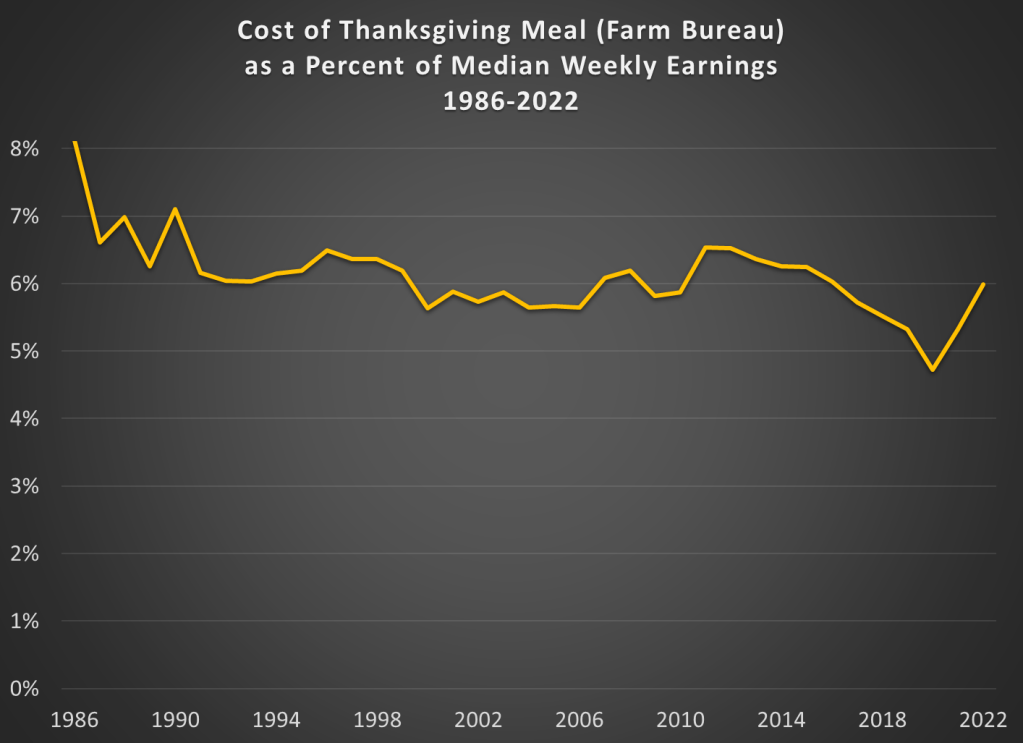
Last year inflation hadn’t quite hit the levels we would see in 2022, but they were already rising. When Thanksgiving rolled around, many media sources were reporting that it was the “most expensive Thanksgiving ever.” In nominal terms that was true, though in nominal terms it isn’t that surprising. In a post last year, I compared the prices of Thanksgiving dinners (using the same data from Farm Bureau) to median earnings going back to 1986. While 2021 was more expensive the 2020, it turned out it was still the second lowest it had been since 1986.
As you might expect, this year’s Thanksgiving dinner is even more expensive than last year in nominal terms. It’s up about 20% since last year or over $10 more, according to Farm Bureau. That’s certainly more than the overall rate of inflation (7.7% in the past 12 months) and more than inflation for groceries (12.4% in the past 12 months). But how does that compare with median wages? Comparing the 3rd quarter of this year with the same quarter in 2021, median wages are only up about 7%, certainly not enough to keep up with those rising turkey prices.
When we add 2022 to the historical chart, here’s what it looks like.
The spike in the last 2 years is clear in the chart but notice that at about 6% of median weekly earnings, we have essentially returned to the average level of the entire series. From 2017-2021, we could be thankful that the price of your Thanksgiving dinner had dropped below that 6% level. We’ll have to find something else to be thankful for this year.
In the United States and much of the developed world today, most roads are publicly provided, i.e., they are built and operated by governments. This is not exclusively true, as many private toll roads exist, but the vast majority of roads are owned and operated by governments. Must it be this way?
A recent working paper by Alan Rosevear, Dan Bogart, and Leigh Shaw-Taylor looks at a very important case study: Britain in the 19th century. Britain is important because they were the leading economy in the world at the time, at the forefront of the Industrial Revolution. How were roads built and improved in England and Wales at this time? Here’s what the authors have to say in the abstract:
“non-profit organizations, known as turnpike trusts, built more new roads by attracting private investors and capable surveyors. We also show the Government Mail Road had the highest quality. Nevertheless, most turnpike trust roads were good quality, indicating their practical achievements.”
In the conclusion of the paper, they further add:
“Our analysis demonstrates that turnpike trusts were responsible for building 4,000 miles of new, good quality road in England and Wales, much of it between 1810 and 1838. On a directly comparable basis, the not-for-profit trusts built thirty times the mileage than had been built with direct Government funding during the early 1800s.”
To be clear, this paper is not a completely new discovery. It was already well-known that private companies built roads in Britain, as the authors make clear in their literature review. Similarly, there were many private turnpikes and toll roads in the US in the 19th century, as summarized in an encyclopedia entry by Klein and Majewski.
The Rosevear et al. paper adds new important details. First, they document the extent of private road building and improvements in the 19th century. Second, they show that these roads were generally of good quality, or at least they were of good quality for the time. Prior research had not documented these facts, thus making this a very important advance in our understanding of this time period. But perhaps more importantly, we see the possibility that many more roads today could be privately built and funded with user fee, especially considering that we are much, much wealthier today than 19th century Britain, we have more extensive and functional capital markets for raising the funds, etc.
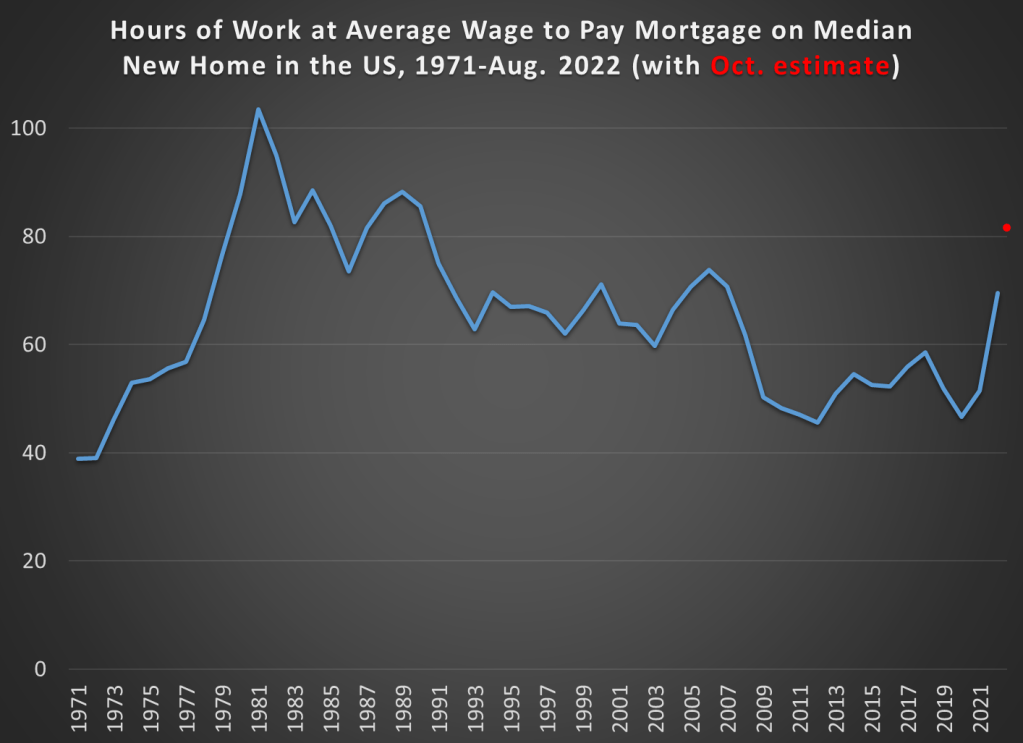
Mortgage interest rates are climbing quickly, while housing prices are still mostly high. These factors combined means that it is much more expensive to buy a home than in the recent past. But how much more expensive? And how does this compare with the past 50 years of history?
The chart below is my attempt to answer those questions. It shows the number of hours you would need to work at the average wage to make a mortgage payment (principal and interest) on the median new home in the US.
My goal here was to provide the most up-to-date estimate of this number consistent with the historical data. Thus, I had to use average wage data rather than median wage data, since the median hourly wage data is not available for 2022 yet. But as I’ve discussed before, while median and average wages are different, their rate of increase is roughly the same year-to-year, so it would show the same trends.
The final point plotted on the blue line in the chart is for August 2022, the last month for which we have median home price data, average wage data, and 30-year mortgage rates. Mortgage rates are the yearly average (or monthly average in the case of August 2022).
You’ll also notice a red dot at the very end of the series. This is my guess of where the line will be in October 2022, once we have complete data for these three variables (right now only mortgage rates are available in October for the three series I am using). I’m doing my best here to provide as much of a real-time picture as possible, given that rates are rising very sharply right now, while still providing consistent historical comparisons. If that estimate is roughly correct, mortgage costs on new homes are now less affordable than any year since 1990.
I listen to a lot of podcasts, but many are forgettable, and even the good ones can be hard to share, since they get their point across slowly and gradually. But on the latest Conversations with Tyler, I found foreign policy thinker Walter Russell Mead to be eminently quotable. Some highlights:
On Germany:
Kennan’s goal for Germany was to have a united, neutral, disarmed Germany at the heart of Europe. In some ways, [laughs] Kennan’s goal looks, maybe, closer than ever.
China’s development plan, much more than its Taiwan policy or its human rights, is a gun pointed at the head of German business
On America:
Over the last 40 years, there’s been an enormous increase in the number of PhD grads engaged in the formation of American foreign policy. There’s also been an extraordinary decline in the effectiveness of American foreign policy. We really ought to take that to heart.
One of the teachers at Groton used to take aside some of the boys — it was an all-boys school at the time — and explain to them how their family fortune was made. He might say, “Well, George, we’ve been reading a lot about war profiteers in World War I. You need to know that your grandfather . . .”
I think neoconservatism reflected a sense of people who’ve never been wrong and never been beaten, at least in their own minds
On the Middle East:
In the Arab world, the Middle East, Islamism, and jihad — just call it jihadi ideology more broadly — is seen to have failed. Like socialism, like Arab nationalism, it’s one more in a long list of failed ideological movements. Not that there still aren’t terrorists, or for that matter, Arab socialists, but it’s not the same.
Nobody really thought, in 2008, as George W. Bush left office, that you could possibly mess up the Middle East worse than the Bush administration. But President Obama proved that that was wrong and that you could actually take the Middle East at the end of 2008 and make it almost infinitely worse, both for American interests and for the safety and happiness of the people in the region
On Ukraine:
The message, actually the totality of the message that we sent to Putin [through the intelligence we released] is, “You are going to win if you do this”.
I read Mead’s book Special Providence in college and enjoyed it then, but have’t kept up with his work since. The book’s title comes from another great quote, this time attributed to Otto von Bismarck:
God has a special providence for fools, drunks and the United States of America.
The Mont Pelerin Society was founded 75 years ago. The title of this post was the opening sentence of the Statement of Aims the new Society agreed upon. They had many concerns about what they considered “central values,” but primary among those concerns were the dangers related to market economies: “a decline of belief in private property and the competitive market” and “the growth of theories which question the desirability of the rule of law.”
How has the world done since 1947? It’s easy to point to the decline of communism and socialism, both in practice and as a dominant theory, as a victory for the goals of the Mont Pelerin Society. However, we might be concerned that in the non-communist world, economic freedom has declined even as communism has failed. Let’s dig a little deeper.
One source we can use is an extension of the Fraser Institute’s Economic Freedom of the World index. The primary index only extends back to 1970, but recently Lawson and Murphy have constructed a version of the index which goes all the way back to 1950 for some countries. As far as I’m aware, they haven’t yet perfectly mapped the pre-1970 index with the primary index that extends to the present, but I’ll make a quick comparison using the available data. The 1950 data brings us very close to the date of the first MPS meeting.
Here’s a list of countries relevant to the discussion at MPS in 1947. The list includes countries where attendees came from, as well as other countries of interest to the discussion, such as China and Russia (I’m using the list from Caldwell’s recent edited transcripts of the 1947 meeting). Caveat: this isn’t a chain-linked index, so the 1950 and 2020 numbers are perfectly comparable. Also, the 2020 number only includes Areas 1-4 of the index, since that’s what the pre-1970 data contains.
The table above should give us some optimism about the state of market economies in the world from the perspective of 1947. Not only have China and Russia, clearly improved their economic freedom scores, but all of the Western market economies have as well. Again, exercise caution in interpreting these, since it’s not a chain-linked index, and it excludes one area of economic freedom (regulation, which surely has grown substantially since 1947). Despite those cautions, the picture in 2020 looks pretty good compared with 1950.
But what of other liberal institutions? While the MPS statement of aims doesn’t specifically mention democratic institutions, the threat to democracy seems to clearly be a concern in 1947 (“extensions of arbitrary power” and “freedom of thought and expression”).
Authors of the kinds of books I read present themselves as a voice of reason against our declining society that no longer can evaluate arguments or define moral principles. (I’m fun at parties.) “Postmodernism” has been attacked all my life.
For a while, I have been looking for a successor of postmodernism. To simply define our age as the one that came after modernism seems unsatisfactory. How many more decades can we coast along on this antithesis idea?
One reason I don’t like the term postmodernism is that it gives a sense of progress where we might be losing ground. If you aren’t modern, then you are pre-modern. If you aren’t a verbal culture, then you have regressed to pictographs. If you aren’t engaging arguments, then you have degenerated to tribalism. So, postmodern might be dressing up a decline with a word that is too respectable sounding.
Calling people who use smartphones premodern does not seem right. But, what information are they consuming on those screens? Is it mostly low-quality videos and quick poasts? That doesn’t seem like what someone in 1900 would expect of a modern person.
Here’s an idea for the new century. We are in an age of poastmodernism, beginning with the founding of Twitter. This is different from the kind of skepticism or moral relativism that defined postmodernism. The poasters and their followers can be earnest. They retweet like evangelists. (A “poast” is a message posted in an internet forum.)
Poasts are short. This does not allow for nuance or traditional rational forms of argumentation. A poast could be referencing a rich history or body of literature, but if this generation has not evaluated those original sources then they are really just getting the meme. The poast does not provide its own context. Tyler Cowen says that people who think “modern art” is absurd have no context. Context for modern art would be the classical art and realistic landscape paintings that came before. Most Americans including myself are pretty ignorant about classical art. Similarly, how much value would teenagers get from Lord of the Rings internet memes if they have never seen the movies or read the books?
I’m on Twitter. The pace of discourse is more fun than reading a 50-page econ journal article. I get the appeal of poasting. It’s easy. Our first pediatrician told us not to let our baby use touchscreen games. She told us that it is good for a child to struggle to touch a ball that is two feet away across the floor. Better that they cry over the ball than get the dopamine too easily on a tablet game. Tapping on a screen trains kids for instant rewards. Something that concerns me about a generation that was not raised on books is that they will actually enjoy poasting less than I do, because they will be used to the rapid pace of reward. Twitter as a company benefits from the current generation of people who did not grow up with Twitter.
Poasting affects politics. This week two US Senate candidates had a debate. What would someone who gets most of their news from social media learn about the debate? Some top poasts about the debate have almost zero positive policy substance. Campaigners use the internet medium to dunk on their opponents instead of offer solutions to problems. What attracts engagement is the fire emoji.
It says a lot about Blake Masters that he’s the only one on this stage who never wore a uniform for our country, and yet he thinks he knows better than our military on how to fight wars.
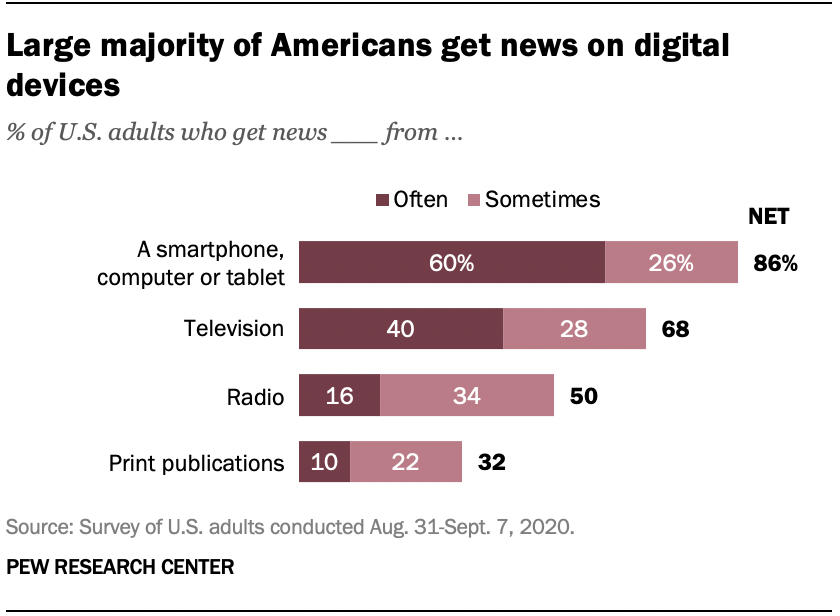
This is not meant as a comment on either men as candidates. I share these jabs because lots of Americans are consuming their “news” in this form (see Pew Research chart). In postmodernism a successful political candidate has to appeal to feelings as much as reason. In poastmodernism, they only have 280 characters to work with. (Donald Trump was a skilled poaster.)
Getting elected today might require great poasting, but that has little to do with being good at governing. Most people think the details of government are dull. Ten minutes into a city council meeting, I’m bored and ready to check the notifications on my phone. And yet, we cannot just poast about poasting. It’s the physical political world and the classic books that make the best subjects of conversation. So, I’m not sure if the era of poastmodernism will last for a long time, or simply to the end of my lifetime. Millennials are not going to give up the dog fire meme.
You’ll have to pry it from our hands after our large generation has passed on. But will it inspire people in the future? I have already been informed that teenagers are calling our gifs “cringe”. They seem to prefer 90 second videos of their peers dancing to pop music. Don’t ask me what comes next after that.
I’ll end on a positive note by saying that sometimes shorter is better. Get to the point quickly, if you can. Some of the novels produced in the modern era were too long. Adam Smith’s books would be more widely read if they were shorter. Long-winded speeches are not necessarily good and I’m glad I am not forced to listen to them. (I get the tl;dr the next day.)
A lot of bad ideas were dressed up in pages of smart-sounding language and then passed off for wisdom in the modern era. It might be harder to pull that off today. Authoritarian regimes in the past relied on being able to lie about conditions on the ground. Today, we know what is happening because of individuals on the ground sharing to Twitter (although social media can also be used for disinformation). American elites believed lies about what was going on inside the Soviet Union for years. That would be more difficult today.
Its Nobel Prize season- the economics prize will be announced Monday, while most prizes are announced this week. My favorite so far is the Medicine prize being awarded to Svante Pääbo “for his discoveries concerning the genomes of extinct hominins and human evolution”. He figured out how to sequence DNA from Neanderthal remains despite the fact that they were 40,000 years old.
As recently as 2010 it was controversial to suggest that Neanderthals might have mixed with humans, until Pääbo’s DNA definitively settled the debate, showing that “Neanderthals and Homo sapiens interbred during their millennia of coexistence. In modern day humans with European or Asian descent, approximately 1-4% of the genome originates from the Neanderthals”
While the Neanderthal genome settled an existing controversy, Pääbo’s other big discovery came entirely unlooked for. The Nobel Foundation explains:
In 2008, a 40,000-year-old fragment from a finger bone was discovered in the Denisova cave in the southern part of Siberia. The bone contained exceptionally well-preserved DNA, which Pääbo’s team sequenced. The results caused a sensation: the DNA sequence was unique when compared to all known sequences from Neanderthals and present-day humans. Pääbo had discovered a previously unknown hominin, which was given the name Denisova. Comparisons with sequences from contemporary humans from different parts of the world showed that gene flow had also occurred between Denisova and Homo sapiens. This relationship was first seen in populations in Melanesia and other parts of South East Asia, where individuals carry up to 6% Denisova DNA.
Pääbo’s discoveries have generated new understanding of our evolutionary history. At the time when Homo sapiens migrated out of Africa, at least two extinct hominin populations inhabited Eurasia. Neanderthals lived in western Eurasia, whereas Denisovans populated the eastern parts of the continent. During the expansionof Homo sapiens outside Africa and their migration east, they not only encountered and interbred with Neanderthals, but also with Denisovans
The same techniques that enabled these discoveries have been applied much more widely throughout the field of Paleogenomics, which continues to rewrite what we thought we knew about history and pre-history. The field has been advancing so quickly over the last decade that its hard to keep up with it. I’ve found the best introduction to be David Reich’s Who We Are and How We Got Here, though again the field is moving so fast that a 2018 book is already a bit out of date. Razib Khan is always writing about the latest updates at Unsupervized Learning. If you haven’t kept up with this stuff since school, this post and diagram give a quick introduction to how much our understanding of human origins has recently changed:
Last week I wrote about wealth growth during the pandemic, but my favorite way to look at wealth data is comparing different generations. Last September I wrote a post comparing Boomers, Gen Xers, and Millennials in wealth per capita at roughly the same age. At the time, Millennials were basically equal to Gen X at the same age, and we were a year short of having comparable data with Boomers.
What does it look like if we update the chart through the second quarter of this year?
I won’t explain all of the data in detail — for that see my post from last September. I’ll just note a few changes. We now have single-year population estimates for 2020 and 2021, so I’ve updated those to the most recent Census estimates for each cohort. Inflation adjustments are to June 2022, to match the end of the most recent quarter of data from the Fed DFA. We still have to use average wealth rather than median wealth for now, but the Fed SCF is currently in progress so at some point we’ll have 2022 median data (most recent currently is 2019, and there’s been a lot of wealth growth since then).
What do we notice in the chart? First, we now have one year of overlap between Boomers and Millennials. And it turns out… they are pretty much at the same level per capita! Millennials have also now fallen slightly behind Gen X at the same time, since they’ve had no wealth growth (in real, per capita terms) since the end of 2021 to the present.
But Millennials have fared much better in 2022 with the massive drop in wealth: about $6.6 trillion in total wealth in the US was lost (in nominal terms) from the first to the second quarter of 2022. None of that wealth loss was among Millennials, instead it was roughly evenly shared among the three older generations (Boomers hid hardest). This difference is largely because Millennials hold more assets in real estate (which went up) than in equities (which went way down). The other generations have much more exposure to the stock market at this point in their life.
You can clearly see that affect of the 2022 wealth decline if you look at the end of the line for Gen X. You can’t see the effect on Boomers, since I cut off the chart after the last Gen X comparable data, but they saw a big decline since 2021 as well: about 6% per capita, along with 7% for Gen X. Even so, Gen X is still about 18% wealthier on average than Boomers were at the same age.
Of course, even since the end of the second quarter of 2022, we’ve seen further declines in the stock market, with the S&P 500 down about 4%. And who knows what the next few months and quarters will bring. But as of right now, Millennials don’t seem to be doing much worse than their counterparts in other generations at the same age.
“Can [the President] not at the head of his army beat down every opposition? Away with your President, we shall have a King: The army will salute him Monarch; your militia will leave you and assist in making him King, and fight against you: And what have you to oppose this force? What will then become of you and your rights? Will not absolute despotism ensue?” It is noted in the manuscript that the stenographer could not keep up with the torrent of terrible possible consequences that Henry was shouting about concerning a chief executive.
Most of his apocalyptic scenarios have not happened … yet. What inspired me in his speech was his energy more than his arguments. As much as he praised the American spirit of the past that ousted British rule, he was not complacent. He models a kind of patriotism that embraces an American project without holding to any fantasies about the morality of particular American leaders or soundness of American institutions. He would not have been disillusioned by the scandals and crimes of the American political class. He anticipated it.

:format(webp)/cdn.vox-cdn.com/uploads/chorus_image/image/49493993/this-is-fine.0.jpg)


 Economist Writing Every Day