This week the Biden Council of Economic Advisers blogged about “Historical Parallels to Today’s Inflationary Episode”.
Consumer demand in 2021 is roaring back after pandemic shutdowns. Demand for airline travel is exceeding expectations. Car dealer lots are empty.
The authors argue that, of all the periods of rapid inflation in American history, the boom after WWII has the most parallels to today.
During WWII, Americans were obviously in war mode. Price controls and supply shortages led to deprivation on the Homefront. Families had trouble buying cars, just like today.
Instead of focusing on consumer or industrial durable goods, manufacturing capabilities were concentrated on military production. Today’s shortage of durable goods is similar—a national crisis necessitated disrupting normal production processes. Instead of redirecting resources to support a war effort, however, manufacturing capabilities were temporarily shut down or reduced to avoid COVID contagion.
Remember when oil had a negative price in 2020? While people in the US were staying home, many were building up personal savings. As soon as the “war” ends, consumers compete as buyers and drive up the prices of the limited available goods.
They present the post-war inflationary episode as dramatic but temporary, because it only lasted for two years. It’s short compared to inflation of the late ‘70’s. They are standing behind the Powell “transitory” story, in their conclusion.
On the other hand, they say that the most comparable moment in history to today involved the price level spiking 20% and taking two years to come down. I’m pondering a very expensive repair on our car, just make sure I don’t have to buy a new one soon.
This joke is relevant to the recent discussions within the economics profession about rigor in research. It’s also just funny and shouldn’t be lost, as so many memes quickly are.
The worst philosopher dude offender is Rousseau. Rousseau is cringe.
Here are his misleading thoughts from the bath about primitive humans, “The produce of the earth furnished [man] with all he needed, and instinct told him how to use it.”
A quick search about primitive humans brings up this from Psychology Today:
The caveman diet is a great diet if you want to live to be 30 or 35 years old. That was the adult life expectancy until very, very recently (indeed, it wasn’t until well after the advent of agriculture that life expectancies began to rise—in agricultural communities!). We know this from skeletal evidence.
The data is very sketchy on primitive life. However, there is no reading of the available evidence that makes it sound like people were well-provisioned to care for themselves and their children. This BBC article provides more sources on life expectancy throughout history.
It’s unusual for me to sit down on a weekend morning and read *literally checks notes* Polybius. This was assigned to me for a seminar. Here’s his proposal for the inevitable endless cycle of human leadership structures:
Some humans are still alive. They band together because they are too weak to survive alone.
A strong man who bravely defends the group in his youth becomes a monarch. “Kingship” is the next progression. Polybius assumes that people could consent to be under the leadership of a powerful and noble man.
The king has children. The people venerate the descendants of the good king, but these princes and princesses will be spoiled and selfish. The princes “gave way to their appetites owing to this superabundance…” Thus, kingship becomes tyranny.
Nobles overthrow the tyrants, and so become aristocrats. “But here again when children inherited this position of authority from their fathers, having no experience of misfortune and none at all of civil equality and liberty of speech… they abandon themselves to greed… and… rape…” The aristocracy becomes a corrupt oligarchy.
Democracy emerges when people have “killed or banished the oligarchs” and the people remember being mistreated by kings. How does Polybius think democracy ends? Once again, it’s the new generation and the corruption they indulge in. Where do they end up? “… democracy in its turn is abolished and changes into a rule of force and violence.”
There are two ways to get back to stage 1 monarchy. Life in the decline of a democracy is chaotic enough that people willingly back a strong man to protect them. Alternatively, he presents a “floods, famines, failure of crops… all arts and crafts perish…” scenario. A natural disaster, regardless of what stage in the political cycle humans were at before, will position the survivors to start again at monarchy.
It’s almost summer. About half the US population has at least one dose of a COVID vaccine. For many Americans that haven’t had their employment impacted by the pandemic, their bank accounts are flush with cash and they are ready to do one thing with that cash: travel. See family and friends. See something other than the inside of your own home.
And for many Americans traveling this summer, they will fly. The airlines, no doubt, will appreciate your business. At this time last year, the world had so radically shifted that Zoom’s market cap was bigger than the 7 largest airlines in the world. In May 2020, air passenger traffic in the US was less than 10% of traffic in 2019. Today, we’ve recovered a lot, but we are still only back to about two-thirds of normal levels. And since airplanes are just a marginal cost with wings, flying all their planes at close to full capacity is crucial for airlines to return to profitability. They really need you to fly the friendly skies this summer.
One of the reasons that so many Americans are able to fly in today is because flying is, compared to historical prices, very cheap.
How cheap is flying to today compared to the past? Let’s look at some historical price data for flights.
I’ve written previously about initial US state compulsory schooling laws in regard to literacy and in school attendance rates. I ended with a political economy hypothesis. Here’s the logic:
Legislators like lower costs, all else constant (more funding is available for other priorities).
Enforcing truancy and educating an illiterate populous is costly.
Therefore, state legislatures that passed compulsory attendance legislation will already have had relatively high rates of school attendance and literacy.
That’s it. Standard political economy incentives. But is it true? Well, we can’t tell what’s going on in politician heads today, much less 150 years ago. Though, we can observe evidence that might corroborate the story. In plain terms, consistent evidence for the hypothesis would be that school attendance and literacy rates were rising prior to compulsory schooling legislation. The figures below show attendance and literacy rates for children ages 10 to 18.
40 hours. That’s what we think of as a typical workweek. 8 hours per day. 5 days per week. Perhaps the widespread practice of working from home during the pandemic (as well as the abnormal schedule changes for those unable to work from home), has led some to rethink the nature of the workweek. But the truth is that the workweek has always been evolving.
Take this chart, for example. It comes from Our World in Data (be sure to read their excellent related essay as well), and the historical data comes from a paper by Huberman and Minns. I’ve singled out 4 countries, but you can add others at the OWiD link.
The historical declines are dramatic. This is especially true in Sweden. The average Swedish worker labored for over 3,400 hours per year in 1870. Today, that’s down to 1,600 hours. In other words, the typical Swede works less than half as many hours as her historical counterpart. Wow! The decline for the US is not quite as dramatic, but still astonishing: a US worker today labors for only about 57% of the hours of his 1870 predecessor.
It’s tempting to focus on the differences across countries today: the average worker in the US works about 250 hours more than the average French worker. That’s 6 weeks of vacation! And as recently as 1980, the US and France were roughly equal on this measure. We might also wonder why these historical changes happened. For a very brief introduction to the research, I recommend the last section of this essay by Robert Whaples.
But still, the historical declines are dramatic, even if we in the US haven’t seen much improvement in the past generation (and those poor Swedes, working 100 hours per year more than 40 years ago).
I think another natural question to ask is whether GDP data is distorted, at least as a measure of well being, given these differences in working hours. The answer is partially. Let’s look at the data!
The original 1947-48 finds of scrolls in caves near the Dead Sea were a huge sensation. Preserved by the aridity of that region in the southwestern part of Israel, these scrolls dated back to around 100 B.C.-100 A.D. They included Hebrew texts of much of the Old Testament, which were about a thousand years older than previously known Hebrew Old Testament manuscripts. There were also other writings peculiar to the Jewish community that lived near those caves, which gave new insights into the religious and social currents of that day.
The last of those manuscript finds by scholars was in 1961. Since then, there has been only trickle of artifacts from looters who have dug up items to sell, but with no proper historical context. In the last few years, the Israel Antiquities Authority (IAA) has mounted an exhaustive survey of every nook, cranny, and hole in that Judean Desert area, in order to forestall further loss of ancient artifacts. The IAA has now announced some finds from that survey. They include further Bible texts (in Greek), the oldest known woven basket (10,500 years old), and a 6,000 year old mummified skeleton of a child, covered with a cloth. The searchers also found arrow and spear tips, coins, sandals and even lice combs, all from the time of the Bar Kochba revolt (133-135 A.D.).
My last post of 2020 tried to end the year on an optimistic note: the rapid innovation of a new vaccine was truly a marvel. But I also warned you that I would have a post in the new year talking about the deaths of 2020 during the pandemic. And here it is.
Throughout 2020, I have tried to keep up with the most recent data, not only on officially coded COVID-19 deaths, but also on other measures. An important one is known as excess mortality, which is an attempt to measure the number of deaths in a year that are above the normal level. Defining “normal” is sometimes challenging, but looking at deaths for recent years, especially if nothing unusual was happening, is one way to define normal. The team at Our World in Data has a nice essay explaining the concept of excess mortality.
One thing to remember about death data is that it is often reported with a lag. The CDC does a good job of regularly posting death data as it is reported, but these numbers can be unfortunately deceptive. For example, while the CDC has some death data reported through 51 weeks of 2020, but they note that death data can be delayed for 1-8 weeks, and some states report slower than others (for reasons that are not totally clear to me, North Carolina seems to be way behind in reporting, with very little data reporting after August).
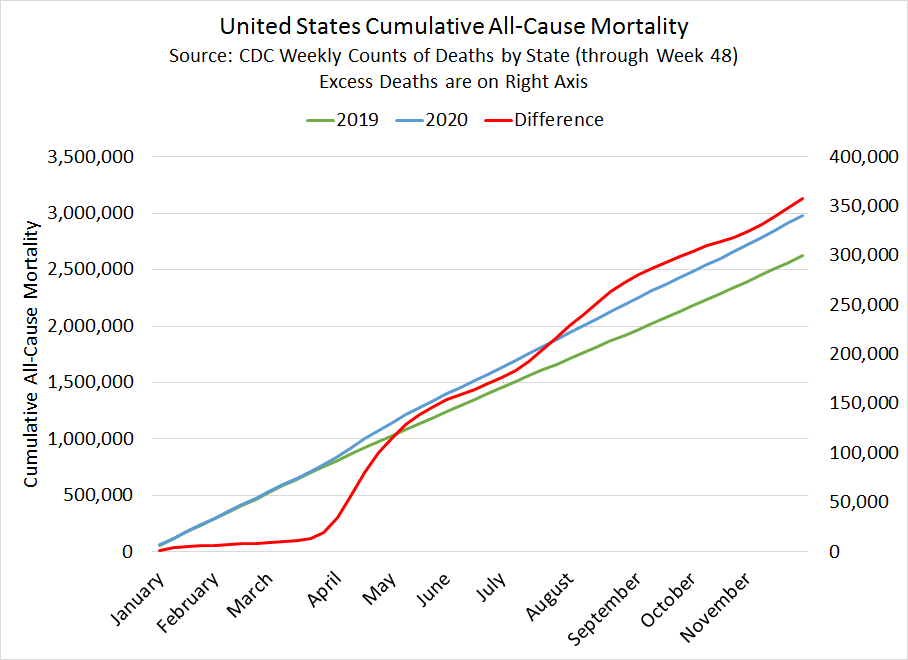
So there’s the caution. What can we do with this data? Since 2019 was a pretty “normal” year for deaths, we can compare the deaths in 2020 to the same weeks of data in 2019. In the chart at the right, I use the first 48 weeks of the year (through November), as this seems to be fairly complete data (but not 100% complete!). The red line in the chart shows excess deaths, the difference between 2019 and 2020 deaths. From this, we can see that there were over 357,000 excess deaths in 2020 in the first 11 months of the year, or about a 13.6% increase over the prior year.
Is 13.6% a large increase? In short, yes. It is very large. I’ll explain more below, but essentially this is the largest increase since the 1918 flu pandemic.
It started as a simple question: can you substitute blackstrap molasses for regular molasses in a gingerbread recipe?
In order to reduce our potential exposure to Covid, we are ordering groceries online and having them delivered. Whole Foods (owned by Amazon), delivers free to Amazon Prime customers like us. In our order the other day we included molasses. We are almost out, and I wanted to make a gingerbread recipe this holiday week. The bottle that arrived yesterday along with the rest of our order says “Blackstrap Molasses”. Hmm, I wondered, what is different about blackstrap molasses and can you use it in place of the usual Grandma’s molasses that we have always had in our cupboards?
Once I get reading on a topic, it is hard to stop. It turns out there is much to know about molasses (treacle, in the U.K.). We all know it to be a sweet, flavorful ingredient in baked goods, and in savory dishes like pulled pork and baked beans. Diluted molasses is touted as a hair de-frizzer and hair mask, and there are even claims it can help combat gray hair.
However, there is a decidedly unsavory side to its past. It played a key role in fueling the triangular Atlantic slave trade in the 1700’s and early 1800s. Plantations worked by slaves in the Caribbean would ship molasses to the American colonies, where it would be converted into rum. The rum was shipped to West Africa, to pay for more people to be captured and then shipped to the Caribbean plantations to grow more sugar and make more molasses.
Not to mention the deadly “Great Molasses Flood” in Boston. On January 15, 1919, a 50-ft high storage tank of molasses ruptured, and sent a 15-ft high wall of syrup racing through the street at 35 miles an hour. It crushed and drowned anything and anyone in its path. Buildings were collapsed, and 19 people died. It has a place in the history of litigation as the birthing the modern class action lawsuit.
But I digress. Back to the difference since between types of molasses. Sugarcane is squeezed to extract cane juice. Sugar, the main desired product, starts off dissolved in the juice. The cane juice is boiled to remove water, to precipitate the solid sugar crystals. The liquid that remains after the first boiling (and the removal of the sugar from that stage) is called first or light molasses. That is what has usually been sold in U.S. grocery stores.
That first molasses is subjected to a second boiling, to extract even more sugar. The remaining liquid is called second molasses, or dark or robust molasses. From all accounts, this is pretty similar in properties to the initial light molasses, just somewhat less sweet and more flavorful. Folks say that you can substitute dark molasses for light molasses in most recipes without making a big difference.
To extract the last little bit of sugar, the second molasses is boiled even longer and hotter. After the sugar from that stage has been removed, what is left is the so-called blackstrap molasses. Obviously, this product will have less sugar and less liquid, then the light molasses, with a higher concentration of the other flavoring components. The operational question for me is: Can I take some of that blackstrap molasses and simply re-dilute it with some sugar and some water to get the equivalent of light molasses?
Internet opinion on this matter is mixed. On the one hand, there are those who answer this question in the affirmative. They say that a half cup of blackstrap molasses plus half cup of light corn syrup (or half a cup of a water plus sugar mixture) can readily be substituted for a cup of light molasses.
Blackstrap molasses is what results when regular molasses is boiled down and super-concentrated, This results in bitter, salty sludge that only has a 45 percent sugar content, as opposed to the 70 percent sugar level found in both light and dark varieties of baking molasses. Spoon University warns against using blackstrap molasses as substitute for true molasses in any recipe calling for the latter due to the fact that its bitter flavor will overpower the taste of whatever you’re making.
Do not use blackstrap molasses as a substitute for light or dark molasses. It has a strong, bitter taste and isn’t very sweet. It’s more likely to wreck your recipe than help it.
But still I (being a chemical engineer by trade) wondered if this “strong, bitter” taste is merely the lack of sugar, which could be cured by replacing the missing sugar. After all, unsweetened chocolate is unpalatably bitter, but we fix that by adding sugar.
I don’t claim the final word on this, but it seems that the severe third boiling that yields the blackstrap molasses does some chemical alterations. It is not merely a matter of removing sugar. It is all well when sugar is lightly heated to form light brown caramel, but when it gets pushed too far, some bitter, dark brown compounds can form. It is not clear that merely adding sugar can undo these flavors, considering that blackstrap still contains a lot (45%) of sugar.
Conclusion: Blackstrap molasses may be fine for your BBQ sauce and as a trendy, mineral-packed low-sugar sweetener for your yoghurt and tea. But that bottle of thick black goo on my counter is going back to Whole Foods, not into my gingerbread.
A balance sheet gives a snapshot of a corporation’s assets and liabilities. The difference between total assets and total liabilities is (by definition) the value of the equity owned by the owners or shareholders of the company.
With, say, a manufacturing firm, the assets would include tangible items such as buildings and equipment and inventory, and intangibles such as cash, bank accounts, and accounts receivable. Liabilities may include mortgages and other loans, and accounts payable such as taxes, wages, pensions, and bills for purchased goods.
The balance sheet for a bank is different. The “Assets” are mainly loans that the bank has made, plus some securities (such as US Treasury bonds) that the bank has purchased. These assets pay interest to the bank. The money the bank used to make these loans and purchase these securities came mainly from customer deposits or other borrowings by the bank (which are considered “Liabilities” of the bank), and also from paid-in capital from the bank owners/shareholders. [1] As usual, the current equity of the bank is assets minus liabilities. Thus:
The Federal Reserve System is a complex beast. We will not delve into all the components and moving parts, but just take a look at the overall balance sheet.
Unlike other banks, the Fed has the magical power of being able to create money out of thin air. Technically, what the Fed can do with that money is mainly make loans, i.e. buy interest-bearing securities such as government bonds. The Fed makes its transactions through affiliated banks, so it credits a bank’s reserve account with a million dollars, if it buys from that bank a million dollars’ worth of bonds. Those bonds then become part of the Fed’s “assets”, while the reserve account of the bank at the Fed (which is a liability of the Fed) becomes larger by a million dollars. Since the Fed is not a for-profit bank, the “Equity” entry on its balance sheet is nearly zero. Thus, total assets are essentially equal to total liabilities.
The Fed also has the power of literally printing money, in the form of Federal Reserve Notes (printed dollar bills). These, too, are classified as liabilities. Thus, you are probably carrying in your wallet right now some of the liabilities of the central bank of the United States.
Before 2008, the balance sheet of the Fed was under a trillion dollars. Nearly all the “Liabilities” were the Federal Reserve Notes and nearly all the “Assets” were US Treasury securities. The reserve accounts of the affiliated Depository Institutions was minuscule. All that changed with the Global Financial Crisis of 2008-2009. To help stabilize the financial system, the Fed started buying lots of various types of securities, including mortgage-backed securities (MBS) [2]. The Fed thus propped up the value of these securities, and injected cash (liquidity) into the system.
Here is a plot of how the assets of the Fed ballooned in the wake of the GFC, from about $ 0.9 trillion to over $ 4 trillion:
The initial purchases in 2008 were US Treasuries, which the Fed had prior authorization to do. To buy other securities, especially the mortgage products, required congressional authorization. The increased liabilities of the Fed which offset these purchases were mainly in the form of larger reserve accounts of the affiliated banks. The Fed started paying interest on these reserve accounts, to keep short term interest rates above zero at all times (otherwise the whole money market in the U.S. might implode).
With the Fed relentlessly buying the mortgage and bond products, the interest rates on long-term mortgages and bonds was kept low. This was deemed good for economic growth. The Fed tried to sell off some securities to taper down its balance sheet in 2018, but that effort blew up in its face – – the stock market started crashing in response in late 2018, and so the Fed backtracked . You can look at weekly tables of the Fed balance sheet here.
Anyway, the GFC and its aftermath provided the precedent for massive purchases of “stuff” by the Fed. When the Covid shutdown of the economy hit in March of this year, the Fed very quickly went into high gear. Its balance sheet shot up from $4 trillion to $7 trillion in just a few months. It bought not only Treasuries and MBS, but corporate bonds. This was way outside the Fed’s original charter, but the crisis was so intense that nobody seemed to care whether these actions were legal or not. And now, to finance the huge deficit spending of the federal government in the wake of the shutdowns, the Fed has been buying up nearly the entire issuance of Treasury bonds and notes.
These actions may have long term consequences we will explore in later posts [3]. For now, the Fed has made it clear that it will keep interests rates near zero for at least the next couple of years. Invest accordingly.
ENDNOTES
[1] Huge caveat: This statement gives the impression that a bank must first receive say a thousand dollar deposit before it can make a thousand dollar loan. That is not the case. The reality is just the opposite: the act of making a thousand dollar loan actually CREATES a corresponding thousand dollar deposit. This is very counterintuitive, and I won’t try to explain or justify this point here.
[2] Technically, the Fed is not “buying” the mortgage-backed security (MBS). Rather, it is making a “loan” to the bank, and holding the MBS as collateral against that loan.
[3] It is now harder to take the federal deficit seriously as a constraint on spending: the government can issue unlimited bonds to fund deficits, which the Fed will purchase to keep interest rates low. Yes, the government has to pay interest on those bonds, but the Fed has to return most of that interest to the Treasury, so the real cost to the government of that extra debt is low.




 Economist Writing Every Day