One Acceptable Truth or a Million Fantasies

Humans are soft, slow, and (to the best of my knowledge) make for fairly nutritious meals. Brains for tool-making, and the opposable thumbs for using them, are significant evolutionary adaptations, but it is our capacity to act collectively that placed us at the top of the food chain.

By the end of a standard undergraduate economics curriculum, one couldn’t be blamed for coming to the conclusion that the failures of collective action are the greatest obstacle to mankind – Oh what we could have accomplished if only we had ever found a way to just cooperate. Alas, all those externalities, Prisoners’ Dilemmas, free riders, easy riders, market failures, government failures, they just stopped us at every turn…

I’m not doubting the pedagogical value of teaching any of these obstacles, I teach them myself, but I believe we spend insufficient time reminding students that humans have been solving collective action problems with great success for thousands of years. Every national government, book club, homeowners association, and sorority has managed to produce public goods. So has every military coup and angry mob (if only sometimes for fleeting moments), but collective action is collective action, regardless of how we may feel about the outcome.

More often than not the most interesting question to me isn’t can a collective action problem be solved, but rather i) how has it already been solved and ii) how is that solution going to be threatened or hijacked? When I look to the current political landscape and the only mildly-exaggerated state of political and social polarization, I see not just rival ideologies, but alternative strategies for engendering and ensuring cooperation. On the left, I observe greater recent emphasis on purity – there is a narrow band of acceptable truth and any deviation from that, be it however accidental or benign in intent, can lead to significant punishments, including purges colloquially referred to as cancellations. On the right, I see required public professing of incorrect, often seemingly absurd, beliefs. I might talk about purity tests and purges on the left another times. What I’m interested in at the moment are the public untruths of current right wing identities (broadly conceived) and how they fit into the sacrifice and stigma theory, or club theory, of religion.**

I’ve written a lot about sacrifice and stigma theory. It has become the hammer than has left me forever searching for nails. Originally put forth by Laurence Iannaccone in 1992, it is nothing short of brilliant to my mind. A tool for solving collective problems so profound that when it shows up we barely notice it, and where it shows up tends to be the most powerful clubs shaping our societies: the religious, martial, and extremist political groups that bend the arc of history.

Groups produce what we call “club goods” i.e. public goods only accessible to members of the group. What Iannaccone demonstrated was that a group could actually increase their production of club goods by burdening its members with completely unproductive costs. Why do religious groups require clothing, behavior, or language that could stigmatize their members in broader society? Why are members required to sacrifice their resources at the literal or figurative altar of the group? Because if you impair members’ private productivity, or if the fruits of that private production are skimmed away, they will invest more of their resources into the group. If all group members face these same altered incentives, guess what, you’ve solved the collective action problem!

When I see educated women and men declaring the earth is 5,000 years old, that evolution isn’t real, that climate change is a hoax, or that Donald Trump is a brilliant human being, what I see is public profession of beliefs that might limit social or even occupational opportunities and, in turn, further commit them to a specific subset of affiliations. In the constellation of beliefs that might end up as political shibboleths, of course, there stand to be some more costly than others. In fact, there might even be beliefs that impose negative externalities on others, such antipathy towards vaccines or mask-wearing during a pandemic. Excessive burden might hurt the group, of course – remember, club membership must to be a net gain to persist. In a polarized society, however, vitriol created in rival factions by the externality-generating belief could actually intensify the commitment of group members. The liberals hate real-Americans like me so much now, they’d never accept me as anything but a dumb redneck, so the rational thing to do is double down on my commitment to the only group that will have me. Beliefs that reduce private productivity, increase group productivity, and create long-run antipathy in rival groups can serve to create something incredibly valuable to the group: a captured membership. If there is one thing that is evolutionarily hard-wired into human beings it is the knowledge that isolation is death. A member so stigmatized by past public behavior that rival groups would never accept them stands to be very committed to the group going forward.

The vulnerability of sacrifice and stigma born of public adherence to false beliefs, however, is the capacity of leaders to incept preferred false beliefs into the dogma. This is one way that minority groups can become scapegoated, the carbon costs of fossil fuels denied, quack remedies pedaled, or the reliability of electoral institutions undermined. Religious texts exist (mostly) unedited for long periods of time for a very important reason: core rules of behavior, methods of tithing, and sets of beliefs must be inoculated against opportunistic actors who would hijack the club goods they produce.

Sacrifice and stigma through club-specific false beliefs is a dangerous strategy for political parties for the simple reason that without the constraints of fact or scripture, leaders will feel the pull of their own preferences. Far more dangerous however, is the megalomaniacal conman that any political party institutionally designed to demand cognitive dissonance of its members will eventually attract. Political parties need to solve collective action problems, yes, but they also need immune systems. One might point to social norms, both within and outside the group, as key means of protection. Recent years, however, would seem to suggest that norms are not sufficiently robust in the long run. The US court system has held up well, and has in many ways served as the nations constitutional immune system. Perhaps the major political parties should consider updating and reinforcing their own constitutions, and put in place mechanisms to protect themselves from the next inevitable invasion.

American political parties need to update and upgrade their immune systems.

Inspiring research:

Iannaccone, Laurence R. “Sacrifice and stigma: Reducing free-riding in cults, communes, and other collectives.” Journal of political economy 100.2 (1992): 271-291.

Aimone, Jason A., Laurence R. Iannaccone, Michael D. Makowsky, and Jared Rubin. “Endogenous group formation via unproductive costs.” Review of Economic Studies 80, no. 4 (2013): 1215-1236.

**Note: this is not to suggest that left-wing identity affiliations don’t utilize sacrifice and stigma mechanisms. There is no shortage of what I suspect are completely ineffective, but highly visible, ostensibly pro-environment behaviors that are demanded. But the “headline” mechanisms of herding left-of-center identities under the progressive banner look more like threats of exile than sacrifice and stigma.


Where Does Money Come From?

Money can be simplistically defined as “A medium that can be exchanged for goods and services and is used as a measure of their values on the market, and/or a liquifiable asset which can readily be converted to the medium of exchange”.  Earlier we described the amounts of various classes of “money” in the U.S.      Here is a chart showing the amount of currency in circulation (coins and bills; lowest line on the chart) for 2005-2020, and also M1 (green), M2 (upper curve, purple) and “monetary base” (currency plus reserves at the Fed; red line).

To recap what M1 and M2 are:

M1: Physical currency circulating outside of the Fed and private banking system, plus the amount of demand deposits, travelers’ checks and other checkable deposits. This is highly “liquid” money, i.e. accepted and used for transactions in the private economy.

M2: M1 + most savings accounts, money market accounts, retail money market mutual funds, and small denomination time deposits (certificates of deposit of under $100,000).

 The funds in these additional savings and money market accounts can in general be easily transferred to checkable accounts, and thus could go towards making purchases if desired.

Physical currency is made and put into circulation by the government or quasi-governmental agencies (the Treasury mints coins, and the Federal Reserve prints bills). But what about all the other money (M1, M2, etc.), which dwarfs the physical currency? How does it grow?

Without getting into all the weeds, it turns out that the major driver of money creation in modern economies is the process of bank loans.  The vast majority of money in countries like the U.S. is not created directly by government or central bank operations, but is created in the private sector when commercial banks make loans.   When individuals or companies decide to take out more loans (including loans for cars, houses, or business investment), the effective money supply in the nation increases. This is true for other modern economies. For instance, the Bank of England states:

There are three types of money in the UK economy:

3% Notes and coins

18% Reserves

79% Bank deposits

A typical scenario of how bank lending increases money might go something like this: Fred would like to add an enclosed back porch to his house, but doesn’t have the money in hand to pay a carpenter to build it for him. So the base case is no payment to the carpenter and no porch for Fred. However, Fred realizes he can go the bank and get a loan to pay for the porch. So he obtains a $20,000 loan from the bank, which first shows up as a $20,000 credit to Fred’s checking account. The bank credits Fred’s account, and in exchange obtains a contract from Fred promising that Fred will pay it back, with interest.

Fred writes a check for $20,000 to the carpenter, who in turn pays $10,000 to a lumberyard for materials and keeps the other $10,000 as his fee. The lumberyard is able to pay its workers for that day, and order replacement lumber from a mill. The workers spent their pay on various items.  The carpenter puts $5000 of his $10,000 fee in a savings account, and pays the rest to a car dealer for a used car.

The initial loan to Fred set off a chain of spending and economic activity, which would not have otherwise occurred. Fred has his porch, the lumberyard workers continue to be employed and supporting their local merchants, the carpenter gets a second car, and this money keeps ricocheting around until it gets drained away into stagnant savings, or is used to pay down prior debt. Although they are not aware of it, part of the lumberyard workers’ pay for that day came out of the debt incurred by Fred.

The granting of that loan created $20,000 of spending capability, i.e. money.  As far as the economy is concerned, that $20,000 did not exist as effective money prior to the loan. Thus, the money came into existence simultaneously with the debt associated with the loan. Fred received the capacity to spend $20,000 today, but in turn accepted the obligation to pay back this money, with interest. It is assumed that Fred had a stable income, such that he would in fact be able to pay back the loan in the future.

In general, increasing debt increases the money supply, and paying down debt extinguishes money. For simplicity, suppose Fred repays the $20,000 loan (with $2000 interest added) in one big lump, two years later. In that year, he will presumably spend into the economy something like $22,000 less than he would have otherwise. Thus, his paying down of his debt will act as a decrease in the circulating money.

In normal times, as one person is paying down his loan (and thereby shrinking the money supply), someone else is taking out a new and even larger loan, so total debt and the amount of money in circulation stays about the same, or grows somewhat. A feature of the 2008-2009 recession, however, was a big drop in consumer demand for credit; folks decided to pay down debts and not borrow so much money to buy stuff. The effect was a big drop in spending and thus in overall economic activity (GDP) and in employment.

Where was that $20,000 before Fred borrowed it? We might think that it was sitting unused in the bank vaults, just waiting to be borrowed. That turns out to be an incorrect picture of the lending process.

Bank loans differ in key ways from, say, an interpersonal loan. If I lend you money, I might draw down my checking deposit and give you a check which you would deposit in your bank account. No new money is created. You may hand me an I.O.U. slip stating when you will pay me back and with what interest, but that would still be just the same funds being traded back and forth between the two of us. I would have to have the money in my account to start with before I could loan it to you.

Bank lending is different. A bank can lend money and hence create a new deposit, which amounts to brand-new money, even if the bank does not have that money to start with.  This is counterintuitive. In a later post we may flesh out this seemingly magical aspect of bank lending. See  Overview of the U. S. Monetary System for a more complete discussion.

Biden Signs Turn Into Christmas Lights

One of the many things I meant to do and did not have time for this Fall was a photo study of the political signs in my neighborhood. I did snap a few pictures, such as this one of a conservative house:

The next one is not a Biden/Harris sign, but they are supporting the Democrat senator Doug Jones.

The Biden signs far outnumbered the Trump signs. It’s a safe assumption that most Trump voters did not put out signs.

Tonight, you cannot tell which households supported which candidate. I think my election photo journalism failure might actually turn into a different story. Observe this street

Something CUTE that my Alabama neighbors do is put up an outdoor Christmas tree with white lights, like so:

When you drive down a street past dozens of these in a row, the effect is wonderful (and hard to capture adequately with my phone camera). It’s neither a political statement nor an anti-political statement. It’s a community that thrives despite their differences. This is something beautiful they do to enjoy together.

Like many neighborhoods, we also have “that house”:

File under “yes-in-my-front-yard”.

Vaccine Allocation

If you haven’t read Jeremy’s earlier post on vaccine allocation take a few minutes, it’s worth the read. We have fewer vaccines than people who want vaccines. Also, who actually gets vaccines is being decided through a priority system established by the federal government.

People do not seem outraged about the priority system. Probably this is because the priority queue has some grounding in our moral intuitions. In the absence of market allocation, you are forced into some allocation criteria other than price. What would the “right” allocation be? People seem to gravitate towards principles of merit, need, and equality (see my earlier post here) and one could view the allocation to healthcare workers as meeting the criteria of merit. These individuals are currently on the frontlines of exposure to the virus and have endured significant stress the last nine months.

At the same time, it is worth asking whether a switch to the allocation of vaccines through a market mechanism is better. Markets are appealing because there is so much information to take into account (e.g. should an X-Ray tech get the vaccine before a teacher). The presence of externalities complicates the story and implies that non-market allocation could do better. Though there appear to be substantial coordination problems with our current central planning approach.

Like other economists, I see the power of markets to coordinate plans and that makes me lean towards an auction format. I am not confident the government can centrally plan towards a more efficient allocation. However, I admit the ethics of distribution according to willingness to pay makes me reluctant to use auctions. I would favor randomization of who gets the vaccine (all have an equal chance which is morally appealing) with opportunities for side-payments where people can take advantage of their local information. Jeremy suggested a lump sum transfer for the poor but it seems this would introduce new complications like who counts as poor (what percent of FPL) and the correct size of the lump sum transfer.

This approach of randomization likely has the added benefit that it randomizes potentially adverse shocks. Because the vaccines were expedited in clinical trials, there could be unique and unknown long term consequences due to the nature of our current situation and how studies are conducted. If something bad does happen, shocks will be less concentrated within industries and medical distrust will be less concentrated within a subgroup. That seems like a valuable outcome that I haven’t seen people discuss (though I have been busy this week submitting grades and preparing for a new semester).

“Rapid Uncontrolled Disassembly”: Musk’s Positive Take on Rocket Explosion

If you haven’t been living under a rock, you probably saw at least one image of Elon Musk’s “Starship” rocket blowing up last week. This is a really big rocket, some 165 ft high, which Musk intends to use to ferry humans to Mars, as early as 2026. And before that, paying passengers like you and I are to climb aboard for brief tourist excursions to outer space.

The rocket is designed to land back on its launchpad, to be ready for its next flight. That part is what went wrong last Wednesday. I snagged three screenshots from the live-streamed SpaceX video on YouTube to show what happened. The first image shows the vessel descending on its rocket jets, obviously dropping way too fast as it neared the ground.

This is what happened upon impact:

Ouch.  It turns out that not enough fuel was getting to the rocket engines to slow the vessel’s descent.

Here are the smoking ruins:

Another man may have been chagrined over this outcome, but not the indomitable Musk. He had given this flight only one in three odds of landing intact, and he was ecstatic over the vast majority of things that went right, and the useful data collected. After all, the rocket did successfully take off, ascend to 40,000 ft (12 km), and mainly descend in the desired horizontal orientation to minimize overheating. Right after the blast he tweeted:

“Fuel header tank pressure was low during landing burn, causing touchdown velocity to be high & RUD, but we got all the data we needed! Congrats SpaceX team hell yeah!!”

 When you are Elon Musk, a little RUD (Rapid Uncontrolled Disassembly) is all in a day’s work. Which may be partly why he accomplishes so much more than most of us.

Civil society and purpose

Any discussion of building a humane economy that addresses important needs like purpose, security, and opportunity would be incomplete without civil society — the third sector composed of our families, churches, affinity groups, and civic organizations. 

In this post, I will touch on purpose. This year our conversations have been dominated by COVID-19 and discussions about the costs and benefits of state and local policies. In August 2020, the CDC released a report on the mental health effects from the lockdown and the results leave one stupefied. Among young adults (18-24 years old), 25 percent had suicidal ideation. One of the authors’ proposals includes “promoting social-connectedness” suggesting the dearth of community played an important role.

The anguish described above also calls to mind recent attention on “deaths of despair”. This refers to the rise in mortality among middle-aged white men starting in the late 1990s from suicide, overdose, chronic liver disease or cirrhosis. What causes these deaths of despair? In their book Deaths of Despair and the Future of Capitalism, Anne Case and Angus Deaton write,

“Destroy work and, in the end, working-class life cannot survive. It is the loss of meaning, of dignity, of pride, and of self-respect that comes with the loss of marriage and of community that brings on despair, not just or even primarily the loss of money.”

This is also reflected in Marco Rubio’s plea for a common-good capitalism where he cites deaths of despair as a ripple effect from an “economic re-ordering” and holds up the primacy of creating jobs that provide dignified work. This is important. As Adam Smith has noted, “Man naturally desires not only to be loved but to be lovely,” and work helps a man to feel he has made a contribution and is deserving of love and respect. At the same time, I want to resist the temptation to think despair flows only from economic conditions.

In his book Sickness Unto Death, Kierkegaard claims that humankind falls into despair when we have a misunderstanding about who we are as human beings. But, for Kierkegaard this despair can serve an important role. Despair signals our need for God, the only one who can heal our despair. A couple years ago at the Southern Economic Association meetings, I saw some preliminary work that suggested these deaths of despair were pre-dated by the decline in occupations but actually corresponded to earlier declines in religious participation. In order for life to have meaning, a person must have faith, and that faith is sustained in communities.

The key point is this: Man cannot live on economics alone. More depth is needed and this can be found in our communities. If a person removes themselves from important communities that can have a negative impact on their flourishing.

Here is a question: Before the fall of man, was everything perfect in the Garden of Eden? No.  “The Lord God said, “It is not good for the man to be alone. I will make a helper suitable for him.”” (Genesis 2:18) We want to love and to be lovely. There must be some other for us to direct our love and receive love from. And, while that other could be a higher power like God, even Adam before the Fall, wanted that love to come from another human. Small groups like our churches provide the context through which this natural inclination can be pursued. Obviously there are other groups too like families, recreational organizations, civic organizations, etc.

Small groups can be chosen for different reasons and with different levels of commitment. This is a good thing because it is akin to a portfolio of identities. Having many different communities where we can engage different pursuits seems preferable to worship at the altar of politics. When we talk about a life well lived, human needs like purpose, security, and opportunity seem important to meet. Economics and work are important for that sense of purpose but we should not overlook how a lack of community can lead to a loss of purpose.

Reflections on Teaching in Fall 2020

As the Fall semester comes to close on college campuses, it’s a good time to reflect on and assess how the past semester went. Many universities went to almost exclusively virtual learning, but other schools tried to make Fall 2020 as normal as possible given the circumstances of the COVID-19 pandemic.

My school, the University of Central Arkansas, chose the route of trying to have things as normal as possible — by which I mean students live on campus, classes are mostly in-person — while still accommodating students and faculty that preferred a more physically distant atmosphere. For example, UCA increased the number of fully online courses available, roughly trying to meet faculty and student demand. I normally teaching one online course per semester anyway, and I continued that this semester. Other faculty had more online classes than usual, or moved their class to be partially online.

So what was my experience?

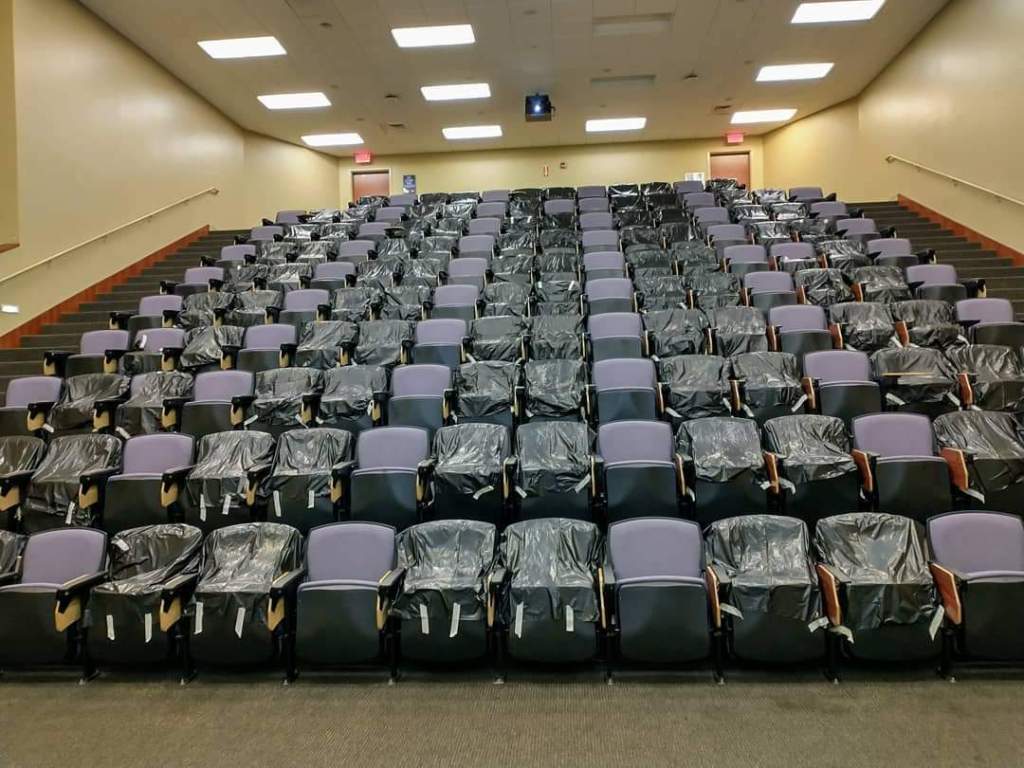
First, the students, the most important part of the teaching process. Overall, I would say my students did very well. At least in the classroom, they complied with all the rules the University set forth: wearing masks, physical distancing in classrooms (seen in the image below), even the one-way entrances and exits to the building. There were only 3-4 times I can recall this semester when a student entered my classroom without a mask, and they immediately asked me for one upon realizing their mistake (I kept a pack of surgical masks with me).

My classroom at the University of Central Arkansas, with chairs blocked off for physical distancing.

As far as academic performance of students, I was very pleased with the students. For those students that were able to stick with the class and keep up, which was most students, they perform as well or better than previous semesters. Some students, due to personal circumstances, had trouble keeping up. I tried as much as possible to accommodate students in these situations, by being flexible with deadlines, offering additional resources, and generally just trying to listen to them and empathize. It was hard for everyone.

On my end, I tried to make the teaching atmosphere of the classroom as normal as possible. I usually do have some interactive aspects of the classroom, where students work in small groups, talk to their neighbors, etc. Most of those activities didn’t happen, unfortunately. But otherwise, the classroom atmosphere operated as usual.

As my students did, I also wore a mask in the classroom while I lectured. For students that had to miss class due to quarantine, isolation, or other reasons, we were asked to record every lecture and have an option for students to watch the lecture virtually if needed. Making sure that the video was properly recording and the I had set up the Zoom link for students that needed to be remote added an extra element to think about at the beginning of each class, but it was the kind of thing that once you get used to it, it just became normal.

I will say that I often felt very exhausted after teaching each day. The mental load of making sure everything was working right in the classroom, combined with the constant sense of doom in the world around us, made this a challenging semester mentally. I’m sure this was even more true for some of my students. But, we made it.

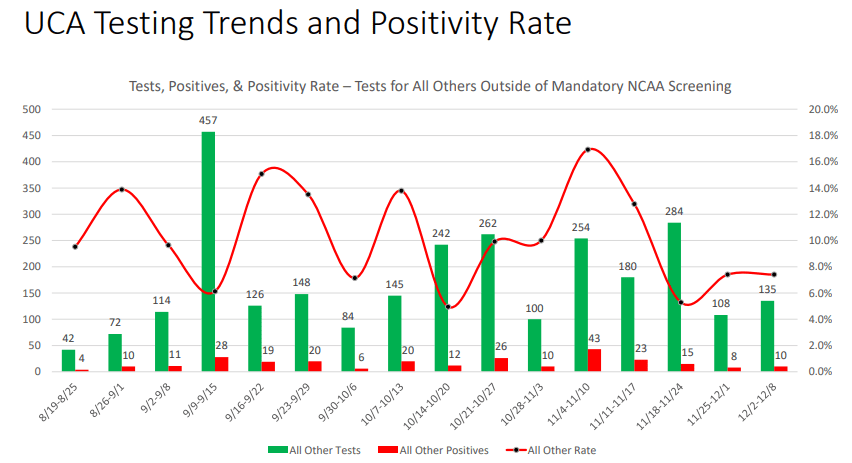
Finally, how about the administration of my University. I’ll bite my tongue a little here: I am up for tenure this year! But really, I don’t have anything major to complain about. Guidance was communicated well, although sometimes big changes were rolled out a bit more quickly than the faculty liked. UCA provided isolation and quarantine dorms for students, though these never came close to capacity. Weekly updates on testing, cases, and related data were provided to everyone (and made publicly available, so I’m not revealing any secrets here).

Testing data for UCA students. This data excludes athletes, since they were required to get tested regularly, which could have skewed the data.

As you can see above, the general student body at UCA did report positive COVID cases every week. And some weeks the positive test rate was a little higher than I was comfortable with! But we never had a large spike in cases, and the University held firm to its commitment to offer in-person classes for everyone that wanted them, as long as the campus was generally safe.

All in all, I think it was the best semester we could have had under the circumstances. The only thing really weighing on my mind: we are going to do it all over in the Spring semester. And we’ll do it as well as we can.

Treating Marriage like a Luxury Good

In the United States, the median age of marriage has been climbing for decades. In 1960 the median age of first marriage for men and women was 22.8 and 20.3 respectively. Fast forward to 2019 and the median ages are 29.8 and 28. Here are the historical tables.

Qualitative studies that interview young people suggest they are waiting on marriage until their careers get underway. Marriage is now something you do once you have a high income. But, this treats marriage as if it were a consumption good.

Consider this blog post from Brides.com,

“With the rising cost of living, mountains of student loan debts, and a lack of job security, some of us just aren’t financially in a position to get married or settled down until we’re a little older.”

What is striking is how marriage is not viewed as a productive and helpful institution to overcome these obstacles in life. This runs contrary to the literature on the Economics of the Family that documents how marriage facilitates gains from trade, risk pools like an insurance policy, and allows couples to take advantage of economies of scale.

Yes, you can obtain some of these advantages with cohabitation but not at the same level of commitment.

This view of marriage as a luxury that is only consumed when your career and finances are in order is harmful because it leads to less opportunity. Marriage is productive and expands our possibilities.

“Firearms and Violence Under Jim Crow”

A new working paper by Mike Makowsky and Patrick Warren finds that “firearms offered an effective means of Black self-defense in the Jim Crow South.” By this the authors mean that greater access to firearms by Blacks decreased the likelihood of being lynched.

That headline finding is sure to be provocative in both debates over gun control and the history of Jim Crow. And with good reason. What I found most interesting is how they measured Black access to firearms. Since they did not have direct access to any good sources measuring Black access to firearms, they proxy access with the percent of Black suicides committed with firearms. Increased access to firearms would also mean a higher proportion of suicides were committed using firearms.

That’s a “grisly” way of measuring Black access to firearms, as Makowsky put it in a Twitter thread summarizing the paper. But also a very creative one.

Here’s the full abstract:

We assess firearm access in the U.S. South by measuring the fraction of suicides committed with firearms. Black residents of the Jim Crow South were disarmed, before re-arming themselves during the Civil-Rights Era. We find that lynchings decrease with greater Black firearm access. During the Civil-Rights Movement, both the relative Black homicide and Black “accidental death by firearm” rates decrease with Black firearm access, indicating frequent misclassification of homicides as accidents. In the contemporary era, greater firearm access correlates with higher Black death rates. We find that firearms offered an effective means of Black self-defense in the Jim Crow South.

Peering Inside the Balance Sheet of the Fed

A balance sheet gives a snapshot of a corporation’s assets and liabilities. The difference between total assets and total liabilities is (by definition) the value of the equity owned by the owners or shareholders of the company.

With, say, a manufacturing firm, the assets would include tangible items such as buildings and equipment and inventory, and intangibles such as cash, bank accounts, and accounts receivable. Liabilities may include mortgages and other loans, and accounts payable such as taxes, wages, pensions, and bills for purchased goods.

The balance sheet for a bank is different. The “Assets” are mainly loans that the bank has made, plus some securities (such as US Treasury bonds) that the bank has purchased. These assets pay interest to the bank. The money the bank used to make these loans and purchase these securities came mainly from customer deposits or other borrowings by the bank (which are considered “Liabilities” of the bank), and also from paid-in capital from the bank owners/shareholders. [1]  As usual, the current equity of the bank is assets minus liabilities. Thus:

Source:  BBVA

The Federal Reserve System is a complex beast. We will not delve into all the components and moving parts, but just take a look at the overall balance sheet.

Unlike other banks, the Fed has the magical power of being able to create money out of thin air. Technically, what the Fed can do with that money is mainly make loans, i.e. buy interest-bearing securities such as government bonds. The Fed makes its transactions through affiliated banks, so it credits a bank’s reserve account with a million dollars, if it buys from that bank a million dollars’ worth of bonds. Those bonds then become part of the Fed’s “assets”, while the reserve account of the bank at the Fed (which is a liability of the Fed) becomes larger by a million dollars. Since the Fed is not a for-profit bank, the “Equity” entry on its balance sheet is nearly zero. Thus, total assets are essentially equal to total liabilities.

The Fed also has the power of literally printing money, in the form of Federal Reserve Notes (printed dollar bills). These, too, are classified as liabilities. Thus, you are probably carrying in your wallet right now some of the liabilities of the central bank of the United States.

Before 2008, the balance sheet of the Fed was under a trillion dollars. Nearly all the “Liabilities” were the Federal Reserve Notes and nearly all the “Assets” were US Treasury securities. The reserve accounts of the affiliated Depository Institutions was minuscule. All that changed with the Global Financial Crisis of 2008-2009. To help stabilize the financial system, the Fed started buying lots of various types of securities, including mortgage-backed securities (MBS) [2]. The Fed thus propped up the value of these securities, and injected cash (liquidity) into the system.

Here is a plot of how the assets of the Fed ballooned in the wake of the GFC, from about $ 0.9 trillion to over $ 4 trillion:

Source: Investopedia

The initial purchases in 2008 were US Treasuries, which the Fed had prior authorization to do. To buy other securities, especially the mortgage products, required congressional authorization. The increased liabilities of the Fed which offset these purchases were mainly in the form of larger reserve accounts of the affiliated banks. The Fed started paying interest on these reserve accounts, to keep short term interest rates above zero at all times (otherwise the whole money market in the U.S. might implode).

 With the Fed relentlessly buying the mortgage and bond products, the interest rates on long-term mortgages and bonds was kept low. This was deemed good for economic growth. The Fed tried to sell off some securities to taper down its balance sheet in 2018, but that effort blew up in its face – – the stock market started crashing in response in late 2018, and so the Fed backtracked . You can look at weekly tables of the Fed balance sheet here.

Anyway, the GFC and its aftermath provided the precedent for massive purchases of “stuff” by the Fed. When the Covid shutdown of the economy hit in March of this year, the Fed very quickly went into high gear. Its balance sheet shot up from $4 trillion to $7 trillion in just a few months. It bought not only Treasuries and MBS, but corporate bonds. This was way outside the Fed’s original charter, but the crisis was so intense that nobody seemed to care whether these actions were legal or not. And now, to finance the huge deficit spending of the federal government in the wake of the shutdowns, the Fed has been buying up nearly the entire issuance of Treasury bonds and notes.

These actions may have long term consequences we will explore in later posts [3]. For now, the Fed has made it clear that it will keep interests rates near zero for at least the next couple of years. Invest accordingly.

ENDNOTES

[1] Huge caveat: This statement gives the impression that a bank must first receive say a thousand dollar deposit before it can make a thousand dollar loan. That is not the case. The reality is just the opposite: the act of making a thousand dollar loan actually CREATES a corresponding thousand dollar deposit. This is very counterintuitive, and I won’t try to explain or justify this point here.

[2] Technically, the Fed is not “buying” the mortgage-backed security (MBS). Rather, it is making a “loan” to the bank, and holding the MBS as collateral against that loan.

[3] It is now harder to take the federal deficit seriously as a constraint on spending:  the government can issue unlimited bonds to fund deficits, which the Fed will purchase to keep interest rates low. Yes, the government has to pay interest on those bonds, but the Fed has to return most of that interest to the Treasury, so the real cost to the government of that extra debt is low.