Preferences for Equality and Efficiency

Most people would consider both equality and efficiency to be good. They are “goods” in the sense that more of them makes us happier.  However, in some situations, there is a trade-off between having more equality and getting more efficiency. Extreme income redistribution makes people less productive and therefore lowers overall economic output.

Examining the preferences people have for efficiency and equality is hard to do because the world is complicated. For example, a lot of baggage comes along with real world policy proposals to raise(lower) taxes to do more(less) income redistribution. A voter’s preference for a particular policy could be confounded by their personal feelings toward a particular politician who might have just had a personal scandal.

With Gavin Roberts, I ran an experiment to test whether people would rather get efficiency or equality (paper on SSRN). Something neat that we can do in a controlled lab setting is systematically vary the prices of the goods (see my earlier related post on why it’s neat to do this kind of thing in the lab).

One wants to immediately know, “Which is it? Do people want equality or efficiency?”. If forced to give a short answer, I would say that the evidence points to equality. But overly simplifying the answer is not helpful for making policy. The demand curve for equality slopes down. If the price of equality is too high, then people will not choose it. In our experiment, that price could be in terms of either own income or in group efficiency. We titled our paper “Other People’s Money” because more equality is purchased when the cost comes in terms of other players’ money.

The main task for subjects in our experiment is to choose either an unequal distribution of income between 3 players or to pick a more equal distribution. Given what I said above that people like equality, you might expect that everyone will choose the more equal distribution. However, choosing a more equal distribution comes at a cost. Either subjects will give up some of their own earnings from the experiment or they will lower the total group earnings. As is true in policy, some schemes to reduce inequality are higher cost than others. When the cost is low, we observe many subjects (about half) paying to get more equality. However, when the cost is high, very few subjects choose to buy equality.

This bar graph from our working paper shows some of the average behavior in the experiment, but it does not show the important results about price-sensitivity.

Continue reading

A Canned-Beer Kind of Guy

An  ex-co-worker was once complaining to me that the prices of things that he liked kept going up.

He was an economics major. Of course he knew that wages also increase. He wasn’t simply cantankerous about inflation. He knew all about improving productivity, income, and price level changes. He was being more specific. The *particular* items that *he* liked were getting more expensive. He was complaining about what, to everyone else, were relative price changes.

Unrelatedly, I was floating around the bls.gov website and examining their Producer Price Index (PPI) FAQs (I learned a bunch). The content is extensive. CPI is broken up into some subcategories. But PPI, being used by multiple industries and trade groups for real-life costs and benefits, is excitingly granular.

You want to know what happened to the price of red, white, rose, and carbonated wines each in particular?  They’ve got you covered. It really is amazing.

Back to my co-worker. I tried to explain that relative price changes reflected underlying economic value and scarcities. We wasn’t having any of it. He just didn’t want his prices to go up. We economists are known for being kind of dispassionate. We see relative prices change and we shrug. Man-on-the-street sees a relative price change and, boy, does he care about it – if it’s the purchasing price that *he* faces.

See the below graph. What kind of consumer are you? Since the start of the pandemic, canned, bottled, and kegged beer have all changed in price. Or maybe you’re a teetotaler and you’ve noticed the increasing price of bottled water.  For interpretability, let’s consider what had cost $10 at the start of the year 2020. Bottled water has gone up to $10.50 and bottled beer has gone up to almost $10.30.  You may not blink at a 3% price increase – unless it’s for 6 bottles of your favorite craft beer.

The price of canned beer, on the other hand, hardly increased at all. And in the last couple of months, the price *fell*. I sure hope that my co-worker is a canned-beer kind of guy. Otherwise, someone is sure to hear a lot of belly-aching.

Delta: Danger is Rising, but 2021 is not 2020

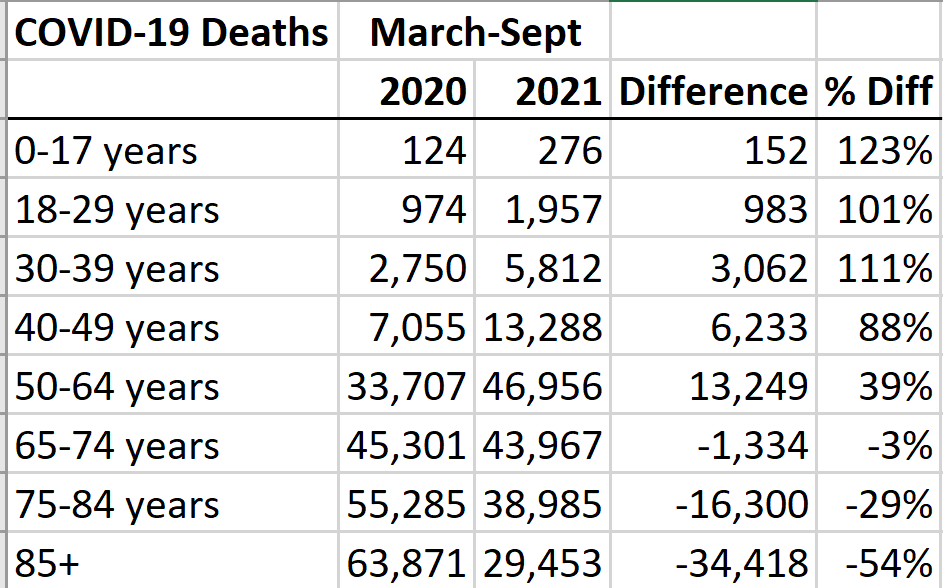
Covid cases are rising rapidly in the US thanks to the more contagious delta variant.

Based on the experience of 2020, this has many states, cities, and organizations considering a return to mask mandates and shutdowns. But our situation in the US has changed substantially since 2020 as we now have better knowledge, better masks, and above all abundant vaccines.

We can see this difference clearly when looking at countries hit by the Delta wave before us. It first devastated India, where less than 10% of the population was fully vaccinated, officially killing 400,000 people and unofficially perhaps 10 times that. In constrast the UK, where more than half the population was fully vaccinated, saw a major spike in cases that did not translate into a major spike in deaths:

The delta waves seem to come and go quickly, with cases rising more rapidly than previous waves, but also falling rapidly 6-8 weeks after they began to rise in India, the UK, and the Netherlands. Cases began rising in the US at the beginning of July, so if this pattern holds we have about 2-4 more weeks of rising cases before a rapid drop.

My worry is that a spike in cases just before the school year will lead schools to shut down just as the danger begins to recede, and when vaccines mean the danger was never as great as in previous waves. Externality-based arguments for shutdowns and mask mandates are now substantially less valid than in 2020 but I don’t know that policymakers have internalized this. The Biden admin actually does seem to get it, calling this a “pandemic of the unvaccinated“- i.e., if you’re worried, get vaccinated, and if other people don’t, that’s their problem. Even with delta the vaccines reduce covid’s danger to you by ~10x, and so also reduce the protection you gain from controlling others by ~10x.

The situation with masks has also changed. Cloth masks have limited effectiveness in protecting you from others, but decent effectiveness in protecting others from you, which meant there was a strong externality-based case for mask mandates. But now in 2021 high-quality KN-95 and even N-95 masks are easily available, and unlike cloth masks they offer excellent protection FROM others, as well as FOR others. Anyone who is vaccinated and wearing an N-95 really has nothing to worry about anymore, and little reason to force masks onto others.

The main externality-based arguments that could still work are for vaccine mandates and for restrictions in areas where hospitals are overwhelmed by unvaccinated Covid patients in a way that substantially worsens care for non-Covid patients. But outside of areas with low vaccination rates leading to overwhelmed hospitals, I no longer see a good case to impose mask requirements or restrictions on movement or events.

According to one set of projections, by the end of August adult ICUs (though not hospitals overall) will be over capacity in most low-vaccination states:

If you want to wear a mask and avoid crowds, you can, and in fact probably should do at least one of those during the Delta wave of the next month. But the externality-based case for restrictions is mostly gone, and governments would do better to focus on continuing vaccine rollout in the US and ensuring vaccines are available worldwide to help other countries and to prevent more variants from emerging and finding their way here. Personally I’m glad that my employer has a vaccine mandate but, at least currently, no mask mandate. For those who do still want Covid restrictions I ask- what are you waiting for? What event or number would make you say “ok, now we can go back to normal”? When do you expect that to happen? For me, what I was waiting for was vaccines available for everyone and now, at least in the US, we are lucky to have that.

Vaccine Lotteries: They Work!

To try and encourage vaccination during the on-going COVID pandemic, there have been many public and private incentives offered. For example, free doughnuts. Or offering $200 to state employees in Arkansas (taxable income, of course!).

But when the governor of Ohio announced on May 12, 2021 that they would be offering a $1 million lottery prize, with 5 winners, it took the incentive game to a new level (college scholarships were also a prize for 5 winners under 18).

So do the lotteries “work”? Do they get more people vaccinated? And even if they do “work,” does it pass a cost benefit test? Many expressed concern that, even if more people get vaccinated, that this is a lot of money to spend in uncertain budget times.

A new working paper by Andrew Barber and Jeremy West attempts to answer these questions. And they do so using synthetic control, one of the better methods social scientists have for attempting to identify causal relationships (which can be tricky).

What do they find? First, vaccine lotteries do work! They estimate that vaccination rates increased by 1.5% in Ohio because of the lottery. This amount is above and beyond the increase that would have been expected without the lottery (by comparing Ohio to other states that didn’t use a lottery — this is what the synthetic control method does).

But does it pass a cost-benefit test?

Continue reading

Air Fryer: Redundant, Self-Indulgent Counter-Space-Waster?

While we were all imprisoned at home in 2020, we turned to eating food, and preparing food to eat in order to occupy and comfort ourselves. People baked bread for the first time in their lives. When yeast in the stores ran out, the internet was alive with tips on how to get sourdough cultures started. And a lot of air fryers were marketed and bought.

The premise of air fryers seems unassailable: quickly circulate very hot air (up to 450 F/230 C) to get that delicious fried crispiness with minimal oil, and get it in minutes with minimal fuss and cleanup. Since we had an offer of getting an air fryer at a discount, I consulted my wise friend, the internet. I wanted to love air fryers, but it seems they don’t cook much differently than a modern countertop convection toaster/oven (“turbo broiler”). There are some space-age-looking air fryers with a more slender, curvaceous profile which has a somewhat smaller footprint than a rectangular turbo broiler, but the capacity is typically only enough for one person or a couple with modest appetites.

Continue reading

What happens when you can’t pay your employees in cool anymore

I’ve previously written about the dangers of trying to make a career out of something 19-year-olds think is cool. There are risks on the other side of the paycheck as well, though.

There’s been a flurry of media attention paid to the difficulties restaurants are facing trying to re-staff their kitchens and servers. This piece is my favorite so far, for the simple reason that it pays less attention to policy and politics, and more to the actual jobs in question and what restaurants can actually do to convince employees to return. Rather than condescend to the service industry as a petri-dish for wage policy experiments in “unskilled” labor markets, it dares to recommend employers investigate both the goods they are selling and the value proposition to employees they are trying to hire.

The restaurant and service industries have long been a haven for employees who might otherwise find resistance in the labor market. St. Anthony Bourdain first found his way into our hearts with his love letters to the kitchen as pirate ship, and in doing so contributed as much as anyone to making the restaurant industry cool. Really cool. 2nd-tier rock star cool. Not Beatles cool, but more than few chefs found their way to third-to-last-band at Lollapalooza cool.

And from this pirate ship rebel identity and willingness to hire employees of fringe legality, the restaurant industry found itself with a capacity enviable for any employer: it could pay people with something other than money. It could pay you with a willingness to overlook, ahem…questionable work histories or I-9 employment eligibility. It could pay you in enabling a contrived identity. It could pay you in “No, you’re not selling out trying build a career in a kitchen and yes, you can totally reaffirm that to yourself with two full sleeves of ink.” It could (unfortunately) also pay you through tolerance of workplace aggression, misogyny, and sundry behaviors otherwise on their way out of the office Overton window of acceptable behavior.

There is risk, however, in growing reliant on paying people in non-pecuniary rewards, especially “coolness”. What happens when, whether via a pandemic or just, well, aging, employees realize they can’t pay their rent with cool? What happens if working in your industry stops being cool? What if the world changes, and it broadly stops tolerating the workplace hostility attractive to some of your previous employees? Absent such variously fleeting, juvenile, or outright terrible non-pecuniary indulgences, they’re going to demand higher pay. In money.

The restaurant industry was, quite likely, in exactly the kind of equilibria that major exogenous shocks can shake us out of, sometimes forever. And make no mistake – this isn’t just something that restaurant owners are going to have a tough time adjusting to. I expect a lot us frequent restaurant customers are in for a rude awakening as well. Increased restaurant labor costs pass directly into higher prices. By 2010 the average household in the United States had grown accustomed to dining out more than at home, a luxury enabled by prices kept lower in no small part by a labor force paid in non-pecuniary benefits. I am very much part of that average. Growing up in a family that dined out less than once a month (and that was usually at Pizza Hut), constantly eating out at an endless variety of restaurants has become my single favorite luxury enabled by my employment.

Yes, I’ll probably get a little wistful for the days when I could afford to eat-out almost every night. But it’s also exciting to imagine what a new and different restaurant industry might look like. As an economist, I’ll admit a bit of ironic amusement if it is not the $15 minimum wage that makes way for the oft-prognosticated wave of automated kiosks and labor displacement, but rather the end of a labor pool mythos that leads to a labor exodus. The sudden and collective realization that while, yes, we all concede that a 14-inch scimitar and a flask of Fernet Branca on your hip are cool, they’re not nearly as cool as health insurance and a 401k from a job where the sous chef doesn’t hump your leg every shift.

Which is a long way of saying:

Beware dependence on monopsony power born of coolness, for it is fleeting and full of bankruptcies. Just ask every magazine or media company staring down a writer’s union who’s members have hit their early 30s and realize they can’t pay Brooklyn rent with Williamsburg street cred.

Knowledge for 1990 Children

We picked up a yard sale book: People and Places: A Random House Tell Me About Book.* When I saw that the U.S.S.R. was a huge swath across the northern hemisphere (drawn as a Mercator projection), I checked the publication date. It was published in New York in 1991 by Random House.**

This content would have been considered uncontroversial knowledge for children. It was written by Boomers for Millennials, one year before The End of History came out.***

The first fact discussed is that the earth had about 5 billion people and they saw no end to population growth. The book states that the world could be up to 15 billion people within 60 years (which would be 2050). Today, it is predicted that world population will peak soon and then decline. Fertility rates in most rich countries are currently below replacement and birth rates are falling everywhere. I guess the authors didn’t see that coming.

On the next page is a matter-of-fact explanation that A.D. stands for Anno Domini. If there was a new edition printed today, they would likely follow the academic trend of using BCE/CE, to avoid referencing religion.

Much of the book is about culture, with illustrations. In today’s terminology, this might be considered an attempt at color-blindness. All of the major world religions are presented next to each other with a neutral/positive spin on each. Racial and gender representation is carefully balanced, like the stock images I grew up with in American public school.

Considering how many students were forced to learn remotely this year, I liked the section on the Australian School of the Air. Remote farm children talked to a teacher by radio and sent written work by mail.

At the end is the answer to, “How will we live in the future?” Jeff Bezos might be happy to know that they predict space travel will be more common and people will live in space colonies. The stated reason for space colonization was the predicted unrelenting population growth. There wasn’t a hint of pessimism about, for example, global warming.

Their diagram of a futuristic house has a “Main computer” prominently featured. They predicted that computerized machines would do more work for humans, which has already happened in the past 30 years. The idea of mobile computers and internet services was probably not considered. They imagined house-bound clunky robots that could follow simple instructions.

*Currently still available on Amazon

** Lithuania declared independence from the Soviet Union in 1990. I suppose the publishers couldn’t be bothered to stop the presses.

*** In 1991, Gen X may have been too old to be the target audience of a children’s’ book.

Self interest and self care

“Self care” is all the rage. It’s heralded as a novel and progressive notion.

The stance one takes on Simone Biles is largely colored by one’s theory of self care.

So, as Biles occupies the headlines for days, why isn’t more credit going to Adam Smith and his intellectual descendants? “Self interest” was condemned, yet here we are in 2021 with “self care”!

James had a similar post yesterday! He went back in history much further than Adam Smith.

Simone Biles and the Trojan War

When star gymnast Simone Biles decided to sit out the Olympics this week to ‘focus on herself’, both those praising her and those criticizing her seemed to treat this like a unique story that wouldn’t have happened in earlier generations. But it reminds me of one of the oldest recorded stories in the world, one that predates even the first ancient Greek Olympics of 776 BC- Achilles’ decision to sit out the Trojan War.

Here is Biles this week:

We also have to focus on ourselves, because at the end of the day we’re human, too… We have to protect our mind and our body, rather than just go out there and do what the world wants us to do.

Here is Achilles, greatest of the Greek warriors, thousands of years ago:

Him do I hate even as the gates of hell who says one thing while he hides another in his heart; therefore I will say what I mean. I will be appeased neither by Agamemnon son of Atreus nor by any other of the Danaans, for I see that I have no thanks for all my fighting. He that fights fares no better than he that does not; coward and hero are held in equal honour, and death deals like measure to him who works and him who is idle. I have taken nothing by all my hardships- with my life ever in my hand; as a bird when she has found a morsel takes it to her nestlings, and herself fares hardly, even so man a long night have I been wakeful, and many a bloody battle have I waged by day against those who were fighting for their women. With my ships I have taken twelve cities, and eleven round about Troy have I stormed with my men by land; I took great store of wealth from every one of them, but I gave all up to Agamemnon son of Atreus. He stayed where he was by his ships, yet of what came to him he gave little, and kept much himself….

Agamemnon has taken her from me; he has played me false; I know him; let him tempt me no further, for he shall not move me. Let him look to you, Ulysses, and to the other princes to save his ships from burning…. I will draw my ships into the water and then victual them duly; to-morrow morning, if you care to look, you will see my ships on the Hellespont, and my men rowing out to sea with might and main. If great Neptune vouchsafes me a fair passage, in three days I shall be in Phthia. I have much there that I left behind me when I came here to my sorrow, and I shall bring back still further store of gold, of red copper, of fair women, and of iron, my share of the spoils that we have taken; but one prize, he who gave has insolently taken away. Tell him all as I now bid you, and tell him in public that the Achaeans may hate him and beware of him should he think that he can yet dupe others for his effrontery never fails him.

As for me, hound that he is, he dares not look me in the face. I will take no counsel with him, and will undertake nothing in common with him. He has wronged me and deceived me enough, he shall not cozen me further; let him go his own way, for Jove has robbed him of his reason. I loathe his presents, and for himself care not one straw. He may offer me ten or even twenty times what he has now done, nay- not though it be all that he has in the world, both now or ever shall have; he may promise me the wealth of Orchomenus or of Egyptian Thebes, which is the richest city in the whole world, for it has a hundred gates through each of which two hundred men may drive at once with their chariots and horses; he may offer me gifts as the sands of the sea or the dust of the plain in multitude, but even so he shall not move me till I have been revenged in full for the bitter wrong he has done me. I will not marry his daughter; she may be fair as Venus, and skilful as Minerva, but I will have none of her: let another take her, who may be a good match for her and who rules a larger kingdom. If the gods spare me to return home, Peleus will find me a wife; there are Achaean women in Hellas and Phthia, daughters of kings that have cities under them; of these I can take whom I will and marry her. Many a time was I minded when at home in Phthia to woo and wed a woman who would make me a suitable wife, and to enjoy the riches of my old father Peleus. My life is more to me than all the wealth of Ilius while it was yet at peace before the Achaeans went there, or than all the treasure that lies on the stone floor of Apollo’s temple beneath the cliffs of Pytho. Cattle and sheep are to be had for harrying, and a man buy both tripods and horses if he wants them, but when his life has once left him it can neither be bought nor harried back again. 

My mother Thetis tells me that there are two ways in which I may meet my end. If I stay here and fight, I shall not return alive but my name will live for ever: whereas if I go home my name will die, but it will be long ere death shall take me. To the rest of you, then, I say, ‘Go home, for you will not take Ilius.’ Jove has held his hand over her to protect her, and her people have taken heart. Go, therefore, as in duty bound, and tell the princes of the Achaeans the message that I have sent them; tell them to find some other plan for the saving of their ships and people, for so long as my displeasure lasts the one that they have now hit upon may not be

In either case, economists aren’t surprised to see people stop showing up to work when they think the costs to them exceed the benefits, even when that work is itself unusual and could benefit their country.

The Recession Is Over! (15 months ago)

Lately there has been lots of both good and bad news about the pandemic and its impact on the economy. But here’s once piece of good news you might have missed: the recession which began in February 2020 ended in April. And not April 2021… it ended in April 2020. At least, that’s according to the NBER Business Cycle Dating Committee, which made the announcement last week.

The 2020 recession of just 2 months is by far the shortest on record. NBER maintains a list of recessions with monthly dates going back to 1854 (there are annual business cycles dates before that, including important modern revisions of the original estimates, but the monthly series starts in 1854). In that timeframe, there have been 7 recessions in the 6-8 month range, but nothing this short. Still, it was mostly definitely a recession, as unemployment briefly spiked to levels not seen since the Great Depression. But only for 2 months. Keep in mind that the first part of the Great Depression last 43 months.

Unemployment Rate, 1948-present

But how can this be? Is the recession really over? There are still about 6-7 million fewer people working than before the pandemic began. Lots of businesses are still hurting. The unemployment rate is still 2 full percentage points above pre-pandemic levels. How in the world can we say the recession ended 15 months ago?

To answer that question, it helps to know what NBER and most macroeconomists mean by a “recession” — essentially, it is used interchangeably with “contraction.” It means the economy, by a broad array of measures (NBER uses about 10 measures), is shrinking — or we might say, going in the wrong direction. The only other option, at least in the NBER chronology, is an expansion — when the economy is going in the right direction.

Does an economic expansion mean that everything is fine the economy?

Continue reading