Back to School! But what’s up with college pricing?

It’s time to head back to school! Which means it’s time for college students to once again ask the question: How am I going to pay for this?

It’s common knowledge that college is expensive and getting more expensive every year. A Google search for “skyrocketing tuition” produces almost 60,000 results. But whenever a fact is so commonly accepted, it’s worth asking if it’s really true.

Here’s one way to think about: are college tuition and fees increasing faster than the overall rate of inflation? For much of recent history, the answer has been most definitely “yes.” I start the series here in 2006, because there were some methodological changes to the index just before 2006. Cumulatively, college tuition and fees (as measured in the CPI) have increased by 78%, while prices overall have only increased by about 38%.

But for the very recent history, since 2017, the answer is “no.” College tuition and fees have often been increasing at slower rates than overall prices in the CPI, and the difference is especially dramatic in 2021. Since 2017, overall prices have increased by about 12.4%, but college tuition and fees has only increased by 7.8%.

However, even this data overstates how much tuition and fees have gone up for undergraduates in the US!

Continue reading →

Home for a Millennial

We read a children’s book called Home for a Bunny. In springtime, a bunny wants to find “a home of his own. A home for a bunny.” The bunny goes around talking to other forest creatures and considers crashing with them. It keeps not working out. Finally, the bunny finds another bunny to pair off with and they live happily ever after in a hole. (The implication is that the interloper is male and he finds a woman who already has her own place.)

Judging by the current housing market, the country’s currently largest generation has decided it’s time to find a home.

According to Jerusalem Demsas on the Macro Musings podcast last month, part of the reason houses are selling so fast today is that many millennials want to buy their first home now. They are competing against each other, especially for starter homes near growing cities.

The problem with making blanket statements about millennials is that we are a diverse group. For example, we are majority-white like Boomers, but only 56% are white. We went to college at higher rates than previous generations, but still less than half of American millennials graduated from college.

Millennials who could afford to consume wanted experiences, not stuff. I never saw peers brag about owning a pricey watch, but I have seen many photos posted of soul-searching adventure trips to Thailand. As I said, one should not generalize because it’s only the wealthiest millennials who could afford such things. But the wealthiest millennials are the ones who could have become homeowners. Instead they sought out the next avocado toast served with a view of a hip city core. Covid restrictions forced a set of people who had always been on the run to evaluate their home lives, or lack thereof.

Where had the largest generation been living prior to summer 2021?

Here’s a link to an SNL skit “The Millennials Skit” that sums up the complaints I was hearing about my own generation when I was in my early 20’s. If you can believe this, I did something stupid in my early 20’s. With so much hyperbole surrounding us, many don’t have a good sense of the facts.

In 2000, most millennials were in their parents’ houses, right where everyone expected them to be. The US population overall grew substantially since 2000. Many local zoning restrictions didn’t allow for concurrent rapid growth in the housing stock in the places with job growth.*

As millennials aged into adulthood, they were not buying houses or forming families at the rate previous generations had. PEW reports, based on Census data, that millennials are more likely to live with their parents than previous generations.

The group of millennials who were most likely to be living with their parents were men without a college degree. Most millennials were not living in their childhood bedrooms pre-Covid. Once again, it’s hard to generalize. Almost half already owned a home. Many were renting along with a friend or romantic partner. Whereas a majority of Boomers were married as young adults, less than half of millennials currently are. College-educated millennials are more likely to be married.

Millennials have kids later, so that would normally be associated with not buying houses before the age of 30. Some of the causality runs from the high cost of housing to the decision to put off having children. There is a long-running debate over whether millennials are different because they have different preferences from Boomers or because they are relatively economically disadvantaged. The combination of low wages for some and high home prices for many is an economic explanation for the initial hesitancy to purchase a house. Despite what the SNL skit said about us, most millennials are working now. Slower household formation is not due to chronic unemployment.

The highest rates of living-with-parents were in expensive cities like New York and Miami. If you can live close to a good jobs hub without having to pay the high rent, then you can save money. With that personal savings, now that we are older, many millennials would like to jump into home ownership. 

This week I went into a local restaurant that is patronized by adults like me. On the chalk board was a poll “Backstreet Boys or NSYNC?” People were gleefully making chalk tick marks to vote for their preferred band. That’s just one of the subtle signs I have seen in the past year that millennials are in charge of the places I visit.

*Read Jeremy on zoning and the Horpedahl Zone of Affordability. Also see The Complacent Class on how America didn’t make it easy for a diverse set of millennials to thrive.

Penny-Pinchers Gonna Pinch

Text books say that there are two major problems with the Consumer Price Index (CPI). First, accounting for changes in quality is difficult. Second, the CPI is calculated by assuming a fixed basket of goods is consumed over time. For both of these reasons, the rate of inflation that is implied by CPI is typically considered to be about 1% overestimated.

Imperfectly accounting for quality improvements causes higher measured inflation because the stream of services that a product creates for the consumer has increased – even though the product is nominally the same product. For example, the camera on my smart-phone is now good enough to record a high-quality Youtube video, whereas it was of mediocre quality on my previous phone.  My life is better-off with the better camera. But the increase in my quality of life isn’t measured by the CPI. The CPI does, however, make note that I paid a higher price for a phone.

Further, people don’t consume a fixed basket of goods over time. Even if we stopped the introduction of all new products and maintained the quality of all current products, people would still change the composition of their consumption due to price changes among related goods.

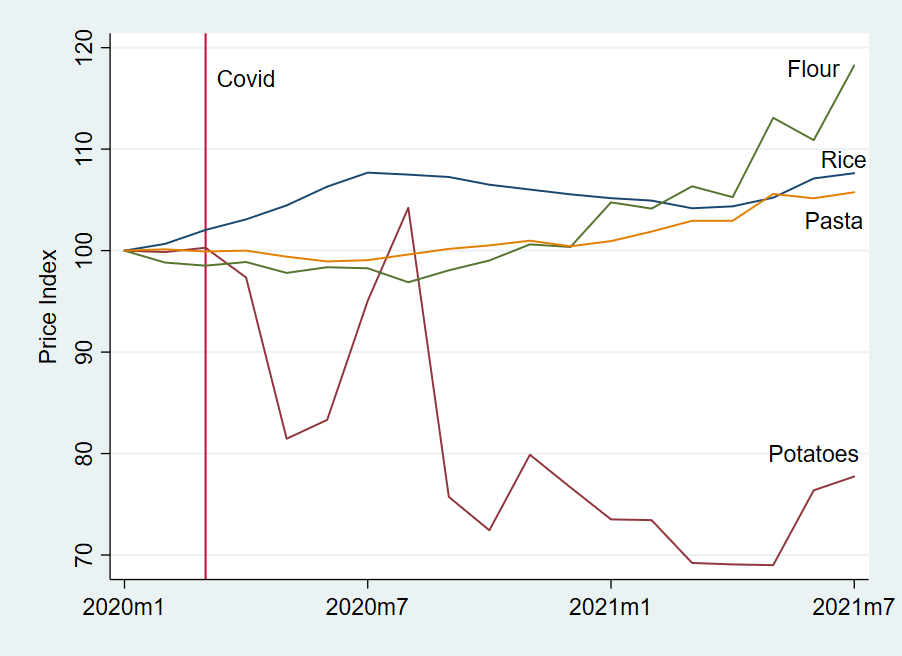
When people get hot and bothered by inflation, they often appeal to people who are of less means and who would find higher prices more burdensome. For that reason, below is a graph of some calorically dense and roughly comparable food staple prices (from the PPI).  You can put a protein on top of any one of these and call it a meal: pasta, flour, potatoes, & rice.

Let’s say that a consumer consumed equal parts of these in January of 2020. The CPI assumes that the consumption basket remains constant and plots a weighted average. In such a case, price rose 2.3% through July 2021. But in real life, penny-pinchers gonna pinch. If our consumer is particularly Spartan, then he will always consume the cheapest option – he treats the different foods as perfect substitutes. The Spartan price of consuming *fell* 22.3%. To be clear, the CPI assumes that the consumption composition remains unchanged, while the consumer’s actual basket is responsive to price changes.  Even if a consumer considers these goods to be imperfect substitutes and is willing to cut any particular type of consumption in half in favor of the cheapest alternative, then the price fell by 10%. In fact, a consumer who is at all responsive to prices will always have a cheaper basket than the headline CPI, all else constant.

In conclusion, be careful with your money. Spend it well and seek out alternatives. Your flexibility determines how much money you’ll have at the end of the month. The headline CPI number impacts only the most passive consumer – and even then, budget constraints gonna constrain.

Generous Health Insurance Makes Employees Stay

The idea of “job lock” is well established in the academic literature- employees leave firms that don’t offer health insurance more often than they leave firms that do. But this literature has always measured employer-provided health insurance as a simple binary: either they offer it or they don’t. In fact employers vary widely in the generosity of their plans, both in the quality of the insurance and in how much of the cost is paid by the employer. Some employers pay all of the premiums, some pay none, and most pay part:

Data are from the Current Population Survey, which uses top-coding to protect privacy (values greater than 9997 are reported as 9997)

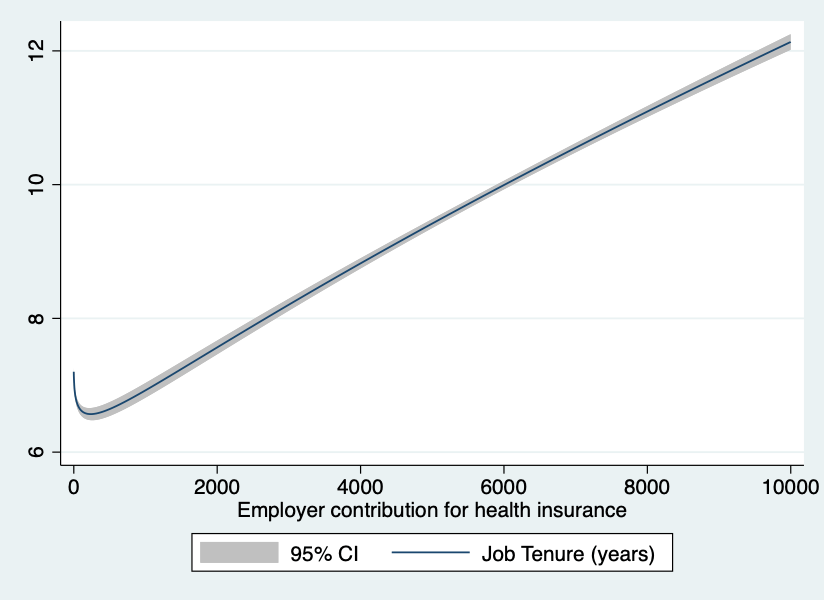
In an article published last week in Applied Economics Letters, my colleague Michael Mathes and I combine two supplements of the Current Population Survey to test whether employers who contribute more towards health insurance see their employees stay longer. Perhaps not surprisingly, we find that they do. We run lots of regressions to establish this, but this simple fit plot tells the story best:

What we found more surprising was the magnitude of this effect: a thousand dollar increase in employer contributions to health insurance is associated with at least 83 additional days of job tenure, compared to less than 10 additional days for a thousand dollar increase in wages. We conclude that:

For employers trying to increase retention, increasing contributions to health insurance appears to lengthen employee tenure far more than increasing wages by a similar amount.

Why the difference? Probably employees rationally valuing $1000 in untaxed contributions to health insurance above $1000 in taxable wages. Why don’t employers shift more compensation away from wages and toward health insurance, given that employees seem to prefer it? Here I’m less sure, and they could simply be making a mistake, but one possibility is that they worry about increasing their costs as couples whose employers both offer insurance choose the more generous one for a family plan. Another is that while generous health insurance plans are better for retention, higher wages could be better for attracting new employees, who tend to be younger and for whom the salary number could be more salient.

Beer, Hot Dogs, and Inflation

The latest inflation data for the US has been released, and the headline CPI-U annual increase of 5.4% is once again raising worries that high inflation could be a permanent part of the landscape for the near future.

My personal opinion is that the picture is much too muddled now, between temporary supply issues and low bases for 2020 prices, to say much about the medium-term picture. I think we’ll have a better picture by the end of the year. Still, it’s worth drilling down into the data, as we have done in the past on this blog, to understand some things about economics, prices, and how price changes are impacting real people.

Certainly the prices of some goods are rising at alarming rates. Many of these are related to automobiles and transportation generally, but some categories of food have rose a lot in the past year too (though groceries overall are only up 2.6%).

But I want to talk about two categories of consumption: beer and hot dogs.

Actually, my co-blogger Zachary has already written about beer. And using the producer price index, he found that canned beer is actually cheaper than it was a year ago. If you like canned beer, rejoice! And for all beer at home, the CPI shows only a 1.8% increase since last year, after a similar small 1.6% increase last July (not much of a base effect… a clue for later!).

But not all Americans consumer alcohol. So let’s talk about that most American food product: the hot dog.

Why should we care about hot dogs? Read on.

Continue reading →

Age ___ Do you smoke Y/N Will you get vaccinated Y/N

Jonathan Meer wrinkled my brain:

“Hospitalizations for COVID are almost entirely confined to those who are not vaccinated, often at the cost of tens or hundreds of thousands of dollars…why should the vaccinated bear those financial costs? Insurers, led by government programs, should declare that medically-able, eligible people who choose not to be vaccinated are responsible for the full financial cost of COVID-related hospitalizations, effective in six weeks….Standing up for your beliefs means being willing to bear the consequences. Otherwise, it’s just cheap talk.”

In summary, anti-vaccination positions are effectively being subsidized by taxpayers, members of insurance pools, and the vaccinated. It’s an expressive form of moral hazard. It’s selfishness, signaling, and group identity as club good. It’s cheap talk. It’s at least 5 different chapters of your microeconomics textbook. It’s a great article and I want to talk about it.

  1. “Cheap talk” doesn’t mean “costless.”

“Cheap talk” means you don’t have sufficient costs or benefits committing you to follow through on the future behavior you are promising. But I think a lot of people have painted themselves in a very public corner. If you spend 6 months telling everyone who will listen that Covid is just the flu, that the vaccines are dangerous or don’t work, then you’ve got a lot of social capital within your peer network (or audience) that will be destroyed if you publicly change your mind or are observed getting vaccinated. For most private citizens, the answer may be found in a hat and fake moustache. Nonetheless, the talk isn’t that cheap. Only a 1/3 of unvaccinated people claimed they’d be more likely to get vaccinated for $100. What Meer proposes is to “uncheapen” their talk at a far greater level, where $25k to $100k price tags are not out of the question. I think such a policy would work specifically because it creates an expected incentive greater than either peer stigma or any feasible reward policy for vaccination, and at levels large enough where loss aversion may likely kick in. Funny thing about people – we don’t plan for low probability events very well, often treating ~1% negative events as an impossibility. I know it may sound crazy, but a 10% chance of being impoverished may actually be a more powerful incentive than a 0.5% chance of dying.

2. It’s really hard to write complete contracts i.e. your health insurance company desperately wishes it could have included vaccination in your premium calculus.

“Knightian Uncertainty” i.e. when you don’t know what you don’t know remains one of the all-time “obviously important, but hard to operationalize” concepts in an economic analysis. If you write an economic model where people are purely backward looking you will get a lot of pushback for making your agents too myopic, too stupid. At the same time, if anyone out there has started a museum of apartment leasing contracts, I have no doubt they have grown at a near perfectly linear rate over time, as tenants forever explore the space for unanticipated holes and landlords continue to supplement their contracts in response. Every new paragraph in a lease tells the story of a previously unanticipated cost. Your health insurance is the same. For decades you’ve had to tell them if you smoke. Here’s a prediction: In the future you’ll have to tell them if you’ll receive FDA-approved vaccines.

3. Given the state of modern democracy, even for problems where government mandates are the first-best solution, we may have little choice but to rely on market- and community-based solutions going forward.

One of the big advantages of government mandated solutions over market alternatives is completeness i.e. you can make everyone do it (with concomitant provision, monitoring, and punishment). What the pandemic has made clear is that simply isn’t the case anymore, for the simple reason that our politics are so polarized and, more importantly, so efficient in polarizing any policy. Any issue where a universal mandate is the optimal policy will immediately be polarized into for/against constituencies, which will slow down and eventually weaken any possible mandate.

I’m honestly not sure we could pull off the small pox vaccination program today, and it is arguably the greatest government program in world history. That was the first-best means to eradicating small pox. So what’s the second-best means to coping with Covid? If health insurance wrote separate premium contracts for vaccinated and unvaccinated customers, maybe that could get us to herd immunity. Medicare and Medicaid could have similar contingencies for reimbursement, but I suspect it’s hospitals that would end up on the hook. If hospitals refused care to unvaccinated Covid patients, I don’t think it would go down very well politically.

What this leaves are the smaller groups within our nesting doll of associations (state, local… church, synagogue, university, Rotary club, hockey league, pub trivia, the eight people you always see on the bus). It may be within these smaller, more voluntary groups, with their easier entry and exit, that we may observe that necessary accepted coercion to produce club immunity. And while vaccination mandates as a series of parallel club goods is clearly inferior to its provision as a monolithic national public good, its still superior to purely independent production.

4. Could HMO’s have their moment?

Health Management Organizations (HMOs) have been pretty stagnant for a while. Skepticism over management incentives to provide optimal healthcare has always lingered, combined with the fact that health insurance does seem to work pretty well for the people that have it (it’s the 28 million Americans that don’t have health insurance where the bulk of problems lie). Given limits on in-network care and the difficulties assuring prospective members that physician and patient interests are aligned, HMOs have always had a hard time presenting a compelling sales pitch relative to traditional insurance.

The club nature of HMO’s, however, may give them a new structural advantage in the post-Covid world. They can exclude people from membership, from taking up limited resources and sharing space with potentially vulnerable members. Would I at this very moment prefer being sent to a hospital that only allowed vaccinated people to work or receive care in it? Yes, I would. If Covid variants become seasonal, if we’re entering an age of pandemics, or if we’re simply watching the emergence of costly medical luddites as a significant portion of the population, then a lot of us might give HMO’s a second look. (NB: This ability of HMOs to “exclude” is, of course, also their potential downfall. The power to exclude is, historically, almost always abused. The idea that healthcare would become a domain not just characterized, but driven, by the power to exclude should cause trepidation. If you thought there were going to be solutions without tradeoffs to the problem of vaccine refusal, get used to disappointment.)

5. Would universal healthcare (or “Medicare for All”) mandate vaccinations? Can they?

I’m genuinely curious about where policy proponents sit on this. If vaccinations are required to receive care, then it requires denying sick people care. Healthcare policy is a great topic to argue about on twitter, but it’s all cheap talk until orderlies are shoving dying patients out the door.

I’m not the kind of person that reads a lot of philosophy, but that’s really what this boils down to– moral philosophy. It’s easy to call yourself a “libertarian” until your personal freedom not to get a shot in your arm is literally killing millions. It’s easy to call yourself a “socialist” until the newly created levers of power to coerce hundreds of millions into receiving a drug today will set the precedent for the “next Trump” to use those same levers for their own nefarious ambitions. There’s always a risk, a trade-off, no matter how many capital letters you use to yell at me.

It’s all cheap talk, but that doesn’t mean it’s costless.


Preferences for Equality and Efficiency

Most people would consider both equality and efficiency to be good. They are “goods” in the sense that more of them makes us happier.  However, in some situations, there is a trade-off between having more equality and getting more efficiency. Extreme income redistribution makes people less productive and therefore lowers overall economic output.

Examining the preferences people have for efficiency and equality is hard to do because the world is complicated. For example, a lot of baggage comes along with real world policy proposals to raise(lower) taxes to do more(less) income redistribution. A voter’s preference for a particular policy could be confounded by their personal feelings toward a particular politician who might have just had a personal scandal.

With Gavin Roberts, I ran an experiment to test whether people would rather get efficiency or equality (paper on SSRN). Something neat that we can do in a controlled lab setting is systematically vary the prices of the goods (see my earlier related post on why it’s neat to do this kind of thing in the lab).

One wants to immediately know, “Which is it? Do people want equality or efficiency?”. If forced to give a short answer, I would say that the evidence points to equality. But overly simplifying the answer is not helpful for making policy. The demand curve for equality slopes down. If the price of equality is too high, then people will not choose it. In our experiment, that price could be in terms of either own income or in group efficiency. We titled our paper “Other People’s Money” because more equality is purchased when the cost comes in terms of other players’ money.

The main task for subjects in our experiment is to choose either an unequal distribution of income between 3 players or to pick a more equal distribution. Given what I said above that people like equality, you might expect that everyone will choose the more equal distribution. However, choosing a more equal distribution comes at a cost. Either subjects will give up some of their own earnings from the experiment or they will lower the total group earnings. As is true in policy, some schemes to reduce inequality are higher cost than others. When the cost is low, we observe many subjects (about half) paying to get more equality. However, when the cost is high, very few subjects choose to buy equality.

This bar graph from our working paper shows some of the average behavior in the experiment, but it does not show the important results about price-sensitivity.

Continue reading →

Delta: Danger is Rising, but 2021 is not 2020

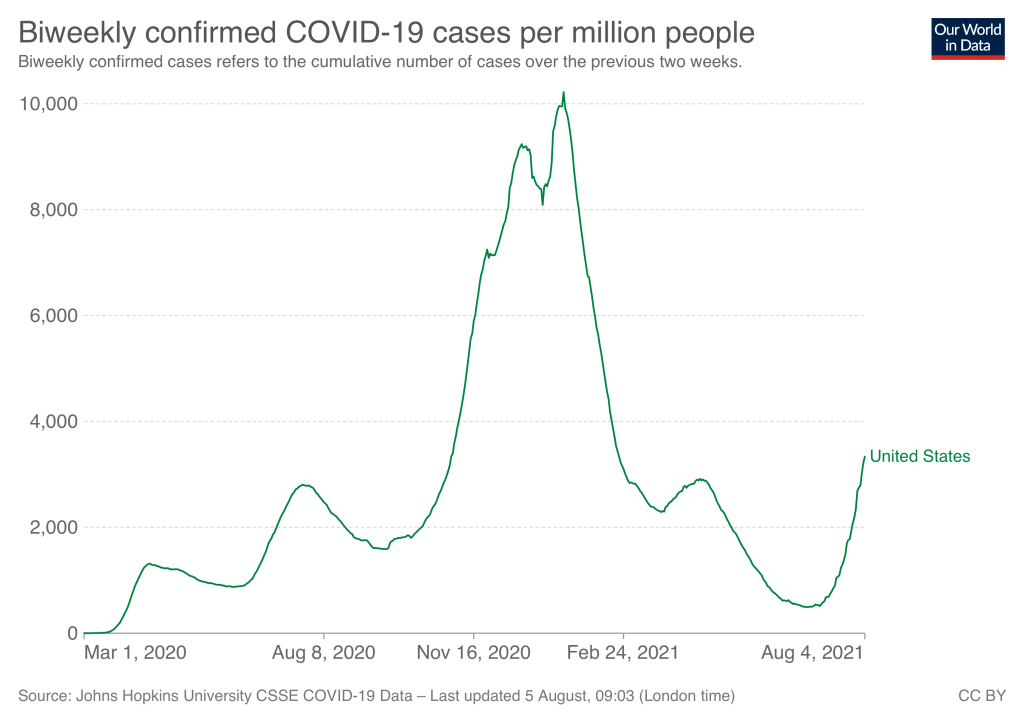
Covid cases are rising rapidly in the US thanks to the more contagious delta variant.

Based on the experience of 2020, this has many states, cities, and organizations considering a return to mask mandates and shutdowns. But our situation in the US has changed substantially since 2020 as we now have better knowledge, better masks, and above all abundant vaccines.

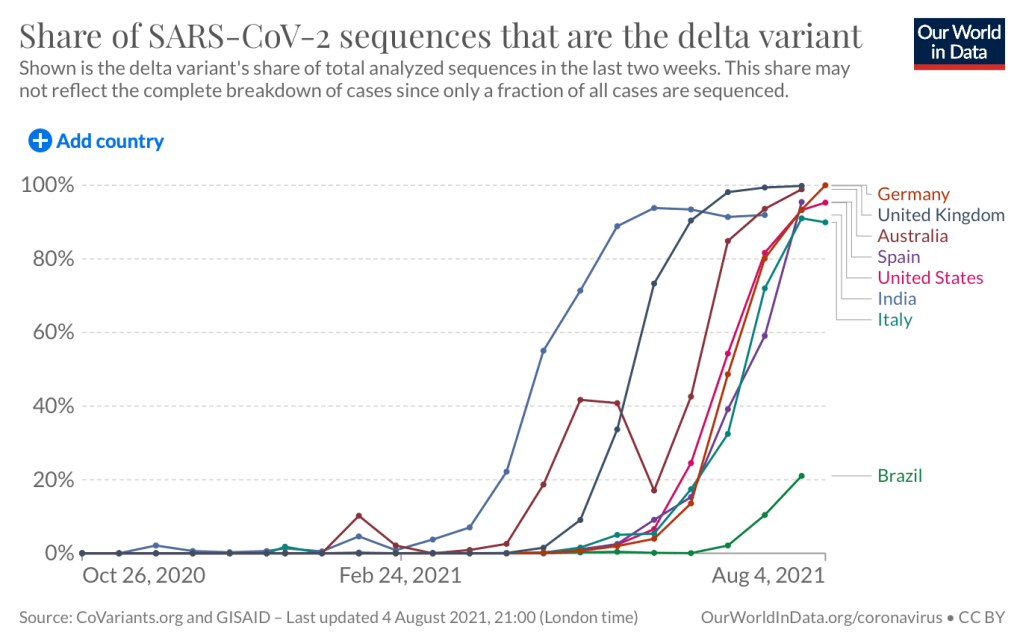
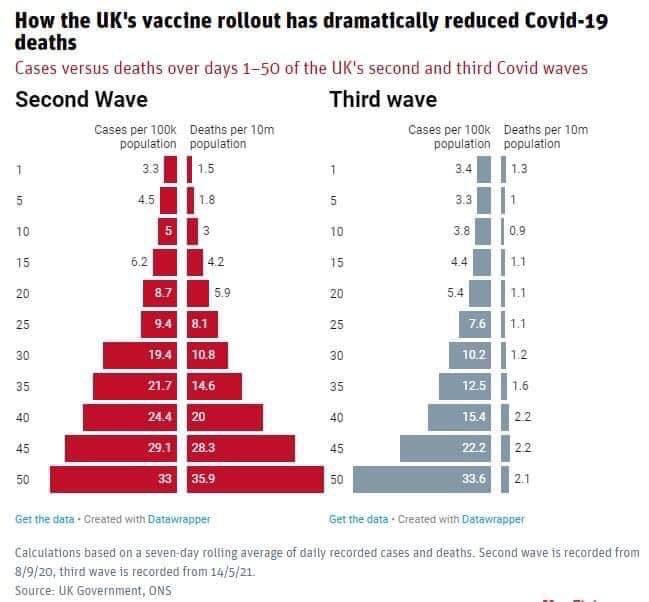
We can see this difference clearly when looking at countries hit by the Delta wave before us. It first devastated India, where less than 10% of the population was fully vaccinated, officially killing 400,000 people and unofficially perhaps 10 times that. In constrast the UK, where more than half the population was fully vaccinated, saw a major spike in cases that did not translate into a major spike in deaths:

The delta waves seem to come and go quickly, with cases rising more rapidly than previous waves, but also falling rapidly 6-8 weeks after they began to rise in India, the UK, and the Netherlands. Cases began rising in the US at the beginning of July, so if this pattern holds we have about 2-4 more weeks of rising cases before a rapid drop.

My worry is that a spike in cases just before the school year will lead schools to shut down just as the danger begins to recede, and when vaccines mean the danger was never as great as in previous waves. Externality-based arguments for shutdowns and mask mandates are now substantially less valid than in 2020 but I don’t know that policymakers have internalized this. The Biden admin actually does seem to get it, calling this a “pandemic of the unvaccinated“- i.e., if you’re worried, get vaccinated, and if other people don’t, that’s their problem. Even with delta the vaccines reduce covid’s danger to you by ~10x, and so also reduce the protection you gain from controlling others by ~10x.

The situation with masks has also changed. Cloth masks have limited effectiveness in protecting you from others, but decent effectiveness in protecting others from you, which meant there was a strong externality-based case for mask mandates. But now in 2021 high-quality KN-95 and even N-95 masks are easily available, and unlike cloth masks they offer excellent protection FROM others, as well as FOR others. Anyone who is vaccinated and wearing an N-95 really has nothing to worry about anymore, and little reason to force masks onto others.

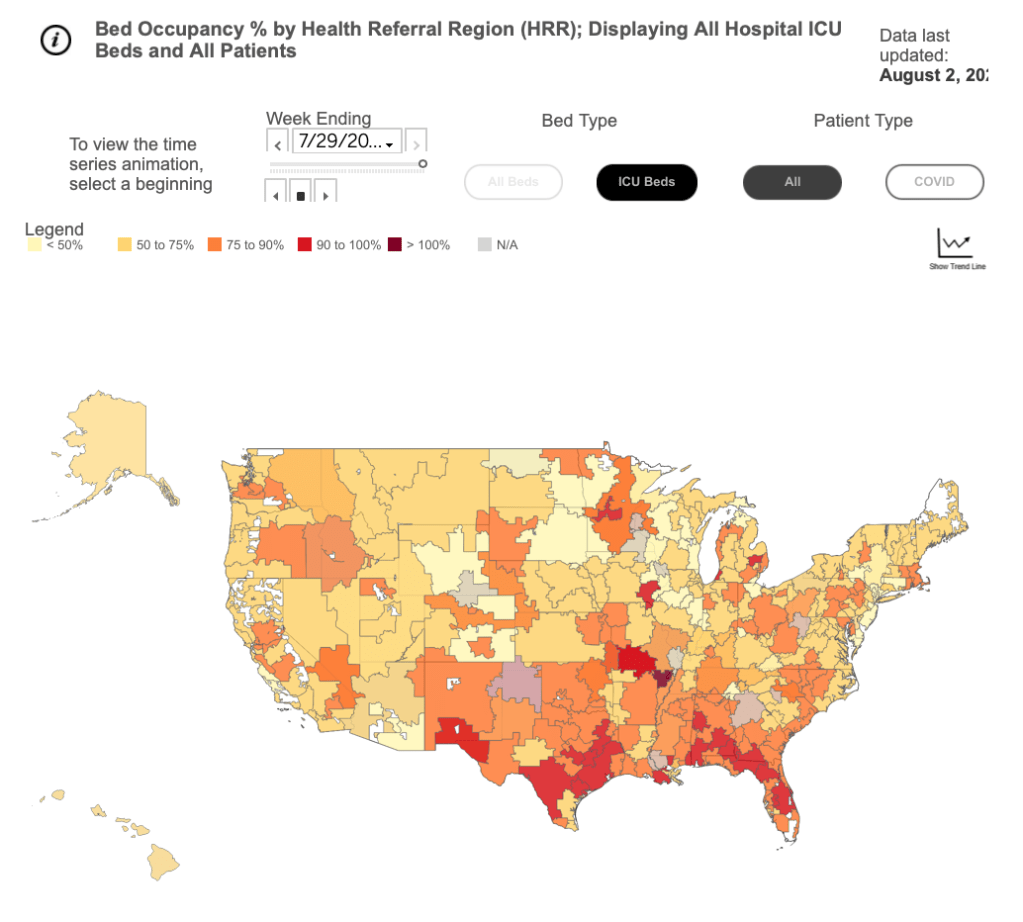
The main externality-based arguments that could still work are for vaccine mandates and for restrictions in areas where hospitals are overwhelmed by unvaccinated Covid patients in a way that substantially worsens care for non-Covid patients. But outside of areas with low vaccination rates leading to overwhelmed hospitals, I no longer see a good case to impose mask requirements or restrictions on movement or events.

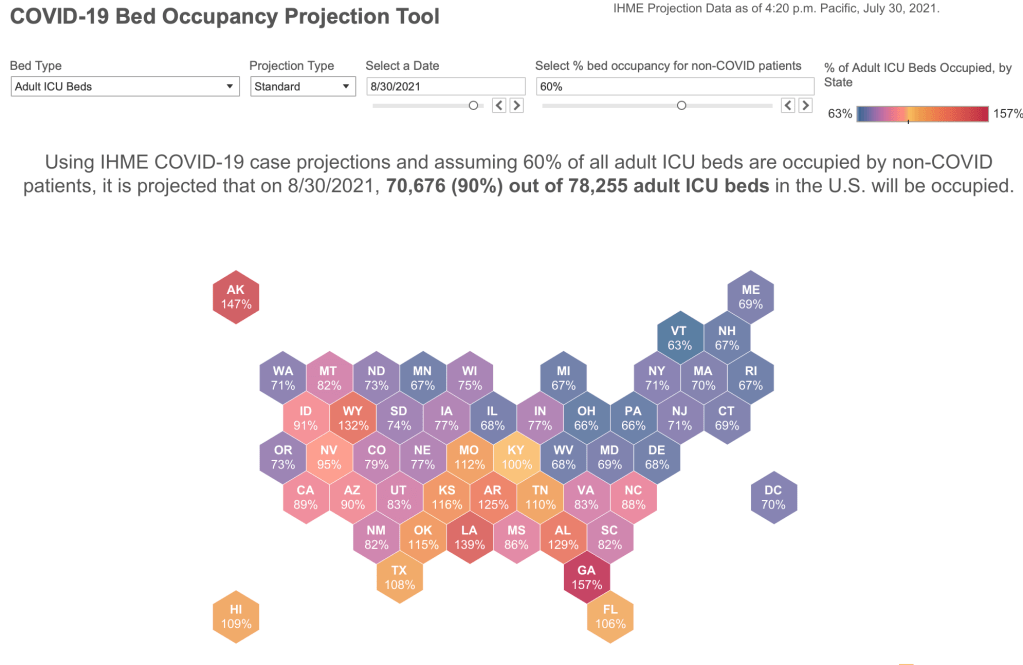
According to one set of projections, by the end of August adult ICUs (though not hospitals overall) will be over capacity in most low-vaccination states:

If you want to wear a mask and avoid crowds, you can, and in fact probably should do at least one of those during the Delta wave of the next month. But the externality-based case for restrictions is mostly gone, and governments would do better to focus on continuing vaccine rollout in the US and ensuring vaccines are available worldwide to help other countries and to prevent more variants from emerging and finding their way here. Personally I’m glad that my employer has a vaccine mandate but, at least currently, no mask mandate. For those who do still want Covid restrictions I ask- what are you waiting for? What event or number would make you say “ok, now we can go back to normal”? When do you expect that to happen? For me, what I was waiting for was vaccines available for everyone and now, at least in the US, we are lucky to have that.

Vaccine Lotteries: They Work!

To try and encourage vaccination during the on-going COVID pandemic, there have been many public and private incentives offered. For example, free doughnuts. Or offering $200 to state employees in Arkansas (taxable income, of course!).

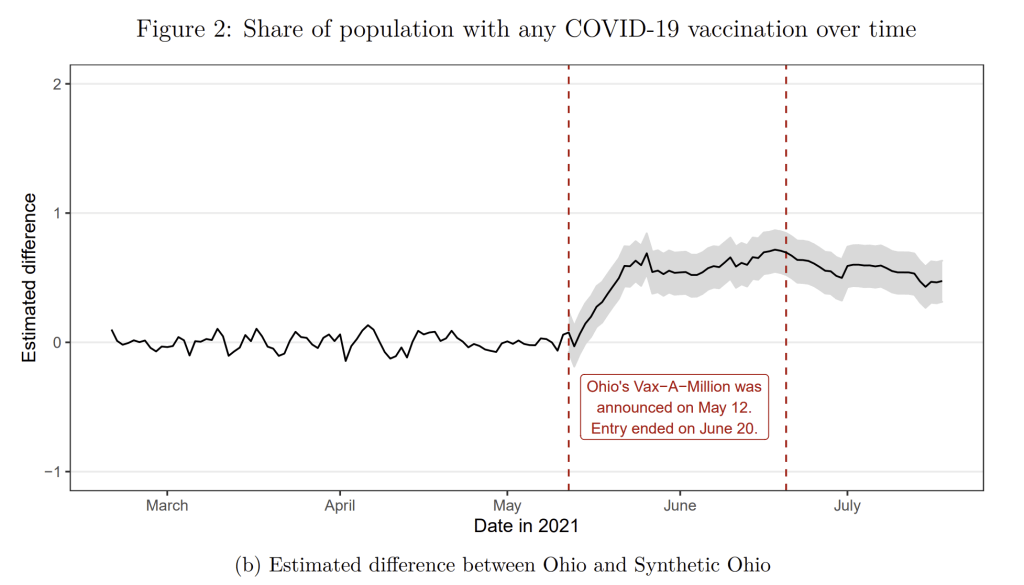
But when the governor of Ohio announced on May 12, 2021 that they would be offering a $1 million lottery prize, with 5 winners, it took the incentive game to a new level (college scholarships were also a prize for 5 winners under 18).

So do the lotteries “work”? Do they get more people vaccinated? And even if they do “work,” does it pass a cost benefit test? Many expressed concern that, even if more people get vaccinated, that this is a lot of money to spend in uncertain budget times.

A new working paper by Andrew Barber and Jeremy West attempts to answer these questions. And they do so using synthetic control, one of the better methods social scientists have for attempting to identify causal relationships (which can be tricky).

What do they find? First, vaccine lotteries do work! They estimate that vaccination rates increased by 1.5% in Ohio because of the lottery. This amount is above and beyond the increase that would have been expected without the lottery (by comparing Ohio to other states that didn’t use a lottery — this is what the synthetic control method does).

But does it pass a cost-benefit test?

Continue reading →

Self interest and self care

“Self care” is all the rage. It’s heralded as a novel and progressive notion.

The stance one takes on Simone Biles is largely colored by one’s theory of self care.

So, as Biles occupies the headlines for days, why isn’t more credit going to Adam Smith and his intellectual descendants? “Self interest” was condemned, yet here we are in 2021 with “self care”!

James had a similar post yesterday! He went back in history much further than Adam Smith.