The War of Ideas Isn’t Over

I have spent some of the last week educating myself about Afghanistan. You might ask where I was back when the US had a strategic advantage. I now regret the time spent at the paint store squinting at 200 different shades of white. Here’s an idea: America gets only 20 paint colors until we achieve our foreign policy objectives. 40? All I know is that we are past the optimal number of shades of white, considering what just happened.

A lot of the “takes” in the past week have been on the subject of blame. Despite the fact that American lives are still at risk in Afghanistan, this has not been a unifying event, like 9/11 was.

Are we picking our battles in such a way that helps vulnerable people? Any energy spent fighting your enemy B is a resource you cannot use to fight enemy C. Incidentally, that is one of the points that President Biden made in his speech on August 16th. There is an opportunity cost to mean tweets.

I reached out to a veteran friend of mine for insight last week. This is part of what he told me:

Biggest mistake is looking at Afghanistan as a single cohesive entity. It isn’t. There is no national identity. The Kyrgyz, Uzbeks, and Kazaks of the north … Karzai was a Pashtun and always ensured the main leadership roles were Pashtun.

He said that there are sub-units of Afghan people opposed to the Taliban who are upset by the advance we all witnessed to Kabul. Divided people lose, and then they don’t have the capacity to help others.

There was a time when the Taliban were few in numbers and hanging on the fringes. One advantage they had is that they went with the “legalize it, tax it” drug policy. Farmers under their jurisdiction can grow opium poppy and pay the Taliban a fee. In the American sphere of influence, we were fighting against the laws of supply and demand. The American public is not the only destination market for illicit opioids, but it’s a big one. It’s pretty self-defeating to ask our security forces to fight against drugs when most Americans can’t be bothered about them.

Consider the movie Little Miss Sunshine, a beloved American comedy. Consider the grandpa. He’s not a perfect man. He has his little vices, like dropping F-bombs in front of his young granddaughter. And, he snorts heroin. It’s easy to imagine what a great rapport he has with his dealer. No one would report his behavior to the police.* The drug habit is not portrayed as a virtuous thing, but overall he’s a sympathetic figure.

There is a lot of muddled thinking in our society when it comes to drugs. The bill comes due.

Humans are very creative. The good news is that we could have more discussions about drugs and experiment with new policies. It’s not inevitable that laws regarding drugs will be the same next year, but there is a lot of inertia that needs to be overcome. A society where celebrities joke openly about doing illegal drugs is not going to also be a society that can effectively “reshape the world in its image”, to quote Tyler.  

Tyler’s point is that this unfavorable outcome was not inevitable. From responses I read, many people offering opinions on Tyler’s article did not read past the headline. Nuance can’t be conveyed in a headline or a tweet. Tweet culture is a handicap right now, at a time when good complete ideas are badly needed. What happened in Afghanistan was complex. A tweet might be long enough to say what you would like to see happen, but it’s not long enough to help anyone.

The same Americans who tweet that they want refugees to live somewhere safe won’t go to a city council meeting and argue in favor of building high-density housing in their neighborhood. The same Americans who have tweeted that they hope the Taliban will build an “inclusive” society…

If you take the view that the failure in Afghanistan was inevitable, then Matt Y ’s explainer is ungated and helpful. There is also a lone voice saying that 20 years of “jail” had value.

If indeed this is a major crisis, then we are showing a lack of awareness when it comes to media. Some Americans alive today might not know about the role of media in fighting Nazis. Here is a fun read about that. In addition to WWII-era Brits, the Taliban are also strategic with media.

Considering that this is partly a war of ideas, I don’t know if taking Kabul so fast will look strategic in hindsight. There is much still to be determined. Had the Taliban consolidated power more incrementally, they would have been able to control the images that got out.

Here’s one image I won’t forget:

On the assumption that 20 times more people saw the image than liked it, this picture has been seen by well over 2 million people. Imagine how those girls’ lives have changed. “they are now with the Marines.” The entire world is breathlessly watching the airlift, and any abuses by the Taliban are headline news.

The media you choose to consume shapes the world around you. Every click is a vote for the kind of world you want. The war of ideas continues.

James Bailey here on information consumption (not on Afghanistan)

*It’s nothing glamorous or entertaining, but this is one approach to opioid use. As more parents lose children to fentanyl overdoses, more civic action is happening which generates publicity. Deaths from opioids increased rapidly after 2010. Little Miss Sunshine came out in 2006, so perhaps if it were made today they wouldn’t have taken such a cavalier approach to heroin.

Have you heard about Human Capital?

While writing a paper recently, I was reminded of the importance of economic modelling.

Macroeconomic models are fun to rag on – everybody does it. But all economic models help us to express our understanding of the world clearly and help us to be specific when the temptation to hand-wave is strong. After all, a model is just a fancy way of saying “a system of logic”.

The paper linked above is several revisions in. What you don’t see are the mistakes that my co-author and I made along the way and the vagueness that we had to resolve. An earlier version of the paper simply stated that deaf people were endowed with less human capital than people who could hear. So far so good. But then we said that it was ambiguous who, the deaf or the hearing, would ultimately have more human capital after making additional human capital investments.

But this is not the case!

Continue reading →

Anti-coercive ways to fight Delta

Two weeks ago I predicted that Covid cases would continue to spike for at least two weeks due to the Delta variant, but argued against general shutdowns as a way to combat this spike. Two weeks later cases have indeed spiked, and while localities and organizations have been mandating masks and vaccines, we have largely avoided new lockdowns, at least in the US (Australia is reverting to its roots as a prison). In the last post I mostly said what we shouldn’t do to fight Delta, so today I want to show what a better response looks like.

The tendency of authorities to reach first for coercive solutions is a natural product of their incentives, but I’ve been disappointed to see the same tendency among the chattering classes. I think this is due to polarization- people are most interested in debating solutions that are identified with a specific side in politics or the culture war. Masks became blue-coded, so many reds oppose them even though they probably work. Likewise with vaccines, even though they definitely work well and funding them early was the greatest achievement of the Trump presidency. Meanwhile certain medications became red-coded, leading blues to oppose them before the evidence even came in. But many of the best non-coercive and anti-coercive solutions barely get discussed because they have no political valence, or a mixed one.

Fully Approve the Vaccines Already!

The Covid vaccines are still being distributed under an emergency use authorization. This lack of full approval is a source of vaccine hesitancy. More concretely, it also means that pharmaceutical companies aren’t allowed to advertize their vaccines, even though they are much more effective than the typical pharmaceutical you see advertized. The randomized control trials testing the vaccines have been complete for months, we are just waiting on the FDA to do their job.

Authorize Vaccines for Kids

The FDA still bans children under 12 from receiving the vaccine, saying they are waiting for more trial data. Last week, the American Academy of Pedicatrics argued that we have enough data to justify an Emergency Use Authorization for children aged 5-11 given, you know, the emergency. The government is going to make my 5 year old wear a mask to kindergarden won’t allow me (or my physician wife!) to get him a vaccine which would protect him and others much better than a mask.

Ventilation

Opening windows, modifying HVAC systems to bring in more outside air, and using air purifiers is about as effective as requiring masks and is definitely less of an imposition on people. But we don’t talk about it, partly because people took so long to recognize that Covid is spread through the air more than through droplets, and partly because it is less of an imposition on people and so never became a culture-war debate. Ventilation might be too boring to advocate but I think staying alive is very exciting.

Outpatient Treatments that Work

Repurposing existing drugs to fight Covid is a great idea that has not yet lived up to its promise, aside from the widespread use of Dexamethasone for inpatients with severe cases. The core problem is that it takes large randomized controled trials to really prove that a drug works, and these are expensive. Worse, pharmaceutical companies don’t want to pay for these expensive trials once their drug has gone off patent. This means that many promising treatments have been ignored, while a few have been over-promoted on the basis of observational studies and tiny RCTs (and worse, still promoted once large RCTs showed they probably don’t work). But the British government stepped up to fund the large trials that found Dexamethasone effective last year, and private donors have funded mid-size trials that just found Fluvoxamine reduced Covid hospitalization by 31%. This is excellent news because Fluvoxamine is a cheap and relatively safe anti-depressant that people can take at home. There are other promising treatments that have yet get funding for large RCTs; this is exactly the sort of thing that NIH should be throwing money at. While we’re waiting on compentent government, you can ask a doctor about outpatient treatment if you do get Covid.

Overall, many of our best tools for fighting Covid are being ignored despite, or perhaps because of, the fact that they maintain or increase our freedom.

Back to School! But what’s up with college pricing?

It’s time to head back to school! Which means it’s time for college students to once again ask the question: How am I going to pay for this?

It’s common knowledge that college is expensive and getting more expensive every year. A Google search for “skyrocketing tuition” produces almost 60,000 results. But whenever a fact is so commonly accepted, it’s worth asking if it’s really true.

Here’s one way to think about: are college tuition and fees increasing faster than the overall rate of inflation? For much of recent history, the answer has been most definitely “yes.” I start the series here in 2006, because there were some methodological changes to the index just before 2006. Cumulatively, college tuition and fees (as measured in the CPI) have increased by 78%, while prices overall have only increased by about 38%.

But for the very recent history, since 2017, the answer is “no.” College tuition and fees have often been increasing at slower rates than overall prices in the CPI, and the difference is especially dramatic in 2021. Since 2017, overall prices have increased by about 12.4%, but college tuition and fees has only increased by 7.8%.

However, even this data overstates how much tuition and fees have gone up for undergraduates in the US!

Continue reading →

Lightning Strike Out My Back Door

I know the Big News at the moment is how to evacuate people from Kabul who should have been evacuated weeks ago; as with Vietnam fifty years ago, there never was realistic hope that the U.S. backed regime could withstand an utterly determined foe without our military support. I am old enough to remember the frantic Vietnamese trying to cling to the last helicopters leaving the roof of the U.S. embassy in Saigon, because again the American authorities did not evacuate in time. But I have nothing special to offer on this topic except deepest sympathies for all the poor Afghan progressives who will be rounded up, killed or (if they are lucky), “reeducated” by the Islamic fundamentalists. And who knows what the thousands of Al Qaeda aligned operatives, captured at the cost of thousands of American soldiers’ lives, will do now that they have been freed from detention.

So, shamelessly turning inward – – a couple of nights ago during a thunderstorm we heard a loud crack of thunder which was simultaneous with a bright flash of lighting. Either our house or some nearby tree had been struck. I stuck my head out the window to look for fire, but saw none.

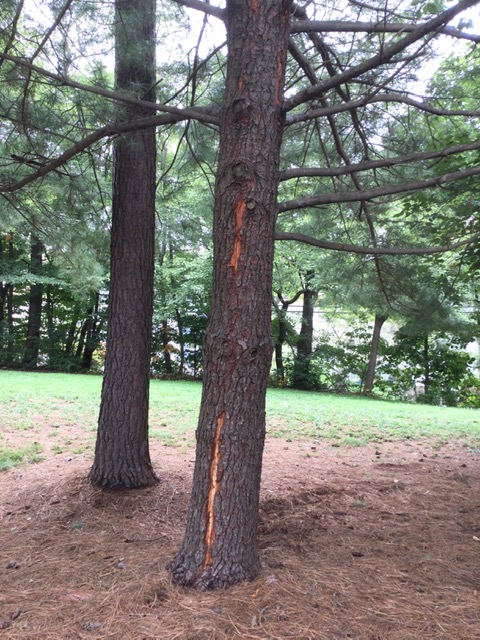
Later, we saw long vertical rips in the bark of a pine tree right beside our row of houses. I’ll share photos below. Here is what we see from the house side. There are vertical rips in the bark near the base of the tree, and also visible going up about 30 feet to a fork in the trunk. I could not see any marks or broken branches above that.

On the far side of the trunk at the base there was an even wider gash, with shredded bark on its sides, and also trench in the ground extending away from the tree. Presumably the lighting instantly boiled the moisture in the bark and dirt, and the sudden steam made the bark and soil explode.

Since it does not take much of an electrical jolt to paralyze your diaphragm, these markers of the lightning strike are a good reminder as to why we are advised to NOT stand under a tall tree during a thunderstorm.

When to weigh in on human suffering

The US began the process of pulling out of Afghanistan. The Taliban has begun rapidly retaking in cities. In doing so, it quickly has become apparent that conditions on the ground are not safe for anyone who aided the US military, journalistic, or perhaps even humanitarian efforts. People are rightfully terrified and the rapid evacuation of hundreds of thousands of Afghani’s is at this moment a global priority.

I am extremely comfortable and confident in the belief that the US should, without question, expedite the emergency accommodation and resettlement of several hundred thousand Afghani families, much in the way we resettled roughly 130,000 Vietnamese after the war in Vietnam (only faster). Yes, I believe it would be a boon to our economy and our society in the long run, but that is largely besides the point. We should welcome these men and women into our society because it is unequivocally the right thing to do, it is a moral responsibility we took on when we put boots on the ground there and left them there for a decade.

But that’s pretty much the limit of any insight I could possibly hope to have and, as such, it’s not what I want to talk about. I want to talk about the egregious smattering of take, hot takes, re-takes, W-taking takes, and L-giving takes that is currently proliferating on social media and the standard outlets at the moment. No, I am not going to link to any. No, I am not going to refer to anyone by name. Yes, this is one big, long-form subtweet.

Unless you are a bona fide expert in military incursions, occupations, or exit strategies, I do not care about what you have to say. Unless you have spent a non-trivial portion of your career covering or studying how to cope with a humanitarian crisis, I don’t value your opinion. Unless you can lend genuine insight into what the best course of action is at this moment, nobody needs to hear from you.

While they may be trivial in effect, you are well within your rights to express sympathy for the victims of this terrible moment and to extoll your leaders to ease and prevent as much suffering as possible. But trying to raise your status in this moment with anything remotely resembling an “I told you so” or claim to “victory” for your political identity du jour is horrifying. Please don’t equate this with pro-gun reprisals of “Now is not the time for politics” every time there is a gun-related tragedy, either. Rather, consider this a reminder that this moment, like nearly everything else, is not about you, your politics, or what you tweeted in 2011. We are all better served when we keep that in mind.

Maybe I’m overreacting. It’s easy to write such things when the crisis of the moment puts you squarely on the sidelines. And it’s not like an 800 word scolding calling out exactly no one is going to help anyone. But there are expert, scholarly, and journalistic voices that are being drowned out by the droning, self-congratulatory thirst for public approbation and status. And if this snotty little post rings in ears and reminds just one person that “this isn’t about you,”, and they choose to leave even one bad tweet in drafts, then it’ll be worth it.

But please, support any and all of your representatives that want to take action to bring as many refugees from Afghanistan to the US as is possible. I don’t know much about Afghanistan or wars, but I am confident it is the right thing to do.

Home for a Millennial

We read a children’s book called Home for a Bunny. In springtime, a bunny wants to find “a home of his own. A home for a bunny.” The bunny goes around talking to other forest creatures and considers crashing with them. It keeps not working out. Finally, the bunny finds another bunny to pair off with and they live happily ever after in a hole. (The implication is that the interloper is male and he finds a woman who already has her own place.)

Judging by the current housing market, the country’s currently largest generation has decided it’s time to find a home.

According to Jerusalem Demsas on the Macro Musings podcast last month, part of the reason houses are selling so fast today is that many millennials want to buy their first home now. They are competing against each other, especially for starter homes near growing cities.

The problem with making blanket statements about millennials is that we are a diverse group. For example, we are majority-white like Boomers, but only 56% are white. We went to college at higher rates than previous generations, but still less than half of American millennials graduated from college.

Millennials who could afford to consume wanted experiences, not stuff. I never saw peers brag about owning a pricey watch, but I have seen many photos posted of soul-searching adventure trips to Thailand. As I said, one should not generalize because it’s only the wealthiest millennials who could afford such things. But the wealthiest millennials are the ones who could have become homeowners. Instead they sought out the next avocado toast served with a view of a hip city core. Covid restrictions forced a set of people who had always been on the run to evaluate their home lives, or lack thereof.

Where had the largest generation been living prior to summer 2021?

Here’s a link to an SNL skit “The Millennials Skit” that sums up the complaints I was hearing about my own generation when I was in my early 20’s. If you can believe this, I did something stupid in my early 20’s. With so much hyperbole surrounding us, many don’t have a good sense of the facts.

In 2000, most millennials were in their parents’ houses, right where everyone expected them to be. The US population overall grew substantially since 2000. Many local zoning restrictions didn’t allow for concurrent rapid growth in the housing stock in the places with job growth.*

As millennials aged into adulthood, they were not buying houses or forming families at the rate previous generations had. PEW reports, based on Census data, that millennials are more likely to live with their parents than previous generations.

The group of millennials who were most likely to be living with their parents were men without a college degree. Most millennials were not living in their childhood bedrooms pre-Covid. Once again, it’s hard to generalize. Almost half already owned a home. Many were renting along with a friend or romantic partner. Whereas a majority of Boomers were married as young adults, less than half of millennials currently are. College-educated millennials are more likely to be married.

Millennials have kids later, so that would normally be associated with not buying houses before the age of 30. Some of the causality runs from the high cost of housing to the decision to put off having children. There is a long-running debate over whether millennials are different because they have different preferences from Boomers or because they are relatively economically disadvantaged. The combination of low wages for some and high home prices for many is an economic explanation for the initial hesitancy to purchase a house. Despite what the SNL skit said about us, most millennials are working now. Slower household formation is not due to chronic unemployment.

The highest rates of living-with-parents were in expensive cities like New York and Miami. If you can live close to a good jobs hub without having to pay the high rent, then you can save money. With that personal savings, now that we are older, many millennials would like to jump into home ownership. 

This week I went into a local restaurant that is patronized by adults like me. On the chalk board was a poll “Backstreet Boys or NSYNC?” People were gleefully making chalk tick marks to vote for their preferred band. That’s just one of the subtle signs I have seen in the past year that millennials are in charge of the places I visit.

*Read Jeremy on zoning and the Horpedahl Zone of Affordability. Also see The Complacent Class on how America didn’t make it easy for a diverse set of millennials to thrive.

Penny-Pinchers Gonna Pinch

Text books say that there are two major problems with the Consumer Price Index (CPI). First, accounting for changes in quality is difficult. Second, the CPI is calculated by assuming a fixed basket of goods is consumed over time. For both of these reasons, the rate of inflation that is implied by CPI is typically considered to be about 1% overestimated.

Imperfectly accounting for quality improvements causes higher measured inflation because the stream of services that a product creates for the consumer has increased – even though the product is nominally the same product. For example, the camera on my smart-phone is now good enough to record a high-quality Youtube video, whereas it was of mediocre quality on my previous phone.  My life is better-off with the better camera. But the increase in my quality of life isn’t measured by the CPI. The CPI does, however, make note that I paid a higher price for a phone.

Further, people don’t consume a fixed basket of goods over time. Even if we stopped the introduction of all new products and maintained the quality of all current products, people would still change the composition of their consumption due to price changes among related goods.

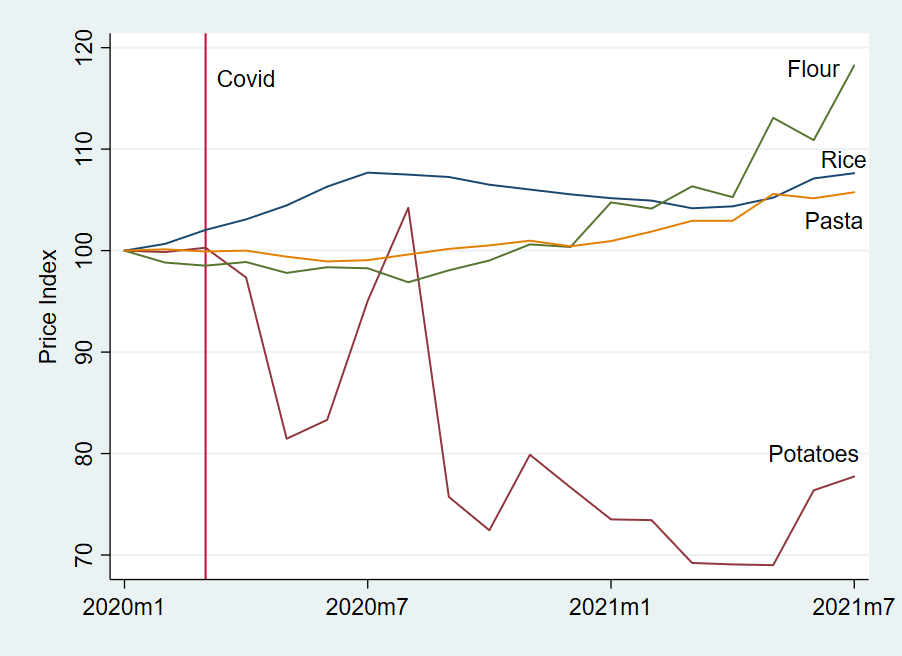
When people get hot and bothered by inflation, they often appeal to people who are of less means and who would find higher prices more burdensome. For that reason, below is a graph of some calorically dense and roughly comparable food staple prices (from the PPI).  You can put a protein on top of any one of these and call it a meal: pasta, flour, potatoes, & rice.

Let’s say that a consumer consumed equal parts of these in January of 2020. The CPI assumes that the consumption basket remains constant and plots a weighted average. In such a case, price rose 2.3% through July 2021. But in real life, penny-pinchers gonna pinch. If our consumer is particularly Spartan, then he will always consume the cheapest option – he treats the different foods as perfect substitutes. The Spartan price of consuming *fell* 22.3%. To be clear, the CPI assumes that the consumption composition remains unchanged, while the consumer’s actual basket is responsive to price changes.  Even if a consumer considers these goods to be imperfect substitutes and is willing to cut any particular type of consumption in half in favor of the cheapest alternative, then the price fell by 10%. In fact, a consumer who is at all responsive to prices will always have a cheaper basket than the headline CPI, all else constant.

In conclusion, be careful with your money. Spend it well and seek out alternatives. Your flexibility determines how much money you’ll have at the end of the month. The headline CPI number impacts only the most passive consumer – and even then, budget constraints gonna constrain.

Generous Health Insurance Makes Employees Stay

The idea of “job lock” is well established in the academic literature- employees leave firms that don’t offer health insurance more often than they leave firms that do. But this literature has always measured employer-provided health insurance as a simple binary: either they offer it or they don’t. In fact employers vary widely in the generosity of their plans, both in the quality of the insurance and in how much of the cost is paid by the employer. Some employers pay all of the premiums, some pay none, and most pay part:

Data are from the Current Population Survey, which uses top-coding to protect privacy (values greater than 9997 are reported as 9997)

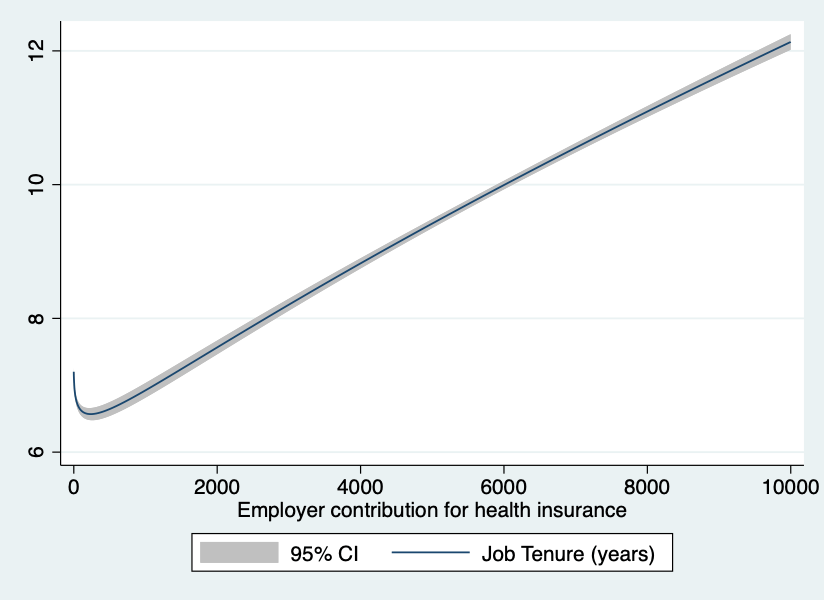
In an article published last week in Applied Economics Letters, my colleague Michael Mathes and I combine two supplements of the Current Population Survey to test whether employers who contribute more towards health insurance see their employees stay longer. Perhaps not surprisingly, we find that they do. We run lots of regressions to establish this, but this simple fit plot tells the story best:

What we found more surprising was the magnitude of this effect: a thousand dollar increase in employer contributions to health insurance is associated with at least 83 additional days of job tenure, compared to less than 10 additional days for a thousand dollar increase in wages. We conclude that:

For employers trying to increase retention, increasing contributions to health insurance appears to lengthen employee tenure far more than increasing wages by a similar amount.

Why the difference? Probably employees rationally valuing $1000 in untaxed contributions to health insurance above $1000 in taxable wages. Why don’t employers shift more compensation away from wages and toward health insurance, given that employees seem to prefer it? Here I’m less sure, and they could simply be making a mistake, but one possibility is that they worry about increasing their costs as couples whose employers both offer insurance choose the more generous one for a family plan. Another is that while generous health insurance plans are better for retention, higher wages could be better for attracting new employees, who tend to be younger and for whom the salary number could be more salient.