Most academic journals are run by big for-profit publishing companies, and most of the rest are run by universities or big academic societies. The Journal of Healthcare Finance was an extreme outlier from this norm, run single-handedly by Editor-In-Chief James Unland since 1994. It was the rare journal that was free both for readers and authors.
I loved the idea of having a single person truly in charge and accountable without being slowed by a complex bureaucracy. But eventually a single person will want to, or have to, move on. Having an institution run a journal can ease this process, though an individual can still try to find their own successor.
In this case, The Journal of Healthcare Finance had been on hiatus since its Editor-In-Chief stepped back, with its last issue published in 2023. Their old website domain had expired- not a great look for anyone who published there and was going up for a job or tenure.
But now it is officially back at a new domain, with the single Editor-In-Chief replaced by a full editorial team, and accepting submissions again with the hope of releasing a new issue this year.
Selfishly, I’m happy to see this both because it means they will continue hosting my past publication, and to have a potential outlet for my future work. I recommend that other health economists and health services researchers give it a try, though as of now I have no personal experience with the new editorial team.
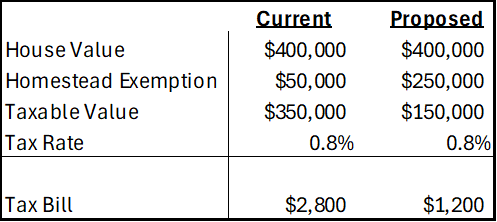
Voters this November will face a proposed amendment to the Florida state constitution on property tax reform. Currently, Florida has what’s called a ‘homestead’ exemption of $50,000. If a residential property is your primary residence, then your home’s assessed value is $50k less before taxes are calculated. There is no exemption for rental property or 2nd homes or vacation homes. The proposed amendment increases the exemption to $250k by 2028 and then indexes it to inflation.
First, let’s get an idea of the magnitudes. The median home in Florida is priced at about $400k and the average property tax rate is around 0.8%. Below compares the current consolidated tax bill against that of the proposed amendment. Given current home prices and local tax rates, the new exemption would have a huge impact on municipal governments who get the bulk of their revenue from property tax. In fact, there is no Florida state property tax, so the proposed amendment would adopt a new rule for municipalities and not the state government.
What Motivates the Amendment?
The current homestead exemption of $50k was established in 2008. A subsequent amendment in 2024 allowed half of that to be indexed to CPI-U. The average home price in Florida has risen 114% since 2008 and 84% since 2020. That’s a lot faster than inflation, but the tax burden is partially offset by a maximum of 3% annual increase in assessed value. Regardless, many individuals face a larger tax bill over time even independent of whether their income or use of public services has changed. Plenty people are feeling the squeeze.
What’s the Purpose of the Homestead Exemption?
The exemption is available for primary residences only. That means that rentals and vacation homes do not qualify. It’s important to keep in mind that, given some total revenue, every tax break for one group or activity implies a higher tax rate for others. So, clearly, the effect is to tax residents less and tax seasonal residents and visitors more. Florida doesn’t have an income tax, but it does have a sales tax, gasoline tax, and others that are disproportionately borne by non-residents. Given that higher income individuals tend to have higher home values, the homestead exemption is a way to lower the tax burden of lower income households. Obviously, the lowest income individuals are renters, but so are non-residents who Florida prefers to tax.
The Economics
Homeowners
The exemption is enjoyed by all primary residences, but helps low income owners the most. And, given a stable amount of municipal tax revenue, a higher homestead exemption requires that municipalities replace that revenue. This might take the form of higher local fees and taxes, making life harder for lower income people to, say, own a car or make purchase if taxes on those activities rise. Revenue stability might also be helped by higher property tax rates. The higher the property value is above $250k, the greater the average tax burden that is borne. So, someone with a very high property value may find themselves with an even higher property tax bill after municipalities adjust to the proposed statewide rule. In this sense, the new amendment would be a step in the direction of tax progressivity (a higher proportion taxed from those with higher income/wealth).
Indexing
Normally, I am in favor of indexing nominal values to CPI. In this case, we need to think about what the goal is. Let’s assume that the goals is to provide relief to lower income homeowners specifically and all primary residence homeowners generally. Does indexing to the CPI help? It depends!
The conventional wisdom is that the NBA regular season has too many games. Teams play worse because they are tired, or injured, or resting their stars so they can be ready to actually play hard in the playoffs.
Teams on the second night of a back-to-back shoot less efficiently (lower eFG%), grab fewer offensive rebounds, and play at a slower pace. On defense, they allow opponents to shoot more efficiently, force fewer turnovers, and give up more free throw attempts and second-chance opportunities. Turnover percentage and offensive free throw rate did not change significantly, consistent with our conceptual framework’s distinction between effort-dependent and execution-dependent metrics. While not every metric changed significantly, the overall pattern is clear: second-night back-to-back scheduling is associated with a measurable decline in team performance
The effect sizes here tend to be small, around 0.5-2%, but they are statistically significant given that we studied over 20,000 games, and practically significant given how close NBA games are.
Max had the idea for this paper and wrote the first draft as a student in my Economics Senior Capstone class in 2025. After he graduated, I joined the paper as a coauthor to get it ready for journals. We share the data and code for the paper here.
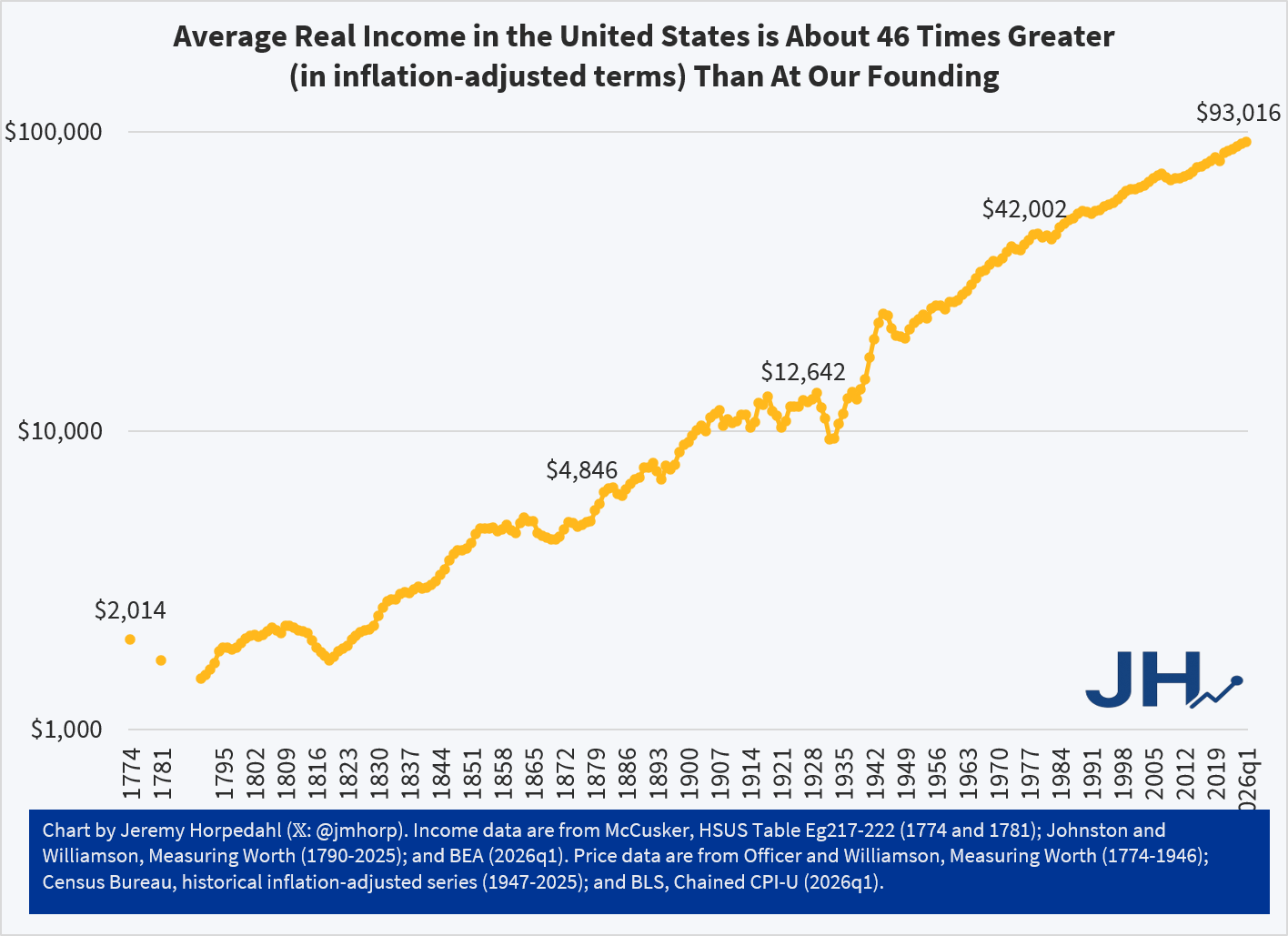
My post and chart from last week showed the phenomenal growth of average income in the US since the Founding. Using GDP per capita historical estimates and adjusting for inflation, this figure is about 46 times greater today than right around the time we declared independence.
It will probably not surprise you that some folks were skeptical. Could this really be true? Two major objections were raised to using GDP per capita. First, wouldn’t it be better to use a median income value rather than a mean (simple average)? Second, wouldn’t a measure of wages be better than GDP per capita?
I really would like to show you an annual series of median income data back to 1776, but unfortunately it just doesn’t exist. Good median income data are hard to find much before the 1950s, much less the 1770s. However, while median values are often better for showing levels, the growth rates of median wages and mean wages aren’t that different for periods when we have comparable data. Consider the following chart, which compares median wages (as calculated by EPI using CPS data) and mean wages (from BLS’s series for non-supervisory workers) since 1973. I have stated these in nominal terms, so don’t take this as real growth rates, but rather it is a raw comparison of two series (we could apply the same inflation adjustment to both, but that won’t change the picture, only the numbers).
Median wages increased by 667% and mean wages increased by 657%, almost identical. Again, these aren’t inflation adjusted, but that’s not the point of this exercise. The point is that whether you use mean or median wages, at least since 1973, the growth rates are the same. Was this true if we went back another 200 years? We can’t say for sure. But many people have this same skepticism about mean wages in recent decades. I think it is better to use median values when you have them, but we shouldn’t throw up our hands and claim we know nothing if all we have is mean wages.
Next, consider the following chart. It begins in 1790, but instead of using GDP per capita, as I did last week, it uses a measure of average wages from economic historian Lawrence Officer. This measure is for “production workers in manufacturing,” and it is a total compensation measure, meaning that it will include the value of fringe benefits as well — though these aren’t noticeable in the data until the 1930s. This is still an average value, but because it is for manufacturing laborers, it won’t be distorted by the wages of managers and owners in that industry, and it won’t be affected by the growth of new industries that might require more years of education (indeed, manufacturing wages are lowering than overall average wages today, so this is taking the hard case). I have also included a second line, which only includes manufacturing wages (not benefits) that I have blended with Officer’s compensation series starting in the 1930s, in case you think including benefits is somehow “cheating.” (Note the log scale again, as in last week’s chart.)
The trends here are very much in the ballpark from the GDP per capita chart I created last week. Using total compensation, wages are 65 times higher than in 1790. Using only wages, they are 49 times higher. Notice that these are both better than the 46 times multiplier using GDP per capita. How is that possible, since I am using the same price deflator in both cases? First, average hours of work have fallen significantly since the 18th century, so incomes haven’t risen quite as much as wages. Second, there was a bit of a decline in GDP per capita during the Revolutionary War, and if we use 1790 as the baseline for GDP per capita, the multiplier is 63. But again, these numbers are all in the ballpark: whether the true figure for a typical American is 46x, 49x, 63x, or 65x, this is a tremendous amount of economic growth.
If you want to look at that chart pessimistically, you will see that there is some reduction in growth rates in the past few decades. That’s true whether we use wages or compensation. This is a well known issue, and has been discussed endlessly in academic papers and on social media. I don’t want to glaze over it here, but I mostly will: the long-run trend of growth in the US is amazing. That’s true whether you use GDP per capita, or wages or compensation for production workers.
So once again, Happy 250th Birthday to the USA and all of you living in the wake of that amazing 250 years of economic growth!
We celebrate 250 years since the Declaration of Independence was signed on July 4th, 1776. That’s the day that we celebrate our country’s birth. So, it’s very American of us to celebrate the day that we merely declared independence (not the day that the revolutionary war ended). We simply said we were independent from the crown. Regardless, we celebrate 250 years as a people. BUT, our government is only 237 years old. The current constitution replaced the articles of confederation in 1789. So there are some caveats to the whole semiquincentennial thing.
An important distinction that is baked into the American pie is that we are not our government. Our government is younger than we are. Our government has a piggy bank called ‘US Treasury’. It can spend and borrow for the US national government. It can also impose tax liabilities on the population in order to service those outlays. Now that it’s the government’s 237th birthday, what’s its basic financial track record?
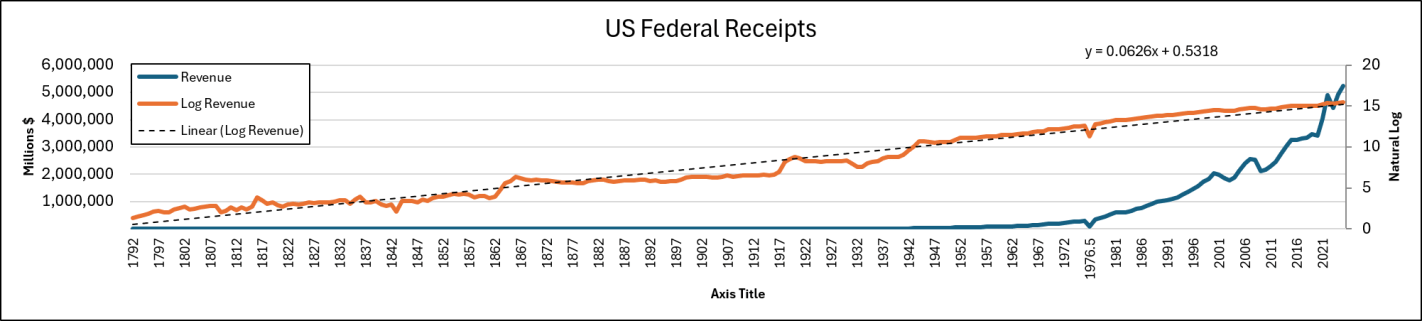
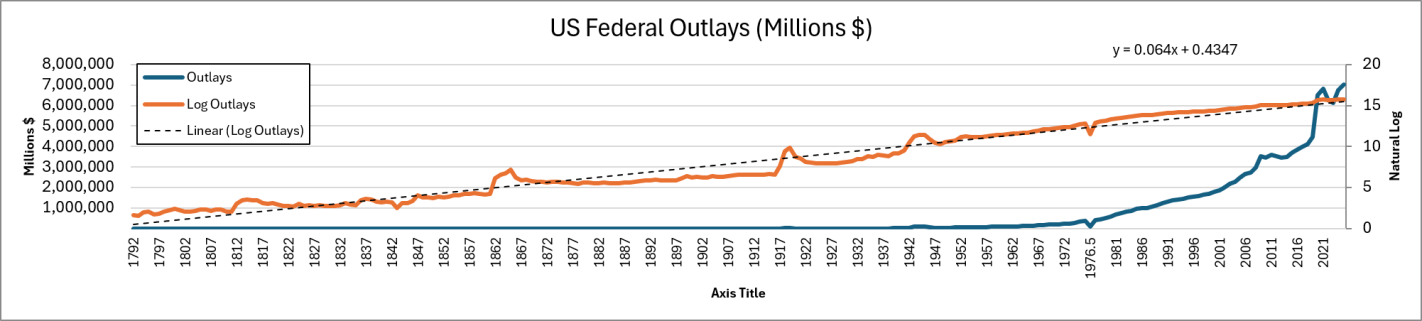
I like to think in the long run, for better or for worse, and I don’t like to get hysterical. So, let’s look at the full span of the 237 years – well – 235 years. The oldest annual data that we have is from Bicentennial Historical Statistics, which goes back to 1792. Below are the series for Federal Receipts and Outlays (revenue and spending).
The blue line is in nominal dollars and the orange line is the natural log so that we can see the changes in growth rates more easily. These aren’t inflation adjusted numbers, so we should expect to see some inflationary patterns. Long-run inflation was pretty stable prior to the 1913 Federal Reserve act and wee can see that reflected in both series. There was some drift upward in terms of revenue and expenditures. But the primary pattern was one of punctuated rises followed by plateaus. That’s a pretty standard ratcheting leviathan pattern. There’s a bump up for the big events in the first half of our history: the War of 1812, Civil War in 1861, and World War I in 1917.
Then, after the great depression and leaving the gold standard (mostly), in about 1933 a new and positive trend in cash flows began. In fact, it’s amazing how consistent the raw nominal series is. We can see where World War II is in the series, but after that we appear to have traded punctuated increases for steady increases. Even the higher inflation rates of the 1970s look pretty muted and on trend (Btw, the blip in 1976 is a record-keeping artifact. There was a 3 month gap-period when the US government changed its fiscal year start/end). Even the new growth in total cashflows seems to be slightly bending downward and growing a little more slowly.
But rest assured, spending has exceeded revenues. Below is the long run deficit. I don’t take the log for this one since there are negative numbers. It’s hard to tell from the line graph, but the first big and persist swing in the deficit arrived after the Fed was established and the onset of WWI. The deficit hit $9 billion in 1918, which was 10x the prior peak of $0.9 billion at the end of the civil war in 1865. Notice that the above government revenues stayed flat or fell after 1920, but the outlays began trending upward before the revenues. The deficit doesn’t really start its long, steady march until 1932. Of course, for the past quarter century, the national government has been in a deficit mess (even if you measure the proportion of GDP).
For America’s 250th birthday, my present to all of you is this chart showing our economic history. Average income in the US has increased dramatically since the country was founded. This chart attempts to provide one, continuous series, using the best available income data and inflation adjustments (well, mostly continuous — before 1790 there are just a few estimates). Sources are listed at the bottom of the chart. The y-axis is a log scale.
This is a near-perfect policy experiment showing us, once again, that immigration is not only a net gain for all, but an absolute gain in the rural communities that have become the most politically resistant to immigration.
🗣️ Published today in @aeajournals.bsky.social. Ethan Lewis and I use a visa lottery, as a nationwide randomized experiment, to test the effects of foreign labor on US firms and workers. doi.org/10.1257/app….A concise summary from @nber.org —> http://www.nber.org/digest/20221…
The brilliant content creator economist Matt Hill has posted a video “How Piracy Accidentally Created AI” to the @EconNerds channel on YouTube.
The video is so funny (and smart!) that I encourage you to sit back and watch it all the way through. Around minute 2, he gets to the topic of online piracy.
The @EconNerds channel on YouTube has over 100 engaging videos like this to help you learn economics. You can also find Econ Nerds updates on X/Twitter
I summarized our findings in a previous blog “Summary of You Wouldn’t Steal a Car,” but Matt’s video is more fun and quite technically accurate, so now everyone can just watch it.
I’ve recently gone back and started listening to the archived episodes of the ‘Macro Musings’ podcast hosted by David Beckworth. The show started in 2016. At that time, there was still a sense of malaise after the 2007-2008 Great Financial Crisis (GFC) and the slow recovery that followed it. We were also in a prolonged low-interest rate environment.
A recurring theme is whether the Fed should have engaged in expansionary policy earlier than they did in response to the GFC. There are multiple ways to answer. It’s not helpful to say ‘knowing what we know now’. The Fed didn’t have that opportunity. It’s a little bit more helpful to say ‘if the Fed had a different target or different tools’. The target and tools are higher-order policy decisions and changing them can be helpful in the future. But they typically can’t be changed with the flip of a switch. After all, the 2% inflation target itself rolled out over the course of decades.
The most awkward/damning question is “Given the target, tools, and data that the fed actually had, did they make the right decision?”. If the answer is ‘no’, then that warrants a serious investigation of individuals, groups, processes, etc. I don’t mean a legal investigation. I mean the decentralized kind in which public and expert trust can be affected.
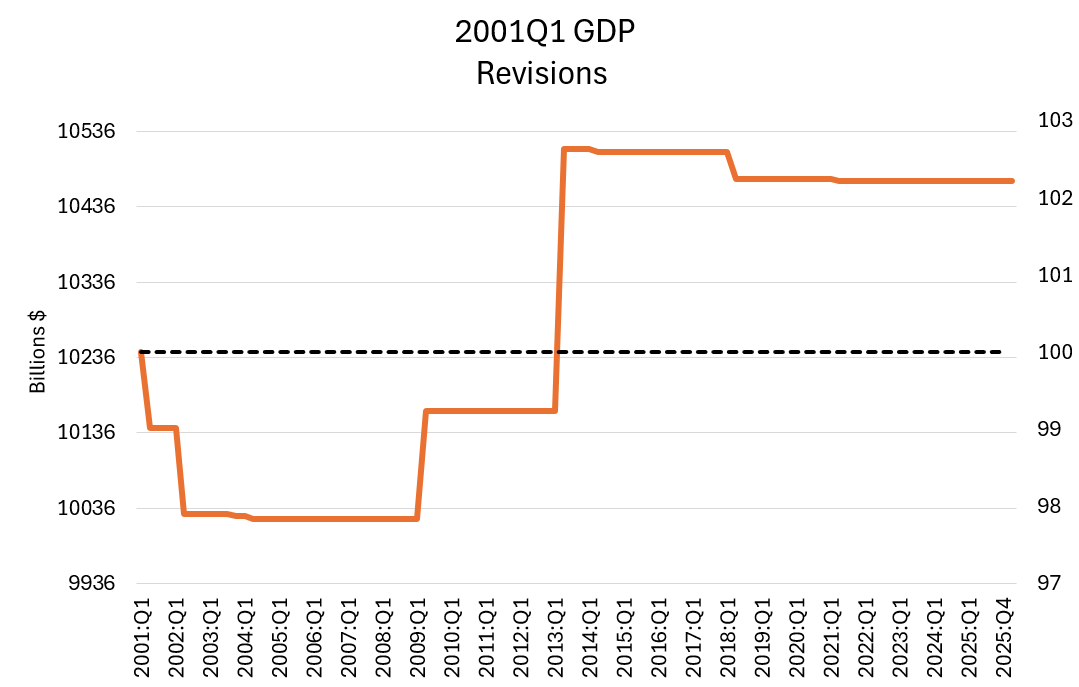
A concept that Beckworth often mentions concerning Fed culpability/performance during the GFC is the problem of data revisions. Currently, we know what the revised data says about NGDP, inflation, employment, etc. But the Fed only had the contemporary numbers and immediate revisions. In a world where economic growth is lousy or stellar in a range of 1-3%, small revisions can matter a lot. For example, below are the 2001q1 NGDP revision values over time.
Revisions occurred twice by 2002q2, revising NGDP down by more than 2%. Subsequent revisions raised the value on record to nearly +3% of the initial estimate, before settling at a less elevated value. Sheesh! In a world where a 1% swing is a big deal, how can we possibly expect the Fed to succeed at managing aggregate demand?
Things are not so scary as they might seem. The Fed doesn’t much care about revisions to an individual quarter. Rather, they care about the direction of change over time. Whether future revisions increase GDP by 2% is unimportant. What’s important is whether one period’s value is lower relative to the earlier value. That’s the relevant difference that tells us how the economy is changing.
Now, in 2026, our current understanding of NGDP during the GFC follows the below pattern starting in 2005q1 (lest I omit important pre-trends). NGDP growth had weakened in 2007q4, turning negative in 2008q1. Weak growth resumed in 2008q2. Then we had near-zero or negative growth for the next five quarters. Of course, we’re now approaching twenty years later, so we have the huge benefit of hindsight and revisions. Keep in mind that the contemporary numbers aren’t available until the subsequent quarter. By the yard stick of NGPD, the Fed should have been loosening by Q3 or certainly Q4 of 2008 if they cared about supporting total spending. Maybe as early as Q2 is they were especially sensitive.