Deficits Are Here to Stay

Last week President Biden released his Fiscal Year 2023 budget proposal. The annual release of the budget proposal is always exciting for economists that study public finance. The president’s proposal is the first step in the federal budgeting process, which in some cases leads to the full passage of a federal budget by the start of the fiscal year in October (though perhaps surprisingly, the process rarely works as intended).

This year’s budget is especially interesting to look at because it gives us our first look at what post-pandemic federal budgeting might look like. And while the budget has a lot of detail on the administration’s priorities, I like to go right to the bottom line: does the budget balance? What are total spending and revenue levels?

The bottom line in the Biden budget this year is that permanently large deficits are here to stay. Keep in mind that a budget proposal is just a proposal, but it’s reasonable to interpret it as what the president wants to see happen with the budget over the next 10 years (even if Congress might want something different). Over the next 10 years, Biden has proposed that budget deficits remain consistently right around 4.5% of GDP, with no plan to balance the budget in the near future.

How does this compare to past budget proposals? For comparison, I looked at the final budget proposals of Biden plus his two predecessors. I start Obama’s in 2021 to match Trump’s first year, and all three overlap for 2023-2026. I put these as a percent of GDP so we don’t have to worry about inflation adjustments (though we might worry about optimistic GDP forecasts, see below).

Continue reading

The Different Classes of Crypto Stablecoins and Why It Matters

Last month the Biden administration issued an executive order outlining some priorities and aspirational goals regarding government initiatives and future regulations regarding cryptocurrencies.
These goals may be summarized as:

1.         Protect Investors in the Crypto Space

2.         Mitigate Systemic Risks from Innovations

3.         Provide Equitable Access to Affordable Financial Services

4.         Ensure Responsible Development of Digital Assets

5.         Limit Illicit Use of Digital Assets

6.         Research Design Options of a U.S. Central Bank Digital Currency (CBDC)

7.         Promote U.S. Leadership in Technology


These positions seem generally reasonable and moderate, and were welcomed by the cryptocurrency community, which had feared a more restrictive stance. (China, for instance, has banned cryptocurrency use altogether).

Why Fear Stablecoins?

Here I’d like to focus on #2, “Mitigate Systemic Risks from Innovations”. Although so-called stablecoins are not explicitly mentioned in the executive order, it is understood that they represent a key area of concern for regulators.

A stablecoin typically has its value pegged 1:1 to a leading national or international currency such as the U.S. dollar or the euro, or to some commodity like gold, or even to other cryptocurrencies. In practice, most of them have generally held pretty well to their pegs. So what’s not to like about them? Why would they be perceived as more of a threat that, say, bitcoin, whose dollar value is all over the map?

I think the reason is that market participants count on them maintaining their (say) dollar peg. These coins are used as dollar substitutes in billions of dollars’ worth of transactions and are depended on to hold their value.The total value of stablecoins in use is nearly $200 billion and is growing fast.  If a major stablecoin crashed somehow, it could lead to significant instability, which regulators don’t like.

Four Major Types of Stablecoins

Stablecoins may be classified according to how their “tether” is maintained:

( 1 ) Pegged to fiat currency, maintained by a central stablecoin issuer

The biggest U.S.-based stablecoin is USD Coin (USDC), which is backed by significant financial institutions. There is every reason to believe that there is in fact a dollar backing each USDC. Gemini Dollar (GUSD) is smaller, but also takes great pains to garner trust. Its issuer, Gemini, operates under the regulatory oversight of the New York State Department of Financial Services (NYDFS). It boasts, “The Gemini Dollar is fully backed at a one-to-one ratio with the U.S. dollar. The number of Gemini dollar tokens in circulation is equal to the number of U.S. dollars held at a bank in the United States, and the system is insured with pass-through FDIC deposit insurance as a preventative measure against money laundering, theft, and other illicit activities.”

So far, so good. The huge stinking elephant in the room here is a stablecoin called Tether. Tether is the largest stablecoin by market capitalization (at $79 billion), and is heavily used as a dollar substitute, mainly in Asia. It has been widely criticized as a shady, unaudited operation, operating from shifting off-shore locations to avoid regulation (and prosecution). There are justified doubts as to whether the claimed 1:1 dollar backing for Tether is really there. Tether sort-of disclosed its backing reserves in the form of a sparse pie-chart. Very little was in the form of cash or even “fiduciary deposits”. Some was in the form of “loans” to who-knows-what counterparties. The majority of their holdings were “commercial paper”; but nobody can find any trace of Tether-related commercial paper in the whole rest of the financial universe (it has become a sort of game for financial journalists to try to the be first one to actually locate any legitimate Tether assets).

So, Tether by itself may justify concern on the part of regulators. Also, without diving too deeply into it, a plethora of financial institutions and tech companies are starting to issue their own stablecoins, which again are purported to be as good as cash, and so are vulnerable to abuse.

( 2 )  Stablecoins backed by commodities

Tether Gold (XAUT) and Paxos Gold (PAXG) are two of the most liquid gold-backed stablecoins. Other coins are tied to things like oil or real estate. The holder of these coins is depending the  coins issuer to actually have the claimed backing.

( 3 )  Cryptocurrency Collateral (On-Chain)

It is hard to explain in a few words how this type of coin works.  A key point here is that your stablecoins are backed by other, leading cryptocurrecies (such as Ethereum), with the process all happening on the decentralized blockchainvia smart contracts. A leading coin here is DAI, an algorithmic stablecoin issued by MakerDAO, that seeks to maintain a ratio of one-to-one with the U.S. dollar. It is primarily used as a means of lending and borrowing crypto assets without the need for an intermediary — creating a permissionless system with transparency and minimal restrictions.

Unlike with the two types of stablecoins discussed above, you are not dependent on the honesty of some central issuer of the stablecoin. On the other hand, Wikipedia notes:

The technical implementation of this type of stablecoins is more complex and varied than that of the fiat-collateralized kind which introduces a greater risks of exploits due to bugs in the smart contract code. With the tethering done on-chain, it is not subject to third-party regulation creating a decentralized solution. The potentially problematic aspect of this type of stablecoins is the change in value of the collateral and the reliance on supplementary instruments. The complexity and non-direct backing of the stablecoin may deter usage, as it may be difficult to comprehend how the price is actually ensured. Due to the nature of the highly volatile and convergent cryptocurrency market, a very large collateral must also be maintained to ensure the stability.

( 4 ) Non-Collateralized Algorithmic Stablecoins

The price stability of such a coin results from the use of specialized algorithms and smart contracts that manage the supply of tokens in circulation,  similar to a central bank’s approach to printing and destroying currency. These are a less popular form of stablecoin. The algorithmic coin FEI proved unstable upon launch, although it has since achieved an approximate parity with the dollar.

Some takeaways:

Stablecoins are a big and fast-growing piece of practical finance.

These coins bring a different kind of risk, because (unlike Bitcoin or Ethereum), users depend on them holding a certain value.

For the coins backed by major fiat currencies or commodities,  risk is introduced by the need to depend on the honesty and competence of the centralized coin issuers.

For the non-centralized stablecoins like DAI and FEI, there are risks associated with proper automatic functioning of their protocols.


One can understand, therefore, the urge of the federal government to impose regulations in this area. That said, it does not seem to me that the existing system is broken such that the feds need to come in to fix it in a major way. The main shady actor in all this is Tether, which everyone knows to be shady, so caveat emptor (and the vast majority of Tether transactions occur outside the West, in the East Asian shadowlands).

Amazon Credit Card Rewards

I have a credit card that gives me rewards. I get a nice 5% cash-back on purchases from Amazon and a lower cash-back rate on other purchases. Sometimes, there are promotions that provide a rate of 10% or even 15%. But what are these rewards worth?

To simplify, there are two reward options:

Option 1 adds to my Amazon gift-card balance. It’s attractive. When I’m checking out at Amazon, it shows me my reward balance and it also shows me what the total cost of my purchase could be if I applied the gift card. It’s like they’re trying to pressure me to redeem my rewards in this particular way.

Option 2 is simply to transfer my rewards as a payment on my credit card or as a credit to my bank account (for the current purposes, they’re identical). Either way, the rewards translate to the same number of dollars.

Say that I spend $1,000 at Amazon. Whether I choose option 1 or 2 has value implications.

Option 1

The calculation is simple. If I spend $1,000 at amazon this month, then I can spend another $50 in gift card credits at Amazon next month. That’s the end. There are no more relevant cashflows. I used my credit card one month, and then was rewarded the next month. The only detail worth adding is the time value of money, which at 7% per year*, yields a present value of rewards at $49.72. Option 1 is nice in the moment. It’s so enticing to have a lower Amazon check-out balance due.

But you should never select Option 1.

Option 2

Continue reading

Tradle

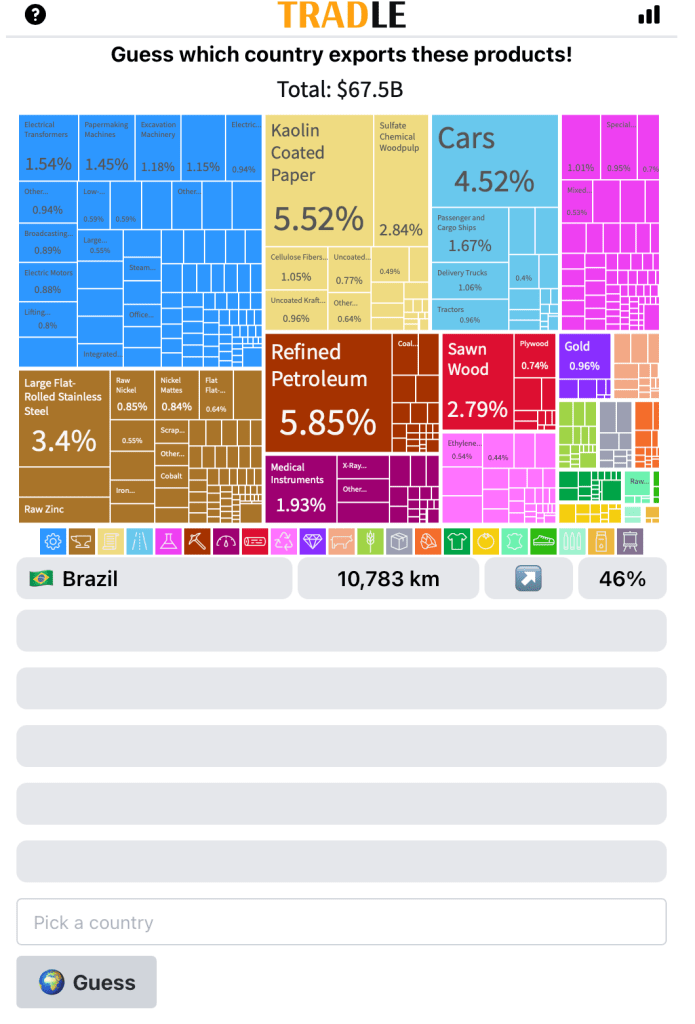
The success of Wordle has inspired a host of similar games. My personal favorite is Worldle, where you guess a country based on its shape. But the one that’s most econ-relevant and the one that I learn the most from is Tradle. You have to guess the country based on its exports:

This one would be a lot easier if I knew what Kaolin is

Its powered by data from the Observatory of Economic Complexity. I recommend checking that out after you try the game.

$5,000 Worth of Vaccines Saves One Life

I’ve written about the social benefits (in terms of the value of lives saved) of COVID mitigation measures, such as wearing face masks, before. But at this juncture in the pandemic (and really for the past 12 months), the key mitigation measure has been vaccines. How much does it cost to save one life through increased vaccination?

Robert Barro has a new rough estimate: about $5,000. In other words, he finds that it takes about 250 additionally vaccinated people in a state to save one life, and the vaccines cost about $20 to produce (marginal cost). So, about $5,000.

Barro gets this number (specifically, that 250 new vaccinated people saves one life) by using cross-state regressions on COVID vaccination rates and COVID death rates. Of course, there are plenty of potential issues with cross-state regressions. It’s not a randomized control trial! But Barro does a reasonable job of trying to control for most of these problems.

Another way to restate these numbers: if we assume that the VSL of an elderly life is somewhere around $5 million, then the social benefit from each person getting vaccinated is around $20,000. In other words from a public policy perspective, it would have made sense to pay each person up to $20,000 to get vaccinated!

Or thought of one more way: each $20 vaccine is worth about $20,000 to society. That’s an astonishing rate of return. And we’re not even including the value of opening up the economy earlier (from both a political and behavioral perspective) than an alternative world without the vaccines.

The Carousel of Stupid

The destruction of value is graphic and tragic, caused by Russia invading Ukraine this month. Of course violence is common, around the world and throughout history. Violence and repression lead to poverty. Only in rare circumstances have autocracy and despotism been escaped, so that commerce can flourish and wealth can be shared.

Last week I blogged about my nice experience at Disney World. I was happy to see them telling the story of technological growth at The Carousel of Progress ride. At Disney, people really commit to their stories. Adults don’t wear mouse ears or Jedi robes ironically, in the park. The Carousel of Progress message is 100% optimistic about our future, without any cynicism or hedging. There is no mention of government institutions or which legal arrangements will allow progress to continue.

Here is some political economy that is missing from the ride. I quote, without indenting, from the late P.J. O’Rourke’s book On the Wealth of Nations. O’Rourke explains, sometimes using Adam Smith’s words, how in rare circumstances humans managed to rise out of poverty and subjugation.

Beginning of Chapter 7: The first two books of The Wealth of Nations are Adam Smith’s creed of economic progress. Smith placed his faith… in the logic of common sense. We are required to care for ourselves. We act upon this requirement. Our actions are demonstrably beneficial to others. The economy progresses, QED. Or it would, Smith wrote, “if human institutions had never thwarted those natural inclinations.”

More from Chapter 7, on pre-Medieval history of Europe: Smith wrote that the “rapine and violence which the barbarians exercised” left Western Europe “sunk into the lowest state of poverty.” Commerce was destroyed, towns were deserted, fields were left uncultivated. But although the rule of law and the legal title to property that goes with it were destroyed, the result was not “Imagine no possessions/ I wonder if you can.”

End of Chapter 7, an explanation of how economic progress started in the West when the merchants gained some freedom: Adam Smith argued that the inclination of the feudal overlords to be selfish was so strong that it overwhelmed their instinct for self-preservation:

All for ourselves, and nothing for other people, seems, in every age of the world, to have been the vile maxim of the masters of mankind. As soon, therefore, as they could find a method of consuming the whole value of their rents themselves, they had no disposition to share them with other persons. For a pair of diamond buckles… they exchanged… the price of the maintenance of a thousand men for a year, and with it the weight and authority which it could give them. The buckles, however, were to be all their own… whereas in the more ancient method of experience they must have shared with at least a thousand people… and thus, for the gratification of… vanities, they gradually bartered their whole power and authority.

Never complain that the people in power are stupid. It is their best trait.

Joy writing again: “Stupid” refers to the fact that the European lords could have maintained their own power if they had been willing to keep themselves and everyone else poor through continued violence. Consider who is currently being being crazy versus “stupid,” in Europe and elsewhere.

In Disney World’s Magic Kingdom, you can get off the Carousel of Progress and walk across the park, past the Main Street shops, to a dark scary ride called The Pirates of the Caribbean. Someone could teach a travel course where students do both rides and then discuss wealth creation. It would pair nicely with a Doug North reading. Then, everyone could ride “It’s Small World” ironically.

My view from the “It’s a Small World” ride

Covid Evidence: Supply Vs Demand Shock

By the time most students exit undergrad, they get acquainted with the Aggregate Supply – Aggregate Demand model. I think that this model is so important that my Principles of Macro class spends twice the amount of time on it as on any other topic. The model is nice because it uses the familiar tools of Supply & Demand and throws a macro twist on them. Below is a graph of the short-run AS-AD model.

Quick primer: The AD curve increases to the right and decreases to the left. The Federal Reserve and Federal government can both affect AD by increasing or decreasing total spending in the economy. Economists differ on the circumstances in which one authority is more relevant than another.

The AS curve reflects inflation expectations, short-run productivity (intercept), and nominal rigidity (slope). If inflation expectations rise, then the AS curve shifts up vertically. If there is transitory decline in productivity, then it shifts up vertically and left horizontally.

Nominal rigidity refers to the total spending elasticity of the quantity produced. In laymen’s terms, nominal rigidity describes how production changes when there is a short-run increase in total spending. The figure above displays 3 possible SR-AS’s. AS0 reflects that firms will simply produce more when there is greater spending and they will not raise their prices. AS2 reflects that producers mostly raise prices and increase output only somewhat. AS1 is an intermediate case. One of the things that determines nominal rigidity is how accurate the inflation expectations are. The more accurate the inflation expectations, the more vertical the SR-AS curve appears.*

The AS-AD model has many of the typical S&D features. The initial equilibrium is the intersection between the original AS and AD curves. There is a price and quantity implication when one of the curves move. An increase in AD results in some combination of higher prices and greater output – depending on nominal rigidities. An increase in the SR-AS curve results in some combination of lower prices and higher output – depending on the slope of aggregate demand.

Of course, the real world is complicated – sometimes multiple shocks occur and multiple curves move simultaneously. If that is the case, then we can simply say which curve ‘moved more’. We should also expect that the long-run productive capacity of the economy increased over the past two years, say due to technological improvements, such that the new equilibrium output is several percentage points to the right. We can’t observe the AD and AS curves directly, but we can observe their results.

The big questions are:

  1. What happened during and after the 2020 recession?
  2. Was there more than one shock?
  3. When did any shocks occur?

Below is a graph of real consumption and consumption prices as a percent of the business cycle peak in February prior to the recession (See this post that I did last week exploring the real side only). What can we tell from this figure?

Continue reading

Post Tenure Agenda

To get anywhere new, you need to step off the treadmill

Before tenure, most academics need to publish their work in peer-reviewed journals if they want to keep their jobs. After tenure, most can publish their work anywhere or nowhere and still keep their jobs. This is a dramatic change in incentives, and you’d think it would lead to dramatic changes in behavior, particularly in a field like economics that studies incentives. In some ways it does- most professors spend less time on research after tenure. But if they do keep doing research, it is generally the same kind they did before- it seems surprisingly rare for economists to change what kind of research they do in response to their changed incentives.

On Monday the President of Providence College told me I’ve been promoted to tenured Associate Professor. I spent much of the last 10 years focused on publishing the 26 academic articles that got me here. So now I’m wondering, what do I change when freed from constraints? I’m planning a pivot toward higher-risk, longer time-horizon, potentially higher-reward research:

Different venues– publish things where people will read them, not where its most prestigious. More white papers, working papers, open access. More blog posts and popular articles, more books– not everything needs to be a peer-reviewed academic paper.

Different topics and methods– focus on work that might have policy impact even if it doesn’t publish well. Do more replications, forecasting and related work that moves us toward being a real science that establishes real truths, even if it doesn’t publish well and might anger some people. Make a point of posting data and code publicly so that its easy for others to use.

New skills– develop generalist skills or a 2nd specialty, ideally in a young/developing field like metascience or superforecasting. Breakthroughs are more likely to come that way, especially for someone not at the top of their 1st field. Create slack so that when big opportunities or needs arise, I’m not “too busy” working on old articles to do anything about it (like I was with Covid in February 2020, Bitcoin mining in 2011, et c). Of course, many of the directions I’m considering (prediction markets, consulting, angel investing, hanging around the state house) might never be “research” even if they do pan out.

The GMU economists are good role models here, though they are such outliers now that people don’t realize they often started their careers focused on publishing journal articles (admittedly some weird ones). For instance, Bryan Caplan’s first book came out 4 years after he got tenure. I’d like to hear more examples of people whose research changed for the better after tenure if you have them. I’d also like to hear about the projects you wish someone not concerned about career risk would take on.

I’m happy to be an Associate Professor at Providence College. While I wouldn’t mind hitting some higher rungs of the academic career/prestige ladder (full professor, endowed chair, NBER invitations, et c), I don’t view these as incentives strong enough to distort my choices the way needing to get a job and get tenure did. Now the goal is simply to do the best work I’m capable of, as I see it. As you can tell I’m pulled in a lot of different directions about what this will look like, but I hope that within 5 years it will be clear I’m doing quality work beyond standard applied microeconomics I’ve been exclusively focused on till now. If not, you’ll have this post to hold over me.

“I consider the “wasting of tenure” to be one of the aesthetic crimes one can commit with a wealthy life, and yet I see it all the time” –Tyler Cowen

West’s Seizing of Russian Foreign Reserves May Lead to Rise of Commodities as Money

Some eighteen months ago, I wrote here on “Money as a Social Construct“. Most civilizations over the millennia have found it expeditious to move from simple, immediate barter of physical objects like cows to some system involving “money”. But what is money? Wikipedia gives the following standard definition:

Money is any object or record that is generally accepted as payment for goods and services and repayment of debts in a given socio-economic context or country. The main functions of money are distinguished as: a medium of exchange; a unit of account; a store of value.

For convenience, the “thing” used as money is best if it is portable and durable and of limited amount. Gold and silver have historically served these purposes. Even though these are physical objects, their actual value in usage (e.g. how much gold does it take to buy a cow) is arbitrary. Its value in usage is whatever is agreed upon by the users.

For this system of money to work, the key players all have to believe in the value of the gold coins. Thus, money is a mainly social construct, an article of mutual faith. If people lose faith in the value of some form of non-commodity money, it will in fact become valueless.

We have moved from useful commodities like cows, to gold coins and bars, to printed dollar bills redeemable in gold,  and now to fiat currencies not formally tied to any physical objects. And in the twenty-first century, most “money” is not even tangible printed bills, but is in the form of digital entries in accounts “somewhere”.

Trillions of dollars’ worth of transactions take place every year, on the supposition that the dollar you deposit in a major bank will be there next week or next year. At my own personal level, nearly all of my life savings exists in the form of investments in stocks or bonds of corporate entities, which are held in accounts that I only ever access from my computer. Thus, I rely on on-going functional, reasonably honest government to enforce rules on the stewardship of those funds at multiple levels. So I am betting everything on the supposition that law and order prevail.

Well, in war sometimes “law and order” do break down and the normal rules of stewardship are over-ridden. Such has been the case with Russian foreign reserves. The central banks of major nations hold assets in the form of accounts at other central banks. Russia, as a big net exporter, has accumulated reserves of dollars and other currencies at the central banks of various nations in the West. In the wake of Russia’s invasion of Ukraine, the Western banks froze some 630 million of Russian assets held in these banks. There has even been discussion of redeploying these assets to pay for assistance to Ukraine.

(Sadly, as I noted in How Overzealous Green Policies Force Europe to Bankroll Putin’s Military, these seemingly dramatic fund seizures and SWIFT sanctions are annoying but not crippling for Russia. Europe is still funneling billions of euros a month to Russia, because Europe has made itself utterly dependent on Russian natural gas due to prematurely chopping its own nuclear and coal power generation and banning the fracking process that has unlocked such enormous oil and gas production in the U.S.)

It is understandable why the West has taken such a step, in view of the unjustified Russian attack on Ukraine, and the ongoing atrocities such as the bombing of a maternity hospital and a clearly-marked children’s shelter. However, this action may lead to worldwide reappraisals of what is money and how net export nations choose to store their monetary surpluses.

The Wall Street Journal ran a piece called, “If Russian Currency Reserves Aren’t Really Money, the World Is in For a Shock.” It is suggested that central banks may be motivated to accumulate more of their reserves in the form of physical gold, held in their own countries, which cannot be confiscated by some outside forces. Or we may even go back to using “cows” as a store of value, with central banks gaining title to piles of useful commodities such as wheat or nickel or palladium.

Good hockey players skate to where the puck is heading. I bought into a fund of corn futures yesterday. After posting this article, I think I will log into my brokerage account and buy some shares in a fund holding physical gold.

This Time was Way Different

The financial crisis recession that started in late 2007 was very different from the 2020 pandemic recession. Even now, 15 years later, we don’t all agree on the causes of the 2007 recession. Maybe it was due to the housing crisis, maybe due to the policy of allowing NGDP to fall, or maybe due to financial contagion. I watched Vernon Smith give a lecture in 2012 in which he explained that it was a housing crisis. Scott Sumner believes that a housing sectoral decline would have occurred, and that the economy-wide deep recession and subsequent slow recovery was caused by poor monetary policy.

Everyone agrees, however, that the 2007 recession was fundamentally different from the 2020 recession. The latter, many believe, reflected a supply shock or a technology shock. Performing social activities, including work, in close proximity to others became much less safe. As a result, we traded off productivity for safety.

The policy responses to each of the two were also different. In 2020, monetary policy was far more targeted in its interventions and the fiscal stimulus was much bigger. I’ll save the policy response differences for another post. In this post, I want to display a few graphs that broadly reflect the speed and magnitude of the recoveries. Because the recessions had different causes, I use broad measures that are applicable to both.

Continue reading