US GDP fell for the second straight quarter according to statistics released this week by the Bureau of Economic Analysis. This means that by one common definition we’re now in a recession, which has ignited a debate about whether “two consecutive quarters of negative GDP growth” is the best definition (as opposed to ‘when the NBER says there’s one’, like I generally teach and Jeremy argued for here, or something else).
Naturally this debate has political overtones, since the party in power would be blamed for a recession, so we’ve seen the White House CEA argue that we’re not in a recession, many on the other side argue that we are, and plentiful hypocrisy from people who should know better.
But in political terms, the fight over the binary “are we in a recession” call won’t be the big economic factor in November’s elections- that will be inflation and GDP, especially 3rd quarter GDP. One of the oldest and best predictors of US elections is the Fair Model, which uses inflation and the number of recent “strong growth quarters”. Fair’s update following the recent Q2 GDP announcement states:
the predicted vote share for the Democrats is 46.70, which compares to 48.99 in October. The smaller predicted vote share for the Democrats is due to two fewer strong growth quarters and slightly higher inflation
By Election Day we’ll have 3 more months of economic data making it clear whether inflation is getting under control and whether economic activity is picking back up or continuing to decline. Monthly data releases on inflation and unemployment will be closely watched, but the most discussed release will likely be third quarter GDP. It will summarize 3 months instead of just one, it will be of huge relevance to the debate over how severe the recession is or whether we’re even in one, and it will likely be released less than two weeks before election day. The NBER almost certainly won’t weigh in by then; they tend to take over a year to date recessions, not adjudicate debates in real time.
So when BEA does release their Q3 GDP estimate in late October, what will it say? Markets currently estimate at least a 75% chance it will be positive (they had estimated a 36% chance of positive Q2 GDP just before the latest announcement). That sounds high to me, the yield curve is still inverted and I bet investment will continue to drag, but forecasting exact GDP numbers is hard. Its a much easier bet that whatever the number turns out to be will loom large in political debates just before the elections. Perhaps we’ll get the Q3 GDP growth number that would make for the most chaotic debate: 0.0%.
Last week my post was on the definition of a recession and argued against using the “two quarters of declining GDP standard.” Little did I know that the White House’s Council of Economic Advisors would write a blog post on this topic the very next day (essentially taking the same position as I did). The CEA post set off a long discussion on Twitter, which even spilled over into the national media.
I don’t want to get into that debate here today. Instead, let’s look at the history of dating business cycles, specifically in the 19th century. Forget waiting a few months or even a year for an official NBER announcement: the first attempt to date business cycles was going back over 100 years! In going over this history, perhaps we can learn something about our current debates over recessions, but I think the history is interesting in its own right (it’s also a great example of how we can get better data and use it to answer important questions).
I’ll give a brief history here, but read this Romer and Romer conference paper to get an excellent, full history of the NBER’s business cycle dating. The NBER was essentially founded as an institution to study business cycles. One of the first major publications was Willard Thorp’s Business Annals, published in 1926. It was groundbreaking study, which not only provided annual business cycle dates for the entire history of the US, it also did so for 16 other countries for roughly the same time period!
While such an undertaking was impressive, the methods used were pretty unsophisticated from the hindsight of almost 100 years later. First, these are annual estimates, not monthly or even quarterly. Monthly estimates would come later, first appearing in Burns and Mitchell’s 1946 volume Measuring Business Cycles. Those monthly estimates began in 1854, and these are the same ones you will find on the NBER website today, essentially unmodified by even a single month for the late 19th century.
But what of the first half of the 19th century? How did Thorp date recessions?
I heard on a radio interview that spending by the bottom quartile is way down in 2022, while it is holding up merrily for the upper two quartiles. My mind jumped to the thesis:
“Hmm, the bottom quartile probably (proportionately) felt the benefit of the three COVID stimulus packages more, plus they would have benefited more, proportionately, from the enhanced 2020-2021 unemployment benefits, which (I gathered from anecdotal observations) often paid them more for staying home than they used to receive for working. But…by 2022, all that extra money may be running out.”
I spent some time poking around the internet, trying to find some pre-made figures or tables to support or disprove this thesis. What I found tended to support it, but this is not rigorous data-mining. So, for what it is worth, here are some charts.
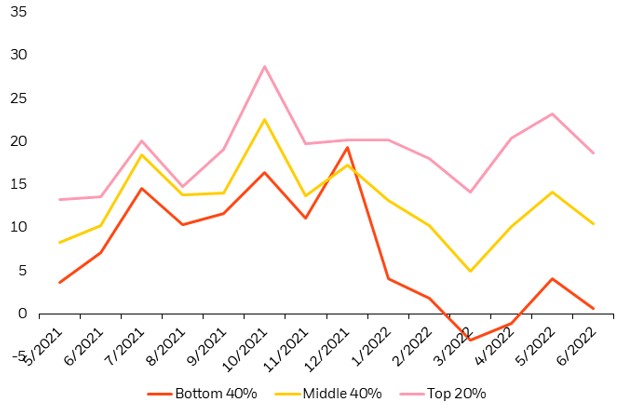
First, about the spending in 2022. This chart indicates that discretionary service spending by the bottom 40% income cohort is indeed down sharply in 2022, and now sits a little lower than a year ago, while the upper 20% cohort is spending actually more than a year ago. Spending by the middle 40% trended up in 2H 2021, then back down in 1H 2022, to end about even over the past 12 months:
Discretionary service consumption by income cohort. (I don’t what the units are for the y-axis, but presumably they show the trends). Source: Earnest Research, as of June 30, 2022, as reproduced by Blackrock.
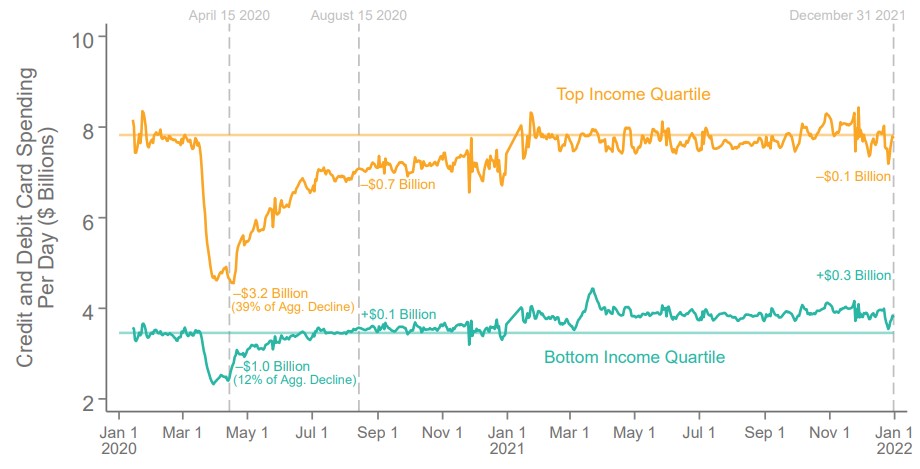
And what about 2020-2021? The next two charts indicate (a) that consumer spending was HIGHER in 2021 that it was pre-COVID for the bottom income quartile, even though (b) their employment in 2021 remained some 20% LOWER than pre-COVID. Looks to me like a lot of spending of stimmie checks was going on in 2021, but (see above) that money has run out in 2022.
Some reader here may have access to a more consistent data set, so I am happy to see this thesis tested further.
I can’t shake the idea that captured land value serves as the origin, or at least accelerant, of a great deal of the problems in the United States. What if the YIMBY vs NIMBY fight is just the most visable element of the core economic disease in America? A heads up, if you’re expected a deeply researched 5,000 word post that will YIMBY “pill” your most skeptical colleague, make your peace with disappointment now. But if you’re into policy failures and run-on sentences, you’re in for a good time.
I just can’t get over how often the examination of seemingly every subpar economic context (not immediately attributable to a pandemic or war) comes down to people X are geographically constrained, they need to be proximate to a specific physical location to produce or consume Y, and a huge amount of the economic surplus that would be created from any sort of exchange is captured by land/property owners because legal constraints on development have made the physical place in which an exchange happens THE short side of nearly every market that is pointed to as a failing institution.
Seriously, go through the list of everything that leaves critics of markets ready to burn capitalism (and its fostering society) to the ground. Wages are too low relative to rent. Rent is too high in the places that are near the jobs I want. Public schools aren’t good enough unless you’re willing to carry a mortage that would account for 70% of your take-home pay. Healthcare…eh, maybe not healthcare. Healthcare is crappy for its own bespoke and byzantine set of reasons.
I am a person with no shortage of bodily ailments because I chose to play lots of sports despite never being especially good at them. As a result, I am an avid consumer of physical therapy and therapeutic massage. I have had many conversations about the economics of these fields, and I am now 100% certain that the key to making a career at either, given a minimal level of competence, is not how good you are at your job, but your capacity and good fortune in solving your real estate problem. The entire Massage Envy empire appears to exist not based on greater competence in technique, training, or personnel. It exists solely to extract rents from employees because scale lets them solve the real estate problem (and probably pool liability risk, too). The single biggest thing an individual professional can do to increase their yearly income is not win an award for Therapist of the Year or get 5 stars on Yelp. It’s buying a house with a room they can use as a home office, where they can pay “rent” to themselves and take a tax deduction for the office.
I was once told a likely apocryphal story (that I can’t find on the internet, so it’s probably not true) that the then CEO of Starbucks declared “We make coffee, but we’re in the real estate business.” That their business had matured to the point where revenues could be projected with sufficient accuracy that the profitability had been reduced to identifying opportunities in the real estate market. I don’t know if that ever happened, but that still seems about right to me.
Housing costs hold a special place in how we view our own economic status and security going forward, in part because food costs have been reliably low for so long (knocks on all of the wood). When the rent goes up we feel worse off, not just because we have less disposable income today, but because it increases our expectations for future rent increases as well. We have lots of words for economic insecurity and desperation, but nothing quite makes your blood run cold like the prospect of being homeless, even for the briefest moment.
The phrase “paying your nut” is a lot less common these days. You usually only hear it from self-employed people who live off of a la carte incomes, either in entertainment, freelance, or contracting work. It refers to the minimum amount you have to earn in a month to avoid significant consequences, usually the aggregate of rent/mortgage, utilities, and debt payments. Economists talk about “nominal” and “real” incomes to account for the changes in prices people face. Sometimes there is discussion of “money illusion” where people living under inflation are fooled by higher take-home pay into thinking they’ve become richer. I’ve never been persuaded that nearly anyone suffers from money illusion, nor do I think folks track national price indices and growth statistics.
I think people just know whether it’s easier or harder to pay their nut, and the simplest version of that is the ratio of their take home pay to their rent. Paycheck divided by rent, full stop. If you follow this blog or Jeremy on twitter, you’ll know that one of the puzzles frequently revisited is why Americans are so pessimistic about the economic dynamics of the last 20 to 30 years, and why younger people seem terribly aggrieved about their relative economic status.
Is it harder for Homer Simpson to afford a mortgage than in the 1990s? And what does this tell us about the typical American household?
— Jeremy 'adjusted for inflation' Horpedahl 📈 (@jmhorp) February 23, 2022
So if generational income is fairly consistent and median home mortages account for a slightly declining fraction of median income, what gives? Well, it could all be one big economic mass hysteria, but I’ve got a simpler explanation: the ratio of rent to income to has skyrocketed in the places that young people want to live. Maybe I’m overprojecting my own lived experience, but when I was 25 I did not want to live in a rural area, the suburbs of a major city, or even the downtown of a minor city. I wanted to live in a proper big city. And for a young person, that means living in a small apartment, possibly with roommates, which is exactly the kind of housing places like California stopped building.
Why do so many young people seem pessimistic? Putting aside the absolute failure of politics to produce meaningful climate policy, the simplest explanation is that they have an unpleasant choice. They can live in the same places young people have always lived, only absent any possibility of savings and economic security. Or they can be dispersed from the cultural and economic capitals of our country, and try to build social networks without the benefits of the generational density, plethora of events, and dating markets that have been the hallmark of being a young person in the city since World War I (if not longer).
What will solve this? Policy? California has showed some glimmers of hope. Young people voting with their feet, moving to the shining middle-sized cities that are allowing for growth and affordable rents? Could be, but critical mass is real and growing into a proper metropolis takes decades. Work from home?
That’s interesting enough that I’ll write about it next week. I have thoughts and policy prescriptions, in case any major city is looking for a czar of housing policy (NB: I’m not qualified, but available).
Drone racing was an event at the World Games in my city. Now I know it exists (as does canoe polo!).
The composition of contestants was interesting. One pilot was only 14 years old, the youngest person competing in the 2022 World Games. Another pilot was in a wheelchair. Drone racing is for sports like Work From Home is for professional jobs – the number of competitors is potentially enormous.
Spectators reported that it was hard to follow the actual drones with your eyes. People in the stadium for the race usually watched the jumbo screens that show the point of view of the pilots. This raises the question: why bother with the drones at all when we could just be doing e-sports? There is something special about the extra challenge of a physical race. The machinery adds a NASCAR-like element, and it gives people an excuse to gather together.
Videos, if you’d like to get a sense of how the sport works:
Polaris published an industry report that predicts growth.
Drone racing will grow in the United States. This seems like a sport that will appeal to Generation Alpha and their parents.
As a parent, I would support it. It’s expensive, so that’s going to be prohibitive for a while, but millions of Americans bought drones at some point in the last decade. Drones get broken in races, but the cost of components is coming down. Part of the sport is being able to repair and build your own custom drones.
A handful of US high school already have drone racing clubs. Adults will be able to point to the value of learning technology that comes along with racing for fun.
I’m usually the one writing the papers, but I recently did two studies as a participant / guinea pig. Both just released major positive updates.
I joined the Novavax trial in late 2020 to have the chance to get a Covid vaccine sooner; at the time Pfizer had just got emergency approval but wasn’t available to the general public. The smart bio people on Twitter also seemed to think it was likely to be safer, and perhaps more effective, than other Covid vaccines (it delivers relevant proteins directly, rather than using mRNA or a viral vector). The trial results were published over a year ago now, and were in fact excellent:
Results from a Phase 3 clinical trial enrolling 29,960 adult volunteers in the United States and Mexico show that the investigational vaccine known as NVX-CoV2373 demonstrated 90.4% efficacy in preventing symptomatic COVID-19 disease. The candidate showed 100% protection against moderate and severe disease
As usual the FDA dragged its feet, even as other agencies around the world like the European Medical Agency and the World Health Organization approved the US-made Novavax. But last week it finally gave emergency authorization, and yesterday the CDC recommended Novavax. Of course, by now almost everyone who wants a Covid vaccine has one, and this approval is only for adults. But this will be a great option for boosters, as well as for anyone who was genuinely just concerned with the new technologies in the other vaccines (rather than just afraid of needles, or preferring to cut off their nose to spite authority’s face). As the CDC put it:
Protein subunit vaccines package harmless proteins of the COVID-19 virus alongside another ingredient called an adjuvant that helps the immune system respond to the virus in the future. Vaccines using protein subunits have been used for more than 30 years in the United States, beginning with the first licensed hepatitis B vaccine. Other protein subunit vaccines used in the United States today include those to protect against influenza and whooping cough….
Today, we have expanded the options available to adults in the U.S. by recommending another safe and effective COVID-19 vaccine. If you have been waiting for a COVID-19 vaccine built on a different technology than those previously available, now is the time to join the millions of Americans who have been vaccinated
I’m glad I was in this trial- I got a Covid vaccine several months before I otherwise could have, I made a few hundred dollars, and I learned a lot. But it would have been much better if they found a way to do fewer blood draws, and if FDA approval had come quicker. I’ve been in a weird gray area with respect to vaccine mandates for the last year; almost everyone ended up accepting my vaccine card, but I never knew if they were going to say “no, you need an FDA approved one”. I ended up getting Pfizer for a booster even though I think it’s a worse vaccine, partly for this reason, and partly because Novavax said they’d only give me the booster if I did another blood draw and I was tired of that.
The all-potato diet trial I wrote about here also released its results this week. This trial was much less formal, much smaller, and had no control group, so the results aren’t a slam-dunk the way Novavax is. But I think they’re still impressive. I lost 8 pounds in the 4-week trial, but it turns out the average participant who did all 4 weeks did even better:
Of the participants who made it four weeks, one lost 0 lbs…. Everyone else lost more than that. The mean amount lost was 10.6 lbs, and the median was 10.0 lbs.
Their summary also explains other costs and benefits of the diet, showing lots of data as well as many quotes from participants, including two from me. They conclude with some fascinating speculation about potential mechanisms from the boring (literally, lower variety makes eating boring so you eat less) to the speculative (low lithium? high potassium? weird lithium-potassium interactions), check it out if you’re interested in why obesity rates keep rising or if you’re considering doing the potato diet.
I’m glad I was in these two trials- what to try next?
The truth is, we don’t know. But let’s be clear: whether we are or not doesn’t depend on the 2nd quarter GDP report. Though two consecutive quarters of declining GDP is often cited as the definition of a recession, it’s not the definition economists use. And with good reason.
Instead, the NBER Business Cycle Dating Committee uses this definition: “a significant decline in economic activity that is spread across the economy and that lasts more than a few months.” And they explain why GDP is not their preferred measure, which includes several reasons but this one seems most germane to our current moment: “[the] definition includes the phrase, ‘a significant decline in economic activity.’ Thus real GDP could decline by relatively small amounts in two consecutive quarters without warranting the determination that a peak had occurred.”
If not GDP, what do they look at? I’ll get into more detail later, but in short, they look at monthly measures of income, consumption, employment, sales, and production (a direct measure of production, which GDP is not — it’s a proxy).
However, the American public seems convinced that we are in a recession. The most recent poll I can find on this is from mid-June, which is useful because (as we’ll see below) we have most of the relevant measures of the economy for June 2022 already. In that poll, 56% of Americans say we are in a recession. And while there is some partisan bent to the responses, even 45% of Democrats seem to think we are in a recession. For those that say we are in a recession, 2/3 cite inflation as the primary indicator that we are in a recession.
Already here we can see the difference between the general public and NBER: the rate of inflation is not one of the measures that NBER considers when defining a recession. So, what are the measures they use?
Pablo Budassi has created a logarithmic map of the entire known universe, that shows the distances and relative sizes of objects above the earth’s surface. I think you will find it a worthwhile use of your 30 seconds of attention to click on the link below, scroll to the bottom to start down at the earth’s surface (the image quality at the link is much better than I can convey in these snips here):
And then scroll your way up and up, through planets and stars to galaxies (not every star and every galaxy is shown, of course) and galaxy clusters:
And out through galaxy superclusters, to the very edge of the observable universe:
I am awed by the sheer sizes of things compared to familiar earth-scale objects. We know that our observable universe has not existed forever; presumably whatever caused this vast universe is incomprehensibly vaster. [1]
I am also impressed that humans are able to figure all this out; it is not obvious to the naked eye. An enormous amount of collective brainpower over the years has gone into making instruments (including space-based telescopes) to collect data at many electromagnetic frequencies and to figure out what it all means.
Bonus: In case you haven’t seen them already, here is a link to compelling infrared images from the newly-deployed $10 billion Webb space telescope (your tax dollars at work):
[1] I don’t want to distract from the sheer visual enjoyment of this graphic with a controversial discussion of what is responsible for bringing our universe into existence. All I will say here is that it did not come from “nothing”, as a certain dishonest physicist is fond of claiming. See the “Thinking About the Existence and Attributes of God” section of Christian Apologetics Insights from David Geisler, Ray Ciervo, and Prem Isaac [2020 NCCA, 9], including footnotes 1 and 2, for a brief discussion of these issues, and implications for a nonmaterial sustainer of physical reality.
For those who were unaware, we are apparently a Severanceblog now, a trend made all the better since nobody else is talking about the show anymore. Like all high concept fiction, the show can be consumed as a metaphor, in this case usually as a metaphor for modern office work. While I consume more than my share of metaphors, I usually find speculating about the “true” underlying metaphor driving a piece of storytelling to be more fun than useful. Instead, let’s talk about what the central conceit of the show actually is, namely a return to explicit slavery. Not almost slavery. Not wage slavery. Not “I’d rather be playing Minecraft on Twitch than making pivot tables in Excel ” slavery.
Actual slavery. The hook, through a clever bit of science fiction, is that it is slavery through a channel that allows a person to enslave the only person that we can imagine the world allowing to pass as anything but grossly criminal: themselves. The person you are enslaving to toil on your behalf happens to be a partitioned-off portion of your own consciousness (known as an “innie”) who continues to operate within a now shared bodily meat sack while your “outie” consciousness goes into a apparent blacked-out stasis. The innie does all the work, while the outie reaps (nearly all) all of the material rewards.
One take away is that there are people so desperate to not have to go to their jobs that they will carve off 8 hours a day out of their own claim to existence, a full third of their life, grant independent sentience to that third, and then enslave it. Putting aside the moral repugnance of such a decision for a second, one can’t help but ponder the preferences being revealed by an individual paying such a price.
Never trust a “unified theory” of damn near anything. It’s usually bullshit from the first moment, a cheap trick for gaining attention while grotesquely overreaching for importance in what is either a relatively mundane insight or a bit of intellectual sleight of hand designed to misdirect the reader from a deep underlying fallacy.
Anyway..
The price we’re willing to pay to not do something we don’t like often reveals more about ourselves than the prices we pay for the things we do like. The cost we’re willing to inflict on others reveals it all the more.
One of my little mental tricks when trying to understand human behavior that I can’t quite grok is to swap out a “utiliity maximizing” model for a “disutility minimizing” model. Trying to understand why a person would enslave a portion of themselves within the framework of “what are they maximizing?” lends itself to complex speculation on dimensions of their lives we can’t observe. Flipping it around, however, and asking what they are minimizing is immediately more intuitive. Without getting too deep into spoilers, there’s clearly a motive to minimize the disutility of work itself. Of toil, tedium, and drudgery. Of being told what to do and doing what you are told.
The hypothesis of Severance is that people will create an enslaved conscious person and explicitly deny the humanity of that person if, in doing so, they can minimize their own disutility of work. The corporation that creates these institutions in this fictional world will probably turn out to be either decadently evil in pursuit of pure profit or banally evil in pursuing some sort of yet unseen greater good. Even if they have rich and tragic back stories, the middle management that keep the plantation functioning are morally wretched individuals who have chosen to enable slavery to preserve their own status quo. The corporation, the managers, these are the bad guys. The heavys. The bullys who gain from the suffering of others.
But they’re not the monsters. The only monsters in the world of Severance are the individuals who made a choice to create and enslave another person solely so they themselves might enjoy a life without toil or tedium.
The cost that you are willing inflict on another in an effort to minimize your own discomfort reveals a lot about you. Whether you’re a socialist preaching “solidarity”, an economist who knows that Smithian “sympathy” is the glue of modern society, or just someone who thinks that it all comes down to coping with the prisoner’s dilemma, how a person values the suffering of others is a defining attribute.
Which brings me to a question I think only the creaters of Severance can answer. Is the conceit of their show to show that people will enslave a portion of themselves because they deny the humanity of their creation? Or is it that an office job is so abhorrent that opportunity to offload that burden to another while keeping the rewards for themselves overcomes any sympathy they might have for the other?
This show isn’t a metaphor. It’s a model. In this sense, Severance may be the most misanthropic hypothesis of humanity in the economically developed world I’ve ever observed. That humans, freed of the disutility of possible starvation or annihilation, will take any opportunity to minimize their own discomfort, even at the cost of a third of their lives and moral rot that comes with the enslavement and denied humanity of another. Somewhere, in the deep dark noughaty core of this piece of fiction is the consideration that, freed from our need for one another, our antipathy for discomfort will birth an idle, half-drunk decadence that will lead us to literally eat away at ourselves.
Or maybe the creators just all had office jobs while they were trying to make it in hollywood, and they really, really hated them.
I have written three blogs on the TV show Severance this summer. My newest post is up at the Online Library of Liberty.
I discuss how job perks are portrayed in the show. The bosses in the show are creepy and we come to find out that they are totally evil. Given the way everything feels in the show, you could come to the conclusion that perks are generally manipulative and false. Someone implied that in an op-ed published by the NYT.
My argument is that free adults can use “perks” to motivate themselves and each other to do the right thing.
We are all just trying to get that dopamine, in the short term. Should people only feel happy when they are doing drugs or playing video games? Should bosses not be allowed to create a fun moment at work?
Trivial gifts and prizes must be cheap, so that their cost does not start to outweigh the benefits of incentivizing things we should be doing anyway. Finding ways to make a responsible life exciting is in fact the key to maintaining our liberty. Most people do not want to be martyrs. They want life to be fun.
The following tweet shows the character Dylan and his performance prize.
— OutofContextSeverance (@SeveranceOutof) June 24, 2022
Behavioral scientists have documented lots of quirks in human behavior. We aren’t solely motivated by our (real wage) salaries to produce effort. The good news is that we are capable of self-reflection. We can make these quirks work for us. Lots of successful people will promise themselves a small reward at the end of the week if they accomplish something hard.
Perks aren’t all bad at work, but, on the other hand, Severance could make you more alert to genuine manipulation that is out there.
Watching Severance prompts good questions. Who are you? (That’s the opening line of the show.) What are you doing with your life? Whose purposes are you serving?
I liked the show because it has great characters, funny moments, and it gets you thinking. If you watch the show, don’t take it too seriously. Ben Stiller is a co-director. The man (the genius) brought us Zoolander (2001).
One give-away that this ain’t the new 1984 is a plot hole concerning how the main character Mark decided to sever himself and join the evil corporation. According to the show, his wife died and he was so sad that he quit his job as a history professor after three weeks of feeling sad. I know a lot of academics. History professors have worked too hard and too long to quit their jobs after three weeks of feeling sad. Take everything with a grain of salt from these writers. Mark’s general lack of executive control is at odds with the backstory that he once obtained a job as a history professor.
Severance is described as science fiction but it clearly takes place in the United States of America. For one thing, a “senator” has a role. For another thing, the work schedule is pretty American. This is a funny video on how Europeans view the American work schedule:
What Finland thinks an American workday looks like
I have no idea how far down the rabbit hole the writers will feel like they have to do in Season 2. Will there be a role for a POTUS?
The second blog was posted to EWED: my thoughts about relating Severance to Artificial Intelligence.
A question this raises is whether we can develop AGI that will be content to never self-actualize.
And, back in May, OLL ran my first blog about Severance and drudgery.
The first line in the show is, “Who are you?” Themes about identity and purpose are explored alongside the thrilling hijinks of the prisoner innies. Outie Mark has nothing except his personal life to think about, which in his case is tragic. Innie Mark has nothing but work. Neither man is happy or complete.