Michael Maynard and I wrote about giving a good gift. A good gift is one in which the giver has an information advantage. Gifting an object or a service can provide a consumption bundle to the recipient that they didn’t know was even possible or that they didn’t know that they would prefer. They would have chosen the items themselves, if only they had known about them. Giving a gift card can be similar if the recipient did not know about the vendor previously. Cash is a good gift when the giver does not have an information advantage over the recipient.
In our previous post, we showed diagrammatically that ‘better off’ was indicated by the higher utility. But this spurs an important question:
No big post this week, I’m in the Maine Woods without reliable internet or electricity.
The one economics angle to all this is that like many seemingly ancient Maine forests, the one I’m in used to be a farm. Notice the barbed wire running right through the middle of a huge old tree; the farm was abandoned so long ago that the tree had time to grow that big around it.
Why was the farm abandoned? Maine is cold and our soil is rocky, so agriculture tends to be unproductive relative to the Midwest. Many people left their farms in the late 1800s and early 1900s for new land in the West or, more commonly, manufacturing jobs in the cities. Maine used to be half farms, but now its land is 90% forest.
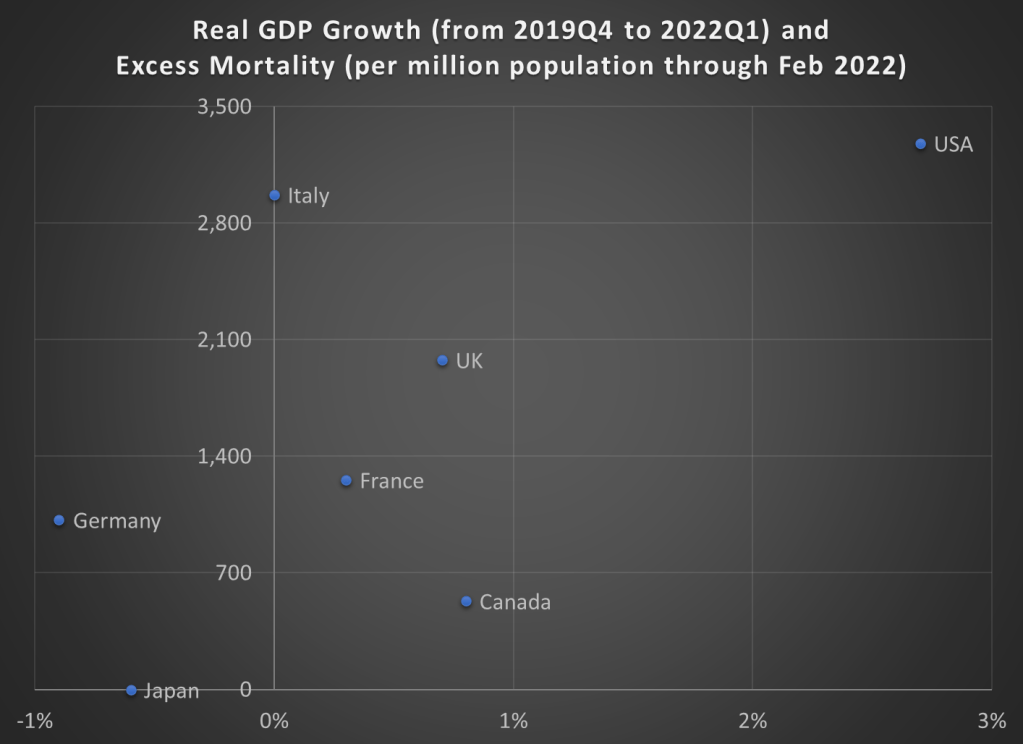
Today, my chart looks at the G7 countries (representing roughly half of global wealth and GDP), showing both their economic performance (as measured by real GDP growth) and health performance (as measured by excess mortality through February 2022).
The US has clearly had the best economic performance. But the US also had the highest level of excess deaths per capita (not all of this is from COVID — US drug overdoses are also way up — but even using official COVID deaths, the US still tops this group).
Japan had the best health performance, in fact amazingly no cumulative excess deaths through February 2022 (this has risen very slightly since then, but I stopped in February so all countries had complete data). However, Japan also had slightly negative economic growth.
Which country ends up looking the best? Canada! Very low levels of excess deaths, and at least some positive economic growth. Not as much growth as the US, but Canada is the second best performer in the G7.
To give some context of just how low the level of deaths have been in Canada, first recognize that the US had 1.1 million excess deaths in the pandemic through February 2022. If instead our excess deaths had been roughly equal to Canada on a per capita basis, we would have only had 180,000 excess deaths in the US, saving over 900,000 lives.
Some of Canada’s COVID policy have been overly restrictive, such as the vaccine mandates that sparked protests in February 2022. But by then, Canada had already largely achieved it’s COVID victory over the US and most other G7 nations. Compare excess mortality in Canada with the US: the only big wave in Canada that came close to the US was the Spring 2020 wave. After that, Canada was always much lower.
Ah, the delicious crypto bubble of 2021. Major cryptocurrencies like Bitcoin and Ethereum more than tripled in value. Every week, some new coin would get minted, letting early adopters 10X their money in a month. Decentralized finance (DeFi) based on blockchain technology was The Next Big Thing. Move over, stodgy old Bank of America.
That was then, this is now. The chart below of Bitcoin price serves as a proxy for the fortunes of the whole sector:
This has the smell of a bubble bursting. First, why did crypto soar in 2021? I think COVID gets some credit for that. Most adults in the developed world sat home for many months in 2020-2021, and in countries like the U.S. were handed thousands of dollars of stimulus money, in addition to giant unemployment checks. Much of that money went to buying “stuff” on Amazon, but much of it went into financial assets like stocks and crypto. Something like half of men in the United States between the ages of 18 and 49 dabbled in crypto. As you saw your friends making money effortlessly, classic tulip bulb FOMO set it.
All bubbles end eventually. Crypto has imploded from a $ 3 trillion market to a $ 1 trillion dollar market in just a few months. That is two trillion (with a “t”) gone. If Bitcoin were the only significant factor in the crypto universe, the latest bust would be a fairly trivial matter. Since Bitcoin goes up and Bitcoin goes down, that is nothing new. But part of the hype of 2021 was all the breathless commentary on how DeFi would sweep the world and Change Everything. No more centralized banking controlled by old men in suits – – power to the people! And in fact, a whole industry of lending and borrowing in the crypto world has sprung up. That is where some more consequential problems have shown up.
Warren Buffet is known for the saying, “When the tide goes out, you find out who is swimming naked.” The rapid fall in crypto valuations has set off a cascade of failures in DeFi. A key event was the implosion of the Luna/Terra (un!)stablecoin, in April-May 2022, which we wrote about here. A more widespread problem has been the unwinding of the crypto lending/borrowing system. Various firms loaned out the coin holdings of their customers to parties that wanted to trade (speculate) with them, and who were willing to pay something like 4-9% interest for get ahold of these coins. The parties doing the lending thought they were keeping themselves safe by requiring excess collateral for these loans.
Oversimplified example: I will lend you $100 (real dollars) if you deposit $140 of Dogecoin with me. If Dogecoin falls in value to close to $100, I would require more collateral from you within say ten days, or else I would sell your Dogecoin into the market and get my $100 back (and you eat the $40 loss). The big problem comes if Dogecoin falls so fast that by the contracted grace period ends, its value is down to $80. Now I as well as you realize losses, and widespread panic ensues. Now, if I have been lending out your Dogecoin to yet more parties who (it turns out) can’t pay me back in full, I am doubly hosed. And now the solid customers start withdrawing their funds/coins from these firms, and we have an old-fashioned bank run. It doesn’t help that Celsius Network froze customers’ accounts last month, so they could not withdraw the coins they had deposited. That sort of thing really gets clients nervous.
And so a number of significant DeFi firms are going bust, and calls get louder for more government regulation, which is largely antithetical to the whole DeFi enterprise. I will paste below a summary of this carnage, and then in the interests of full disclosure, tell how it has affected me personally:
The crypto and the DeFi industry boomed over the past few years but the recent crypto crash has plundered the fortunes of several crypto companies. The following crypto companies have recently encountered financial difficulties:
Vauld
Business Today broke the news on Monday that Vauld, the Singapore-based crypto lending and investment firm operating in India announced that it has halted withdrawals and deposits for its more than 8,00,000 clients. Vauld’s CEO Darshan Bathija said in a blog post that unstable market circumstances had created “financial challenges” for the company. The CEO also announced that investors had withdrawn over $197 million in the past few months.
Terraform Labs
Terraform Labs was the company that had triggered the recent crypto crash. They created the algorithmic stablecoin TerraUSD which de-pegged from the US Dollar and led to the crash of Terra Luna another token of the ecosystem causing massive panic and sell off in the crypto markets.
Terra co-founder Do Kwon announced a “recovery plan” in May that included infusion of additional funding and the rebuilding of TerraUSD so that it is backed by reserves rather than depending on an algorithm to maintain its 1:1 dollar peg.
Voyager Digital
On July 6, the American crypto lender disclosed that it had filed for bankruptcy. In its Chapter 11 bankruptcy petition, Voyager stated that it had over 1,00,000 creditors, assets between $1 billion and $10 billion in value, and liabilities in the same range.
Three Arrows Capital (3AC)
The Singapore-based cryptocurrency hedge firm went bankrupt on June 29, just two days after receiving a notice of default on a crypto loan from lender Voyager Digital for failing to make payments on an approximately $650 million crypto loan. The company filed a petition for protection from its creditors under Chapter 15 of the United States’ bankruptcy code on July 1. This section of the code permits overseas debtors to safeguard their U.S.-based assets.
Celsius Network
Celsius Network also suspended withdrawals and transfers last month due to “extreme” market conditions. They also hired consultants in preparation for a future bankruptcy filing. The American-Israeli business reportedly disclosed on July 4 that a quarter of its workers had been let go.
Babel Finance
The Hong Kong-based cryptocurrency lender stated on June 17 that it had temporarily halted crypto-asset withdrawals as it scrambled to reimburse consumers. According to the company, “Babel Finance is suffering unprecedented liquidity issues due to the current market situation,” emphasising the severe volatility of the market for cryptocurrencies.
CoinFLEX
In a blog post published on Thursday, CoinFLEX’s CEO Mark Lamb announced that the company would temporarily halt withdrawals due to “extreme market conditions” and uncertainty about a certain counterparty. The company is facing serious financial troubles and there seems to be no way out.
My Confessions
Briefly — I bought into Bitcoin and Ethereum in the form of the funds GBTC and ETHE towards the end of 2020. As crypto started to unwind this year, I sold out of ETHE to de-risk, coming out a little ahead there. I decided to hang in with the Bitcoin fund, riding it up, and now down, down, down. I am so far in the red on this one that I am just going to hold it indefinitely, hoping for some recovery someday.
I bought into Voyager (see above, it has recently crashed and burned) and sold half after it doubled, and the rest at about breakeven price, so came out ahead there. Another, similar firm, Galaxy Digital, I bought has also plummeted to near zero. I got out of that, but waited too long and lost about 30% there.
Readers with exquisite memories might recall that I wrote an article some months back here on EWED touting the DeFi model as a great way to earn interest to keep up with inflation: “Earning Steady 9% Interest in My New Crypto Account.” I chose BlockFi rather than Celsius Network to put my funds in for this, since Celsius (an offshore enterprise) seemed a little shady, whereas BlockFi made a point of being audited and compliant with U.S. regulations. Good choice, in light of Celsius’ recent freeze on customer withdrawals.
Now, even solid firms like BlockFi are hurting. Customers spooked by all the other crypto drama are withdrawing assets “just to be on the safe side.” BlockFi is seeking cash infusions from white knight Sam Bankman-Fried to stay afloat. The 30-year old crypto billionaire looks to be able to acquire the firm for pennies on the dollar, wiping out the initial (private) investors in BlockFi. I am one of these BlockFi customers withdrawing funds (half of my deposit there) – – just to be on the safe side.
Pete Buttigieg is the Secretary of Transportation in the Biden administration. He has made an interesting habit of going on Fox News and willingly submitting himself to what his interlocutors clearly anticipate to be difficult “gotcha” questions that will leave their liberal target squirming on camera. Secretary Buttigieg seems to always come out the clear winner and I think there is something to be learned from it.
The easy answer is that Buttigieg is smarter and more polished than the Fox News interviewers, which he is, but I think that’s easy to overrate. There is no shortage of smart people who wouldn’t fair half as well as the Secretary does. Part of it is his calm and poise, but credit should also go to just being nice. That niceness really puts people on the back foot. The secret sauce, in my estimation, is that he never for a second sounds like he is arguing. There’s no sense that he is interested in a back in forth. He never gives anyone an opening to raise their voice, to seem attacked.
But it’s not just being nice. The interviewer in the first clip quickly realizes that his question has failed to get the desired reaction, and subsequently tries to interrupt him at multiple points. The Secretrary simply ignores him and proceeds with his answer without missing a beat or raising his voice. He’s the G-d— Secretary of Transportation. He doesn’t have to be deferential to some teleprompter anchorman trying to raise points of political decorum and social norms with a member of the opposition party that has been given no quarter on their network for 20 years.
So how do you be like Pete?
Be nice.
Know your stuff.
Never defer to anyone who isn’t nice and doesn’t know their stuff.
Being nice is inclusive of being polite, but there is more to it. It means being generous in the motives you assume in others, including those who are questioning or arguing with you. It means using tones of voice and choices of language that don’t imply you are dealing with an enemy or a fool, even when dealing with a foolish enemy.
Knowing your stuff means that you can explain choices and positions clearly and concisely in a manner than allows the people listening to you to actually learn something. Knowing you stuff, however, also confers on you the right to finish your thoughts. If others prefer your conversation be more akin to a verbal brawl, that’s their prerogative, but that doesn’t mean they get to dictate where your thoughts begin and end just because they’ve lost control of the outcome. Knowledge should confer some privleges, be them however limited.
And finally, being like Pete means never deferring to people who don’t want to play by the rules of basic civility and have nothing to contribute to the conversation. You’ve got a job to do and being nice will help you do it all the better. So be nice, until it’s time to not be nice.
Have you heard of The World Games? It’s the Olympics for sports that are too random to be in the real Olympics. It is happening right now in Birmingham, AL. It’s not too late to get your tickets to see Canoe Polo.
For people interested in regional politics, this blog about the city successfully hosting a major event might be interesting. His references to people in “the suburbs” is something you won’t understand without some context and history. But you don’t have to be a local to learn that history, since everything is online.
We are living in volatile times. With covid-19, big federal legislation packages, and the Ruso-Ukrainian conflict disruptions to grain, seed oils, and crude oil, relative prices are reflecting sudden drastic ebbs of supply and demand. I want to make a small but enlightening point that I’ve made in my classes, though I’m not sure that I’ve made it here.
Economists often get a bad rap for being heartless or unempathetic. Sometimes, they are painted as ideologues who just disguise their pre-existing opinions in painfully specific terminology and statistics. Let’s do a litmus test.
Consider two alternative markets. One is a perfect monopoly, the other has perfect competition. All details concerning marginal costs to firms and marginal benefits to consumers are the same. In an erratic world, which market structure will result in greater price volatility for consumers? Try to answer for yourself before you read below. More importantly, what’s your reasoning?
Extreme Market Power
A distinguishing difference between a competitive market and a monopoly concerns prices. While firms maximize profits in both cases, the price that consumers face in a competitive market is equal to the marginal cost that the firms face. There is no profit earned on that last unit produced. In the case of monopoly, the price is above the marginal cost. Profits can be positive or negative, but the consumer will pay a price that is greater than the cost of producing the last unit.
Below are two graphs. Given identical marginal costs of production and benefits that the consumers enjoy, we can see that:
The monopoly price is higher.
The monopoly quantity produced is lower.
But static models only go so far. What about when there is volatility in the world?
Volatile Costs
Oil and gasoline are important inputs for producing many (most?) physical goods. Not only that, they are short-lived, meaning that they disappear once they are used, making them intermediate goods. Therefore, changes in the price of oil constitutes a change in the marginal cost for many firms. If the price of oil rises, or is volatile otherwise, then which type of market will experience greater price and quantity volatility?
Below are two figures that illustrate the same change in the marginal cost. We can see that:
Monopoly price volatility is lower (in absolute terms and percent).
Monopoly quantity produced volatility is lower (in absolute terms, though no different as a percent).
The take-away: While monopoly does constrict supply and elevate prices, Monopoly also reduces price and output volatility when there are changes in the marginal cost.
Volatile Demand
That covers the costs. But what about volatile demand? A large part of the Covid-19 recession was the huge reallocation of demand away from in-person services and to remote services and goods. What is the effect of market power when people suddenly increase or decrease their demand for goods?
Below are two figures that illustrate the same change in demand. We can see that:
Monopoly price volatility is higher (in absolute terms, though no different as a percent).
Monopoly quantity produced volatility is lower (in absolute terms, though no different as a percent).
Monopolies Don’t Cause Inflation
Economists know that inflation can’t very well be blamed on greed (does less greed beget deflation?). Another problematic story is that market concentration contributes to inflation. But the above illustrations demonstrate that this narrative is also a bit silly. Monopolistic markets cause the price level to be higher, it’s true. But inflation is the change in prices. Changing market concentration might be a long term phenomenon, but can’t explain acute price growth. If demand suddenly rises, monopolies result in no more price growth than perfectly competitive markets. If the marginal cost of production suddenly rises, monopolies result in less price growth.
All of this analysis entirely ignores welfare. Also, no market is perfectly competitive or perfectly monopolistic. They are the extreme cases and particular markets lie somewhere in between.
Did you guess or reason correctly? Many econ students have a bias that monopolies are bad. So, in any side-by-side comparison, students think that “monopolies-bad, competition-good” is a safe mantra. But the above illustrations (which can be demonstrated mathematically) reveal that economic reasoning helps to reveal truths about the world. Economists are not simply a hearty band of kool-aid drinking academics.
Most Americans are covered by employer-sponsored health insurance, either through their own job or a family member’s. This can make it difficult to switch jobs- the new job might not offer insurance, or might have a worse insurance plan or network- locking people into their current job.
Economists have documented since at least the 1980’s how our insurance system seems to reduce job mobility. Several reforms have tried to improve the situation- COBRA, HIPAA, and most recently the Affordable Care Act.
In a paper published this week, Gregory Colman, Dhaval Dave and I evaluate how the extent of “job lock” has changed over time. In short, we find that job lock remains substantial and the Affordable Care Act doesn’t appear to have done anything to improve the situation. The paper has many tables of regression results, but the pictures tell the basic story:
Trends in job mobility for those with and without employer-sponsored insurance (ESI) using Current Population Survey data
The details differ a bit depending on which dataset and identification strategy we use, but a few things are clear:
Macroeconomic factors are dominant in the short run; mobility falls during recessions like 2001 and 2007, then recovers.
The long run trend has been toward lower job mobility for those with AND without employer-based insurance
Those without employer-based insurance are still much more likely to switch jobs (we find 25-45% more likely)
To the extent that this gap has closed since the year 2000, it has come through falling job mobility for those without employer-based insurance more than rising job mobility for those with employer-based insurance
Why does the Affordable Care Act appear not to have improved things? This remains unanswered, but we conclude the paper with some hypotheses:
In fact, our point estimates suggest that job lock actually got stronger following the ACA. One possible explanation for our finding is that the ACA’s individual mandate made insurance even more desirable by fining the uninsured. Another possibility is that workers continue to value employer-provided health insurance more over time as premiums continue to rise
I’m on vacation this week. But no, I’m not just saying this to get out of posting this week, or to brag. Americans really have started going back to the normal routine of vacations after a long break during the pandemic.
You might think that the high price of gasoline will slow down summer travel. Not so, according to estimates from AAA. While the total number of estimated travelers for Independence Day weekend is still slightly below Summer 2019 (by about 1 million travelers), travel by car is predicted to be just above 2019 levels (by about 0.5 million travelers), with 42 million Americans traveling by car. Air travel has been a mess lately and quite expensive (even compared to pre-pandemic levels), and is predicated to be about 0.5 million below 2019. Bus/train/cruise travel is still the big loser, well above the past two summers, but still 1 million travelers below 2019. (These are all estimates, of course, but AAA is in the business of knowing this data well.)
What gives? Basic economic theory would tell us that if the price of something increases, people should buy less of it. And traveling by car is much more expensive than in Summer 2019. We should also think about substitutes, and airline travel is certainly a substitute for car travel. But if we look at what has happened to both airfares and gasoline prices since July 2019, we can see that gasoline prices have increased much more (about 60% vs. 25% for airfares).
So, do we just throw up our hands and say: “it’s just too complicated, lots of factors at play”?
I just ran across a short article [1] summarizing a talk with some techniques on learning more efficiently, which seemed worth sharing here. It may be something for professors to pass along to their students.
The speaker was Andrew Watson, who is an expert on learning and the brain, and currently a teacher at the Loomis Chaffee School in Connecticut. He noted three key ways that students (and adults) can work with the ways the brain learns information. The last two points are good but well known, while the first point was not something I have seen emphasized much:
( 1 ) Retrieve information while studying:
To study better, students should focus on the idea of retrieval rather than review. Trying to recall information before looking back at it produces more remembering than simply reading it through again. He suggested creating flash cards and using visual hints and clues as effect retrieval techniques.
( 2 ) Change the environment to avoid distractions:
The environment in which someone studies also affects how well they retain information because the human brain works best when it focuses on one activity at a time.
(My comment: That is absolutely true for me, I can’t stand any distraction when I am studying or writing, but I know people who claim they study more effectively with a TV show or music going in the background…I wonder what academic studies show about that.)
( 3 ) Bolster your health:
The brain, like the rest of the body, benefits from a healthy lifestyle, including eating well and exercising regularly. Ample sleep helps the brain to process and solidify information absorbed during the day. If homework is everything that helps a person learn and if sleep help you learn, then sleep is a part of homework.
[1] “Brain Hacks for Brainiacs” in the Loomis Chaffee Magazine, Spring 2022, page 13.