Pumpkin Spice: 15th Century Edition

It’s pumpkin spice season. That means that not only can you get pumpkin spice lattes, but also pumpkin spice Oreos, pumpkin spice Cheerios, and even pumpkin spice oil changes.

The most important thing to know about “pumpkin spice” things is that they don’t actually taste like pumpkin. They taste like the spices that you use to flavor pumpkin pie. (Notable exception: Peter Suderman’s excellent pumpkin spice cocktail syrup, which does contain pumpkin puree.)

Last week economic historian Anton Howes posted a picture of the spice shelf at his grocery store and guessed that this would have been worth millions of dollars in 1600.

Some of the comments pushed back a little. OK, probably not millions but certainly a lot. Howes was alluding to the well-known fact that spices used to be expensive. Very expensive. Spices, along with precious metals, were one of the primary reasons for the global exploration, trade, and colonialism for centuries. Finding and controlling spices was a huge source of wealth.

But how much more expensive were spices in the past? One comment on Howes’ tweet points to an excellent essay by the late economic historian John Munro on the history of spices. And importantly, Munro gives us a nice comparison of the prices of spices in 15th century Europe, including a comparison to typical wages.

As I looked at the list of spices in Munro’s essay, I noticed: these are the pumpkin spices! Cloves, cinnamon, ginger, and mace (from the nutmeg seed, though not exactly the same as nutmeg). He’s even included sugar. That’s all we need to make a pumpkin spice syrup!

Last week in my Thanksgiving prices post I cautioned against looking at any one price or set of prices in isolation. You can’t tell a lot about standards of living by looking at just a few prices, you need to look at all prices. So let me just reiterate here that the following comparison is not a broad claim about living standards, just a fun exercise.

That being said, let’s see how much the prices of spices have fallen.

Continue reading

This Is Not the Most Expensive Thanksgiving Ever

“Thanksgiving 2021 could be the most expensive meal in the history of the holiday.”

That’s the first sentence of a recent New York Times story. The Times and the New York Post rarely agree on editorial matters, but on this topic the Post ran a very similar story the same week. You can find many such headlines.

But is it true? In short: no. I’ll explain why, but my larger goal is to get you to think more clearly about inflation.

How should we measure the cost of a Thanksgiving meal? A widely used measure comes from the Farm Bureau, which shows that the cost of a traditional turkey-centric meal costs about 14% more than last year. In dollar terms it is $53.31 for a turkey, a pumpkin, cranberries, sweet potatoes, stuffing, etc. That’s more that it has ever been, in dollar terms. Farm Bureau has been tracking the cost of this same meal since 1986.

So in one sense, it seems like the headline claim is true. Most expensive Thanksgiving ever!

But we need to think deeper. A nominal price doesn’t actually tell us much. If a long-lost cousin from the Republic of Horpedahl told you it costs 1 million Jeremys to buy a Thanksgiving dinner, what would your reaction be? The first and best reaction is: how much do people earn in the Republic of Horpedahl?

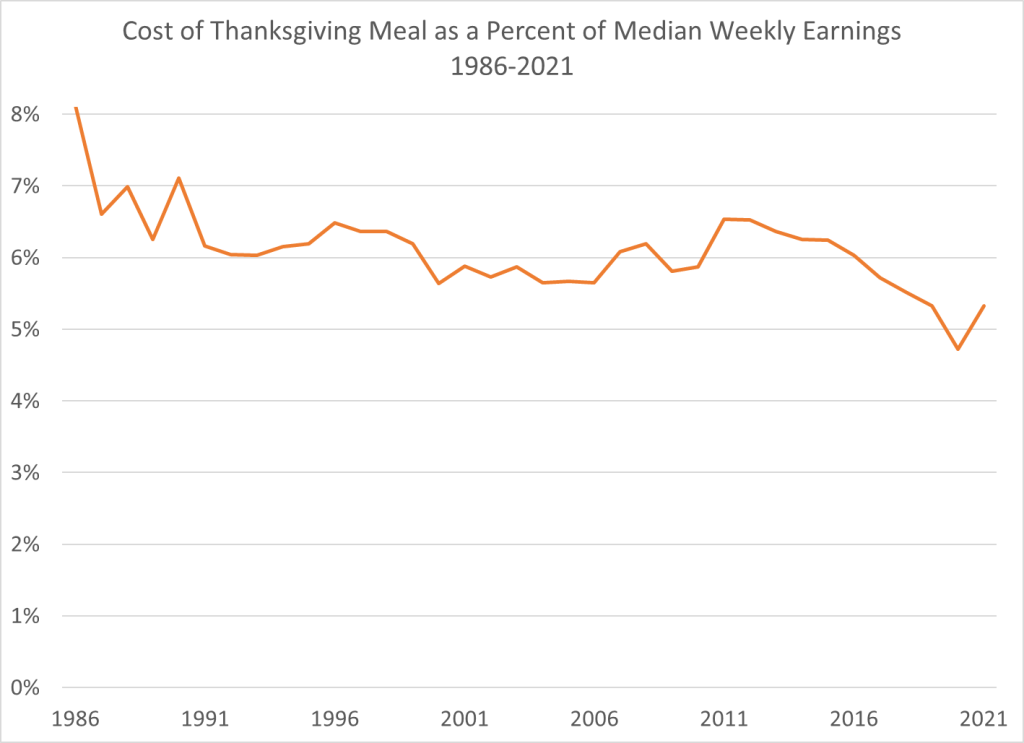
We should ask the same question in the United States today: how do incomes today compare to incomes in the past? Which measure of income you use is important, but if we use median usual weekly earnings of full-time workers, we can make a simple comparison of how much of your weekly earnings would be needed to buy a traditional Thanksgiving meal. This chart shows exactly that. In 2021 that meal will be the second lowest it has ever been as a percent of median earnings — higher than last year, but tied with 2019 for the second lowest. And much less than in the late 1980s and early 1990s (I use third quarter data for each year, the most recent available).

Adjusting for income is the best way to look at this question. It’s not perfect — part of this depends on what income measure you use — but it’s much better than the alternative. The worst approach is to just look at nominal prices. This tells you virtually nothing.

Continue reading

I’m Excited about a New World’s Fair

Everyone who attended the recent Emergent Ventures Unconference is excited. Craig Palsson is excited about the primal branding of the unconference. My co-blogger Mike Makowsky is excited about Plascrete (I was too! We listened to that pitch simultaneously).

I was most excited about the New World’s Fair. This is Cameron Weise’s project, for which he won an EV grant (see all the winners). I have always been interested in the history of World’s Fairs (though probably not as much as my wife). And they still exist, in a sense. There are still World Expos every few years, but as Cameron will tell you, these have mostly turned into “nation branding” exercises, promoting the host nation itself and whatever other countries set up their own exhibits.

But today, World Expos are not about promoting science, technology, and the future, as many World’s Fairs of the past did. And aren’t there already technological conferences, such as the Consumer Electronics Show (now just CES)? Yes, there are. And these are great. But they aren’t serving the same role as World’s Fairs used too.

This is the gap that Cameron Wiese is stepping into. I don’t know exactly what it will look like (he has lots of ideas!), nor exactly when it will happen. But I will be following his project closely, and you should too.

In the conclusion to his e-book The Great Stagnation, Tyler Cowen presents a solution to the stagnation: “Raise the social status of scientists.” I think a New World’s Fair would go a long way towards do this.

Inflation is Here. Why? What Can We Do?

The latest CPI release today shows that real inflation is here. Headline inflation for consumer prices is up 6.2% compared to a year ago and a almost full percentage point in just the past month (seasonally adjusted, so compared to the normal monthly increase).

Back in June, we could reasonably say that 45% of the increase that month (and 27% over the prior year) had been due to just the price of new and used cars, in the past month only 17% can be attributed to vehicle prices. That’s still a lot, considering cars are only about 8 percent of the overall CPI, but inflation is clearly showing up in other areas.

Gasoline prices (also car related!) are always volatile, but they are up sharply in the past year. The over 50% increase for regular unleaded gasoline translates to $1.22 more per gallon than a year ago (and $1.50 more gallon than Spring 2020), which is the largest nominal price increase consumers have seen in a 12-month period (the data stretches back to 1977).

But gasoline is only about 4 percent of consumer spending. What if we look more broadly? Even excluding energy prices, inflation is 4.7% over the past year, the highest increase since 1991.

The natural related questions are Why? And what can we do about it?

The Why question is tricky. The Federal Reserve is very interested in whether the increase in prices is caused by monetary policy. It very much guides their action. Consumers don’t really care that much. They just want the pain to stop. Unfortunately, though, part of the pain may be induced by consumers themselves: spending on goods is extremely high right now, with the year so far 18% above the comparable period in 2019. Higher spending will increase prices in any environment, but the strain it is putting on supply chains only exacerbates the problem. This is not to “blame the victim,” but rather to understand what is going on.

What can be done? That’s an even harder question. It’s convenient to blame the President for things like gas prices. And certainly many voters and pundits will blame him. This charge is not completely without basis, as there are certainly things at the margin a president could do to ease gas prices in the short run (allow more drilling, gas tax hiatus), but we shouldn’t oversell this. And in other areas too, perhaps there are changes that could be made at the margin. But given the massive increases in consumer spending (at least for now), any changes won’t put a dent in the overall inflation rate.

But what about at the individual level? Milton Friedman was asked this question in 1980. That year inflation was 13.5%, the highest since World War II. Friedman’s answer: high living. He said there is no asset which you can expect to protect you against inflation, so you should spend what you have now on something nice. Buy a nice house, a nice suit, a picture to hang on the wall. This is what economists sometimes call “the flight to real values,” or as Phil Donahue put it “convert your money into material things.” While this advice may make sense at the individual level, it doesn’t have great implications for the current supply chain issues.

Friedman did have clear advice for the nation: the Federal Reserve should stop increasing the money supply. Whether that advice will work in the current environment, or whether it will stall the economic recovery, is the hard question the Fed is wrestling with at this very moment.

COVID and The Young

The CDC just approved vaccines from Americans aged 5-11. That’s great news! But today, I want to talk about another age group: mine.

A few months ago I wrote a post summarizing data for COVID-19 deaths among people in their 30s and 40s. While we have primarily thought of COVID as a disease impacting the elderly (and indeed in the aggregate, it is), there have been major health consequences for those under 65 too. Including major health consequences for the age group 30-49 (which I believe is the age range of all our bloggers here at EWED).

I wanted to update that data because a few new things have come to light. First, I highly recommend reading a recent paper by my friend Julian Reif and co-authors. They estimate the number of Years of Life Lost and Quality-Adjusted Years of Life Lost for different age groups from COVID-19. Their data runs through mid-March 2021, so before vaccines probably had much of a chance to impact the aggregate death numbers (though vaccines were being rolled out at the time).

Here’s their main result: while most of the deaths from COVID were among those aged 65 and older (80% through March 2021), most of the life lost in terms of years was for Americans under 65 (54% of QALYs). And even for very young adults, the risk in terms of years of life lost was not minimal. A comparison from the paper: “Adults aged 85 years or older faced 70 times more excess risk for death than those aged 25 to 34 years but only 3.9 times more individualized loss of QALYs per capita.” Compared to the 35-44 age group, the relevant factor is 2.8 times more individualized loss for the 85+ group.

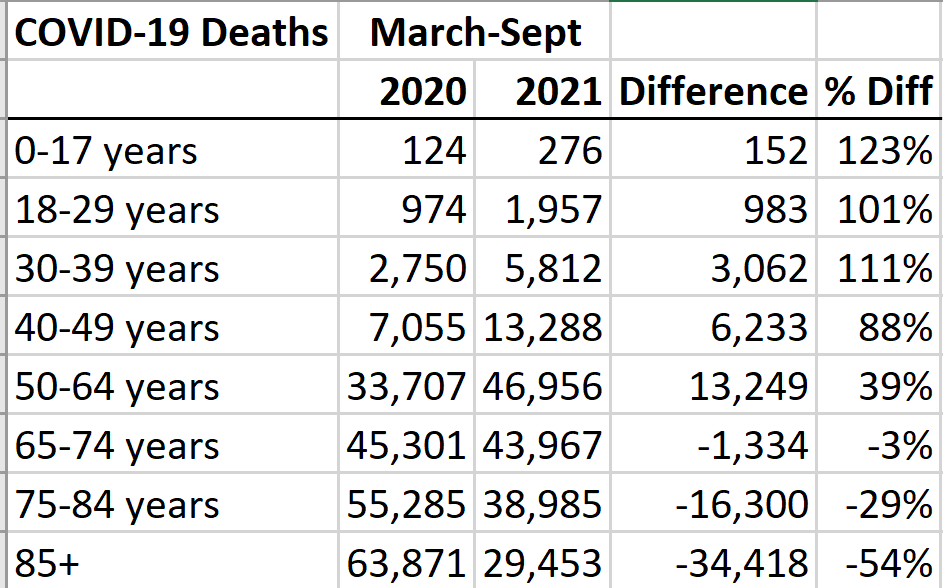
It’s a great paper, but it only goes through March. What has happened since March 2021? While 80% of the COVID deaths up through March 2021 were among the elderly (65 and older), since April 2021 only 60% of the COVID deaths have been among the elderly. Part of this is because deaths are down among the elderly, but it’s also because deaths are up for the non-elderly. The table is my attempt to show this effect, looking at the period from March-September in both 2020 and 2021 (data is current as of October 27, so the September 2021 data is still not complete, but instructive).

For the oldest Americans, COVID deaths fell by 50%. That’s great! But for younger Americans, COVID deaths roughly doubled. Not good!

Continue reading

What to Read: Claudia Goldin’s Career and Family

A better battery is an excellent gift, but for the gift that never needs recharging, a book is always a great idea. So this week Joy asked us to recommend a book. Again, this would be great as a gift or for yourself!

My recommendation is a very new book: Claudia Goldin’s Career and Family, which just came out this month. Confession: the book is so new, that I’ve only read about half of it so far! But this book is, as they say, self-recommending.

Goldin has spent almost her entire academic career studying the history of women’s participation in the US labor force. I think it’s fair to say that there is no person living today that knows more about the subject, possibly no one ever. This book is her attempt to sum up much of her research into a cohesive narrative about the changes in women’s labor force participation throughout the 20th century.

Her 2006 AEA Ely Lecture, “The Quiet Revolution,” was an earlier attempt to explain these long changes, and it is highly readable still today. Her 2014 AEA Presidential Address, “A Grand Gender Convergence,” is also excellent (watch the video of it too!). But this book brings all the ideas together into a complete narrative, tracking five cohorts of women and their experience in the labor force from 1900 to 2000. The last of these five cohorts matches the title of her book, the generation of women that entered the labor force since 1980 and now have a reasonable chance of achieving both an career and a family, rather than having to chose between the two.

This does not mean, and certainly Goldin would not say, that the journey is over and all is well for women today. Goldin focuses primarily on college graduates in this story, since they are the group most well-positioned to achieve the goal of having a career and a family. Obviously there are still challenges, and Goldin spends some time discussing one that the COVID pandemic revealed but was always there: the challenge of finding affordable childcare.

If you want a taste of the book, you can read or watch her 2020 Feldstein Lecture, “Journey Across a Century of Women.” But really the story is so complex that it does take a book to explain it all.

Continue reading

You Need a Better Battery

As we did last year, Joy has asked us to recommend some gifts for our readers. My recommendation is simple: a battery.

But not just any battery. I’m not talking about adding to your cardboard box full of AAs, AAAs, and weird watch batteries.

Instead, what you and everyone on your gift list needs is a portable battery for charging your many devices. There are plenty of good options out there, but anything under 30 bucks with at least 20,000mAh (the standard measure for battery life) is what you want. Here’s a good one on Amazon right now which should be $25 after a coupon and gives you 36,800mAh of charging power.

How much battery life is that? An iPhone has around 3,000mAh of power. You can charge an iPhone over 10 times with this thing! That may sound like overkill, but if you are charging multiple devices on a long trip, this battery is worth its weight in gold (it weighs about 13.4 ounces, which would be about $24,000 worth of gold — maybe I’m exaggerating a little).

For better or worse, our devices are how we communicate, navigate, and entertain ourselves on a daily basis. Especially on long trips. You don’t want your phone to die when you land at a strange, new airport. You also don’t want your friend’s phone to die: more than once, I have been the “battery hero” by loaning my portable battery to a friend at a conference.

Continue reading

A Nobel for What?

The Nobel Prize in Economics was announced this week. As usual, Alex Tabarrok has a great description of the contributions of the winners. But I have seen a number of commentators, mostly on “the right,” question this award, especially for David Card. Mostly they have focused on the highlighting of Card’s paper (with the late Alan Krueger) on minimum wages, saying that this paper has been heavily criticized and debunked, or as evidence that “economics has degenerated into socialist propaganda.”

Yikes! If true, these are serious charges against a profession in decline.

But hang on. What’s really going on with the award for David Card? Again, Tabarrok sums it up nicely: “what really made the paper great was the clarity of the methods that Card and Krueger used to study the problem.” What was this clarity?

Continue reading

Racial Gaps and Data Gaps

Are there racial gaps in the distribution of the COVID-19 vaccine? This is an important and interesting question in its own right. But I’ll talk about this question today because it’s an interesting example of how confusing and sometimes misleading data can be.

How do we answer this question? One is by surveying people. There are a number of surveys that ask this question, but a recent one by the Kaiser Family Foundation finds that among adults 70% of Blacks and 71% of Whites report being vaccinated. And given the sampling error possible with surveys, we would say that these are virtually identical. No racial gap! (Note: there was a racial gap when they did the same survey back in April, with 66% of Whites and 59% of Blacks vaccinated.)

But, surveys are just a sample, and perhaps people are lying. Maybe we shouldn’t trust surveys! And shouldn’t there be hard data on vaccines? Indeed, the CDC does publish data on vaccinations by race. That data shows a fairly large gap: 42.3% of Whites and only 36.6% of Blacks vaccinated. This is for at least one dose, and the percentages are of the total population (which is why it’s lower than the survey data). So maybe there is a racial gap after all!

But wait, if you look closely at the footnotes (always read the footnotes!), you’ll see something curious: the CDC admits that the race data are only available for 65.8% of the data. We don’t have the race information for over one-third of those in this data. Yikes! And given the exist disparities we know about in terms of income and access to healthcare, we might suspect that the errors are not randomly distributed. In other words, if there is probably good reason to suspect that Blacks are disproportionately reflected in the “unknown” category. But we just don’t know.

So what can we do? Since this data comes from US states, we can look at the individual state data and see if perhaps some of it is better (fewer unknowns). What does that data show us?

Continue reading

The Half-Life of Policy Rationales

Bryan Caplan recently wrote about public goods theory, how we teach it, and the unrealistic nature of how we classify goods as either/or, rather than on a continuum. I explored similar themes in a blog post that I wrote back in January, but Caplan brings up another important point about public goods theory that I forget.

In a short 2002 paper, and then in a 2003 book with the same title, Foldvary and Klein proposed the idea of “the half-life of policy rationales.” In brief, the justification for many market failure arguments is contingent on the current state of technology. They apply this to concepts such as natural monopoly and information asymmetries, but for public goods theory the most important application is to the concept of excludability.

Here’s the basic idea: it is costly to exclude non-payers for using some goods. If it is so costly that it would not be profitable for a private enterprise to produce the good in question, it won’t be produced privately. But it still may be efficient for government to produce the good, if the benefit from the good exceeds the cost of raising the revenue to pay for it (likely out of general revenue, since we have already admitted it is infeasible to charge the users directly).

But here’s the Foldvary and Klein point: all of the above paragraph is dependent on the current state of technology! Take roads for example. When you had to pay someone to physically take a few coins for a toll road, plus force all motorists to slow down to a complete stop to pay the toll, it was probably cost prohibitive to operate limited-access private toll roads. But technology changes. We now have the technology for electronic tolling done at highway speed (and even coin buckets were slightly faster than handing some dude your change). The argument for government provision of highways, which was strong when technology was ancient, is significantly weakened now that technology has reached its modern state.

(There may be lots of other reasons you think that roads should be publicly provided, such as equity, but these are separate questions and distinct from the argument made in standard public goods theory.)

Foldvary and Klein go through many more examples in their book, but we can already see the key insight. And I think this is extremely important for teaching public goods to undergraduates. It’s normal for us to say that goods are either excludable (in which private provision is best) or non-excludable (in which there is a strong case for some government intervention). But this either/or framing is wrong (a continuum is a better way to think about it), and crucially it can change over time depending on technological changes. Excludability is not some inherent feature of a good or service, it is a function of the state of technology.