The Economics of Good Gift Giving

This post was co-authored with a recent AMU Economics Graduate, Michael Maynard (Linkedin here). It is based on his senior thesis entitled “The Highest Virtue: Re-examining gift Giving and Deadweight Loss”

When my older sister was in middle school, she received a book of baby animal stories. She loved that book and read it every day. A couple of years later my mother accidentally donated it, and my sister was heartbroken. We went to the thrift store repeatedly that week hoping to encounter it before it sold, but we never found it. Years later, our father scoured the internet trying to find the lost book – to no avail.

Years after that, I stumbled onto the exact same copy of the book in the for-sale corner of a nearby library. For a single dollar and negligible effort, I purchased the book that had long frustrated my family’s searching. Shortly before the birth of her first child, I gave the book to my sister for Christmas. It was one of the best Christmas gifts she had ever received.

Economic theory typically assumes that individuals have perfect information. Therefore, they are best suited to purchase their own gifts. That’s what motivates the not-so-romantic economist prescription to give a gift card or cash for birthdays, Christmas, graduations, etc. The theory states that, if we do not intimately know the receiver’s preferences, then we have incomplete information and it’s better to give a money-gift rather than to give a gift from which the receiver would enjoy less additional utility.

Continue reading

Human Capital is Socially Contingent

The Deaf community is interesting.

Before I did research, I thought that deaf people simply could not hear. After seeing the Spiderman episodes that featured Daredevil, I believed that it was plausible and likely that deaf people had some sort of cognitive or sensory compensatory skill.

But it wasn’t until recently that I learned of the Deaf Studies field. There is an entire field that’s dedicated to studying deaf people. It’s related to, but not the same as Disability Studies. In fact, there are some sharp divisions between the two fields.

Continue reading

AS-AD: From Levels to Percent

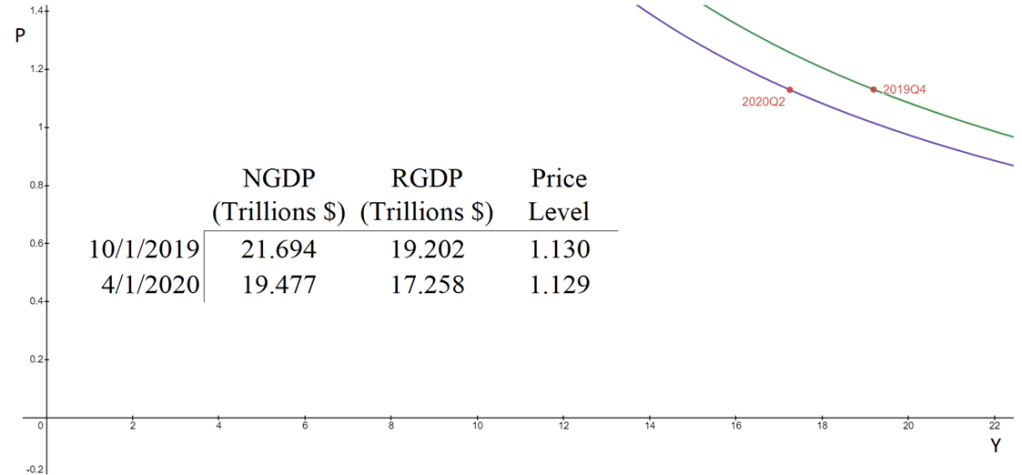
The aggregate supply & aggregate demand model (AS-AD) is nice because it’s flexible and clear. Often professors will teach it in levels. That is, they teach it with the level of output on one axis, and the price level on the other axis. This presentation is convenient for the equation of exchange, which can be arranged to reflect that aggregate demand (AD) is a hyperbola in (Y, P) space. Graphed below is the AD curve in 2019Q4 and in 2020Q2 using real GDP, NGDP, and the GDP price deflator.

The textbook that I use for Principles of Macroeconomics, instead places inflation (π) on the vertical axis while keeping the level of output on the horizontal axis. The authors motivate the downward slope by asserting that there is a policy reaction function for the Federal Reserve. When people observe high rates of inflation, state the authors, they know that the Fed will increase interest rates and reduce output. Personally, I find this reasoning to be inadequate because it makes a fundamental feature of the AS-AD model – downward sloping demand – contingent on policy context.

At the same time, I do think that it can be useful to put inflation on the vertical axis. Afterall, individuals are forward looking. We expect positive inflation because that’s what has happened previously, and we tend to be correct. So, I tell my students that “for our purposes”, placing inflation on the vertical axis is fine. I tell them that, when they take intermediate macro, they’ll want to express both axes as rates of change. I usually say this, and then go about my business of teaching principles.

But, what does it look like when we do graph in percent-change space?

Continue reading

In Praise of the FRED Excel Add-in

Sometimes, large entities have enough money to throw at a problem that by sheer magnitude they produce something great (albeit at too high a cost). The iPhone app from the FRED is not that thing. But the Excel add-in is something that every macroeconomics professor should consider adding to their toolkit.

Personally, I include links to FRED content in the lecture notes that I provide to students. But FRED makes it easy to do so much more. They now have an add-in that makes accessing data *much* faster. With it, professors can demonstrate in excel their transformations that students can easily replicate. The advantage is that students can learn to access and transform their own data rather than relying on links that I provide them.

The tool is easy enough to find – FRED wants you to use it. After that, the installation is largely automatic.

Installed in excel you will see the below new ribbon option. It’s very user friendly.

Continue reading

Covid Evidence: Supply Vs Demand Shock

By the time most students exit undergrad, they get acquainted with the Aggregate Supply – Aggregate Demand model. I think that this model is so important that my Principles of Macro class spends twice the amount of time on it as on any other topic. The model is nice because it uses the familiar tools of Supply & Demand and throws a macro twist on them. Below is a graph of the short-run AS-AD model.

Quick primer: The AD curve increases to the right and decreases to the left. The Federal Reserve and Federal government can both affect AD by increasing or decreasing total spending in the economy. Economists differ on the circumstances in which one authority is more relevant than another.

The AS curve reflects inflation expectations, short-run productivity (intercept), and nominal rigidity (slope). If inflation expectations rise, then the AS curve shifts up vertically. If there is transitory decline in productivity, then it shifts up vertically and left horizontally.

Nominal rigidity refers to the total spending elasticity of the quantity produced. In laymen’s terms, nominal rigidity describes how production changes when there is a short-run increase in total spending. The figure above displays 3 possible SR-AS’s. AS0 reflects that firms will simply produce more when there is greater spending and they will not raise their prices. AS2 reflects that producers mostly raise prices and increase output only somewhat. AS1 is an intermediate case. One of the things that determines nominal rigidity is how accurate the inflation expectations are. The more accurate the inflation expectations, the more vertical the SR-AS curve appears.*

The AS-AD model has many of the typical S&D features. The initial equilibrium is the intersection between the original AS and AD curves. There is a price and quantity implication when one of the curves move. An increase in AD results in some combination of higher prices and greater output – depending on nominal rigidities. An increase in the SR-AS curve results in some combination of lower prices and higher output – depending on the slope of aggregate demand.

Of course, the real world is complicated – sometimes multiple shocks occur and multiple curves move simultaneously. If that is the case, then we can simply say which curve ‘moved more’. We should also expect that the long-run productive capacity of the economy increased over the past two years, say due to technological improvements, such that the new equilibrium output is several percentage points to the right. We can’t observe the AD and AS curves directly, but we can observe their results.

The big questions are:

  1. What happened during and after the 2020 recession?
  2. Was there more than one shock?
  3. When did any shocks occur?

Below is a graph of real consumption and consumption prices as a percent of the business cycle peak in February prior to the recession (See this post that I did last week exploring the real side only). What can we tell from this figure?

Continue reading

Teaching Price Controls (Poorly)

Economics textbooks differ in their treatment of price controls. None of them does a great job, in my opinion. The reason is mostly due to the purpose of textbooks. Despite what you might suspect, most undergraduate textbooks are not used primarily to give students an understanding of the world. They are often used as a bound list of things to know and to create easy test questions. If a textbook has to change the assumptions of a model too much from what the balance of the chapter assumes, then the book fails to make clear what students are supposed to know for the test.

I think that this is the most charitable reason for books’ poor treatment of price controls – even graduate level books. The less charitable reasons include sloppy exposition due to author ignorance or an over-reliance on math. I honestly would have trouble believing these less charitable reasons.

I picked up 5 microeconomics text books and the below graph is typical of how they treat a price ceiling.

The books say that the price ceiling is perfectly enforced. They identify producer surplus (PS) as area C and consumer surplus (CS) as areas A & B. There are very good reasons to differ with these welfare conclusions.

Problem #1

Continue reading

What we pay for the thing that some workers do that most people do not

In middle school, I broke my leg in a soccer tournament game. I needed to go to the hospital and get extra support for the next month. Some of the workers who helped me were not highly paid, but my value of their services was very high.

Why bring this up? There has been conversation about the label “low skill” work this week. Brian Albrecht summarized the debate. Brian tangentially mentioned the “diamond-water paradox,” but I think it is worth talking more about that. Economists have a few models and stories that change the way you think about the world.

When I teach Labor Economics, we read an excerpt from Average is Over and then I explain the diamond-water paradox in class. I ask the students why diamonds cost more than water, even though water is more important. The answer can help us understand how wages get set for human workers (I say “human” because by that time we are deep in the topic of robot workers as substitutes).

I tell my students that some of the low-pay work performed by humans is extremely important. I’m still looking for the perfect illustration here. The one I use goes something like this, which is related to my broken leg anecdote… imagine if you tripped on train tracks and couldn’t get yourself out of the way of an oncoming train. How much would you pay a human to haul you to safety? Almost any human could perform the task. That service would be as valuable as a glass of water if you are about to die from thirst, which is to say that your value for it is almost infinite.

The key to understanding the market price of cleaners as opposed to the high wages for repairing Facebook code is marginal thinking. There is a lot of water, so the next glass is going to be cheap.

In writing Average is Over, Tyler Cowen is trying to understand why wages for the-less-highly-paid-skills have stagnated recently, while wages for the-highly-paid-skills are increasing along with GDP. He brings computers and technology into the conversation, as one culprit for recent changes. There is a limited supply of humans who can show up to a tech job and contribute reliably. “Programmers” are not the only highly paid class of workers, but it’s easy to see that the supply of people who are proficient with Python is limited.

I see two opposing forces in the tech world, which I have been following for a few years. First, we have boot camps, code clubs and all kinds of resources to both equip and encourage people to go into tech. I volunteer to advise a club that provides resources for female college students taking a technical route. On the other hand, lots of people who do get a foot into the door of a tech company become upset and quit.

Here is a quitter (a twitter quitter?):

You can read about this specific situation at this woman’s website. It seems like she made the right choice for herself. She is actually on a mission to change tech for women. I’ll reproduce the text here, in case someone can’t see the tweet: “first day at my new job! i am now a ceramicist because it lets me have no commute, make my own hours, decide the value of my work, and bring people joy. make no mistake, i wanted to code, but tech fulfilled none of that. so i hand off the baton. please fix tech while i make pots!”

The point is that she is one of many people who have dropped out of the tech workforce. Those employees who remain are pushed up toward the “diamond market price” and away from the “water market price”. Here is a blog about “burnout” survey data from 2018.

Populations in rich countries are not growing and labor force participation is down. Could the market wage for lower-skill-requirement jobs in the US rise dramatically in the next century, or at least keep pace with the wage increases that were recently enjoyed by those-with-the-capabilities-that-are-highly-valued? Marginal utility still apply, but prices will change if supply shifts.

See my old blog about Andrew Weaver who is researching skills that are in demand.

PSNE: No More, No Less

Today marks the 27th anniversary of John Nash winning The Sveriges Riksbank Prize in Economic Sciences in Memory of Alfred Nobel for his contributions to game theory.

Opinions on game theory differ. To most of the public, it’s probably behind a shroud of mystery. To another set of the specialists, it is a natural offshoot of economics. And, finally a 3rd non-exclusive set find it silly and largely useless for real-world applications.

Regardless of the camp to which you claim membership, the Pure Strategy Nash Equilibrium (PSNE) is often misunderstood by students. In short, the PSNE is the set of all player strategy combinations that would cause no player to want to engage in a different strategy. In lay terms, it’s the list of possible choices people can make and find no benefit to changing their mind.

In class, I emphasize to my students that a Nash Equilibrium assumes that a player can control only their own actions and not those of the other players. It takes the opposing player strategies as ‘given’.

This seems simple enough. But students often implicitly suppose that a PSNE does more legwork than it can do. Below is an example of an extensive form game that illustrates a common point of student confusion. There are 2 players who play sequentially. The meaning of the letters is unimportant. If it helps, imagine that you’re playing Mortal Kombat and that Player 1 can jump or crouch. Depending on which he chooses, Player 2 will choose uppercut, block, approach, or distance. Each of the numbers that are listed at the bottom reflect the payoffs for each player that occur with each strategy combination.

Again, a PSNE is any combination of player strategies from which no player wants to deviate, given the strategies of the other players.

Students will often proceed with the following logic:

  1. Player 2 would choose B over U because 3>2.
  2. Player 2 would choose A over D because 4>1.
  3. Player 1 is faced with earning 4 if he chooses J and 3 if he chooses C. So, the PSNE is that player 1 would choose J.
  4. Therefore, the PSNE set of strategies is (J,B).

While students are entirely reasonable in their thinking, what they are doing is not finding a PSNE. First of all, (J,B) doesn’t include all of the possible strategies – it omits the entire right side of the game. How can Player 1 know whether he should change his mind if he doesn’t know what Player 2 is doing? Bottom line: A PSNE requires that *all* strategy combinations are listed.

The mistaken student says ‘Fine’ and writes that the PSNE strategies are (J, BA) and that the payoff is (4,3)*.  And it is true that they have found a PSNE. When asked why, they’ll often reiterate their logic that I enumerate above. But, their answer is woefully incomplete. In the logic above, they only identify what Player 2 would choose on the right side of the tree when Player 1 chose C. They entirely neglected whether Player 2 would be willing to choose A or D when Player 1 chooses J. Yes, it is true that neither Player 1 nor Player 2 wants to deviate from (J, BA). But it is also true that neither player wants to deviate from (J, BD). In either case the payoff is (4, 3).

This is where students get upset. “Why would Player 2 be willing to choose D?! That’s irrational. They’d never do that!” But the student is mistaken. Player 2 is willing to choose D – just not when Player 1 chooses C. In other words, Player 2 is indifferent to A or D so long as Player 1 chooses J. In order for each player to decide whether they’d want to deviate strategies given what the other player is doing, we need to identify what the other player is doing! The bottom line: A PSNE requires that neither player wants to deviate given what the other player is doing –  Not what the other player would do if one did choose to deviate.

What about when Player 1 chooses C? Then, Player 2 would choose A because 4 is a better payoff than 1. Player 2 doesn’t care whether he chooses U or B because (C, UA) and (C, BA) both provide him the same payoff of 4. We might be tempted to believe that both are PSNE. But they’re not! It’s correct that Player 2 wouldn’t deviate from (C, BA) to become better off. But we must also consider Player 1. Given (C, UA), Player 1 won’t switch to J because his payoff would be 1 rather than 3.  Given (C, BA), Player 1 would absolutely deviate from C to J in order to earn 4 rather than 3. So, (C, UA) is a PSNE and (C, BA) is not. The bottom line: Both players must have no incentive to deviate strategies in a PSNE.

There are reasons that game theory as a discipline developed beyond the idea of Nash Equilibria and Pure Strategy Nash Equilibria. Simple PSNE identify possible equilibria, but don’t narrow it down from there. PSNE are strong in that they identify the possible equilibria and firmly exclude several other possible strategy combinations and outcomes. But PSNE are weak insofar as they identify equilibria that may not be particularly likely or believable. With PSNE alone, we are left with an uneasy feeling that we are identifying too many possible strategies that we don’t quite think are relevant to real life.

These features motivated the later development of Subgame Perfect Nash Equilibria (SGPNE). Students have a good intuition that something feels not quite right about PSNE. Students anticipate SGPNE as a concept that they think is better at predicting reality. But, in so doing, they try to mistakenly attribute too much to PSNE. They want it to tell them which strategies the players would choose. They’re frustrated that it only tells them when players won’t change their mind.

Regardless of whether you get frustrated by game theory, be sure to have a drink and make toast to John Nash.

*Below is the normal form for anyone who is interested.

Gen Z on The Great Resignation

Even though a housing price crash is often reported on as a crisis, it benefits first time homebuyers. Do the college seniors in 2021, likewise, see this “labor shortage” as a wonderful opportunity and stroke of luck for them personally? They overwhelmingly think of themselves as sellers of labor, not employers.*

Sometimes Samford students write for EWED if I felt like there was something that I and readers could learn from their perspective. This is accounting major Rachel Brinkley:

As a 21-year-old senior in college, the workforce is a confusing place. On the one hand, “The Great Resignation” is creating millions of jobs across America. It is a very encouraging time to be graduating college, as it appears that most of my peers and I will have no issues finding employment. Employers are currently struggling to compete in terms of compensation and benefits offered. I am majoring in accounting, and everyone that I have spoken to in my major has had at least one compensation increase since accepting their position. None of us have worked even one day on the job. This competition between employers creates favorable bargaining power for those entering the workforce, while putting a strain on employers.

While I may have confidence in my employment status after graduation, I will be starting at an entry level position for a firm that has a relatively structured promotional process. Like most large accounting firms, the promotions within the firm are based on the number of years spent working at the firm. There may be a few exceptions to the standard promotional pace, but I am not very optimistic about climbing the corporate ladder any faster than I would under more typical economic conditions. This is due, in part, to the fact that the best jobs are hard to come by. At a large accounting firm, the structured promotional process limits the number of the most sought-after jobs.

This circumstance leads me to ask how it is possible to obtain a top job when competition for those positions seems to be increasing. We read “Deep Work” for class, and I think about the author’s advice. We will need to continue learning new skills to make it into top positions.

Are my students running through the halls celebrating the current state of the labor market? Maybe they should be, but they are not, especially if their focus is on what Rachel called “top jobs”. Some jobs, almost by definition, are limited because they are top-of-the-pyramid or “tournament” positions.

My current Fall students pointed out that they feel better than the last two batches of students graduating into a closed-down Covid world. Many of our previous students got hired virtually and I don’t know at what point if at all they have had in-person interactions with work colleagues.

*The truth is more complex in a large diverse economy. Even though I don’t think of myself as en employer, I am concerned that there will be no one to operate my upcoming flight to a conference. The airline I rely on has had to cancel hundereds of flights in the past week over labor issues.

Clemens and Strain on Large and Small Minimum Wage Changes

In my Labor Economics class, I do a lecture on empirical work and the minimum wage, starting with Card & Kreuger (1993). I’m going to quickly tack on the new working paper by Clemens & Strain “The Heterogeneous Effects of Large and Small Minimum Wage Changes: Evidence over the Short and Medium Run Using a Pre-Analysis Plan”.

The results, as summarized in the second half of their abstract are:

relatively large minimum wage increases reduced employment rates among low-skilled individuals by just over 2.5 percentage points. Our estimates of the effects of relatively small minimum wage increases vary across data sets and specifications but are, on average, both economically and statistically indistinguishable from zero. We estimate that medium-run effects exceed short-run effects and that the elasticity of employment with respect to the minimum wage is substantially more negative for large minimum wage increases than for small increases.

The variation in the data comes from choices by states to raise the minimum wage.

A number of states legislated and began to enact minimum wage changes that varied substantially in their magnitude. … The past decade thus provided a suitable opportunity to study the medium-run effects of both moderate minimum wage changes and historically large minimum wage changes.

We divide states into four groups designed to track several plausibly relevant differences in their minimum wage regimes. The first group consists of states that enacted no minimum wage changes between January 2013 and the later years of our sample. The second group consists of states that enacted minimum wage changes due to prior legislation that calls for indexing the minimum wage for inflation. The third and fourth groups consist of states that have enacted minimum wage changes through relatively recent legislation. We divide the latter set of states into two groups based on the size of their minimum wage changes and based on how early in our sample they passed the underlying legislation.

The “large” increase group includes states that enacted considerable change. New York and California “have legislated pathways to a $15 minimum wage, the full increase to which firms are responding exceed 60 log points in total.” Data comes from the American Community Survey (ACS) and the Current Population Survey (CPS).

Continue reading