Eat 20 Potatoes a Day…. For Science

Several people have tried eating an all-potato diet for a few weeks and reported losing lots of weight with little hunger or effort. Could this be the best diet out there? Or are we only hearing from the rare success stories, while all the people who tried it and failed stay quiet?

Right now we don’t really know, but the people behind the Slime Mold Time Mold blog are trying to find out:

Tl;dr, we’re looking for people to volunteer to eat nothing but potatoes (and a small amount of oil & seasoning) for at least four weeks, and to share their data so we can do an analysis. You can sign up below.

I was surprised to see that they are the ones running this, since they are best known for the “Chemical Hunger” series arguing that the obesity epidemic is largely driven by environmental contaminants like Lithium. The conclusion of that series noted:

Bestselling nutrition books usually have this part where they tell you what you should do differently to lose weight and stay lean. Many of you are probably looking forward to us making a recommendation like this. We hate to buck the trend, but we don’t think there’s much you can do to keep from becoming obese, and not much you can do to drop pounds if you’re already overweight. 

We gotta emphasize just how pervasive the obesity epidemic really is. Some people do lose lots of weight on occasion, it’s true, but in pretty much every group of people everywhere in the world, obesity rates just go up, up, up. We’ll return to our favorite quote from The Lancet

“Unlike other major causes of preventable death and disability, such as tobacco use, injuries, and infectious diseases, there are no exemplar populations in which the obesity epidemic has been reversed by public health measures.”

That said, they did still offer some advice based on the contaminant theory that is consistent with the potato diet:

1. — The first thing you should consider is eating more whole foods and/or avoiding highly processed foods. This is pretty standard health advice — we think it’s relevant because it seems pretty clear that food products tend to pick up more contaminants with every step of transportation, packaging, and processing, so eating local, unpackaged, and unprocessed foods should reduce your exposure to most contaminants. 

2. — The second thing you can do is try to eat fewer animal products. Vegetarians and vegans do seem to be slightly leaner than average, but the real reason we recommend this is that we expect many contaminants will bioaccumulate, and so it’s likely that whatever the contaminant, animal products will generally contain more than plants will. So this may not help, but it’s a good bet. 

Overall though I think the idea here is to ignore grand theories and take an empirical approach. The potato diet works surprisingly well anecdotally, so lets just see if it can work on a larger scale. Seems worth a try; I’m sure plenty of my ancestors in Ireland and Northern Maine did 4-week mostly-potato diets and lived to tell about it. You can read more and/or sign up here. Let us know how it goes if you actually try it!

What if You Didn’t Have to File a Tax Return?

Now that we’ve all made it through the 2021 tax filing season, it’s worth thinking about a recurring question in tax policy: is it possible that most of us wouldn’t need to go through this annual ritual? Couldn’t the government just tell us how much we owe (or are due as a refund), or better yet, just deduct the correct amount from our paycheck so we’d have paid the right amount?

We need to imagine such a system: it exists in many developed nations around the world! And it’s true that, at least for many taxpayers, the IRS already has all the information on you it needs to calculate your taxes.

But how many US taxpayers would this be beneficial for? A new working paper which tries to quantify this question. In “Automatic Tax Filing: Simulating a Pre-Populated Form 1040,” the authors use a large sample of tax returns to estimate how many taxpayers a pre-filled return would work for. The results are almost split down the middle: it would work well for maybe half of US taxpayers (41-48% of taxpayers, depending on how we are defining successful). For the other half, it wouldn’t give you an accurate estimate of how much tax you owed.

And the errors can be large. For example, the authors report that “two-thirds of the cases where the lower bound approach is inaccurate, the pre-populated liability is higher than the reported liability, with a median gap of $4,200.” Note: looking at the tables, I think they mean to say “mean,” not “median” here, with the median being $1,400. Still, that’s a lot of errors in a direction that would hurt taxpayers if they didn’t fill it out on their own or pay someone to do it. And it’s not just one thing that’s causing pre-filled returns to be wrong. You might think itemized deductions are a big issue, and they are, but only for about 11% of returns (and in only 4% of returns is this the only issue). They find that 9% of returns didn’t even have the reported wages matching what the IRS showed!

Does this mean that pre-filled returns are doomed in the US? Perhaps not! They seem to work much better for younger, single filers, and as well as filers with very low income, as Figure 1 from the paper shows. Even so, the 60-80% success rate (depending on criteria) for very low income taxpayers isn’t especially encouraging. But one upshot of a pre-filled return is that there are possibly millions of taxpayers (maybe 8 or 12 million?) that don’t file a return because they aren’t legally required to (too low income), but they would benefit if they did because of refundable credits like the EITC and Child Tax Credit.

Maybe there is a compromise position. The IRS could send you a “suggested tax return,” but allow you to modify it. I suspect that, in most cases, those who are currently paying for a person or software to do their taxes would still do it. You can’t know if you are in the one-half of taxpayers where this information is accurate! The IRS could provide a list of “common reasons why you may be in the half of pre-filled tax returns that are wrong,” but we’re still shifting the burden back to the taxpayer.

I would like to suggest, instead, that there are a few changes we could make to our tax system (“simplifications,” if you will) that might make pre-filled returns much more viable.

Continue reading

AS-AD: From Levels to Percent

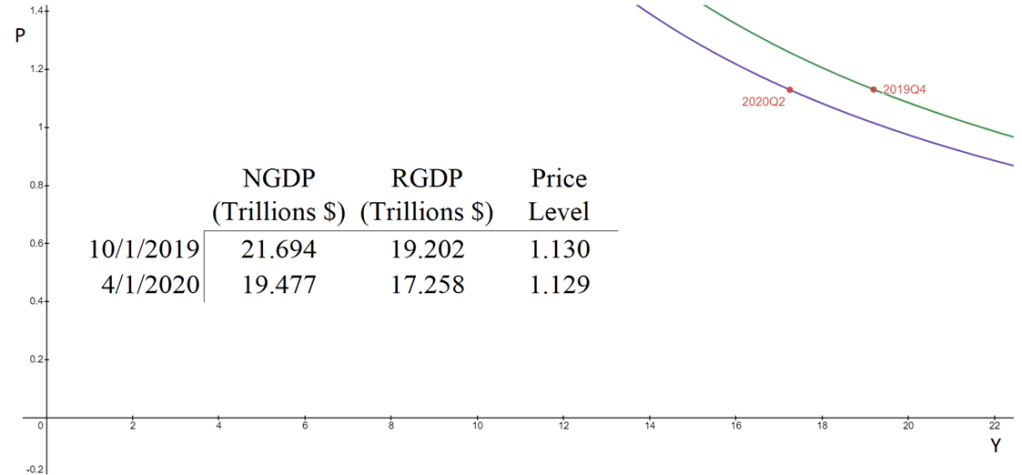
The aggregate supply & aggregate demand model (AS-AD) is nice because it’s flexible and clear. Often professors will teach it in levels. That is, they teach it with the level of output on one axis, and the price level on the other axis. This presentation is convenient for the equation of exchange, which can be arranged to reflect that aggregate demand (AD) is a hyperbola in (Y, P) space. Graphed below is the AD curve in 2019Q4 and in 2020Q2 using real GDP, NGDP, and the GDP price deflator.

The textbook that I use for Principles of Macroeconomics, instead places inflation (π) on the vertical axis while keeping the level of output on the horizontal axis. The authors motivate the downward slope by asserting that there is a policy reaction function for the Federal Reserve. When people observe high rates of inflation, state the authors, they know that the Fed will increase interest rates and reduce output. Personally, I find this reasoning to be inadequate because it makes a fundamental feature of the AS-AD model – downward sloping demand – contingent on policy context.

At the same time, I do think that it can be useful to put inflation on the vertical axis. Afterall, individuals are forward looking. We expect positive inflation because that’s what has happened previously, and we tend to be correct. So, I tell my students that “for our purposes”, placing inflation on the vertical axis is fine. I tell them that, when they take intermediate macro, they’ll want to express both axes as rates of change. I usually say this, and then go about my business of teaching principles.

But, what does it look like when we do graph in percent-change space?

Continue reading

Inflation and GDP Growth Around the World

Kalshi cofounder Tarek Mansour recently shared this graph:

In hindsight it seems like an obvious graph to make, and a good way to teach Aggregate Supply / Aggregate Demand models, but I don’t actually recall seeing much like this. One obvious improvement is to include more countries. I do so below using data from Trading Economics, showing all 182 countries that have recent data on both annual GDP growth and inflation. I also flip the axes to be more consistent with the convention in economics:

This makes clear both the costs and benefits of including all countries. We see just how extreme some outliers are: hyperinflation in Venezuela, Sudan, Lebanon, and Syria; a severe contraction in Libya; and huge growth in Azerbaijan and the Maldives (errors in the data?). But all the more typical countries blend together. So here I zoom in on the more typical countries:

This makes clear the strong aversion to deflation that most countries have. Well over a hundred countries here, many with very low inflation, but only in South Sudan does inflation actually go negative. Real GDP growth does not exhibit the same sharp divide at zero, presumably because its much harder to central banks to fine-tune. Now I try to zoom and enhance one more time:

But things are starting to just get messy, so its time to drop more countries. Here I focus on the 30 largest economies (minus Turkey, which breaks the scale on inflation):

Here we see:

  • Japan is demonstrating stagnation/ low aggregate demand / “running cold”
  • Brazil, Stagflation (negative supply shocks?)
  • Poland, high aggregate demand / running hot
  • Saudi Arabia and Israel, high growth without high inflation (positive supply shocks?)

The US is on the higher end of inflation, and I still think we should be doing more about this, but in this graph we don’t look like a huge outlier. We’re all still working through Covid-related shocks. But the very latest quarterly data today (not reflected in these graphs) showed negative GDP growth in the US, sending us toward the “Stagflation” quadrant and making the Fed’s job much harder.

Are the COVID Vaccines Effective at Preventing Death?

A recent analysis by the Kaiser Family Foundation of CDC data suggests that about 234,000 COVID deaths in the US could have been prevented if everyone was vaccinated. That’s about 25% of all COVID deaths throughout the pandemic, and about 60% of COVID deaths since June 2021 (roughly the time when most older adults in most states had had a chance to be vaccinated).

The first way to think of that death rate is tragic, given that so many lives could have been saved. Rather than being the high-income nation with the highest COVID death rate, the US could have been more in line with countries like Italy, the UK, and France. The US actually had a lower COVID death rate than Italy and the UK when the vaccine roll-out began, and today we could be at about France’s level with better vaccination rates.

But there’s a flipside to the KFF numbers. If 60% of COVID deaths since June 2021 were preventable, that means 40% weren’t preventable. Furthermore, the same data show that about 40% of COVID deaths in January and February 2022 were fully vaccinated or had boosters. That sounds like the vaccines might not work very well! So what does this all mean? Let’s dig into the data from the CDC a little bit.

The first, and most important thing, to recognize is that most American adults are vaccinated (about 78%), so unless vaccines are 100% effective (and they aren’t, despite some public officials overenthusiastic pronouncements early in the vaccine rollout), there are still going to be a lot of COVID deaths among the vaccinated. If 100% of the population was vaccinated, 100% of the deaths would be among the vaccinated. The key question is whether vaccines lower the chance of death.

And they do. Let’s see why.

Continue reading

In Praise of the FRED Excel Add-in

Sometimes, large entities have enough money to throw at a problem that by sheer magnitude they produce something great (albeit at too high a cost). The iPhone app from the FRED is not that thing. But the Excel add-in is something that every macroeconomics professor should consider adding to their toolkit.

Personally, I include links to FRED content in the lecture notes that I provide to students. But FRED makes it easy to do so much more. They now have an add-in that makes accessing data *much* faster. With it, professors can demonstrate in excel their transformations that students can easily replicate. The advantage is that students can learn to access and transform their own data rather than relying on links that I provide them.

The tool is easy enough to find – FRED wants you to use it. After that, the installation is largely automatic.

Installed in excel you will see the below new ribbon option. It’s very user friendly.

Continue reading

Fed Dot Plot vs Markets

After their last meeting in March, the Federal Open Market Committee released the summary of economic projections. Most of the variables they project are inherently difficult to predict: GDP, unemployment, inflation. But their forecasts of the Federal Funds rate should be pretty good, since they’re the ones that get to pick what it will be. The median FOMC member thinks the the Federal Funds rate will be just under 2% by the end of 2022.

I said in my last post that the Fed is under-reacting to inflation. Markets seem to agree, but they also think that the Fed will change. Kalshi runs prediction markets on what the Fed Funds rate will be, which they recently started to summarize using this nice curve:

So traders think that the Fed will raise rates faster than the Fed thinks they will, with rates getting to 2.5% by year end. Traders at the Chicago Mercantile Exchange see an even bigger change, with rates at 2.75% by year end, and 3.5% by July 2023 (the longest-term market they offer).

I lean toward the markets on this one; if they are wrong there is plenty of money to be made by betting so.

How to Get People Vaccinated for 93 Cents

We’ve talked a lot about vaccines on this blog, including both the benefits of vaccines and how to get people vaccinated. For example, last month I posted about Robert Barro’s estimate on the number of additional vaccines needed to save 1 life. Barro put it at about 250 vaccines. Using some reasonable assumptions, I further suggested that each person vaccinated has a social value of about $20,000. That’s a lot!

But how do we convince people to get vaccinated? Lotteries? Pay them? In addition to just paying them (the economist’s preferred method), another good old capitalist method is advertising (the marketer’s preferred method). And a new working paper tries just that, running pro-vaccine ads on YouTube with a very specific spokesman: Donald Trump.

Running ads on YouTube is pretty cheap. For $100,000, the researchers were able to reach 6 million unique users. And because they randomized who saw the ads across counties, they are able to make a strong claim that any increase in vaccinations was caused by the ads. They argue that this ad campaign led to about 104,000 more people getting vaccinated, or less than $1 per person (the actual budget was $96,000, which is how they get 93 cents per vaccine — other specifications suggest 99 cents or $1.01, but all of their estimates are around a buck).

Considering, again, my rough estimate that each additional vaccinated person is worth $20,000 to society (in terms of lives saved), this is a massive return on investment. Of course, we know that everything runs into diminishing returns at some point (they also targeted areas that lagged in vaccine uptake). Would spending $1,000,000 on YouTube ads featuring Trump lead to 1 million additional people getting vaccinated? Probably not quite. But it might lead to a half million. And a half million more vaccinated people could potentially save 2,000 lives (using Barro’s estimate).

I dare you to find a cheaper way to save 2,000 lives.

John List, Dramatist

As someone who has dabbled in lab experiments for over a decade, I’m familiar with complaints about external validity. If an experiment is run with only college students, then how can we know if the finding will generalize to other populations? It’s a question worth asking, but many questions are worth asking and it doesn’t mean that controlled experimentation can’t add value to the economics literature. In the age of general suspicion of small studies, people say that replications are needed. We should only trust a conclusion that is supported by multiple studies. The thing about replications is that the process has to start somewhere. Empirical work has to get read and published. Replications are composed of individual studies.

I just met John List at the Alabama stop on his epic national book tour. He directed me to his work of art: Ungated Link. He wrote a play in response to the attacks on his work concerning external validity. He employs a rhetorical strategy of making your critics look obtuse. Even though the play is absolutely silly (thoroughly entertaining), he builds a strong defense for doing experiments. It is literally presented as the arguments of a defense lawyer. Before the trial begins, a “reporter” summarizes the conflict that has created the need for a formal trial:

Court Reporter Clifton Hillegass: Thank you Judge Learner. While it is never easy to convey succinctly the key points of a debate, this dispute has crystallized in a manner that leaves no middle ground. The prosecution, led by Mr. Naiv Ete, argues that all empirical work in economics must pass a set of necessary external validity conditions before being published in academic journals or used by policymakers. To date, in this courtroom no empirical work has passed his conditions, effectively rendering the question of generalizability beyond dispute, or as Livius Andronicus reminded us, Non est Disputandum de Generalizability. Ms. Minerva, Lead Defense, has argued that this line of reasoning leaves only theoretical exercises and thought experiments to advance science and guide policymaking, an approach that she fears will return us to the dark ages.

The paper is called “NON EST DISPUTANDUM DE GENERALIZABILITY?” It’s a good refresher on the history of science, not just economics.

Maybe the first best is for you to spend your weekend reading dense technical papers. But if you aren’t feeling up to that, then this play will make you feel like you learned something without even trying.

I’ll link this up to some of the posts I wrote last year about experiments and critics:

Calling Behavioral Economics a Fad

Behavioral Economist at Work

Dressed for Recess(ion)

In my previous post, I decomposed consumer expenditures to figure out which service sectors experienced the largest supply-side disruptions due to Covid-19. I illustrated that transportation & recreation services were the only consumer service to experience substantial and persistent supply shocks. Health, food, and accommodation services also experienced supply shocks, but quickly rebounded. Housing, utility, and financial services experienced no supply disruptions whatsoever.

What about non-durables?

Total consumption spending is the largest category of spending in our economy and is composed of services, durable goods, and non-durables. Services are the largest portion and durable goods compose the smallest portion. So, while there were plenty of stories during the Covid-19 pandemic about months-long delivery times for durables, they did not constitute the typical experience for most consumption.

Even though it’s not the largest category, many people think of non-durables when they think of consumption. Below is the break-down of non-durable spending in 2019. The largest singular category of non-durable spending was for food and beverages, followed by pharmaceuticals & medical products, clothing & shoes, and gasoline and other energy goods. Clearly, the larger the proportion that each of these items composes of an individual household budget, the more significant the welfare implications of price changes.

Continue reading