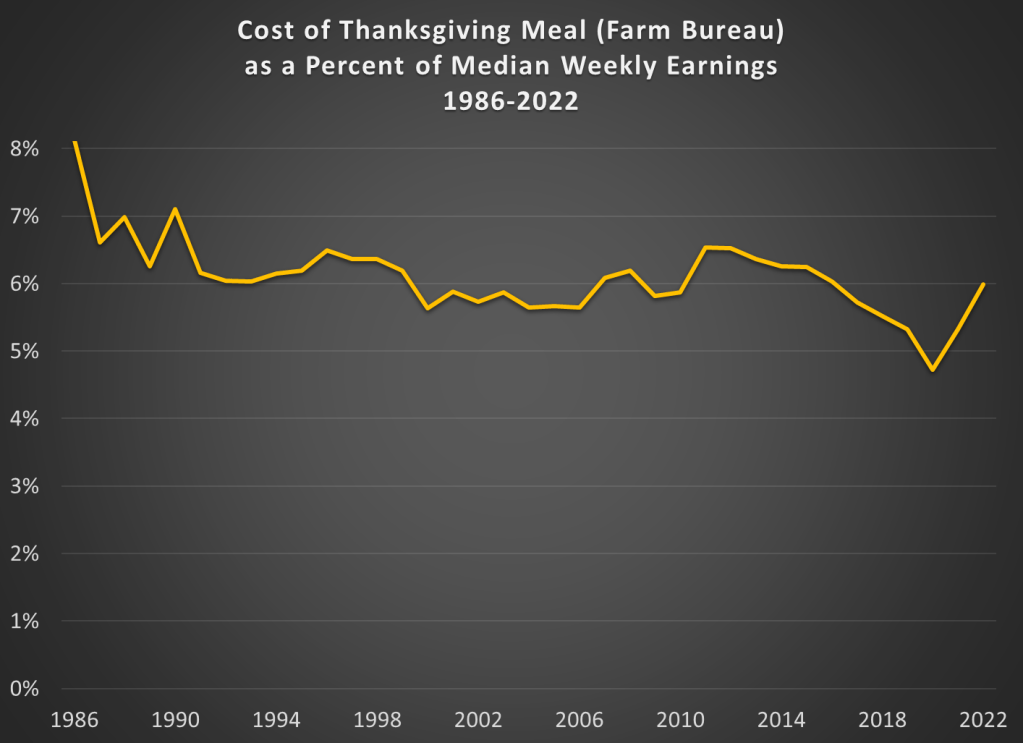
Last year inflation hadn’t quite hit the levels we would see in 2022, but they were already rising. When Thanksgiving rolled around, many media sources were reporting that it was the “most expensive Thanksgiving ever.” In nominal terms that was true, though in nominal terms it isn’t that surprising. In a post last year, I compared the prices of Thanksgiving dinners (using the same data from Farm Bureau) to median earnings going back to 1986. While 2021 was more expensive the 2020, it turned out it was still the second lowest it had been since 1986.
As you might expect, this year’s Thanksgiving dinner is even more expensive than last year in nominal terms. It’s up about 20% since last year or over $10 more, according to Farm Bureau. That’s certainly more than the overall rate of inflation (7.7% in the past 12 months) and more than inflation for groceries (12.4% in the past 12 months). But how does that compare with median wages? Comparing the 3rd quarter of this year with the same quarter in 2021, median wages are only up about 7%, certainly not enough to keep up with those rising turkey prices.
When we add 2022 to the historical chart, here’s what it looks like.
The spike in the last 2 years is clear in the chart but notice that at about 6% of median weekly earnings, we have essentially returned to the average level of the entire series. From 2017-2021, we could be thankful that the price of your Thanksgiving dinner had dropped below that 6% level. We’ll have to find something else to be thankful for this year.
One of my specializations in graduate school at George Mason University was monetary theory. It included two classes taught by Larry White who specializes in free-banking, Austrian macroeconomics, and monetary regimes. Separately, my dad was a libertarian and I’ve attended multiple Students for Liberty events. Right now, I’m writing from my hotel room at a Catholic/Crypto conference, where I learned that the deepest trench in Dante’s Inferno includes money debasers.
Everything about my pedigree suggests that I should have a disdain for the Federal Reserve and cast a wistful gaze toward the perpetually falling value of the US dollar. But I don’t. I certainly do have opinions about what the Fed should be doing and how our monetary system could work. But I’m not excited by the long-run depreciation of the dollar.
Let me tell you why.
Learning a little bit of theory is a dangerous thing. Monetary theory is especially hard because we examine the non-good side of the transaction: the medium of exchange. In frantic excitement, enthusiasts often point out that the value of the dollar has lost very much of its value in the past 100 years. They describe that loss by describing the lower quantity of something that a dollar can purchase now versus what it could have purchased historically. That information is incapsulated in the price of a good. The price of a good is the number of dollars that one must exchange in order to purchase the good. Similarly, the price of a dollar is the number of goods that one must give up in order to purchase the dollar.
We can consider a variety of goods. Below is a graph that describes the quantity price of the dollar where the quantities are CPI basket units, gold, and housing. In the 35 years following 1986, a single dollar purchases 60% less of the consumer basket, 74% fewer houses (not quality adjusted), and 76% less gold.
If you’re like me, then you are very fond of food. What determines the price of food? Supply and demand of course!
We can consider food as a commodity because just about anyone can buy and sell it. Almost all foods have partial substitutes. Therefore, the long-run price in the competitive market for food is largely dictated by the marginal cost. Demand has an impact on the price only in the short run.
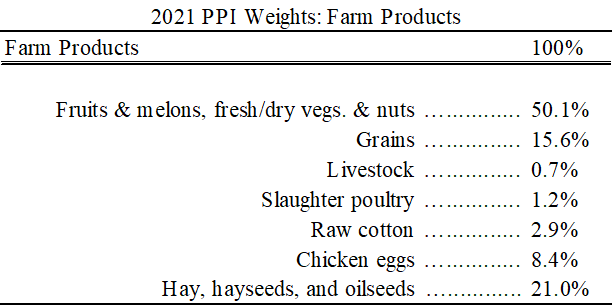
A long-run driver of food prices are the costs that food producers face. The US Bureau of Labor Statistics divides the Producer Price Index into multiple categories that are relevant for a variety of sectors and points within the production process. Below is a table of the most fundamental, relatively unprocessed farm products and their weight among all farm products in December 2021. Cotton is a relatively large component for farm products even though it’s not a food and I include it for completeness. Fruits, veggies, and nuts makeup the overwhelming proportion of the cost of farm products. I was at first surprised that grains composed such a small proportion. But, being dirt cheap, it makes sense.
We all know that inflation has been in the news. It’s been elevated since the second quarter of 2021. Consumer prices tend to lag producer prices. One indicator of where food prices will be in the near future is where the producer prices are now. Below is a graph that displays the above seasonally adjusted farm product prices since the start of 2021*.
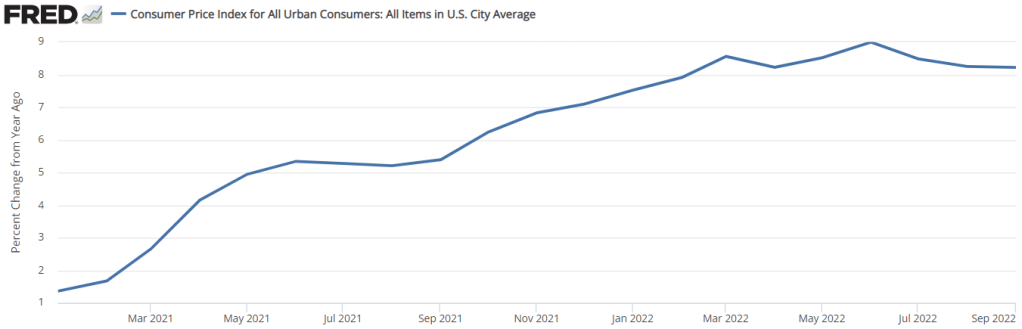
People were all excited last week when the CPI numbers were released because… the year-over-year rate of inflation did a whole lot of nothing. See below. The 12-month rate of inflation was practically constant. The 8.2% number was all over the headlines and twitter. We already know that news outlets don’t always report on the most relevant numbers. And I say that this is one of those times.
First of all, there is a problem with the year-over-year indicator. Well, not so much problem in the measure itself, but more a problem of interpretation. The problem is that the 12-month rate of inflation is the cumulative compound rate for 12 individual months. Each month that we update the 12-month inflation rate, we drop a month from the back of the 12-month window and we add a month to the front of the 12-month window. Below are both a graph and a table indicating the monthly rate of inflation and the 12-month periods ending in August 2022 (pink) and in September 2022 (green).
From the recent CPI inflation report, one of the biggest challenges for most households is the continuing increase in the price of food, especially “food at home” or what we usually call groceries. Prices of Groceries are up 13.5% in the past 12 months, an eye-popping number that we haven’t seen since briefly in 1979 was only clearly worse in 1973-74. Grocery prices are now over 20% greater than at the beginning of the pandemic in 2020. Any relief consumers feel at the pump from lower gas prices is being offset in other areas, notably grocery inflation.
The very steep recent increase in grocery prices is especially challenging for consumers because, not only are they basic necessities, if we look over the past 10 years we clearly see that consumer had gotten used to stable grocery prices.
The chart above shows the CPI component for groceries. Notice that from January 2015 to January 2020, there was no increase in grocery prices on average. Even going back to January 2012, the increase over the following 8 years was minimal. Keep in mind these nominal prices. I haven’t made any adjustment for wages or income! (If you know me, you know that’s coming next.) Almost a decade of flat grocery prices, and then boom!, double digit inflation.
But what if we compare grocery prices to wages? That trend becomes even more stark. I use the average wage for non-supervisory workers, as well as an annual grocery cost from the Consumer Expenditure Survey (for the middle quintile of income), to estimate how many hours a typical worker would need to work to purchase a family’s annual groceries. (I’ve truncated the y-axis to show more detail, not to trick you: it doesn’t start at zero.)
Since they were first introduced as part of the Dollar Menu in 1997, the McDouble and the McChicken have been my go-to choices when I visit Mcdonald’s. It was always hard to justify getting one of the fancier sandwiches like a Big Mac or Quarter Pounder, since they were 4-5x the cost of a McDouble but only about twice the size. This is part of why the McDouble has been called “the greatest food in human history“. But as we’ve seen with the plagues and wars of the 2020s, history doesn’t always progress in the direction you’d hope.
I hadn’t been to a McDonald’s for a while until last weekend, when I was shocked to see the McDouble and McChicken listed at $2.99. This wasn’t at an airport restaurant either, or even in an expensive big city; I stopped in Keene, New Hampshire on a drive home from Vermont. The price is up 200% from the days of the Dollar Menu! Meanwhile, the Big Mac has also got more expensive, but much less dramatically; it was $5.89, compared to the ~$5 I expect. So, 200% price increases at the bottom, vs 18% at the top.
This location may be a bit of an anomaly, but the big picture is clear; a typical McDouble now costs well over $2 in most of the US, while a typical Big Mac is still well under $6. You used to be able to get 4-5 McDoubles for the price of a Big Mac; now you typically get less than 3 and sometimes, as in Keene, less than 2.
What’s going on here? First, the McDouble was always absurdly cheap. Second, prices rise most quickly where demand is inelastic, and demand is less elastic for goods that are cheaper and goods that are more like “necessities” than “luxuries”.
This is why I think the McDouble is worth highlighting- its part of a more general trend of where inflation hits. I’ve noticed this in the grocery store as well; the price of standard ground beef is up much more than grass-fed organic beef, likewise with standard eggs vs free-range organic. How different would the Economist’s Big Mac Index look if it used the McDouble instead?
With falling inflation we may see the end of this necessity vs luxury price compression. But I doubt we’ll ever see the glory of the standard $1 McDouble again.
The New Hampshire McDonalds was disappointing, but Vermont was nice
Raising kids is expensive. As an economist, we’re used to thinking about cost very broadly, including the opportunity cost of your time. Indeed, a post I wrote a few weeks ago focused on the fact that parents are spending more time with their kids than in decades past. But I want to focus on one aspect of the cost, which is what most “normal” people mean by “cost”: the financial cost.
Conveniently, the USDA has periodically put out reports that estimate the cost of raising a child. Their headline measure is for a middle-income, married couple with two children. Unfortunately the last report was issued in 2017, for a child born in 2015. And in the past 2 years, we know that the inflation picture has changed dramatically, so those old estimates may not necessarily reflect reality anymore. In fact, researchers at the Brookings Institution recently tried to update that 2015 data with the higher inflation we’ve experienced since 2020. In short, they assumed that from 2021 forward inflation will average 4% per year for the next decade (USDA assumed just over 2%).
Doing so, of course, will raise the nominal cost of raising a child. And that’s what their report shows: in nominal terms, the cost of raising a child born in 2015 will now be $310,605 through age 17, rather than $284,594 as the original report estimated. The original report also has a lower figure: $233,610. That’s the cost of raising that child in 2015 inflation-adjusted dollars.
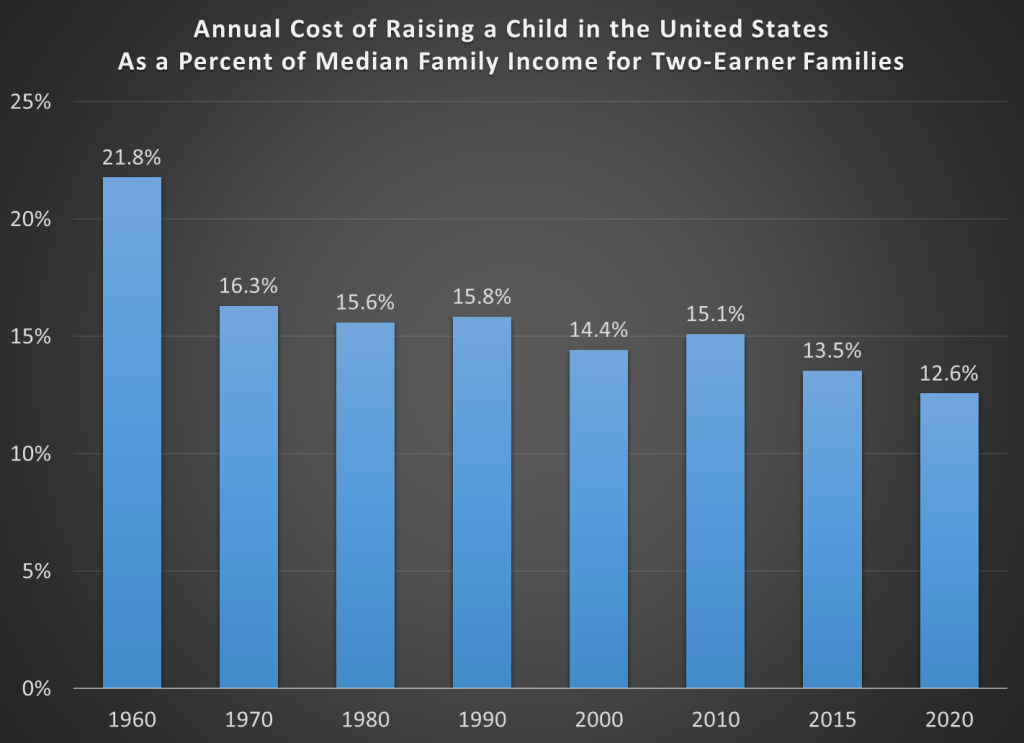
As I’ve written several times before on this blog, adjusting for inflation can be tricky. In fact, sometimes we don’t actually need to do it! To see if it is more or less expensive to raise a child than in the past, what we can do instead is compare to the cost to some measure of income. I will look at several measures of income and wages in this post, but let me start with the one I think is the best: median family income for a family with two earners. Why do I think this is best? Because the USDA and Brookings cost estimates are for married couples who are also paying for childcare. To me, this suggests a two-earner family is ideal (you may disagree, but please read on).
Here’s the data. Income figures come from Census. Child costs are from USDA reports in 1960-2015, and the Brookings update in 2020.
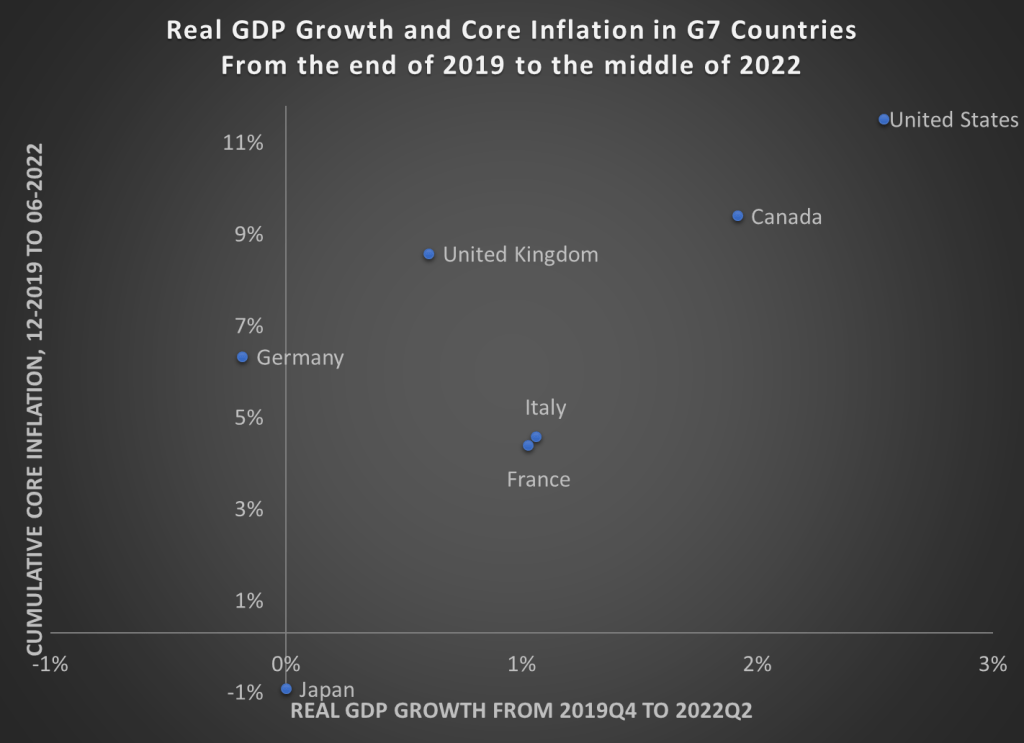
Back in April I wrote about GDP growth rates and inflation rates in G7 countries and the OECD broadly. James also wrote about a broader set of countries (182!) using these two measures. Since the economic scene is evolving so quickly, and we now have 6 more months of data, I wanted to provide an update on the US and our other large peer nations.
Here’s the data, showing cumulative real GDP growth and cumulative core inflation since the right before the pandemic (please note that I flipped the x- and y-axis from the previous post — sorry for the confusion, but this way makes more sense).
The picture looks roughly the same, but here are a few notable changes:
Despite the slight slowdown in GDP growth in the first half of 2022, the US still clearly has the highest rate of economic growth
UK, Italy, and Canada have now moved into positive territory for cumulative economic growth (yes, it’s all inflation adjusted)
But Japan and Germany still have had no net economic growth during the pandemic — and even worse for Germany, they have had a healthy dose of inflation too
The US once again stands out as having both the best economic performance and the worst inflation performance in the G7. Are these two things connected? That’s a question that is unanswerable from a simple scatterplot, and may be unanswerable completely. But I think it’s fair to say that the US hasn’t taken an obviously inferior economic path relative to other countries, even if our path has been inferior compared to some ideal policy. But don’t commit the Nirvana Fallacy!
Finally, we should recognize that the GDP is not the only important measure of how an economic is performing. For example, the US labor market has not recovered as well as some other peer nations have. Still, GDP is one of the important broad measures to look at, even if it is not ideal for diagnosing recessions.
You can download my full paper “If Wages Fell During a Recession” with Dan Houser from the Journal of Economic Behavior and Organization (only free until September 24, 2022).
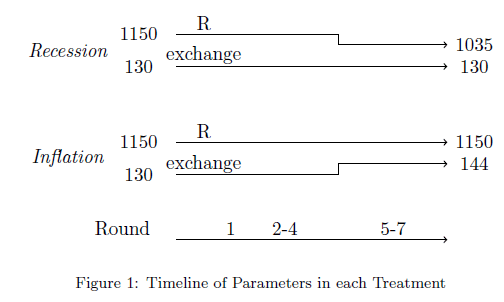
There is a simulated recession in our experiment. We ask what happens if employers cut wages in response. Although nominal wage cuts are rare in the outside world, some of our lab subjects cut the wages of their “employee”. Employees retaliated against nominal wage cuts by shirking, such that the employers probably would have been better off keeping wages rigid.
We also tried the same thing with an inflation shock that allowed the employer to institute a real wage cut without a nominal wage cut. The reaction to that real wage cut was muted compared to the retaliation against the obvious nominal wage cut.
Inflation was implemented after 3 rounds of the same wage to create a reference point.
The Great Recession happened when I was an undergraduate. As I started my career in research, the issue of employment and recessions seemed like THE problem to work on. The economy of 2022 is so different from the years that inspired this experiment! Below I’ll highlight current events and work from others on this topic.
Inflation used to be something Americans could almost ignore, and now it’s at the highest level I have seen in my lifetime. Suddenly, people are so mad about inflation that politicians named their bill the Inflation Reduction Act just to make it popular.
The EWED crew has made lots of good posts on inflation. Although job openings and (nominal) wage increases are noticeable right now, Jeremy explored whether inflation has wiped out apparent wage growth.
More recently, the WSJ reports that real wages are down because inflation is so high. “Wage gains haven’t kept pace with inflation. Private-sector wages and salaries declined 3.1% in the second quarter from a year earlier, when accounting for inflation.”
Firms in 2022 did not just sit back and let real wages get eroded exactly proportional to inflation. But it is also not the case that Americans got a raise of 9% to exactly offset inflation. According to our experiment, there would be outrage if workers were experiencing a nominal wage cut in proportion to the real wage cut they are getting right now.
The high inflation combined with a hot job market makes this current economy hard to compare to anything in our recent history. Brian at Price Theory explained that inflation pressure is coming from both supply and demand factors.
US GDP fell for the second straight quarter according to statistics released this week by the Bureau of Economic Analysis. This means that by one common definition we’re now in a recession, which has ignited a debate about whether “two consecutive quarters of negative GDP growth” is the best definition (as opposed to ‘when the NBER says there’s one’, like I generally teach and Jeremy argued for here, or something else).
Naturally this debate has political overtones, since the party in power would be blamed for a recession, so we’ve seen the White House CEA argue that we’re not in a recession, many on the other side argue that we are, and plentiful hypocrisy from people who should know better.
But in political terms, the fight over the binary “are we in a recession” call won’t be the big economic factor in November’s elections- that will be inflation and GDP, especially 3rd quarter GDP. One of the oldest and best predictors of US elections is the Fair Model, which uses inflation and the number of recent “strong growth quarters”. Fair’s update following the recent Q2 GDP announcement states:
the predicted vote share for the Democrats is 46.70, which compares to 48.99 in October. The smaller predicted vote share for the Democrats is due to two fewer strong growth quarters and slightly higher inflation
By Election Day we’ll have 3 more months of economic data making it clear whether inflation is getting under control and whether economic activity is picking back up or continuing to decline. Monthly data releases on inflation and unemployment will be closely watched, but the most discussed release will likely be third quarter GDP. It will summarize 3 months instead of just one, it will be of huge relevance to the debate over how severe the recession is or whether we’re even in one, and it will likely be released less than two weeks before election day. The NBER almost certainly won’t weigh in by then; they tend to take over a year to date recessions, not adjudicate debates in real time.
So when BEA does release their Q3 GDP estimate in late October, what will it say? Markets currently estimate at least a 75% chance it will be positive (they had estimated a 36% chance of positive Q2 GDP just before the latest announcement). That sounds high to me, the yield curve is still inverted and I bet investment will continue to drag, but forecasting exact GDP numbers is hard. Its a much easier bet that whatever the number turns out to be will loom large in political debates just before the elections. Perhaps we’ll get the Q3 GDP growth number that would make for the most chaotic debate: 0.0%.