As someone who has dabbled in lab experiments for over a decade, I’m familiar with complaints about external validity. If an experiment is run with only college students, then how can we know if the finding will generalize to other populations? It’s a question worth asking, but many questions are worth asking and it doesn’t mean that controlled experimentation can’t add value to the economics literature. In the age of general suspicion of small studies, people say that replications are needed. We should only trust a conclusion that is supported by multiple studies. The thing about replications is that the process has to start somewhere. Empirical work has to get read and published. Replications are composed of individual studies.
I just met John List at the Alabama stop on his epic national book tour. He directed me to his work of art: Ungated Link. He wrote a play in response to the attacks on his work concerning external validity. He employs a rhetorical strategy of making your critics look obtuse. Even though the play is absolutely silly (thoroughly entertaining), he builds a strong defense for doing experiments. It is literally presented as the arguments of a defense lawyer. Before the trial begins, a “reporter” summarizes the conflict that has created the need for a formal trial:
Court Reporter Clifton Hillegass: Thank you Judge Learner. While it is never easy to convey succinctly the key points of a debate, this dispute has crystallized in a manner that leaves no middle ground. The prosecution, led by Mr. Naiv Ete, argues that all empirical work in economics must pass a set of necessary external validity conditions before being published in academic journals or used by policymakers. To date, in this courtroom no empirical work has passed his conditions, effectively rendering the question of generalizability beyond dispute, or as Livius Andronicus reminded us, Non est Disputandum de Generalizability. Ms. Minerva, Lead Defense, has argued that this line of reasoning leaves only theoretical exercises and thought experiments to advance science and guide policymaking, an approach that she fears will return us to the dark ages.
The paper is called “NON EST DISPUTANDUM DE GENERALIZABILITY?” It’s a good refresher on the history of science, not just economics.
Maybe the first best is for you to spend your weekend reading dense technical papers. But if you aren’t feeling up to that, then this play will make you feel like you learned something without even trying.
I’ll link this up to some of the posts I wrote last year about experiments and critics:
In my previous post, I decomposed consumer expenditures to figure out which service sectors experienced the largest supply-side disruptions due to Covid-19. I illustrated that transportation & recreation services were the only consumer service to experience substantial and persistent supply shocks. Health, food, and accommodation services also experienced supply shocks, but quickly rebounded. Housing, utility, and financial services experienced no supply disruptions whatsoever.
What about non-durables?
Total consumption spending is the largest category of spending in our economy and is composed of services, durable goods, and non-durables. Services are the largest portion and durable goods compose the smallest portion. So, while there were plenty of stories during the Covid-19 pandemic about months-long delivery times for durables, they did not constitute the typical experience for most consumption.
Even though it’s not the largest category, many people think of non-durables when they think of consumption. Below is the break-down of non-durable spending in 2019. The largest singular category of non-durable spending was for food and beverages, followed by pharmaceuticals & medical products, clothing & shoes, and gasoline and other energy goods. Clearly, the larger the proportion that each of these items composes of an individual household budget, the more significant the welfare implications of price changes.
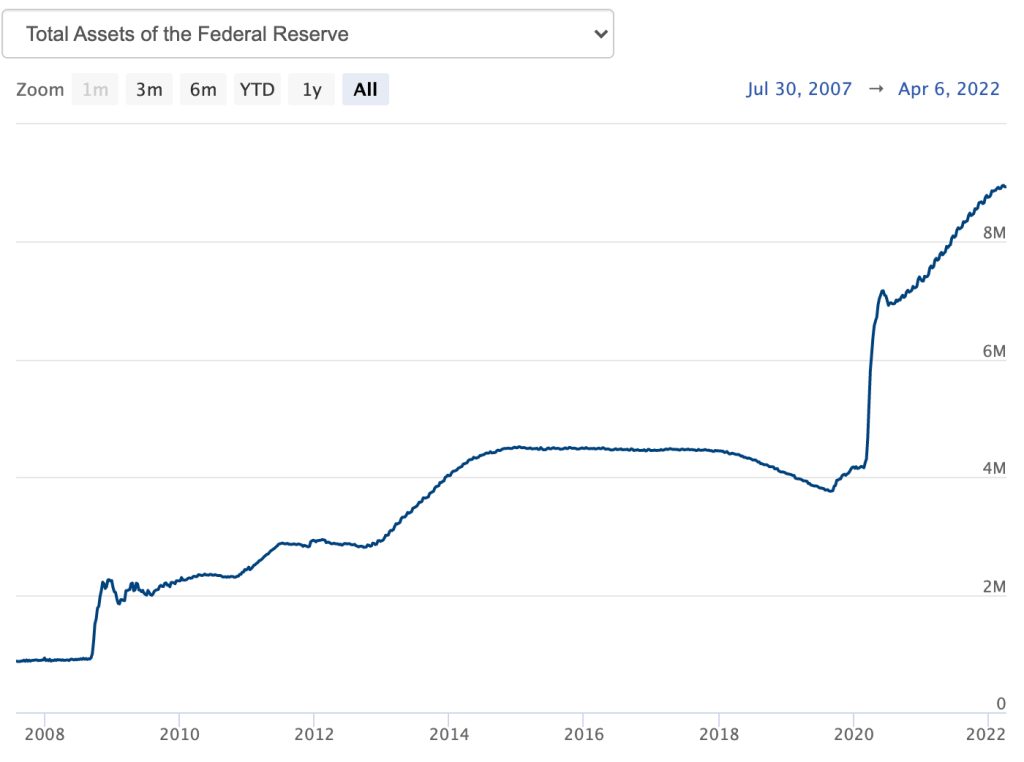
Hard to see but its already down $25 billion from a peak of $8.962 trillion
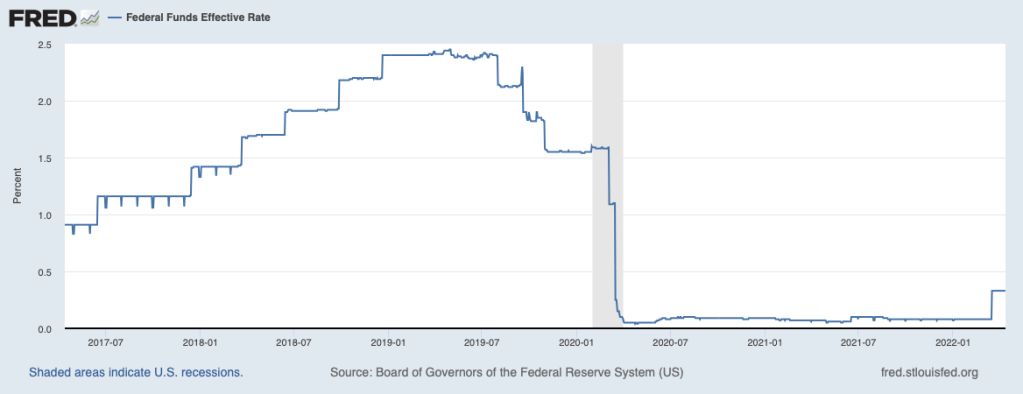
These moves are in the right direction, but represent a slow start to tackling inflation that is the highest of my lifetime, with the CPI up 8.5% over the last year. While temporary supply constraints are contributing to this, it seems clear to me that excessive aggregate demand is a major driver of this inflation. The labor market has already recovered, with unemployment at 3.6% like it was in late 2019. The Covid-induced output gap is fully eliminated by one standard measure:
But market-based measures of inflation expectations remain high. The TIPS spread predicts that inflation rates over the next 10 years will be much closer to 3% than to the Fed’s target of 2%:
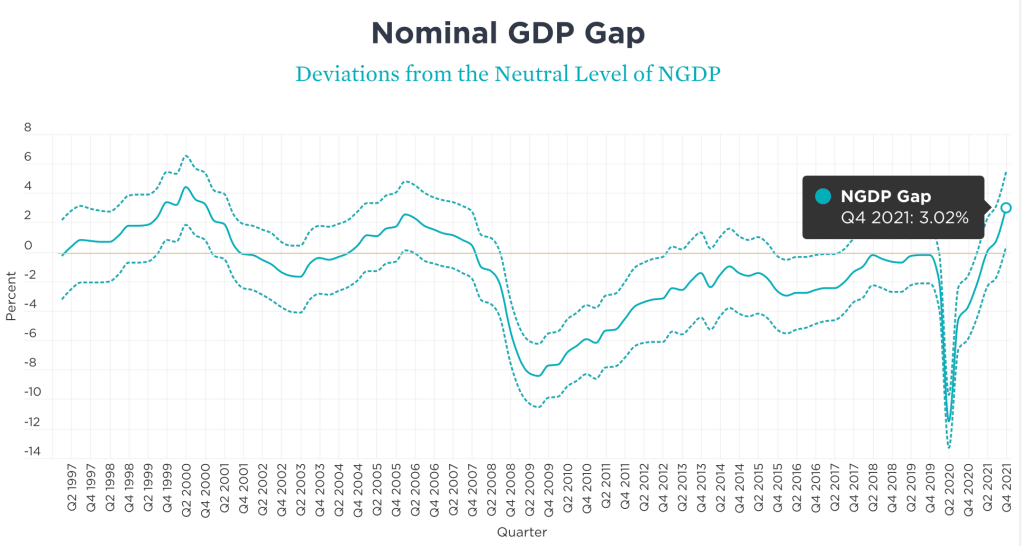
My preferred measure, the NGDP gap, is at 3% (i.e., 3% over the ideal level of 0)
Overall, its seams clear that Fed policy is currently too loose. The harder question is, what exactly to do about it? How much should they raise rates? The simplest way to answer this is to use the Taylor Rule. Using the version of the rule that Bernanke describes here and using core PCE as the inflation measure (currently just 5.4% yoy, vs 8.5% for headline CPI) implies that the Fed Funds rate should be:
5.4% + 0.5*0% + 0.5*(5.4%-2) + 2 = 9.1%
As Bernanke and many others have explained, you don’t want to take the Taylor rule literally, and the Fed raising rates to 9.1% Volcker-style at their next meeting would be a terrible idea. But keeping the Fed Funds rate under 0.5% would also be a terrible idea. Markets do expect the Fed to keep raising rates this year, but slowly, so that they would be around 2.25% by December. I’ll go on record as worrying that this is too slow, and recommending that they raise rates by at least 0.5% at their next meeting, and continue doing so until market-based measures of medium-run inflation are down to 2%.
Disclaimer: I’m a microeconomist whose last post on inflation was at best only directionally right. Consider this the view of one “insider-outsider” and then go read smarter people like Scott Sumner.
Inflation is definitely here. The latest CPI release puts the annual inflation rate in the US at 8.5% over the past 12 months, the highest 12-month period since May 1981. That’s bad, especially because wages for many workers aren’t keeping up with the price increases (and that’s true in other countries too).
But what about other countries? Many countries are experiencing record inflation too. The same day the US announced the latest CPI data, Germany announced that they also had the highest annual inflation since 1981.
Using data from the OECD, we can make some comparisons across countries during the pandemic. I’ll use data through February 2022, which excludes the most recent (very high!) months for places like the US and Germany, but most countries haven’t released March 2022 data quite yet.
Let’s compare inflation rates and GDP growth (in real terms, also from the OECD), using the end of 2019 as a baseline. We’ll compare the US, the other G-7 countries, and several broad groups of countries (OECD, OECD European countries, and the Euro area). The chart below uses “core inflation,” which excludes food and energy (below I will use total inflation — the basic picture doesn’t change much).
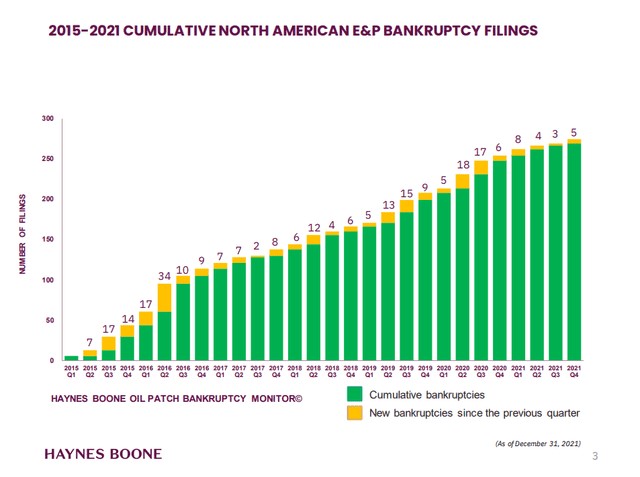
Oil production is a difficult, risky business even under favorable regulatory regimes. For instance, here is a chart of cumulative bankruptcy filings of exploration and production (E&P) companies for 2015-2021:
A few companies go bust every year, but there are some years like 2015-2016 and 2019-2020 when a lot of companies go bust. That happens when the oil industry collectively has overproduced and driven the price of oil below the effective cost of production. Even the mighty ExxonMobil ran deep in the red in 2020, losing an eye-watering 22.4 billion dollars. With all that in mind, shareholders since 2020 have been pressuring companies to show “financial discipline”, which means “drill less”.
Beyond these basic business realities, there is a whole new set of pressures to inhibit petroleum production. Environmental activists have pushed banks to withhold funding from petroleum companies, to strangle further oil production. It was big news in 2020 when activists, alarmed by ExxonMobil’s plans to actually (gasp) increase its oil production, successfully elected several alternative members to the board of directors with the specific goal of curtailing further drilling.
There have been attacks on the oil industry on the political front, as well. Joe Biden ran on a platform of banning drilling on public lands, and one item he checked off his to-do list on his first day in office was to issue an executive order killing a pipeline that would have facilitated imports of oil from the abundant reserves in Canada. One of his nominees for a top financial regulatory post remarked regarding oil producers that “we want them to go bankrupt if we want to tackle climate change”. All these are the sorts of things that make execs less willing to commit capital for expensive drilling programs that may take years to pay back. (The counter-claim by the administration that the U.S. oil industry is just sitting on thousands of unused oil leases is a red herring).
There is only a finite amount of oil in the ground, so it makes sense to move with all deliberate speed toward renewable and nuclear energy (which emits little or no CO2). However, our European friends who have installed lots of solar panels and windmills have discovered that the sun does not shine at night (!) and the wind does not always blow strongly (!!) , and so during their energy transition they need to maintain an adequate supply of fossil fuel power in order to keep the lights on. They elected to let their own oil and gas production dwindle, and rely instead on gas and oil purchased from Russia. We warned back in September that this European policy would give Russia leverage for harassing Ukraine, but apparently not enough EU leaders read this blog. Anyway, even back in the fall of 2021, Russia had restricted natural gas deliveries to Europe, causing sky-high prices there for gas and power.
The European experience ought to have been a cautionary tale for America, but political attacks on oil production continued in the halls of Congress itself. In an October 2021 hearing over climate change prevention, Carolyn Maloney (D-NY) and Ro Khanna (D-CA) insisted that Big Oil commit to reducing US oil and gas production by 3-4% annually (50-70% total by 2050). In a follow-up February 8, 2022 hearing, the two legislators again demanded concrete commitments from oil companies to reduce their domestic production (although, strangely, Mr. Khanna supported President Biden’s call for other regions, such as OPEC and Russia to increase production).
With oil drilling having been curtailed for the past several years (as desired by environmentalists), the world has now flopped from an oil surplus to an oil shortage, exacerbated by Russia’s invasion of Ukraine and subsequent sanctions. And of course world oil prices (which are not under the control of U.S. companies) have gone up in response. Oil companies are actually making money again instead of going bankrupt like two years ago
In 2021 Apple had a 26% net profit margin and an effective tax rate of only 13%, while the oil industry had an average profit margin of 8.9% and an effective tax rate of 26.9%. Yet Congress (mainly Democrats) “investigates” price gouging every time gas prices go up, without hauling in Tim Cook to grill him over the price of each new iPhone model. Repeated previous investigations have shown that domestic gasoline prices are mainly a function of world oil prices, which are not under the control of U.S. companies. Nevertheless, after berating oil execs for increasing oil production, here come the grandstanding Congressional attack dogs, holding a hearing last week titled (wait for it…) “Gouged at the Gas Station: Big Oil and America’s Pain at the Pump”.
The oil producers patiently explained that “We do not control the price of crude oil or natural gas, nor of refined products like gasoline and diesel fuel,” and “”It [the U.S. oil industry] is experiencing severe cost inflation, a labor shortage due to three downturns in 12 years, shortages of drilling rigs, frack fleets, frack sand, steel pipe, and other equipment and materials.” But it is not clear that anyone was listening to the facts.
I choose to believe these tweets are true because I want to write about it. I’m pretty sure they are, but unlike some people, I don’t have “medievalist friends” to verify it and I’m to tired to open Google.
Regardless of whether the “the book preciptated witch hunting” is true, I am in full agreement that much of misinformation is demand driven. Even when motivated by an alterior motive, disinformation has to be wrapped in the candy-coating of something people want to believe is true. For all the talk of disinformation though, the connection to witch hunting and religion is what I find most interesting, particularly in our pandemic times. There’s been a lot of frustration over people’s eagerness to believe non-scientific and pseudo-scientific garbage, but what I find most concerning is how rapidly identities solidified around believing experts and not believing experts. My suspicion is that this is, at least partly, a symptom of becoming a more broadly secular society, where political and scientific beliefs have for many people substituted for faith affiliations as group signifiers and shibboleths.
Religion makes for better and safer group identities than science. Why? Because religion is predominantly interested in untestable assertions whose veracity is entirely orthogonal to the quality of our lives and how we function as a society. This isn’t to say that societies can’t just as easily violently fracture as peacefully congeal around these beliefs, but the “truth” of them is entirely irrelevant. Communities and sub-communities can form Russian nesting dolls all the way up to continents and all the way down to Tilda Swinton, and the truth of the individual sets of religious beliefs won’t matter in the slightest.
Science, on the other hand, is a vastly different story. Groups that form around disbelief in the germ theory of disease or the food safety of the Green Revolution in agriculture will face vastly more limited prospects in the lives of members and their future generations. Groups naturally split into insiders and outsiders– that’s how we solve whole swaths of the collective action problems and Prisoner’s Dilemmas we face everyday.
Science needs religion to stake out territory in the ineffable and claim beliefs as their own. From these beliefs religion can provide people with the tools to tell stories, form bonds, and cultivate trust beyond the limits of kinship and familiarity. Religion needs to thrive so that science can work its way unmolested, and unco-opted, through the unending labryinth of truth-seeking, of learning and unlearning, discarding old truths as evidence mounts. It’s hard enough to accept evidence denying old truths when repuations are built around them (science does, after all, advance “one funeral at a time”). But it’s nearly impossible to discard old truths if they are holding a community together. People will cling to them because there’s too much immediately at stake, and in doing so you become trapped at the sclerotic local maximum of a costly falsehood.
I know there’s a tendency to focus on shared social media clips of preachers advocating against vaccines and masks and what not. But I don’t think that’s religion competing with science. I think that’s ostensibly religious leaders giving up on their faith to sell what they see people buying. Yesterday they were selling God, today they’re selling disinformation. Not because God is disinformation, but because they are seeing more demand for disinformation than God.
I don’t have a faith to sell anyone, and I certainly don’t have a policy solution in my back pocket (though I can only assume the answer starts with crypto and ends with profit). But I do think that if we are going to keep science safe from the short-term vicissitudes of our petty political identities, we will have to better resist the urge to call ourselves, our group, pro-science. It inevitably creates an anti-science opposition, cornering people into rallying around ideas that benefit no one in the long run. And we also have to have more faith in our faiths. If you don’t hold that your beliefs, and the community you’ve built around them, are appealing enough on their own merits,then you’re not really a believer. You’re not a scientist either. You’re a salesman, and one with a bad product at that.
By one definition of the word, Las Vegas is the textbook example of decadence. Is the physical structure of The Strip evidence of American decline? Ross Douthat specifically mentions Disneyland and Las Vegas together in his book, The Decadent Society. He calls them “consumer sublime” which, along with the iPhone, creates a fake experience rather than building something real (like Space Travel).
In his CWT, Douthat expounds on Vegas explaining that, “it represents a kind of simulated sublimity where you are creating models of all of the great achievements of the human species in the modern world and practicing various forms of entertainment around them. So in that sense, it is under my definition too, not just the chocolates-and-bondage-dens definition. I think it is decadent.”
I wrote about Disney World last month and I happened to have just been to Vegas. These places are nice, especially in Spring when it is sunny but not yet too hot.
The New York-New York resort was built in Las Vegas in 1997, followed by the opulent Bellagio in 1998. Paris and the Venetian, both nods to Old World centers of art and culture, were finished in 1999. This construction explosion was all happening during my childhood, and now it is established in modern culture by films such as Ocean’s 11 and The Hangover.
One thing Vegas has all to itself is its sign.
It also boasts to be a place where you are encouraged to overdose on drugs, alcohol, sex, and gambling. That’s not great, but it’s not what Douthat means by decadent. What I noticed is that it’s a loosely regulated place where they will sell you anything that gets you to take out your credit card. There are marijuana stores right across the street from Gucci stores. You pass slot machines on the way out of fancy restaurants.
Tattoo shop next to weed shop, directly across the street from upscale fashion boutiques. l’Arc de Triomphe brought to you by Martha Stewart
The entertainment-by-spending-money enterprise (Walt Disney World was expensive, too) all takes place in a cool physical setting. The pedestrian bridges on the main streets make it fun and practical to walk around, right past all the stores. The Strip is bordered by shiny tall hotels that each have a theme. The centerpiece, in my opinion, is the Paris resort.
How do you signal that civilization is here, when you are in the middle of Nevada-Mars? Meme the heart of European culture. Considering how yucky activity can get on the Strip, that nod to Europe provides a veneer of respectability to lure in rich people with families. I don’t only think of it in that cynical way. Plenty of Las Vegas is unique and new, but humans can only handle so much new at once. The Eiffel Tower is code. It’s a form of language that people understand. It makes us feel safe and perhaps even makes us safe by setting a tone for the style of partying.
Tourists are in a new place surrounded by strangers. Are we going to attack each other? Are Russian soldiers about to come through and massacre us? Do we agree about what is admirable? Everything feels like it is going to be fine, because we are here in civilization. If Americans ever do settle Mars, we’ll build an Eiffel Tower there, too.
This might all seem trivial, except that I have heard multiple people saying something about how Putin thought he could attack Ukraine at this moment because “he thinks the West is decadent.” That makes investigating the issue seem worthwhile.
As I concluded about Disney World, the problem is not that we have a few nice areas to practice escapism. A progressive society would build more of these places with access for more people. Let’s build a bigger Eiffel Tower in the desert that more people can fit under. If the French object, then make it a fake Empire State building. Big Ben, anyone?
The non-superficial problems Douthat mentions are serious. Our declining birth rate has plunged further since he published his book. Our political system seems just as sclerotic (Vegas is the place where developers got a “yes” while every other American city was saying “no”). As I said in my previous post, everyone should read his book and ponder.
To leave Las Vegas, I took an Uber for a morning flight. My driver came from Afghanistan three years ago. I told him I was glad he made it out before the Taliban took over and he said that it is bad there right now. He had to learn English in 6 months out of dire necessity so that he could get better jobs. Now he dreams, like so many Americans, of “getting out of this town”. What does he think of Las Vegas? His complaints are that it is too sunny and boring.
The destinations of his dreams are San Francisco or New York City. I informed him of the places I know that have less sunny days. I wish we could have talked more, but from what I can tell he has embarked on his American Dream. He was located with his parents (and perhaps more family members) in Las Vegas directly from Afghanistan. He’s young and dreams of leaving. However, he said his parents like where they are and want to stay put now that they have found a secure home. That puts the city in a new perspective. It may not be the aesthetic that Ross prefers, but families have found a home where there used to be uninhabited wilderness.
Consumption is the largest component of GDP. In 2019, it composed 67.5% of all spending in the US. During the Covid-19 recession, real consumption fell about 18% and took just over a year to recover. But consumption of services, composing 69% of consumption spending, hadn’t recovered almost two years after the 2020 pre-recession peak. For those keeping up with the math, service consumption composed 46.5% of the economic spending in 2019.
I argued in my previous post that the Covid-19 pandemic was primarily a demand shock insofar as consumption was concerned, though potential output for services may have fallen somewhat. When something is 67.5% of the economy, ‘somewhat’ can be a big deal. So, below I breakdown services into its components to identify which experienced supply or demand shocks. Macroeconomists often get accused of over-reliance on aggregates and I’ll be a monkey’s uncle if I succumb to the trope (I might, in fact be a monkey’s uncle).
Before I start again with the graphs, what should we expect? Let’s consider that the recession was a pandemic recession. We should expect that services which could be provided remotely to experience an initial negative demand shock and to have recovered quickly. We should expect close-proximity services to experience a negative demand and supply shock due to the symmetrical risk of contagion. Finally, we should expect that services with elastic demand to experience the largest demand shocks (If you want additional details for what the above service categories describe, then you can find out more here, pg. 18).
Last weekend I was at Effective Altruism Global X Boston, a great conference that worked very differently from the academic ones I usually attend. The attendees were younger and the topics were different, but the big innovation was the use of Swapcard to encourage 1-on-1 meetings. At academic conferences I spend most of my time listening to formal presentations or talking to people I already know, but here I talked to 13 new people for a half hour each, and many others more briefly.
That said, the talks I did attend were excellent. Alvea is a 3-month-old company that already has a novel DNA-based Omicron-targeted Covid vaccine in Phase 1 trials. My notes on co-founder Ethan Alley’s talk:
Learning by doing is the way to go. I learned more in 3 months as a founder than 12+ months as an MIT grad student. Like that you have to pay a company $125k to randomize your clinical trial, and they take 8 weeks to do it
Richard Cash talked about the Oral Rehydration Therapy he helped develop that has saved tens of millions of lives. In short, many people who died of diarrheal diseases like Cholera were simply dying from dehydration, and he realized that this can be prevented cheaply and easily in most cases by having them drink a solution of water, glucose, and certain salts (basically Gatorade). He noted that much of the basic research behind this had been done in the US well before it was applied in the developing countries where it has helped most, so it was crucial to simply notice how important and broadly applicable the findings were. On the other hand, some things really did work differently in developing countries; here the medical conventional wisdom was that people shouldn’t eat while they had diarrhea, but if kids are already malnourished it turns out they are better off eating anyway.
Wave is a mobile payment company that is hugely successful in Senegal but has been slow to expand elsewhere. I asked their Chief Technical Officer Ben Kuhn why this was, and his answer made perfect economic sense:
Fixed costs plus local network effects. Fixed costs: need to get approval of a country’s central bank to operate, need to hire local staff, et c. Network effects: our system gets more valuable as more of the people you send money to/from use it, and these are usually within-country. Makes more sense to keep expanding within a country until its nearly totally saturated, and only then move to the next country. There’s also a limit of how much $ we have to expand, especially since we don’t want VCs to control the company.
(My notes, not a verbatim quote)
As I talked to people I was trying to narrow down my post-tenure plans. This didn’t really work, because people gave me good new ideas without convincing me to abandon any of my old ideas. Although I talked to several senior researchers at NGOs, the ideas that stuck with me most came from talking to undergrads, and were all things that sound obvious in hindsight but that I hadn’t actually been planning to do. The one I’ll mention here as a commitment device is to post my research ideas on my website. I have many more paper ideas than I have time to write about them, and I no longer care much about whether I get credit/publications for them or someone else does. This summer I’ll post a list of ideas there, and perhaps a series of posts fleshing them out here.
P.S. If you identify at all with Effective Altruism, I recommend trying to attend a conference. I’m planning to go next to the one in DC in September.
Last week President Biden released his Fiscal Year 2023 budget proposal. The annual release of the budget proposal is always exciting for economists that study public finance. The president’s proposal is the first step in the federal budgeting process, which in some cases leads to the full passage of a federal budget by the start of the fiscal year in October (though perhaps surprisingly, the process rarely works as intended).
This year’s budget is especially interesting to look at because it gives us our first look at what post-pandemic federal budgeting might look like. And while the budget has a lot of detail on the administration’s priorities, I like to go right to the bottom line: does the budget balance? What are total spending and revenue levels?
The bottom line in the Biden budget this year is that permanently large deficits are here to stay. Keep in mind that a budget proposal is just a proposal, but it’s reasonable to interpret it as what the president wants to see happen with the budget over the next 10 years (even if Congress might want something different). Over the next 10 years, Biden has proposed that budget deficits remain consistently right around 4.5% of GDP, with no plan to balance the budget in the near future.
How does this compare to past budget proposals? For comparison, I looked at the final budget proposals of Biden plus his two predecessors. I start Obama’s in 2021 to match Trump’s first year, and all three overlap for 2023-2026. I put these as a percent of GDP so we don’t have to worry about inflation adjustments (though we might worry about optimistic GDP forecasts, see below).