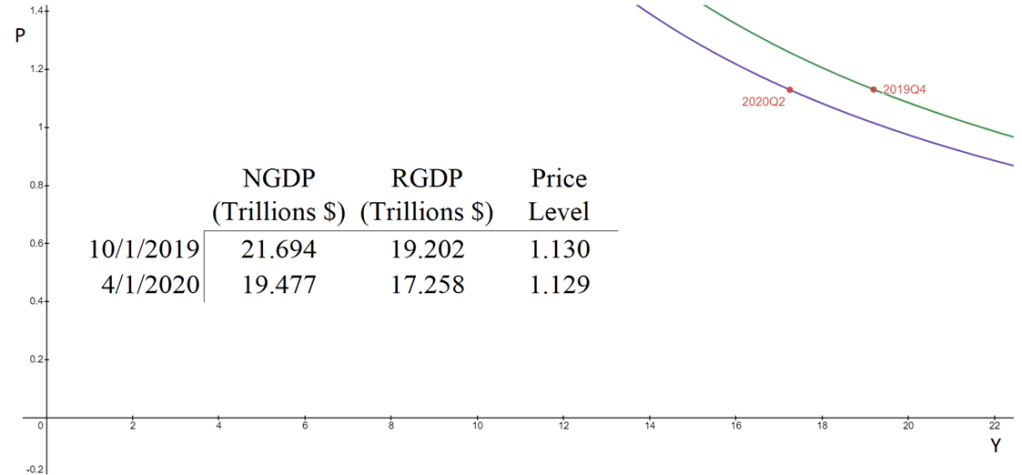
The aggregate supply & aggregate demand model (AS-AD) is nice because it’s flexible and clear. Often professors will teach it in levels. That is, they teach it with the level of output on one axis, and the price level on the other axis. This presentation is convenient for the equation of exchange, which can be arranged to reflect that aggregate demand (AD) is a hyperbola in (Y, P) space. Graphed below is the AD curve in 2019Q4 and in 2020Q2 using real GDP, NGDP, and the GDP price deflator.
The textbook that I use for Principles of Macroeconomics, instead places inflation (π) on the vertical axis while keeping the level of output on the horizontal axis. The authors motivate the downward slope by asserting that there is a policy reaction function for the Federal Reserve. When people observe high rates of inflation, state the authors, they know that the Fed will increase interest rates and reduce output. Personally, I find this reasoning to be inadequate because it makes a fundamental feature of the AS-AD model – downward sloping demand – contingent on policy context.
At the same time, I do think that it can be useful to put inflation on the vertical axis. Afterall, individuals are forward looking. We expect positive inflation because that’s what has happened previously, and we tend to be correct. So, I tell my students that “for our purposes”, placing inflation on the vertical axis is fine. I tell them that, when they take intermediate macro, they’ll want to express both axes as rates of change. I usually say this, and then go about my business of teaching principles.
But, what does it look like when we do graph in percent-change space?
In my previous post, I decomposed consumer expenditures to figure out which service sectors experienced the largest supply-side disruptions due to Covid-19. I illustrated that transportation & recreation services were the only consumer service to experience substantial and persistent supply shocks. Health, food, and accommodation services also experienced supply shocks, but quickly rebounded. Housing, utility, and financial services experienced no supply disruptions whatsoever.
What about non-durables?
Total consumption spending is the largest category of spending in our economy and is composed of services, durable goods, and non-durables. Services are the largest portion and durable goods compose the smallest portion. So, while there were plenty of stories during the Covid-19 pandemic about months-long delivery times for durables, they did not constitute the typical experience for most consumption.
Even though it’s not the largest category, many people think of non-durables when they think of consumption. Below is the break-down of non-durable spending in 2019. The largest singular category of non-durable spending was for food and beverages, followed by pharmaceuticals & medical products, clothing & shoes, and gasoline and other energy goods. Clearly, the larger the proportion that each of these items composes of an individual household budget, the more significant the welfare implications of price changes.
Inflation is definitely here. The latest CPI release puts the annual inflation rate in the US at 8.5% over the past 12 months, the highest 12-month period since May 1981. That’s bad, especially because wages for many workers aren’t keeping up with the price increases (and that’s true in other countries too).
But what about other countries? Many countries are experiencing record inflation too. The same day the US announced the latest CPI data, Germany announced that they also had the highest annual inflation since 1981.
Using data from the OECD, we can make some comparisons across countries during the pandemic. I’ll use data through February 2022, which excludes the most recent (very high!) months for places like the US and Germany, but most countries haven’t released March 2022 data quite yet.
Let’s compare inflation rates and GDP growth (in real terms, also from the OECD), using the end of 2019 as a baseline. We’ll compare the US, the other G-7 countries, and several broad groups of countries (OECD, OECD European countries, and the Euro area). The chart below uses “core inflation,” which excludes food and energy (below I will use total inflation — the basic picture doesn’t change much).
By the time most students exit undergrad, they get acquainted with the Aggregate Supply – Aggregate Demand model. I think that this model is so important that my Principles of Macro class spends twice the amount of time on it as on any other topic. The model is nice because it uses the familiar tools of Supply & Demand and throws a macro twist on them. Below is a graph of the short-run AS-AD model.
Quick primer: The AD curve increases to the right and decreases to the left. The Federal Reserve and Federal government can both affect AD by increasing or decreasing total spending in the economy. Economists differ on the circumstances in which one authority is more relevant than another.
The AS curve reflects inflation expectations, short-run productivity (intercept), and nominal rigidity (slope). If inflation expectations rise, then the AS curve shifts up vertically. If there is transitory decline in productivity, then it shifts up vertically and left horizontally.
Nominal rigidity refers to the total spending elasticity of the quantity produced. In laymen’s terms, nominal rigidity describes how production changes when there is a short-run increase in total spending. The figure above displays 3 possible SR-AS’s. AS0 reflects that firms will simply produce more when there is greater spending and they will not raise their prices. AS2 reflects that producers mostly raise prices and increase output only somewhat. AS1 is an intermediate case. One of the things that determines nominal rigidity is how accurate the inflation expectations are. The more accurate the inflation expectations, the more vertical the SR-AS curve appears.*
The AS-AD model has many of the typical S&D features. The initial equilibrium is the intersection between the original AS and AD curves. There is a price and quantity implication when one of the curves move. An increase in AD results in some combination of higher prices and greater output – depending on nominal rigidities. An increase in the SR-AS curve results in some combination of lower prices and higher output – depending on the slope of aggregate demand.
Of course, the real world is complicated – sometimes multiple shocks occur and multiple curves move simultaneously. If that is the case, then we can simply say which curve ‘moved more’. We should also expect that the long-run productive capacity of the economy increased over the past two years, say due to technological improvements, such that the new equilibrium output is several percentage points to the right. We can’t observe the AD and AS curves directly, but we can observe their results.
The big questions are:
What happened during and after the 2020 recession?
Gasoline prices are high and rising. Anecdotally, they seem to be increasing at the pump by the hour. And indeed, in nominal terms they are now the highest they have ever been in the US (this is true with both the AAA daily price level and the EIA weekly price level). At over $4.10 per gallon, the price now exceeds the peaks briefly hit in 2008, 2011, and 2012. And it’s looking like this peak might not be so brief.
But we all know you can’t compare nominal dollars over long periods of time. We need some context for this price! Plenty of news stories provide what they think is the right context: adjust it for inflation! For example, USA Today reports that today’s price “would come to around $5.25 today when adjusted for inflation.”
$5.25: that’s a pretty concrete number. But it’s not really useful. OK, so clearly that’s higher than the current price, about 20% higher in fact. Still, it doesn’t really give us the right context.
As I argued in a previous post on housing costs, inflation adjustments aren’t always the best way to contextualize a historical number. Yes, when you want to compare income or wages over time, it’s good to adjust for inflation. It’s necessary, in fact. And a good economist will always do that.
However, when comparing particular prices over time, it doesn’t really make sense to adjust for other prices. All you are really saying is “if the price of gasoline increased at the same rate as the average price level, here’s what it would be.” Perhaps slightly useful, but it doesn’t really get at the thing we’re really try to address: is gasoline more or less affordable than in the past?
The best approach is to adjust the prices for changes in wages or income. Which measure of wages or income you choose is important, but it’s the best adjustment to make. No need to make any inflation adjustments, are worrying about whether the index you choose is properly accounting for quality changes, substitution effects, etc. If you want to know how affordable something is, compare it to income.
Here’s what I think is the best simple comparison for gasoline, which I’ll explain it below. In short, it tells us how many minutes the average worker would need to work to purchase one gallon of gasoline.
Since the price of gasoline is rising sharply every day lately, my chart will surely be out of date very soon. But right now, it’s the most current data I could provide with a comparable historical series: EIA weekly data current through March 7th, 2022 (Monday). We can see that at current prices, it takes about 9 minutes of work at the average wage to purchase a gallon of gasoline. At the peak in 2008, it took over 13 minutes of work to purchase a gallon, and it fluctuated between 10 and 12 minutes of work for much of 2011-2014.
Way back in the late 1970s and early 80s, Kydland and Prescott proposed rational expectations theory. This line of research arose, in part, because the Phillips curve ceased to describe reality well. Amid increasing inflation, people began to anticipate higher prices to a relatively correct degree when making labor, supply chain, and pricing decisions. Kydland and Prescott argued that individuals understand the rules of the game or how the world works – at least on average.
An increase in the money supply would increase total national spending, and increase demand for goods. However, firms also experienced increasing revenues and demanded more inputs such as commodities, capital, and intermediate goods. Because there were no greater productivity earlier in the supply chain, price roses. Firms began to understand that greater demand would eventually find its way to causing greater costs. Therefore, firms began raising prices before the cost of resources rose, increasing their willingness to pay for inputs and, ironically, hastening the increase in input prices. As a result, increases in the money supply began having substantial short-run price effects and negligible output effects.
However, assuming that people understand the rules of our economic system and ‘how the world works’ is hard to swallow. It is not at all clear that the typical economist understands monetary theory, much less clear that the typical person has a good understanding. Fortunately, another theory of expectations can help carry some of the load and achieve similar results.
Is it harder to buy a home today than in the past? Many seem to think so. Lately, some people have used the example of the fictional Simpsons family to make this claim. A recent Tweet with around 100,000 likes expressed the sentiment:
The Simpsons own this home on a single salary from a husband who didn't go to college
The unspoken implication is that today a “single salary from a husband who didn’t go to college” couldn’t buy a typical home in the US. Or at least, it would stretch your budget so thin that you would have to give up something else or need two incomes to support that lifestyle (famously dubbed “the two-income trap” by Elizabeth Warren).
But is this an accurate picture of the Simpsons family over time? And does that picture accurately represent a typical family in the US? Let’s investigate. And let’s start by pointing out that as measured by the availability of consumption goods, the Simpsons do see rising prosperity over time. They have flat screen TVs now, instead of consoles with rabbit ears, as the late Steve Horwitz and Stewart Dompe point out in their contribution to the edited volume Homer Economicus. But with all due respect to my friends Steve and Stewart, I don’t think many would deny that TVs, cell phones, and computers are cheaper today than in the 1990s. The familiar refrain is “but what about housing, education, and health care?”
In this post I want to take on the question of housing, partially by using the Simpsons as an example. My main result is this chart, which I will present first and then explain.
Economics involves human beings making decisions. Where there are humans, drama is never absent. Hence, somewhere in the broader financial sphere, there is always some drama. The chart below displays gyrations in the exchange rate of the Turkish lira which may be fairly characterized as “dramatic”. This chart shows the lira-per-dollar exchange rate over the past six months; a higher number here means lower lira valuation.
Foreign Exchange Market Prices, Turkish Lira per Dollar. Source: TradingView.com
What is going on here? Why the spike up in November/December, followed by an even more sudden drop?
As usual, loss of value in foreign exchange goes hand in hand with domestic inflation. Inflation within Turkey for the month of December was reported to 36% on an annualized basis. Now, an orthodox economic response to runaway inflation includes raising interest rates. Higher interest rates tend to make a currency more valuable. Higher interest rates encourage people to hold onto their currency, since they are rewarded by interest on their savings. Conversely, low interest rates, especially when coupled with inflation, motivates people to spend down their money before it loses more value. In the case of emerging market countries like Turkey, high inflation/low interest drives people to exchange their local currency for more stable foreign currencies, like dollars or euros (or crypto stablecoins like Tether).
But Turkey is Turkey, and Turkey is run by the authoritarian President Erdogan. He has economic views which might most charitably characterized as “heterodox”. Erdogan claims that high interest rates actually cause inflation. His views may be influenced by the prohibition on charging interest in classic Islamic practice. The Turkish president has stated, “My belief is that interest rates are the mother of all evils. Interest rates are the cause of inflation. Inflation is a result, not a cause. We need to push down interest rates.” President Erdogan has sacked numerous treasury officials who disagreed with him, and pressured the central bank to implement four interest rates cuts in the last four months of 2021.
It seems he hopes to stimulate enough internal growth to paper over any other problems. I think there could be some merit to that notion, but the current inflation level is toxically high. Lower- and middle-class Turks find it hard to purchase necessities.
Lowering the value of your currency to make your exports more attractive has been practiced successfully by various Asian nations, but Turkey is too exposed to foreign exchange to weather such a huge drop in the value of the lira. A large part of Turkey’s recent economic growth has been funded by foreign investors, and that may dry up because of the currency instability. Turkey is dependent on imports for many essentials, including all of its energy needs, so imports have become much more expensive for Turks as their currency depreciates. Furthermore, because of the fluctuating value of the local currency, many loans are denominated in dollars or euros. This makes it burdensome for borrowers to keep up payments of interest and principal, when these foreign currencies have become more expensive.
Modern currencies have essentially no intrinsic value. Money is a big confidence game. A shopkeeper will take my dollar bill in exchange for some candy, because he is confident that some other party will in turn accept that dollar bill in exchange for something else of value. If confidence in a currency collapses, so does its exchange value.
Foreign creditors and domestic Turkish consumers were becoming more and more nervous about the prospects for the lira in late 2021, as inflation was fueling further inflationary expectation. It crashed to a record high exchange rate of 13.44 against the dollar on November 23 after the Turkish leader insisted that rate cuts would continue.
Things really started getting out of control in mid-December. Turks frantically ditched their currency in exchange for euros and dollars, which led to further devaluation of the lira. On December 21st, however, the Turkish government unleashed an innovative initiative. They offered to backstop the value of the lira deposits of Turkish residents, as long as those deposits were held in lira for a certain period of time. Besides offering interest on the deposits, the offer was to compensate depositors for any loss in value against the dollar. The intent was to motivate residents to keep their lira as lira.
Turkey’s new Finance Minister Nureddin Nebati has no real finance background; his main qualification for office appears to be a willingness to do what his boss wants. When Nebati was asked to give details of this initiative, he reportedly answered thus: “”I won’t give a number now. Can you look into my eyes? What do you see?… The economy is the sparkle in the eyes.” Hmm.
President Erdogan has said he is protecting the country’s economy from attacks by “foreign financial tools that can disrupt the financial system.” Western economists are not impressed. Market strategist Timothy Ash commented, “ More complete and utter rubbish from Erdogan…Foreign institutional investors don’t want to invest in Turkey because of the absolutely crazy monetary policy settings imposed by Erdogan.”
At any rate, this unusual measure, combined with old-fashioned central bank intervention (the Turkish central bank is believed to have used some 10 billion dollars’ worth of its foreign reserves to buy lira), seemed to stem the immediate panic. Within a day, the exchange rate thudded down from about 18 to about 13, which is roughly the level today.
It has been pointed out that it simply is not feasible for the government to backstop all relevant bank deposits against a huge currency depreciation; the Turkish government and central bank would burn through all their foreign reserves, and have to resort to printing ever more worthless lira. However, sometimes the mere promise of such a guarantee (whether or not it is practical) is enough to restore some measure of confidence, which in turn means that the currency will not collapse and thus the resources of the central bank will not be put to the test. As we said, confidence is what it is all about. We will see how this plays out.
The latest CPI inflation data was released this morning. Mostly the new data just confirms what we’ve seen the past few months: consumer price inflation is at the highest levels in decades, and it is now very broad based.
To see how broad based the inflation is, we can look at any of the “special aggregates” that the BLS produces. CPI less food. CPI less shelter. CPI less food, shelter, energy, used cars and trucks (what a mouthful!). All of these are up substantially over the past year. The lowest number you can get is that last aggregate I listed, which excludes almost 60% of consumer spending, and even it is up 4.7% over the past year — the largest increase since 1991 for that particular special index.
Or, you can just look at food. We all have probably observed that meat prices are way up recently — about 15% over the past year. But it’s not just meat. It’s fruit, vegetables, grains, dairy… the whole darn food pyramid. In fact, there are only two food categories (hot dogs and cheese) and two drinks (tea and wine) that are actually down since December 2020.
The only categories of food and drinks in the CPI that are down since last year are hot dogs, cheese, tea, and wine
— Jeremy 'adjusted for inflation' Horpedahl 📈 (@jmhorp) January 12, 2022
I’ve covered the symbolic importance of hot dog prices before, but the fact that only four food or drink categories had price decreases are indications that food-price inflation is extremely broad-based.
Inflation is colloquially defined as, “Too much money chasing too few goods (and services)”. Supply chain constraints get talked about, and these are widely blamed for the inflation we are seeing. Of course, supply limitations play into inflation, but to focus on them is to miss the elephant in room. The primary driver of this inflation is not “too few goods”, but “too much money.”
While the headlines tend to focus on the micro elements of the supply shock (the LA port, coal in China, natural gas in Europe, semiconductors globally, truckers in the UK, etc.), this perspective largely misses the macro cause that is likely to persist and for which there is no idiosyncratic solution. This is not, by and large, a pandemic-related supply problem: as we’ll show, supply of almost everything is at all-time highs. Rather, this is mostly an MP3-driven upward demand shock. [emphases in the original]
In Bridgewater’s terminology, “MP3” is “Monetary Policy #3”, and refers to massive deficit spending combined with central bank quantitative easing. We saw this implemented in 2020-2021 when the federal government pumped out trillions of dollars of stimulus payments and enhanced unemployment benefits, and the Fed instantly soaked up the bonds that were issued to pay for these trillions. This fed/Fed combo amounts to simply printing money on an enormous scale.
Those trillions of dollars funded a huge surge in durable goods purchases. By late 2021 the supply of these goods was well above 2019 (pre-COVID) levels, and even above normal growth trendlines. However, the supply and transport systems simply could not grow fast enough to accommodate this insatiable demand. Charts below substantiate this. To focus on supply chain bottlenecks of themselves is misleading. The primary driver for this inflation has been the trillions of dollars of federal largesse. The Fed knows all this, obviously, but Jay Powell (the Chief Enabler of this deficit spending) would likely not have been reappointed if he spoke too directly about the cause of this inflation. Hence the endless prattle about supply chains.